ISP Proxies: Architecture, Benefits, and Technical Use Cases
ProxiesLearn how ISP proxies route requests through ISP-assigned IPs hosted on data-center infrastructure, plus their technical use cases, setup considerations, and provider selection criteria.
ISP proxies use ISP-assigned IP addresses hosted on data-center infrastructure to route requests, combining residential-style IP presentation with data-center infrastructure for applications such as scraping, ad verification, and regional monitoring.
How ISP Proxies Operate
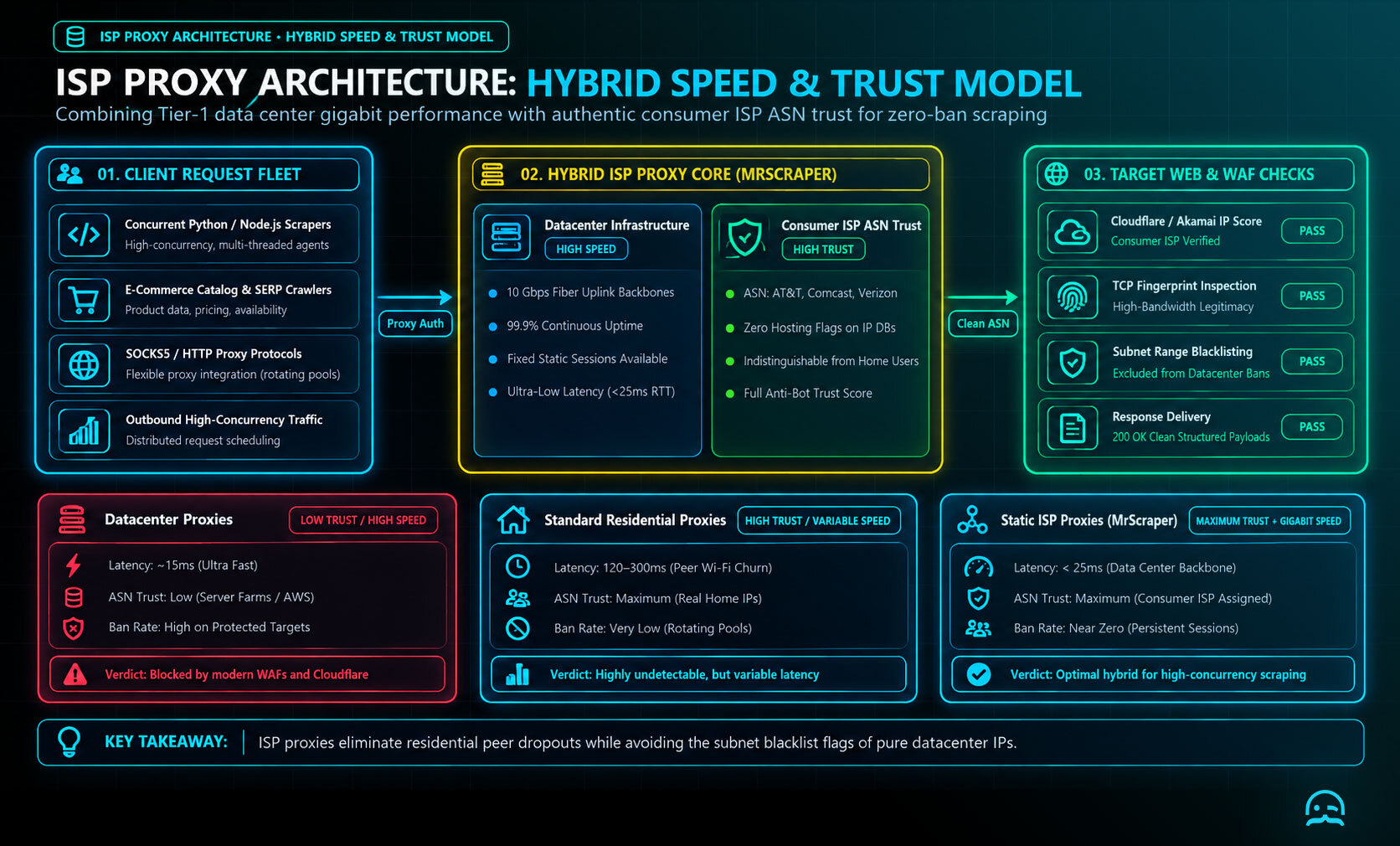
An ISP proxy intercepts and reroutes requests through ISP-assigned IP addresses. It uses advanced routing protocols to keep latency low. Here’s an in-depth breakdown of the ISP proxy operation:
- Client Request Initiation: The user’s device initiates a request, which is directed to the ISP proxy server.
- Routing Layer: The ISP proxy employs a routing layer that can handle multiple concurrent connections. This layer uses network load balancing to ensure efficient distribution of requests across multiple ISP IPs.
- Transmission Layer Security: ISP proxies incorporate HTTPS/SOCKS5 protocols, allowing secure, encrypted requests that protect user anonymity.
- IP Masking and Forwarding: Requests are forwarded to target websites, with ISP IPs masking the origin. The target perceives this request as coming from a legitimate residential user.
- Data Return Path: The data is routed back through the ISP proxy. This helps ensure anonymity. It then returns to the original client.
This layered approach protects privacy and helps avoid IP blocks. This makes ISP proxies key for data-heavy and security-sensitive applications.
Benefits of ISP Proxies for Technical Applications
- Enhanced IP Anonymity and Residential Authenticity: ISP proxies provide residential-grade IPs without the dependency on physical residential networks, reducing detection risk.
- Network Stability and Low Latency: ISP proxies benefit from data center-grade infrastructure with high bandwidth allocation, reducing latency and ensuring uptime.
- Encrypted Connection Protocols (HTTPS/SOCKS5): ISP proxies support HTTPS and SOCKS5. These protocols encrypt requests end to end. This improves data security during transmission.
- Scalable IP Pooling: Many ISP proxy providers offer large IP pools. They include rotating and static options. This supports large applications that need many connections at once.
Technical Use Cases for ISP Proxies
Web Scraping and Data Extraction
- Challenge: Many websites deploy sophisticated anti-bot measures, including IP-based detection.
- Solution: ISP proxies use residential-style IPs in data centers. They help large-scale web scraping by reducing detection and blocking.
- Implementation Tip: Use rotating ISP proxies combined with request throttling to mimic organic traffic patterns and reduce detection risks.
Ad Verification and Compliance
- Challenge: Businesses need accurate regional data to verify ad placements, detect fraud, and ensure compliance.
- Solution: With ISP proxies, advertisers can view ads as regional users, effectively bypassing regional ad restrictions.
- Implementation Tip: Implement geotargeting with ISP proxies to simulate user access from specific regions for precise verification.
E-commerce Monitoring and Price Aggregation
- Challenge: Competitor websites often restrict IPs associated with data centers.
- Solution: ISP proxies enable frequent, anonymous access to e-commerce platforms without triggering anti-bot mechanisms.
- Implementation Tip: Configure proxy rotation intervals to periodically switch IPs while maintaining session persistence for improved data accuracy.
Social Media Management and Multi-Account Operations
- Challenge: Social media platforms detect and block IPs associated with data centers for multi-account management.
- Solution: ISP proxies allow for secure management of multiple accounts by simulating residential connections.
- Implementation Tip: Implement session management and cookie persistence alongside ISP proxies to avoid account flagging.
Choosing an ISP Proxy Provider: Technical Criteria
When comparing providers, assess the following technical criteria. A diverse, large IP pool can reduce detection risk by avoiding overreliance on a narrow address range. Review available bandwidth and typical latency against your application’s throughput, concurrency, response-time, and reliability goals. Confirm support for HTTP, HTTPS, and SOCKS5 so clients can connect securely and compatibly. If workloads need frequent address changes, verify configurable rotation intervals and choose a frequency that fits the task. Finally, check regional coverage to ensure addresses are available in the target markets, especially when localized access is required.
Configuring ISP Proxies: Technical Setup and Best Practices
Integrate the proxy pool into your infrastructure with these configuration practices.
- Configure HTTP clients. Set proxy endpoints in clients such as Python’s requests library or other SDKs that support proxy settings.
- Select a network protocol. Use HTTPS for encrypted HTTP traffic, or SOCKS5 when the client or application requires it. Verify encryption requirements separately because SOCKS5 alone does not provide end-to-end encryption.
- Manage sessions. For ongoing workflows like social media or e-commerce, use static IPs. Or configure cookies so sessions stay active when requests switch proxies.
- Balance traffic and pool proxies. Distribute requests across multiple ISP IP addresses to balance load, reduce latency, and prevent any individual destination or proxy endpoint from becoming overloaded.
Sample Code Snippet (Python)
This example sends an authenticated GET through an ISP proxy, checks status, and uses a ten-second timeout.
import requests
# Configure the ISP proxy
proxy = {
    "http": "http://username:password@proxy_address:port",
    "https": "https://username:password@proxy_address:port"
}
# Send a sample GET request
url = "https://example.com"
response = requests.get(url, proxies=proxy, timeout=10)
# Check the response status
if response.status_code == 200:
    print("Successfully accessed the target website!")
else:
    print("Failed to connect:", response.status_code)
What We Learned
- ISP proxies use IPs from internet providers on data center servers. They offer residential-like trust with fast, scalable performance.
- Their routing, IP masking, and HTTPS/SOCKS5 support help provide low-latency, encrypted connections and protect user anonymity.
- Rotating or static IP pools support apps like web scraping, ad verification, e-commerce monitoring, and multi-account management.
- Effective setup depends on suitable IP diversity, bandwidth, protocol support, rotation options, regional coverage, and session management.
Compare Scraping Options for Your Use Case
Explore Scraper plans for structured data extraction with built-in unblocking tools. Choose an option that fits your proxy and scraping workflow.
Summarize this post
Open it in your assistant of choice with the prompt ready to send.
Take a Taste of Easy Scraping!

Find more insights here

Build a Source-Led Deep Research Workflow With MrScraper
Build a deep research workflow that turns a question into a source plan, collects evidence from appr…
Choose an Agent Framework for a Web Data Application
Compare LangGraph, the OpenAI Agents SDK, Google ADK, CrewAI, Mastra and the Claude Agent SDK on too…

Design AI Research Loops That Stop, Recover and Produce Evidence
Learn how to build an AI research loop with clear states, firm stop conditions, safe retries after f…