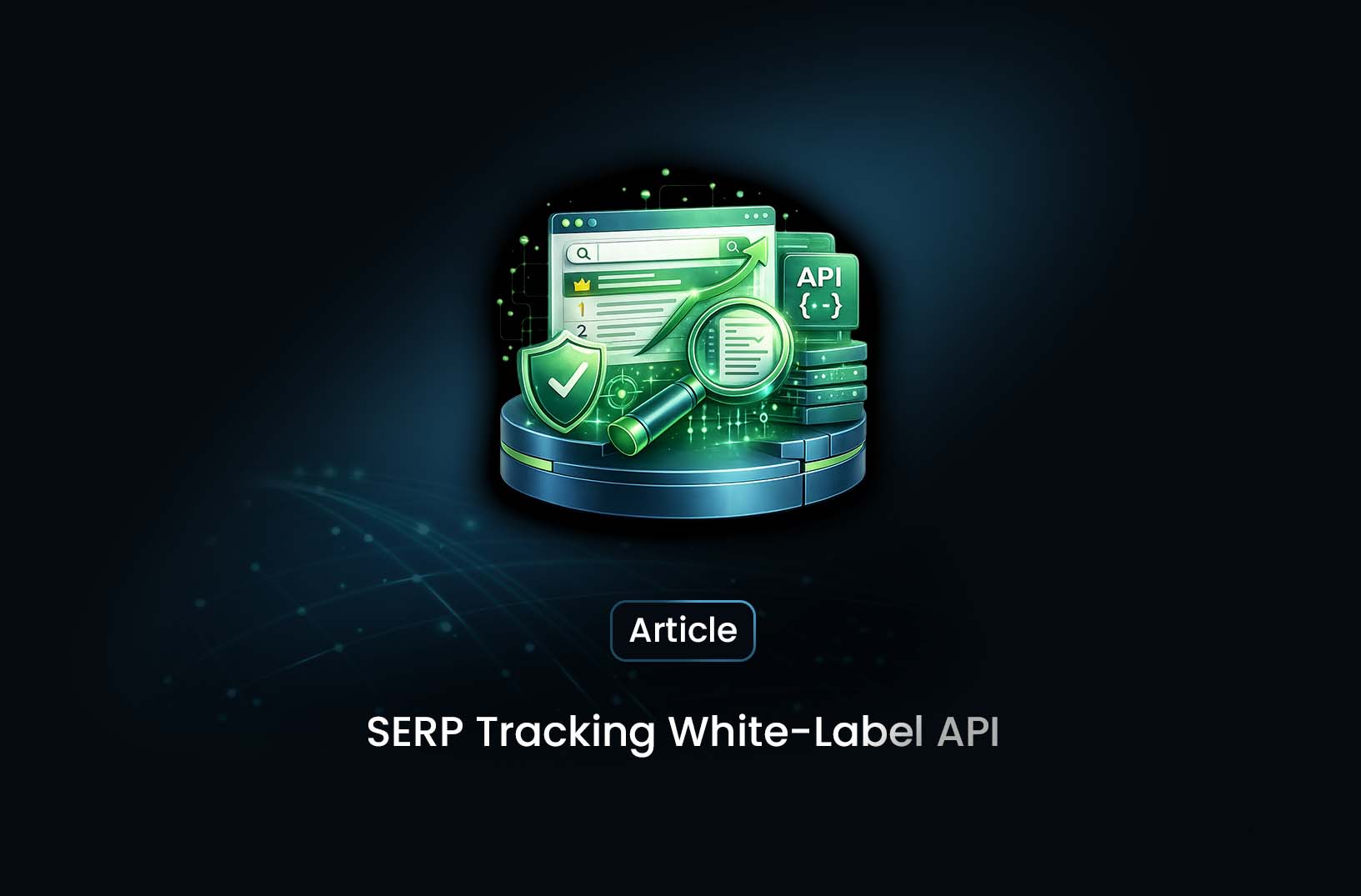
What Is a SERP Tracking White-Label API?
Web ScrapingA concise overview of why white-label SERP tracking APIs are ideal for SEO products, and how platforms like MrScraper provide the infrastructure needed to build custom, scalable SERP data pipelines without managing scraping complexity.
You're building an SEO tool. Or a rank tracker. Or a client reporting dashboard. You need fresh SERP data — real Google results, daily or on demand, for hundreds or thousands of keywords. You could build the scraping infrastructure yourself. You've looked at that road. It leads to proxy management, CAPTCHA solving, browser fingerprinting, and an engineering team spending more time fighting Google's anti-bot systems than building product features.
There's a faster path: a white-label SERP tracking API. You plug it in, your product serves the data, and your customers never know or care where the results actually come from.
Here's what that means in practice: a white-label SERP API is a data provider that lets you serve real-time search engine result data under your own brand — your logo, your domain, your pricing — while the provider handles all the collection infrastructure behind the scenes. It's the difference between building a data pipeline and buying one. For most SaaS founders and agency tool builders, it's the right call. Let's break down exactly how it works and what to look for when choosing one.
What Is a SERP Tracking API?
A SERP tracking API is a service that programmatically fetches search engine result pages and returns structured data — keyword rankings, organic results, featured snippets, People Also Ask boxes, local packs, ads — on demand or on a schedule.
Instead of building and maintaining scrapers that query Google, Bing, or other engines, you send an API request with a keyword, location, and device type. The API handles the fetching, anti-bot bypass, parsing, and structuring. You get back clean JSON ready to store, display, or analyze.
The core use cases:
- Rank tracking — monitoring where specific URLs or domains rank for target keywords over time
- SERP analysis — understanding what SERP features (featured snippets, local packs, image carousels) appear for a keyword
- Competitive intelligence — tracking competitors' ranking positions and visibility
- Content gap analysis — finding keywords where competitors rank but you don't
- Agency reporting — generating client-facing SEO performance reports from live ranking data
All of these need fresh, accurate SERP data at scale. A SERP tracking API is the infrastructure that makes that possible without building scrapers.
What Makes a SERP API "White-Label"?
A white-label SERP API is one where the data provider allows you to resell or embed their data under your own brand, without revealing the underlying provider to your customers.
Here's what that looks like in practice:
Your branding, their infrastructure. Your rank tracking tool shows your logo. Your API responses come from your domain (api.yourtool.com). Your customers pay you. Behind the scenes, your tool calls the white-label provider's API, which fetches real SERP data and returns it to you. The provider is invisible.
Custom pricing and packaging. You define how your customers access the data — by query, by keyword, by report — and at whatever price point fits your market. The provider charges you wholesale; you charge your customers retail.
No attribution required. Your customers don't see "powered by [Provider Name]." Your product looks fully proprietary, even though the data collection is outsourced.
This model works for:
- SEO SaaS tools embedding rank tracking as a feature
- Marketing agencies building white-labeled reporting dashboards for clients
- Developers building vertical SEO tools for specific industries
- Resellers who want to offer SERP data without the engineering overhead
The alternative — building your own SERP scraping infrastructure — means managing proxy pools, fighting Cloudflare, solving CAPTCHAs, parsing HTML that changes without warning, and monitoring for breakage around the clock. For a team whose core value isn't "running scrapers at scale," white-label API is almost always the right tradeoff.
How a White-Label SERP Tracking API Works
The architecture is straightforward once you see it:
Your Product (frontend / reporting dashboard)
        ↓
Your Backend (API layer — your domain, your auth)
        ↓
White-Label SERP API Provider
        ↓
Google / Bing / Yahoo (actual search engines)
        ↓
Structured SERP data flows back up the chain
Your customers interact only with your product. Your backend calls the provider. The provider handles the hard part — fetching real search results through rotating residential proxies, parsing the HTML, and returning structured data.
Here's what a typical integration looks like in Python — calling a white-label SERP provider and serving the data through your own endpoint:
import requests
from flask import Flask, jsonify, request

app = Flask(__name__)

SERP_PROVIDER_KEY = "YOUR_PROVIDER_API_KEY"
SERP_PROVIDER_URL = "https://api.serp-provider.com/v1/search"

def fetch_serp_data(keyword: str, location: str, device: str = "desktop") -> dict:
    """
    Fetch SERP data from your white-label provider.
    Your customers call YOUR API — this call is invisible to them.
    """
    response = requests.get(
        SERP_PROVIDER_URL,
        params={
            "api_key": SERP_PROVIDER_KEY,
            "q": keyword,
            "location": location,
            "device": device,
            "gl": "us",
            "hl": "en",
        },
        timeout=30,
    )
    response.raise_for_status()
    return response.json()

@app.route("/api/rankings", methods=["GET"])
def get_rankings():
    """
    Your customer-facing endpoint — branded as YOUR product.
    Internally calls the white-label provider.
    """
    keyword = request.args.get("keyword")
    location = request.args.get("location", "United States")
    your_api_key = request.headers.get("X-Your-Product-Key")

    # Your auth logic here
    if not validate_api_key(your_api_key):
        return jsonify({"error": "Unauthorized"}), 401

    # Fetch from provider — invisible to your customer
    serp_data = fetch_serp_data(keyword, location)

    # Transform and return under your schema
    return jsonify({
        "keyword": keyword,
        "location": location,
        "rankings": [
            {
                "position": result.get("position"),
                "title": result.get("title"),
                "url": result.get("link"),
                "snippet": result.get("snippet"),
            }
            for result in serp_data.get("organic_results", [])
        ],
        "powered_by": "YourProductName",  # Not the provider name
    })

def validate_api_key(key: str) -> bool:
    # Your customer auth logic
    return key is not None and len(key) > 10

if __name__ == "__main__":
    app.run(debug=True)
The key pattern: your /api/rankings endpoint is what your customers call. The fetch_serp_data() function is the private call to your white-label provider — completely hidden from your customer's perspective. Your response schema, your field names, your branding.
For scheduled rank tracking (daily snapshots for a keyword list), you'd add a job scheduler:
import asyncio
from apscheduler.schedulers.asyncio import AsyncIOScheduler
from datetime import datetime

# Keywords to track daily for each client
CLIENT_KEYWORD_SETS = {
    "client_001": {
        "keywords": ["best crm software", "crm for small business", "salesforce alternative"],
        "location": "United States",
        "device": "desktop",
    },
    "client_002": {
        "keywords": ["london plumber", "emergency plumber london", "plumber near me"],
        "location": "London, England",
        "device": "mobile",
    },
}

async def track_rankings_for_client(client_id: str, config: dict):
    """Fetch and store daily rankings for one client."""
    results = []
    for keyword in config["keywords"]:
        try:
            data = fetch_serp_data(keyword, config["location"], config["device"])
            organic = data.get("organic_results", [])

            # Find where the client's domain appears
            target_domain = "client-domain.com"  # Pulled from your database
            position = next(
                (r["position"] for r in organic if target_domain in r.get("link", "")),
                None  # Not ranking in top results
            )

            results.append({
                "keyword": keyword,
                "position": position,
                "date": datetime.utcnow().isoformat(),
                "client_id": client_id,
            })

        except Exception as e:
            print(f"Failed to fetch {keyword} for {client_id}: {e}")

    # Store results in your database
    store_ranking_snapshot(client_id, results)
    print(f"Tracked {len(results)} keywords for {client_id}")

async def daily_tracking_job():
    """Run daily for all clients — scheduled by APScheduler."""
    tasks = [
        track_rankings_for_client(client_id, config)
        for client_id, config in CLIENT_KEYWORD_SETS.items()
    ]
    await asyncio.gather(*tasks)

# Schedule daily at 2 AM UTC
scheduler = AsyncIOScheduler()
scheduler.add_job(daily_tracking_job, "cron", hour=2, minute=0)
scheduler.start()
This is what a white-label rank tracker's backend actually looks like — your scheduling logic, your database, your client structure, calling the provider's API in the background.
How to Choose a White-Label SERP Tracking API
Not all SERP APIs are built for white-label use, and the ones that are vary significantly on the dimensions that actually matter for building a product on top of them. Here's what to evaluate:
Data Accuracy and Freshness
This is the core product promise. Your customers are making SEO decisions based on this data. If it's stale or inaccurate, your product's credibility is gone.
What to check:
- Does the API return real-time data or cached results? Cached data from 24+ hours ago is often useless for rank tracking.
- How does the provider handle Google's frequent layout changes? Providers with dedicated parsing teams update faster than those relying on community-maintained scrapers.
- Can you verify accuracy? Cross-check a sample of returned rankings against what you see manually in a private browser window from the same location.
SERP Feature Coverage
Modern SERPs are more than 10 blue links. Featured snippets, local packs, image carousels, People Also Ask boxes, shopping results, video carousels — these features often matter as much as organic position for understanding actual search visibility.
# Example: parsing SERP features from a provider response
def analyze_serp_features(serp_data: dict) -> dict:
    features_present = []

    if serp_data.get("answer_box"):
        features_present.append("featured_snippet")
    if serp_data.get("local_results"):
        features_present.append("local_pack")
    if serp_data.get("related_questions"):
        features_present.append("people_also_ask")
    if serp_data.get("shopping_results"):
        features_present.append("shopping")
    if serp_data.get("video_results"):
        features_present.append("video_carousel")

    return {
        "features": features_present,
        "organic_count": len(serp_data.get("organic_results", [])),
        "has_ads": bool(serp_data.get("ads")),
    }
Before committing to a provider, confirm which SERP features their API actually returns — and test on keywords in your target vertical where specific features are common.
Geolocation Accuracy
Local SEO is a major use case for rank tracking. If your tool serves agencies or local businesses, you need city-level (or even ZIP-level) geolocation accuracy — not just country-level results.
# Test geolocation accuracy before committing to a provider
def test_geo_accuracy(provider_api_key: str, keyword: str, locations: list) -> dict:
    results = {}
    for location in locations:
        response = requests.get(
            "https://api.serp-provider.com/v1/search",
            params={
                "api_key": provider_api_key,
                "q": keyword,
                "location": location,
                "num": 10,
            },
            timeout=30,
        )
        data = response.json()
        top_3 = [r.get("link") for r in data.get("organic_results", [])[:3]]
        results[location] = top_3
        print(f"{location}: {top_3}")

    return results

# If "coffee shop near me" returns the same top 3 results for New York and Chicago,
# the provider's geo-targeting isn't working
test_geo_accuracy(
    provider_api_key="YOUR_KEY",
    keyword="coffee shop near me",
    locations=["New York, New York", "Chicago, Illinois", "Los Angeles, California"]
)
Correct geo-targeting should produce meaningfully different results for location-dependent queries across different cities. If results are identical, the provider is ignoring your location parameter.
White-Label Terms and Attribution Requirements
This is the legal piece. Before building your product on a provider, confirm:
- Attribution requirements — Does the provider require you to display their name or logo? Any required attribution undermines your white-label positioning.
- Resale rights — Are you explicitly permitted to resell the data or embed it in a commercial product? Some APIs are licensed for internal use only.
- Data ownership — Who owns the stored ranking data? Can you export historical data if you switch providers?
- Rate limits — What are the concurrency limits? Will they support your projected query volume at peak times?
Read the terms of service carefully. Most reputable SERP API providers have clear commercial licensing terms; if they don't, that's a red flag for a production dependency.
Pricing Model Compatibility
SERP API pricing models vary significantly:
- Per-query pricing — You pay for each SERP fetched. Predictable per-request cost, but high at scale.
- Monthly credit packages — Fixed monthly queries at a discounted rate. Good if volume is predictable.
- Unlimited plans — Fixed monthly cost with no per-query charge. Best for high-volume products but often has concurrency limits.
Match the provider's pricing model to your product's economics. If you're building a SaaS with per-seat pricing, per-query costs can eat your margin unpredictably as customers use the product more than expected. Unlimited or credit-bundle plans offer more predictable COGS.
MrScraper as the Infrastructure Layer
If you're building a white-label SEO or rank tracking product and want full control over data collection — rather than depending on a pre-built SERP API's data schema and coverage decisions — MrScraper's scraping infrastructure lets you build your own SERP collection layer on top of reliable, residential-proxy-backed scraping.
import asyncio
from mrscraper import MrScraperClient

async def collect_serp_data(keyword: str, location: str = "US"):
    """
    Use MrScraper to fetch and parse Google SERP data
    with residential proxy rotation and anti-bot bypass built in.
    """
    client = MrScraperClient(token="YOUR_MRSCRAPER_API_TOKEN")

    result = await client.create_scraper(
        url=f"https://www.google.com/search?q={keyword.replace(' ', '+')}&gl=us&hl=en",
        message="Extract all organic search results with their title, URL, and snippet. Also note any featured snippets, People Also Ask boxes, or local pack results.",
        agent="general",
        proxy_country=location,
    )

    print("SERP collection job ID:", result["data"]["data"]["id"])
    return result

asyncio.run(collect_serp_data("best crm software", location="US"))
This approach gives you maximum flexibility — your own parsing logic, your own data schema, and control over which SERP features you extract and how you structure them — while MrScraper handles the residential proxy rotation, anti-bot bypass, and JavaScript rendering that make reliable SERP collection possible at scale.
Common Challenges and Limitations
Google layout changes break parsers. Google updates its SERP layout regularly — new ad formats, rearranged SERP features, different HTML structure. Providers who maintain dedicated parsing teams adapt quickly; those relying on open-source scrapers may have gaps of days or weeks where data quality degrades. Ask prospective providers how quickly they've historically updated after major Google SERP changes.
Geo-targeting depth varies dramatically. Country-level targeting is table stakes. City-level is where providers diverge. ZIP-code or hyper-local targeting (essential for local SEO tools) is only available from a small subset of providers. Test on your most demanding geo requirements before committing.
Historical data portability. If you switch providers after a year of collecting data, you need that historical ranking history to stay in your product. Some providers lock historical data inside their platform. Ensure from day one that you're storing ranking snapshots in your own database — not relying on the provider's data retention.
Rate limits under load. Your daily scheduled job running for all clients simultaneously can easily hit rate limits that don't matter in testing but become painful at scale. Test concurrent query capacity before launch, not after your customer base grows past the limit.
Conclusion
A white-label SERP tracking API is the practical choice for any team building SEO tooling who doesn't want "run scrapers at scale" to be a core competency. You get real SERP data, under your brand, without managing the collection infrastructure — which lets you focus on the product features that actually differentiate you.
When choosing a provider, accuracy and freshness come first. Geo-targeting depth, SERP feature coverage, and white-label terms come next. And if you want full control over the data schema and collection logic rather than depending on a provider's parsing decisions, MrScraper's infrastructure gives you that foundation — residential proxy rotation, anti-bot bypass, and AI extraction — on top of which you can build exactly the SERP collection pipeline your product needs.
What We Learned
- A white-label SERP API lets you serve real search engine result data under your own brand — your logo, your domain, your pricing — while the provider handles all collection infrastructure invisibly
- The architecture is a simple proxy chain: your customer calls your API → your backend calls the provider → the provider fetches from Google → structured data flows back under your brand, never revealing the provider
- Data accuracy, freshness, and geo-targeting depth are the critical evaluation criteria — cross-check provider results against manual searches and test city-level geo-targeting on location-dependent queries before committing
- SERP feature coverage varies significantly between providers — confirm which features (featured snippets, local packs, People Also Ask, shopping results) are actually returned before building UI components that depend on them
- Always store ranking snapshots in your own database from day one — don't rely on provider data retention; historical ranking data is your product's core asset and must be portable if you ever switch providers
- MrScraper's infrastructure provides the building blocks for a custom SERP collection layer — residential proxy rotation, anti-bot bypass, and AI extraction give you full control over data schema and parsing logic rather than depending on a provider's fixed output format
FAQ
- Can I use a white-label SERP API without technical knowledge? The integration itself requires some development work — you need to make API calls, parse JSON responses, and serve data through your product's backend. Most providers offer clear documentation and client libraries in Python, Node.js, and PHP. If you need a fully no-code solution, look at white-label SEO platforms (like AgencyAnalytics or SE Ranking's white-label offering) rather than raw API providers.
- How often should I refresh SERP data for rank tracking? For most rank tracking use cases, daily snapshots are sufficient — Google's rankings shift constantly but the meaningful trends emerge over days and weeks, not hours. For competitive intelligence or SERP feature monitoring on time-sensitive queries (news, trending topics), hourly or on-demand fetching makes more sense. Scheduling daily jobs for your full keyword set during off-peak hours (2–6 AM) minimizes both API costs and any rate-limit risk.
- What's the difference between a SERP API and building my own SERP scraper? A SERP API is managed infrastructure — you pay for the data collection capability without owning it. Building your own scraper means buying proxies, managing bot detection bypass, writing and maintaining parsers, and monitoring for breakage. The cost differential isn't just money — it's engineering time. For teams whose competitive advantage isn't scraping infrastructure, a SERP API almost always makes more sense. For teams that need full control over collection logic and data schema, building on top of a scraping infrastructure layer like MrScraper is the middle path.
- Will my customers be able to tell I'm using a third-party API? Not if you implement it correctly. Serve all data through your own domain and API endpoints. Never include the provider's name in your response payload or error messages. Store data in your own database so responses come from your infrastructure rather than proxied directly from the provider. If you do this, your product is genuinely white-labeled — the data origin is architecturally invisible to your customers.
- What happens to my product if my SERP API provider shuts down or changes pricing? This is the key risk of provider dependency. Mitigate it by: (1) always storing historical ranking data in your own database — never rely solely on the provider's storage; (2) abstracting your provider integration behind a service layer in your code so switching providers requires changing one module, not rewriting your product; (3) monitoring provider status pages and having a backup provider account provisioned before you need it. Provider concentration risk is real — build your architecture to survive a provider switch within days, not months.
Summarize this post
Open it in your assistant of choice with the prompt ready to send.
Take a Taste of Easy Scraping!

Find more insights here
Use MrScraper MCP to Compare Public SaaS Pricing and Plan Limits
Build a source-backed SaaS plan comparison using MrScraper MCP. Preserve prices, quotas, billing ter…
Build a Product Attribute Classifier with LangChain and MrScraper
Build a LangChain workflow that extracts product evidence with MrScraper, normalizes attributes and…
Create a Source-Verified Question-and-Answer Dataset From Web Pages
Build a question-and-answer dataset from your own documentation pages. Every answer is an exact span…