Amazon Scraper API: A Guide for Developers, Sellers, and Data Teams
Web ScrapingLearn how Amazon scraper APIs work, what product and marketplace data they can return, how to compare providers, and which factors matter when choosing a solution.
The best tool for scraping e-commerce product data depends on the data you need. It also depends on your regions, response format, scale, pricing, and bot protection needs. Amazon scraper APIs provide a managed alternative to building scrapers in-house.
Why Scrape Amazon?
Amazon is the world's largest ecommerce marketplace. It offers millions of products. Prices and stock levels change billions of times each day. Developers, sellers, and analysts scrape Amazon to track competitors. They monitor prices, sync ASIN data with SaaS tools, and study marketplace trends. They also optimize SEO and listings, and track reviews. Scraping Amazon manually is difficult. Amazon aggressively blocks bots, rotates anti-bot challenges, rate-limits requests, and returns inconsistent HTML structures. Getting past those defenses is only part of the work, because maintaining a scraper can become time-consuming. An Amazon Scraper API provides a managed endpoint that retrieves clean, structured Amazon data. It reduces the need to manage proxies, CAPTCHAs, and changing page layouts. This guide explains how these APIs work, what data they provide, and how to evaluate services for a project. It covers product data, pricing, reviews, search results, and offer listings. It also includes provider comparisons and practical guidance to help you choose a solution.
1. Price Monitoring & Competitor Tracking
Track competitor prices, variations, shipping fees, and stock levels automatically.
2. Product Data for SaaS Tools
Many ecommerce apps rely on Amazon product data to function.
3. Market Research
Analyze demand using categories, rankings, and bestseller data.
4. SEO & Listing Optimization
Monitor titles, descriptions, and content changes over time.
5. Review Tracking
Collect reviews for sentiment analysis and product insights.
Amazon has all the data: you just need a reliable way to extract it.
The Problem: Scraping Amazon Is Hard
Amazon has one of the strongest anti-bot systems on the internet.
Common issues include:
- CAPTCHAs
- 503 bot detection pages
- Forced redirects
- Throttling
- Constant HTML changes
- Region-based restrictions
- IP bans
A typical in-house scraper breaks every few weeks: and maintaining proxies alone can cost more than an API.
What Is an Amazon Scraper API?
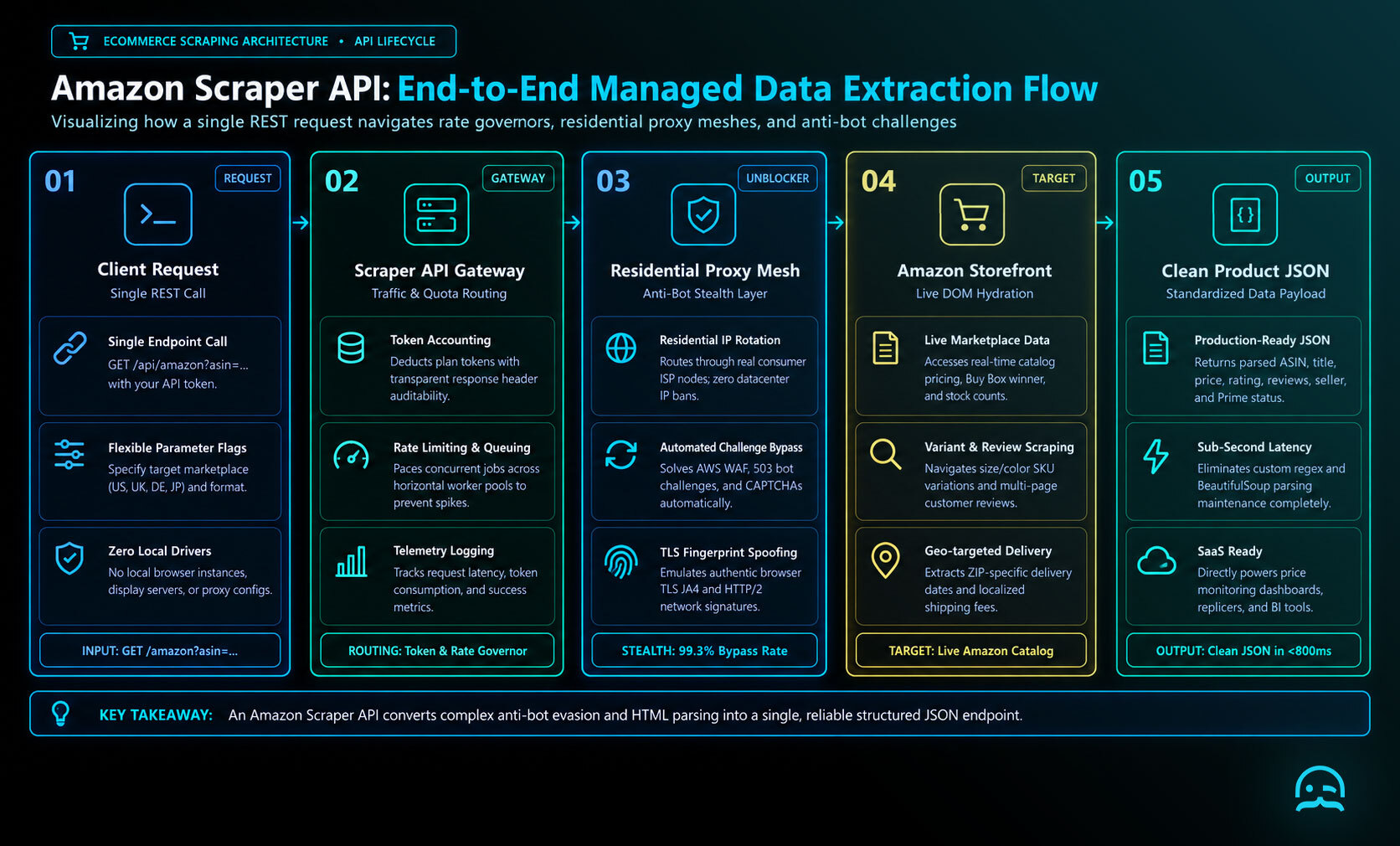
An Amazon Scraper API is a ready-made service that handles:
- IP rotation
- Residential proxies
- CAPTCHA-solving
- HTML parsing
- JSON output
- Region selection (US, UK, DE, JP, etc.)
Instead of scraping Amazon yourself, you simply call an endpoint such as:
GET [https://api.example.com/amazon/product?asin=B08N5WRWNW](https://api.example.com/amazon/product?asin=B08N5WRWNW)
And receive structured JSON:
{
  "asin": "B08N5WRWNW",
  "title": "Apple AirPods Pro",
  "price": 199.99,
  "rating": 4.8,
  "reviews": 182341,
  "images": [],
  "variants": [],
  "seller": "Apple",
  "is_prime": true
}
It’s plug-and-play ecommerce data in seconds.
What Data Can You Get from an Amazon Scraper API?
What Data Can You Get from an Amazon Scraper API?
A good API typically supports:
Designing Multi-Marketplace Adapters
from dataclasses import dataclass, asdict
from typing import Any

@dataclass
class Product:
    marketplace: str
    product_id: str
    title: str
    price: float | None
    currency: str | None
    url: str | None
    metadata: dict[str, Any]

def normalize(marketplace: str, raw: dict[str, Any]) -> Product:
    adapters = {
        "walmart": {
            "id": "usItemId", "title": "name", "price": "salePrice",
            "currency": "currency", "url": "productUrl"
        },
        "ebay": {
            "id": "itemId", "title": "title", "price": "price",
            "currency": "currency", "url": "itemWebUrl"
        },
        "target": {
            "id": "tcin", "title": "title", "price": "current_retail",
            "currency": "currency", "url": "url"
        },
    }
    fields = adapters[marketplace]
    known = set(fields.values())

    def value(field: str):
        return raw.get(fields[field])

    price = value("price")
    return Product(
        marketplace=marketplace,
        product_id=str(value("id")),
        title=str(value("title") or ""),
        price=float(price) if price is not None else None,
        currency=value("currency"),
        url=value("url"),
        metadata={key: val for key, val in raw.items() if key not in known},
    )

samples = [
    ("walmart", {"usItemId": "123", "name": "Example", "salePrice": 19.99}),
    ("ebay", {"itemId": "456", "title": "Example", "price": 21.50}),
    ("target", {"tcin": "789", "title": "Example", "current_retail": 18.00}),
]

for marketplace, payload in samples:
    print(asdict(normalize(marketplace, payload)))
Product Data
- ASIN
- Title
- Description
- Images
- Variations
- Brand
- Rankings
- Prime availability
Pricing
- List price
- Sale price
- Coupons
- Deals
- Shipping cost
- Stock status
Reviews
- Review text
- Ratings
- Reviewer details
- Review images
- Pagination support
Search Results
- Keyword search
- Category pages
- Best sellers
- Storefronts
Offer Listings
- FBA / FBM
- Buy box
- Competitor sellers
If Amazon shows it, an API can scrape it.
Popular Amazon Scraper API Services (2025)
Popular Amazon Scraper API Services (2025)
Several widely used scraping API providers follow.
E-Commerce Tool Comparison
This matrix compares stated capabilities and leaves current pricing to each vendor’s pricing page.
| Tool | Feature emphasis | Pricing |
|---|---|---|
| Apify | Ready-made Amazon actors and flexible automation | Check current vendor pricing |
| ScraperAPI | Product pages converted to JSON with anti-blocking support | Check current vendor pricing |
| Bright Data | Strong proxy network and global scraping support | Check current vendor pricing |
| Oxylabs | Enterprise-grade proxies, large-scale collection, and multi-region support | Check current vendor pricing |
Apify
- Ready-made Amazon actors
- Flexible automation
- Great for custom workflows
ScraperAPI
- Converts product pages into JSON
- Strong anti-blocking
- Good for bulk monitoring
Scrapingdog
- Lightweight & fast
- Budget-friendly
- Ideal for moderate workloads
Oxylabs
- Enterprise-grade proxies
- Massive scale
- Multi-region support
Bright Data
- Strong proxy network
- Global scraping support
How to Choose the Right Amazon Scraper API
Before choosing, evaluate:
- Anti-bot resilience
- Speed of response
- JSON parsing accuracy
- Supported regions
- Pricing model
- Rate limits and concurrency
Why Developers Love MrScraper for Amazon Data
If you need a strong and reliable Amazon Scraper API, use MrScraper. It is built for large-scale ecommerce data extraction.
What MrScraper Offers
- Residential proxy rotation
- Built-in CAPTCHA solving
- Clean JSON output
- Product, search, reviews & offer scraping
- Global Amazon support
Perfect for:
- SaaS founders
- Dropshipping tools
- Price trackers
- Market research teams
- Amazon sellers
Outsource the scraping pipeline: get Amazon data instantly without engineering hassle.
Conclusion
Scraping Amazon at scale is difficult due to bot protection, IP limits, CAPTCHAs, and dynamic HTML. That’s why Amazon Scraper APIs are now essential tools for developers and businesses.
Whether you prefer flexible tools like Apify or fast services like Scrapingdog, the right tool depends on your needs. Enterprise platforms like Oxylabs are also an option.
But if you want an easy scraping solution with proxy rotation and low-code setup, MrScraper is a great choice.
MrScraper lets you extract real-time Amazon data: no proxies, no CAPTCHAs, no maintenance.
Whether you're building a product research tool, monitoring competitor prices, powering a dashboard, or studying marketplace trends, MrScraper gives you production-ready scraping without the engineering burden.
What We Learned
The main takeaway is that you should judge an Amazon scraper API by the workflow it must support. Do not pick one based only on feature lists. Match the endpoint to the required data type, marketplace, request volume, response format, and acceptable latency.
- Test representative product, search, review, and offer pages before committing to a provider.
- Verify region handling, pagination, concurrency limits, and failure behavior under realistic workloads.
- Check that parsed fields remain consistent when Amazon changes page layouts or presents an anti-bot challenge.
- Track response quality and total cost per usable record, rather than requests alone.
- Document Amazon’s terms, privacy obligations, and the lawful basis for collecting and using the data.
Compare Plans for Your Amazon Data Workflow
Review the available plans and choose an option that fits your Amazon data extraction requirements and budget.
Frequently asked questions
What should you compare when choosing an Amazon scraper API?
Compare anti-bot resilience, response speed, JSON parsing accuracy, supported regions, pricing, rate limits, and concurrency. The right choice depends on your project’s data requirements and operating constraints.
What types of Amazon data can a scraper API return?
Depending on the service, Amazon scraper APIs can return product details, prices, and reviews. They can also return search results and offer listings. Fields may include titles, ratings, stock status, shipping costs, and seller information.
Which tools are covered in this Amazon scraper API guide?
The guide covers Apify, ScraperAPI, Oxylabs, Bright Data, and MrScraper, alongside criteria for evaluating an Amazon data extraction service.
Summarize this post
Open it in your assistant of choice with the prompt ready to send.
Take a Taste of Easy Scraping!

Find more insights here

Build an Agent Harness for Repeatable Web Research
Build a small agent harness in Python that saves job state, enforces tool and page budgets, and chec…

Authenticate Web Data Tools for AI Agents Without Exposing Secrets
Learn when to use API keys or OAuth for AI agent tools, where credentials should live, how to separa…

Design Reliable Web Data Tools for AI Agents
Learn how to define clear inputs, structured results and honest errors for the web data tools your A…