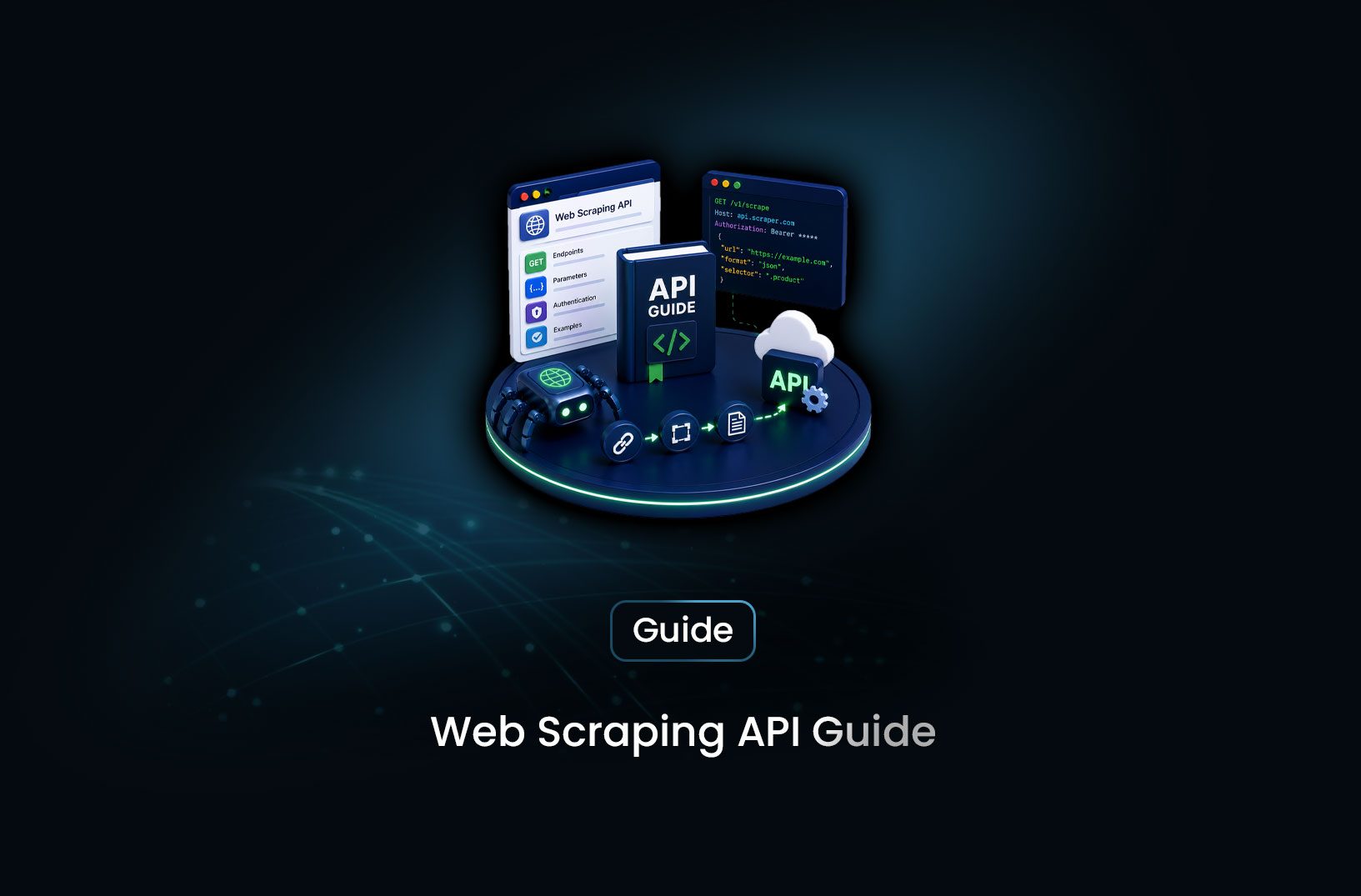
Web Scraping API Guide: How They Work and When to Use One
Web ScrapingA complete guide to web scraping APIs — how they work, the different types, when to use one vs. build your own, and which features matter most.
Building a web scraper from scratch involves more engineering than the data extraction itself. Before you get to the part where you actually collect useful data, you're managing proxy pools, handling IP rotation, configuring headless browsers, staying ahead of bot-detection updates, writing retry logic, and dealing with everything that changes when a target site updates its anti-bot configuration. Most of that engineering isn't your core competency — it's infrastructure that exists only to make the actual data extraction possible.
A web scraping API is managed infrastructure that handles those hard parts — proxies, rendering, anti-bot bypass, rate management — as a service, exposing a simple HTTP interface where you send a URL and receive back the page content, ready for extraction. The engineering investment shifts from building and maintaining scraping infrastructure to using it. This guide covers what web scraping APIs are, how they work at a technical level, the different types available, how to use one, and how to decide whether using a scraping API is the right choice for your specific situation.
What Is a Web Scraping API?
A web scraping API is a cloud-based service that accepts a URL and returns the rendered content of the target web page — along with optional extraction, structuring, or parsing — through a standard HTTP interface. Rather than building and operating the infrastructure required to access web content at scale (proxies, browsers, anti-bot handling), you call the API and let the provider's infrastructure handle it.
The distinction from a simple proxy or a headless browser library is important: a web scraping API is a complete service, not a component. You don't configure proxy pools, manage browser processes, handle CAPTCHA challenges, or track IP reputation — the API handles all of that as a black box. Your code makes an HTTP request to the API with a target URL; the API returns what a browser would see when visiting that URL; you extract the data you need.
This service model is what separates a scraping API from DIY scraping infrastructure. When you build your own scraper, you own every layer: HTTP client or browser, proxy management, rate limiting, fingerprint configuration, retry logic, monitoring. When you use a scraping API, the provider owns those layers and you own the extraction and analysis on top of them.
According to the Python requests library documentation, making an HTTP request in Python is a few lines of code. The complexity in production scraping isn't the HTTP call — it's everything that has to work reliably around that HTTP call to make the response actually useful. Web scraping APIs exist specifically to abstract that surrounding complexity.
How Web Scraping APIs Work
Understanding the infrastructure behind a web scraping API clarifies both what you're paying for and what the API can and can't do.
Request intake. Your application sends an HTTP POST (or GET) request to the scraping API endpoint, including the target URL and optional configuration parameters (render JavaScript, target location, session configuration, output format).
Proxy routing. The API's infrastructure routes the outbound request to the target website through a residential or data-center proxy from the provider's pool. This means the target website sees a request from a residential ISP address rather than from your application's IP or the API provider's infrastructure IP. The API selects the proxy, manages rotation, and retires IPs that have accumulated detection signals.
Bot-detection handling. For providers that include anti-bot bypass, the outbound request is configured with browser fingerprint characteristics (correct TLS fingerprint, complete HTTP headers, appropriate user-agent) that match the expected profile of a real browser visitor. CAPTCHA challenges, if they appear, are handled by the provider's challenge-resolution infrastructure rather than being passed back to your code as an error.
Rendering. For providers that support JavaScript rendering, the target page is loaded in a full browser environment (typically a managed Chrome or Chromium instance), JavaScript is executed, dynamic content is loaded, and the rendered DOM is what gets captured and returned — not the initial HTML server response.
Response delivery. The provider returns the response to your API call: raw HTML, rendered HTML, or structured extracted data depending on the provider and your configuration. Your code receives this response and processes it further — parsing the HTML, extracting specific fields, storing results.
This architecture means a web scraping API is essentially a browser-as-a-service or proxy-plus-rendering-as-a-service, depending on the provider. The quality of the service at each layer — proxy pool freshness, browser fingerprint management, anti-bot bypass effectiveness — is what differentiates providers.
Types of Web Scraping APIs
Not all scraping APIs work the same way or provide the same capabilities. The market includes three main types, each operating at a different level of abstraction:
HTTP Proxy APIs are the simplest type: they route your HTTP requests through their proxy infrastructure and return the raw server response. You still write the HTTP request code; the API just handles proxy selection and rotation. These are appropriate for static HTML targets where you need IP rotation but no rendering. They're typically the cheapest per-request option.
Browser Rendering APIs handle both proxy routing and JavaScript rendering. You send a URL; the provider loads it in a managed browser environment, executes JavaScript, waits for dynamic content to load, and returns the fully rendered HTML. These are appropriate for modern JavaScript-heavy targets — SaaS pricing pages, ecommerce product listings, dynamic news sites — where the content you need only exists in the rendered DOM. Most general-purpose scraping APIs fall into this category.
AI Extraction APIs go a step further: you provide a URL and a schema defining the data you want (field names, types, and descriptions), and the API returns structured JSON containing the extracted values — no HTML parsing required on your side. The provider handles not just rendering but also semantic field extraction using language models. These are most valuable when collecting data from diverse sources with different page structures, where per-site selector maintenance would otherwise be significant engineering overhead.
Step-by-Step Guide: Using a Web Scraping API in Python
Step 1: Get Your API Credentials
Register for an account with your chosen scraping API provider and obtain an API key. Most providers offer a free trial with limited credits — enough to evaluate the API's quality against your real target pages before committing to a paid plan.
Store credentials as environment variables, not in code:
import os

SCRAPING_API_KEY = os.environ.get("SCRAPING_API_KEY", "")
SCRAPING_API_ENDPOINT = os.environ.get(
    "SCRAPING_API_ENDPOINT",
    "https://api.your-provider.com/v1/scrape"
)
Step 2: Make Your First API Call
The basic call pattern is the same across most providers — send the target URL, specify rendering requirements, receive HTML back:
import requests

def scrape_url(url: str,
               render_js: bool = True,
               country: str = "us") -> str | None:
    """
    Fetch a URL through the scraping API.
    Returns rendered HTML, or None on failure.
    """
    payload = {
        "url": url,
        "render_js": render_js,       # True for JavaScript-heavy pages
        "country": country,            # Geo-target: "us", "gb", "de", etc.
        "wait_for_selector": "body",   # Confirm basic content is present
    }
    headers = {
        "Authorization": f"Bearer {SCRAPING_API_KEY}",
        "Content-Type": "application/json",
    }

    try:
        response = requests.post(
            SCRAPING_API_ENDPOINT,
            json=payload,
            headers=headers,
            timeout=60  # Rendering can take longer than a plain HTTP fetch
        )
        response.raise_for_status()
        return response.json().get("html") or response.text
    except requests.HTTPError as e:
        print(f"API error {e.response.status_code}: {e.response.text}")
        return None
    except requests.RequestException as e:
        print(f"Request failed: {e}")
        return None
The 60-second timeout is important — browser rendering APIs can take longer than plain HTTP requests because they wait for JavaScript to execute and dynamic content to load.
Step 3: Extract Data From the Returned HTML
The API returns HTML; you extract data from it with BeautifulSoup or your preferred parsing library:
from bs4 import BeautifulSoup

def extract_product_data(html: str) -> dict:
    """Extract product data from the rendered HTML returned by the scraping API."""
    soup = BeautifulSoup(html, "html.parser")

    def safe_text(selector: str) -> str | None:
        el = soup.select_one(selector)
        return el.get_text(strip=True) if el else None

    return {
        "title": safe_text("h1.product-title, [data-testid='product-name']"),
        "price": safe_text("[data-testid='price'], .price-current"),
        "availability": safe_text("[data-testid='availability'], .stock-status"),
    }
Step 4: Handle Failures and Build Retry Logic
Scraping API calls can fail for various reasons — rate limits, temporary provider issues, target site blocks that the API couldn't bypass. Build retry logic with appropriate backoff:
import time
import random

def scrape_with_retry(url: str,
                       max_attempts: int = 3,
                       base_backoff: float = 2.0) -> str | None:
    """Scrape a URL with exponential backoff retry on failures."""
    for attempt in range(max_attempts):
        html = scrape_url(url)
        if html:
            return html

        wait = (2 ** attempt) * base_backoff + random.uniform(0, 1)
        print(f"Attempt {attempt + 1} failed. Retrying in {wait:.1f}s...")
        time.sleep(wait)

    return None
Step 5: Scale to Multiple URLs With Concurrency
For scraping many URLs, use concurrent requests — the API's infrastructure handles multiple requests in parallel on its side, and you can issue multiple calls simultaneously within your rate limit:
from concurrent.futures import ThreadPoolExecutor, as_completed

def scrape_batch(urls: list[str],
                  max_workers: int = 5) -> list[dict]:
    """
    Scrape multiple URLs concurrently through the scraping API.
    max_workers should respect your provider's rate limit.
    """
    results = []

    def scrape_and_extract(url: str) -> dict:
        html = scrape_with_retry(url)
        if html:
            data = extract_product_data(html)
            data["url"] = url
            return data
        return {"url": url, "error": "extraction_failed"}

    with ThreadPoolExecutor(max_workers=max_workers) as executor:
        futures = {executor.submit(scrape_and_extract, url): url for url in urls}
        for future in as_completed(futures):
            try:
                results.append(future.result())
            except Exception as e:
                print(f"Worker failed: {e}")

    return results
Best Web Scraping APIs in 2026
1. MrScraper
MrScraper combines browser-level rendering, residential proxy routing, anti-bot bypass, and AI-powered structured data extraction in a single API. For teams extracting data from JavaScript-heavy or bot-protected targets, the managed combination of these layers removes the infrastructure engineering that DIY setups require. The AI extraction layer enables returning structured JSON directly from any page — defined by field descriptions rather than CSS selectors — reducing per-source maintenance as target pages change. Documentation at https://docs.mrscraper.com.
Best for: Teams that want browser rendering, anti-bot bypass, and optional AI extraction from one managed API without infrastructure overhead.
2. ScrapingBee
ScrapingBee provides a browser rendering API with residential proxy support, JavaScript execution, and screenshot capability. Its request-based pricing model and clear documentation make it a popular entry point for teams evaluating managed browser rendering. Documentation at https://www.scrapingbee.com.
Best for: Developers evaluating managed browser rendering with transparent per-request pricing and strong documentation.
3. Bright Data Web Scraper API
Bright Data's scraping products include both proxy infrastructure and managed browser APIs. The SERP API and ecommerce-specific endpoints provide pre-built extraction for common data categories, while the general-purpose Web Unlocker API handles anti-bot bypass for arbitrary targets. Documentation at https://brightdata.com.
Best for: Enterprise teams with high volume requirements or specific data category needs (SERP data, ecommerce) covered by Bright Data's domain-specific products.
4. Apify
Apify provides a platform for scraping workflows with a marketplace of pre-built actors (scrapers) for specific sites, alongside infrastructure for building custom scraping solutions. Its actor marketplace is a significant differentiator for teams that need data from specific popular platforms rather than building all extraction logic from scratch. Documentation at https://apify.com.
Best for: Teams that want a complete scraping workflow platform with marketplace actors for popular target sites.
Free vs. Paid: What Each Level Provides
Free tiers from major scraping API providers typically include a limited monthly credit allocation — enough to evaluate the API's quality against your real target pages and confirm that the rendering and anti-bot bypass actually works for your specific use cases. This is genuinely useful: testing against production targets before committing budget is the only reliable way to evaluate provider quality.
Entry-level paid plans cover moderate usage (thousands to tens of thousands of requests per month) and typically unlock higher concurrency limits, better rendering capability, and responsive support. For individual projects and small teams, entry-level plans are where production deployments start.
Enterprise plans remove per-request pricing in favor of committed monthly volumes at negotiated rates, with SLAs, dedicated support, and often additional features like webhook delivery, custom rendering configurations, and guaranteed concurrency.
The comparison to DIY infrastructure: a scraping API's monthly cost at moderate volume is typically lower than the equivalent server costs, proxy bandwidth, and engineering time required to build and maintain equivalent DIY infrastructure. At high volume, the economics shift and self-managed infrastructure becomes more cost-effective — but "high volume" in this context is typically millions of requests per month, not thousands.
Key Features to Evaluate in a Web Scraping API
- JavaScript rendering quality: Does the API wait for async content to load before returning HTML? For modern pages, rendering quality — not just whether JavaScript executes — determines whether the data you need actually appears in the response.
- Anti-bot bypass effectiveness: Test against your actual target pages, not benchmarks. Success rates vary significantly by target and by provider.
- Residential vs. data-center proxy infrastructure: Residential IPs are necessary for any target with IP-reputation-based detection. Confirm which the provider uses and whether residential routing is included or an add-on.
- Geographic targeting: Does the API support routing requests as visitors from specific countries or cities? Required for geo-sensitive data.
- Structured extraction (AI or selector-based): Does the API return raw HTML you parse yourself, or can it return extracted, structured data? The latter reduces your parsing and maintenance work.
- Rate limits and concurrency caps: Does the API support the concurrent request volume your pipeline requires? Provider-side rate limits can become the throughput bottleneck.
- Response time: Rendered browser requests through a scraping API are inherently slower than direct HTTP — confirm typical response times are within your pipeline's latency tolerance.
- Webhook support for async jobs: For large URL batches, synchronous request-response APIs create blocking; webhook delivery lets you queue jobs and receive results asynchronously.
When to Use a Web Scraping API vs. Build Your Own Scraper
Use a web scraping API when:
- You need data from JavaScript-rendered targets immediately, without investing in browser infrastructure setup
- Your target sites have anti-bot protection that would require significant engineering to navigate with a DIY setup
- Your team's primary focus is the data and the analysis it enables — not the infrastructure that delivers it
- You're building on a project or team where infrastructure maintenance would consume disproportionate attention
- You want a predictable per-request cost model rather than variable infrastructure costs
Build your own scraping infrastructure when:
- Your monthly request volume is high enough that per-request API pricing exceeds the cost of dedicated infrastructure with a realistic fully-loaded engineering cost comparison
- You need extraction logic customization that available APIs don't support — highly specific interaction sequences, complex multi-step workflows, or custom browser configurations
- You have dedicated engineering capacity for infrastructure maintenance and want full control over every layer of the stack
- Your target sites are simple, unprotected, static HTML sources where a basic
requestsand-BeautifulSoup scraper works reliably without infrastructure complexity
Common Challenges and Limitations
Response time is higher than direct HTTP. A scraping API request that includes JavaScript rendering typically takes 3–15 seconds per page, compared to sub-second response times for direct HTTP requests. This latency compounds at scale — if your pipeline needs to process 10,000 URLs with 5-second average response times and you have 10 concurrent workers, that's a 1.4-hour collection run. Model your expected throughput before committing to time-sensitive pipeline architectures.
Success rate against specific targets requires testing, not trust. Providers' published success rates are averages across many target types. A provider that claims a 99% success rate may achieve that on general web content and struggle on your specific target's bot-management configuration. Test against your exact target pages with your free trial credits before making a purchasing decision.
Per-request cost accumulates differently than infrastructure cost. A DIY setup with a fixed monthly server and proxy cost is predictable regardless of volume variation. A per-request API cost scales directly with usage — a traffic spike or a collection job that runs longer than expected can produce an unexpectedly large bill. Set up usage alerts and spending caps through your provider before running large-scale jobs.
Selector maintenance still falls on you. A scraping API delivers rendered HTML; extracting the right data from that HTML is still your responsibility. When a target site updates its page structure, your CSS selectors or extraction logic breaks — the API itself doesn't know your selector changed. AI extraction APIs reduce but don't eliminate this maintenance, since schema changes are still required when target data structures shift significantly.
Conclusion
A web scraping API is the managed infrastructure choice for teams that want reliable web data access without owning the engineering complexity of proxy pools, browser processes, and anti-bot configuration. You send a URL, the API handles the hard parts, and you receive page content ready for extraction. The trade-off is per-request cost versus infrastructure cost and engineering time — an equation that typically favors APIs for teams at moderate volume, and favors DIY infrastructure for teams at very high volume with dedicated engineering capacity.
The practical starting point is testing your specific targets with a provider's free trial before committing. The success rate against your actual pages — not a benchmark — is the only reliable quality signal. Once you've confirmed the API works for your use case, integrating it into a Python pipeline follows the standard request-response pattern with a 60-second timeout budget and retry logic for the occasional failure.
What We Learned
- A web scraping API is managed infrastructure, not just a proxy: It abstracts proxy rotation, browser rendering, fingerprint management, and anti-bot bypass into a single HTTP endpoint you call from your code.
- Three types serve different needs: HTTP proxy APIs for basic IP rotation, browser rendering APIs for JavaScript content, and AI extraction APIs for structured data directly — match the API type to your extraction requirement.
- JavaScript rendering quality, not just execution, determines usefulness: An API that executes JavaScript but doesn't wait for async content matters as much as whether rendering is supported at all.
- Test against your actual targets, not provider benchmarks: Success rates vary significantly by specific target — your free trial credits are most valuable when spent on the pages you actually need to scrape.
- Per-request cost is predictable but not fixed: Unlike infrastructure with stable monthly costs, API billing scales with usage — set up spending alerts before running large jobs.
- Selector maintenance remains your responsibility even with a scraping API: The API delivers HTML; extracting the right data and maintaining that extraction as pages change is still engineering work you own.
FAQ
What is a web scraping API?
A web scraping API is a cloud service that accepts a URL and returns the content of the target web page — including JavaScript-rendered content, bot-protection bypass, and optional structured data extraction — through a standard HTTP interface. It abstracts the infrastructure complexity of web scraping (proxy management, browser rendering, anti-bot handling) so developers can focus on data extraction rather than infrastructure.
What is the difference between a web scraping API and a web scraper?
A web scraper is code that collects data from websites — it can be built using
requestsand BeautifulSoup, Playwright, Scrapy, or similar tools. A web scraping API is a managed service that provides rendered page content on demand. You can build a web scraper that uses a scraping API as its infrastructure layer, or you can build a scraper that manages its own proxies and browser sessions. The API model trades per-request cost for infrastructure engineering complexity.Do I need a web scraping API for all web scraping projects?
No. For simple targets without bot protection that serve static HTML, a basic Python scraper using
requestsand BeautifulSoup works without any API. Web scraping APIs add value when you need JavaScript rendering for dynamic content, anti-bot bypass for protected targets, residential proxy routing to avoid IP-type detection, or geographic targeting for location-sensitive data — all of which require significant engineering to build and maintain yourself.How do I choose between different web scraping API providers?
Test against your actual target pages during the free trial period — this is the most important evaluation step. Beyond that, evaluate: whether the provider uses residential or data-center proxies (residential is required for most commercial targets), geographic targeting support for your markets, response time performance on your target page types, concurrency limits relative to your pipeline's throughput requirements, and pricing at your expected monthly volume.
Is a web scraping API legal to use?
Using a web scraping API is subject to the same legal considerations as any web scraping: website Terms of Service, data protection regulations for personal data, and jurisdiction-specific laws govern what data can be collected and how it can be used. A web scraping API doesn't create or remove legal rights — it's infrastructure that makes collection easier, but the legality of the collection itself depends on what you're scraping and how you're using the data.
Summarize this post
Open it in your assistant of choice with the prompt ready to send.
Take a Taste of Easy Scraping!

Find more insights here
HTML to Markdown: Converting Scraped Web Pages for LLM Training
Learn how to convert html to markdown for LLM training. Reduce token usage by 90% and improve RAG ac…
What is Scraping? A Complete Beginner's Guide for 2026
Learn what a web scraper is in 2026 and how AI-powered tools are replacing brittle CSS scripts for r…
The Ultimate Web Crawlers List: 15 Tools for Every Data Need
Compare the best web crawlers for 2026. Learn the difference between open-source, managed APIs, and…