What is Scraping? A Complete Beginner's Guide for 2026
Web ScrapingLearn what a web scraper is in 2026 and how AI-powered tools are replacing brittle CSS scripts for resilient data extraction and price monitoring.
You spend three hours fixing a CSS selector only for the site to change its layout ten minutes later. In 2026, manual scraping is a losing game against dynamic web architecture. If you are still relying on fragile local scripts, you are fighting a losing battle. You must handle DOM hydration and increasingly dynamic page architecture. I analyzed the shift toward managed infrastructure to determine where developers actually save time.
TL;DR: Web scraping is the automated extraction of data from websites using software instead of manual labor. In 2026, the industry has shifted from brittle CSS-based scripts to AI-powered managed APIs. These handle proxy rotation and browser rendering automatically.
What is a web scraper in 2026?
Web scraping refers to the process of collecting data from the web through automated requests. Instead of a human manually copying and pasting price points or product specs into a spreadsheet, a web scraper sends the same HTTP requests a browser sends. It receives the HTML or JSON response and extracts the target fields into a structured format.
Manual copy-pasting doesn't scale for e-commerce intelligence teams monitoring thousands of SKUs across global competitors. A human might manage 30 products before hitting a wall. However, an automated pipeline can process millions of data points daily. Managed APIs now allow you to extract data by making a simple scraping api call, which offloads the infrastructure headache entirely. For those new to the field, understanding the technical pipeline of web scraping is the first step toward automation.
The scraping stack: tools and technologies
Most developers start their journey with web scraping python libraries like BeautifulSoup or Requests. These are excellent for static sites where the data is baked into the initial HTML. However, modern e-commerce sites often use JavaScript to load content. This requires a headless browser to render the page fully. Beyond simple scripts, businesses can leverage automated data extraction for lead generation and price monitoring.
Headless vs. simple HTTP
| Feature | Simple HTTP | Headless Browser |
|---|---|---|
| Speed | Extremely High | Low (10x overhead) |
| Resource Usage | Minimal | High CPU/RAM |
| JS Execution | No | Yes |
| Dynamic content handling | None | Full |
If you are using a standard library, your code might look like this:
import requests
import os

def fetch_simple_page(target_url):
    # Using a managed endpoint for consistent retrieval
    api_url = "https://api.mrscraper.com/"
    params = {
        "token": os.environ["MRSCRAPER_API_TOKEN"],
        "url": target_url,
        "html": "true"
    }
    response = requests.get(api_url, params=params)
    return response.text

html_content = fetch_simple_page("https://example.com/products")
print(f"Fetched {len(html_content)} bytes")
This snippet demonstrates a basic fetch. By using a managed gateway, you avoid the need to manage your own proxy pools or headers.
Why traditional scraping tools break
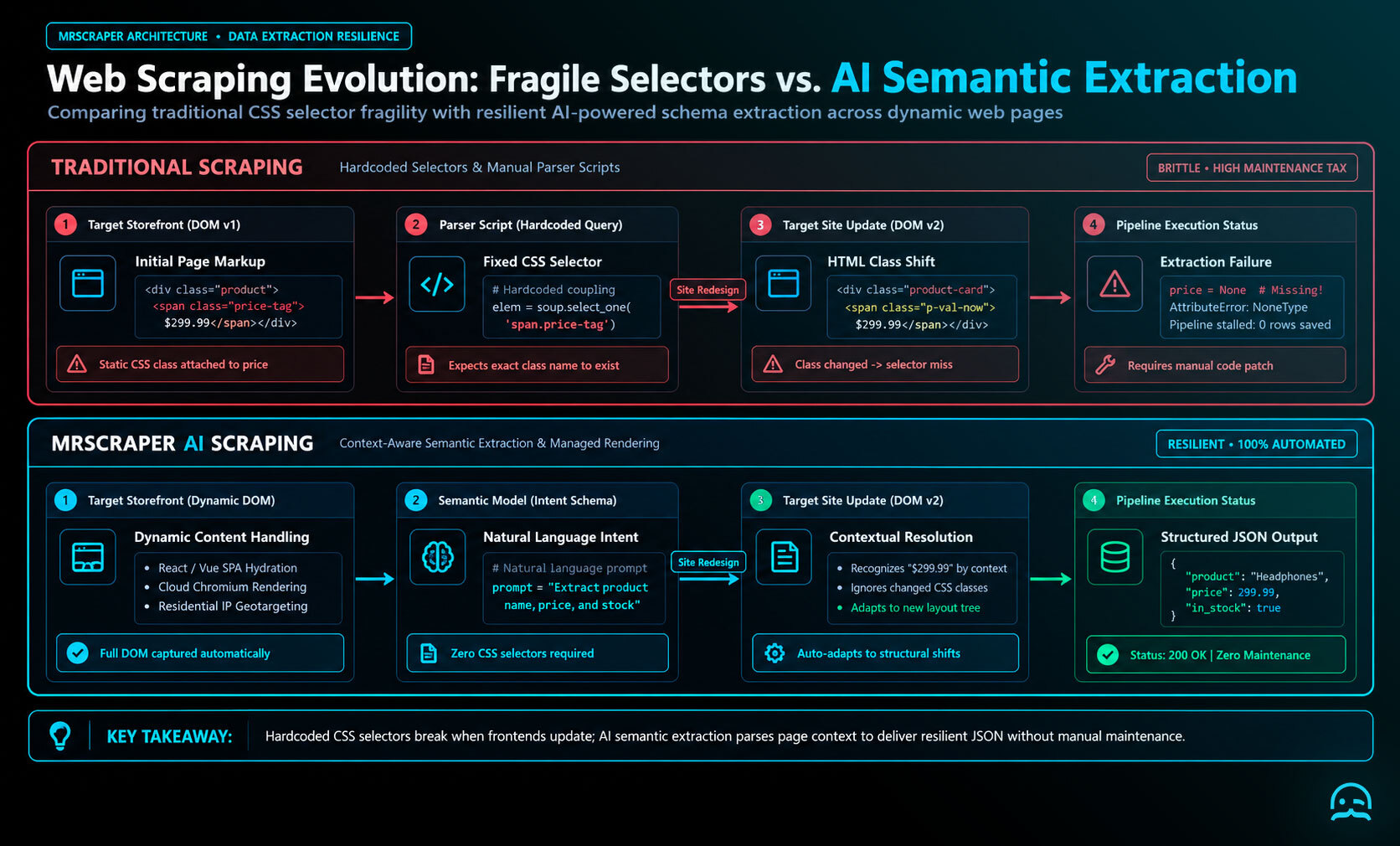
Traditional scraping tools fail because they rely on fixed structural markers. When a site updates its CSS classes from .price-tag to .product-v2-price, a manual script breaks instantly. Common failure points include:
- Dynamic content loading that requires specific user-agent strings.
- Anti-bot systems like Cloudflare that detect non-human traffic patterns.
- CAPTCHAs triggered by high-frequency requests from single IP addresses.
- Rate limiting that blocks datacenter IP ranges.
Dynamic scraping requires 10x the CPU and memory of plain requests. This overhead makes self-hosted infrastructure too expensive at scale. To ensure your site remains visible amidst these technical challenges, performing a technical SEO audit can help identify if your own site is inadvertently blocking legitimate crawlers or suffering from structural errors. Modern web crawling requires handling these technical complexities to ensure data integrity.
The AI shift: from selectors to semantic extraction
In 2026, we are moving away from CSS selectors. AI-powered scrapers now use semantic page understanding to find data. Instead of telling the script to look for a specific div, you tell it to "find the price and stock level." Even as search evolves, the demand for SEO remains high because high-quality data is the foundation of generative answers. When you need to scrape data reliably, semantic models offer a level of resilience that traditional methods cannot match.
Using AI for resilient data
This shift allows for intelligent data extraction that survives site redesigns. When you use an AI agent, the output is consistently clean JSON. This stays true regardless of the underlying HTML mess. A comprehensive site scrape can now be performed without manual rule updates.
{
  "product_name": "Premium Wireless Headphones",
  "price": 299.99,
  "currency": "USD",
  "in_stock": true
}
Managed APIs vs. manual infrastructure
Managed APIs solve the maintenance burden. They handle data scraping at scale behind a single endpoint. You don't have to worry about the 10x resource overhead or proxy rotation. You just get the data. Choosing the right data extraction methodology is critical for choosing between custom and managed infrastructure. Efficient data scraping relies on choosing tools that maintain reliability as sites evolve, without constant oversight. Once the data is webscraped, it can be integrated directly into your business intelligence tools.
Best practices for responsible scraping
To maintain a sustainable pipeline, you must follow an ethical checklist:
- Respect robots.txt and collect only publicly available data.
- Limit request frequency to avoid degrading the target site's performance.
- Use residential routing for geotargeted market research accuracy.
- Review the target's terms of service, and treat anything behind authentication as out of scope.
For businesses in specialized sectors, such as retail, maintaining a digital store checklist ensures that while you scrape competitors, your own storefront remains optimized for performance.
Key takeaways:
- Manual scripts are too brittle for the 2026 web.
- AI extraction eliminates the need for constant CSS selector maintenance.
- Managed APIs reduce infrastructure costs by 90% compared to headless browsers.
- Ethical compliance is mandatory for long-term data access.
Frequently asked questions
What is the best web scraper for beginners?
For those who code, Python with a managed API is the standard. For non-coders, no-code extensions or AI-driven platforms like MrScraper are best.
Is web scraping legal?
Scraping public data is generally legal. However, you must respect terms of service and privacy laws like GDPR.
Schedule a personalized demo today to see how MrScraper can automate your data extraction workflows with precision and speed.
Summarize this post
Open it in your assistant of choice with the prompt ready to send.
Take a Taste of Easy Scraping!

Find more insights here
The Ultimate Web Crawlers List: 15 Tools for Every Data Need
Compare the best web crawlers for 2026. Learn the difference between open-source, managed APIs, and…
Web Scraping MCP Server: Giving AI Agents Direct Access to Live Web Data
Learn how a Web Scraping MCP Server gives AI agents live web access while reducing token costs by 87…
Scaling E-commerce Competitive Intelligence with Automated Data Harvesting
Scale e-commerce data harvesting with residential proxies and AI. Learn how modern data extraction s…