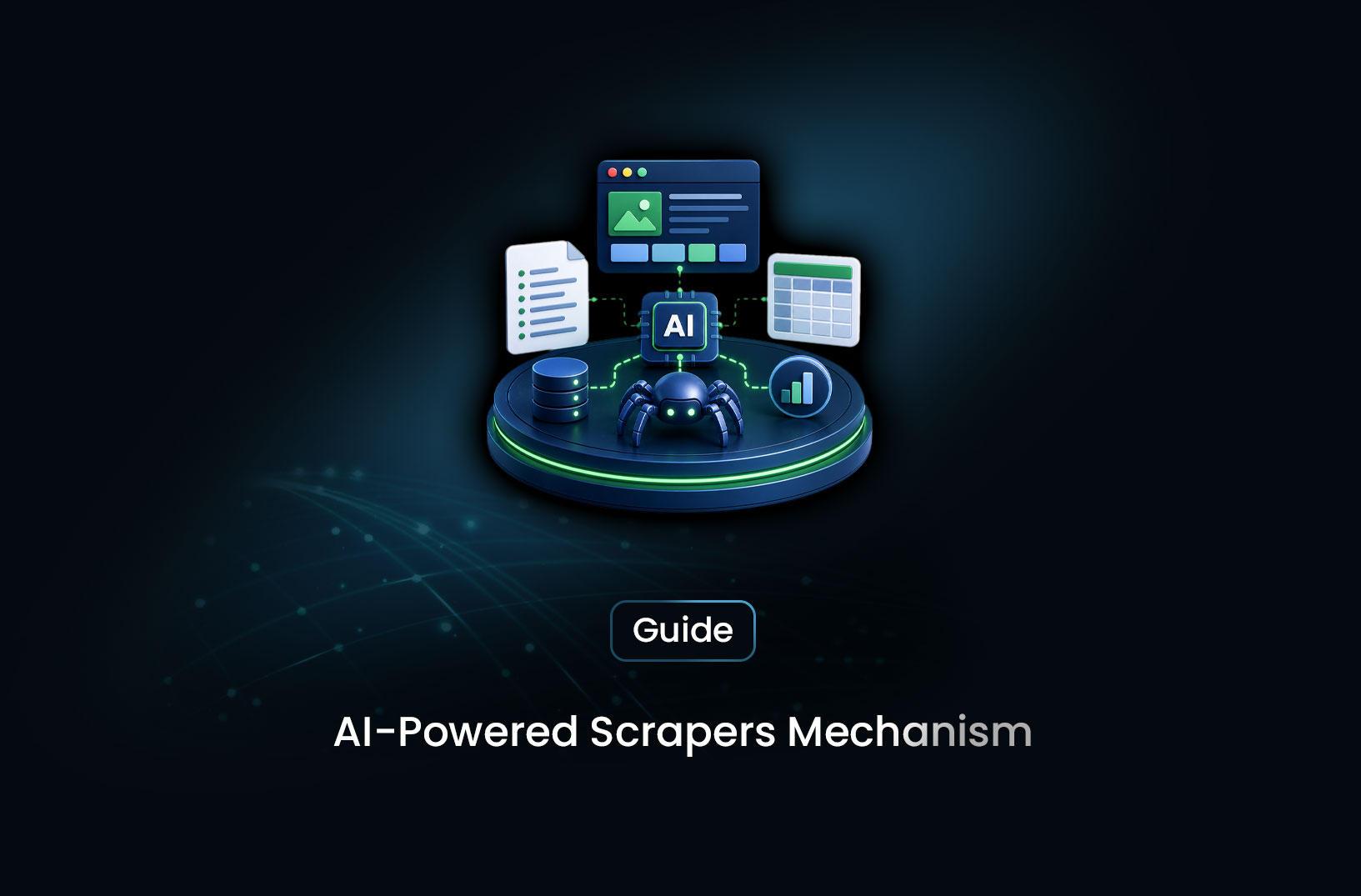
How AI Scrapers Read Any Page Without Selectors
AI & Machine LearningAI-powered web scrapers extract data without CSS selectors or XPath — learn how LLMs and vision models understand any page structure automatically.
Every developer who has maintained a web scraper long enough has lived through this moment: the site updates. A class name changes. A wrapper div disappears. The carefully crafted CSS selector that worked perfectly for three months returns empty strings, and nobody notices until the dashboard is already showing stale data from last Tuesday.
AI-powered web scrapers solve this problem at its root. Instead of locating data by its structural position in the HTML — which element it lives inside, what class it carries, where it sits in the DOM tree — AI scraping approaches understand what the data is, semantically, and extract it regardless of how the page chooses to present it. No selectors. No XPath. No schema to maintain. The scraper reads the page the way a human would: by comprehending its meaning rather than mapping its structure. This is what selectorless scraping actually means in practice, and it represents a meaningful shift in how intelligent data extraction works. In this article, we'll break down exactly how AI-powered scrapers reason about page content, the different technical approaches behind them, and what this means for building scraping pipelines that actually hold up over time.
Table of Contents
- What Are AI-Powered Web Scrapers?
- How AI Web Scraping Works Under the Hood
- Step-by-Step: How an AI Scraper Processes a Page
- Common Challenges and Limitations
- Conclusion
- What We Learned
- FAQ
What Are AI-Powered Web Scrapers?
AI-powered web scrapers are data extraction tools that use machine learning models — most commonly large language models (LLMs) or vision-language models — to identify and extract structured information from web pages without requiring manually defined selectors or schemas.
Traditional web scrapers work through explicit instruction: you tell the scraper exactly where to find each piece of data using CSS selectors or XPath expressions. div.product-title gets the product name. span[data-price] gets the price. The scraper follows those instructions precisely — which means it works until the page structure changes, at which point it fails precisely because it followed those instructions precisely.
AI web scraping inverts this model. Rather than telling the scraper where the data lives, you tell it what you want — "extract the product name, price, and availability from this page" — and the model figures out the where on its own, by reading and understanding the page content. This is selectorless scraping: the extraction is driven by semantic intent rather than structural specification.
This distinction matters because the web changes constantly. According to research published by the International Journal of Information Management, website structure changes are among the primary causes of scraper failure in production environments. When structure is irrelevant to extraction, structure changes become irrelevant to reliability.
The practical result is a scraping pipeline that can generalize across multiple sites, adapt to layout changes without code updates, and handle pages it has never seen before — which is qualitatively different from anything achievable with a selector-based approach.
How AI Web Scraping Works Under the Hood
There are three main technical approaches to AI-powered scraping in production use today. They solve the same problem through meaningfully different mechanisms — and understanding each one clarifies both what they can do and where they hit limits.
Approach 1: LLM-Based Text Extraction
The most common AI web scraping pattern today combines a traditional rendering step with LLM-based extraction. The scraper fetches and renders the page (handling JavaScript if needed), then passes the page content — either the raw HTML or a cleaned, simplified version of it — to a large language model with a prompt describing what to extract.
The LLM reads the content as text, identifies the relevant data using its trained understanding of language and web content patterns, and returns structured output: a JSON object, a CSV row, or whatever format the prompt requested. The model doesn't need a selector because it's doing what a human reader would do — finding the product name by recognizing that it's the prominent heading on a product page, finding the price by recognizing the currency format and its proximity to the product description, finding the stock status by interpreting the natural language that signals availability.
This approach works well for text-rich content and generalizes across sites naturally. The same prompt that extracts product data from one retailer's product page will usually work on a different retailer's product page, because both sites contain the same semantic content even if they use completely different HTML structure.
Approach 2: Vision-Language Models and Screenshot-Based Extraction
A more recent approach bypasses HTML parsing entirely. Instead of reading the page's markup, the scraper takes a screenshot of the rendered page and passes the image to a vision-language model — a multimodal AI that can interpret both visual content and text. The model looks at the page the way a human would look at a screenshot, identifies the relevant content visually, and extracts it.
This approach is particularly powerful for pages where the visible content doesn't map cleanly to the underlying HTML — heavily styled pages, canvas-rendered content, or pages where the data a human can clearly see isn't represented in a way that makes semantic text extraction easy. If you can see it on the page, a vision model can typically find it.
The trade-off is cost and latency. Vision model inference is computationally heavier than text extraction, and passing screenshots adds overhead compared to working directly with HTML. For use cases where visual accuracy on complex layouts matters more than speed, it's worth it.
Approach 3: DOM Pruning with Structured Extraction
A computationally lighter approach sits between full LLM extraction and traditional selectors. Rather than passing the entire rendered page to a model, the scraper first prunes the DOM — removing navigation, footers, ads, scripts, and other boilerplate — to surface only the content-dense regions of the page. That pruned, simplified representation is then passed to a smaller or more efficient model for structured extraction.
This approach trades some of the full LLM's raw generalization capability for significantly lower cost and latency. It works well for well-defined extraction tasks on pages with consistent content patterns, and it's often the architecture behind production-grade AI scraping systems that need to process millions of pages economically. The pruning logic itself can be rule-based (removing known boilerplate patterns) or ML-guided (a smaller classifier that identifies content-bearing vs. non-content-bearing page regions).
Step-by-Step: How an AI Scraper Processes a Page
Walking through a concrete example makes the mechanics tangible. Here's what happens when an AI-powered scraper processes a product page to extract name, price, rating, and availability.
Step 1: Fetch and Render the Page
The first step is identical to traditional scraping: the scraper sends an HTTP request to the target URL and receives the page content. If the page is JavaScript-rendered — which most modern e-commerce pages are — a headless browser renders the full DOM before proceeding. This is necessary because an AI model extracting from a React-rendered product page needs the same fully rendered content a user would see, not the bare HTML skeleton the server initially returns.
Step 2: Prepare the Content for the Model
Raw HTML is verbose. A product page might have 50,000 characters of markup for a few hundred words of actual product content. Passing the full HTML to an LLM is expensive, slow, and often counterproductive — the model spends its context window on <script> tags and CSS declarations instead of the content that matters.
The preparation step cleans this up. Depending on the approach, this might mean converting the HTML to clean Markdown, extracting visible text content while preserving semantic structure (headings, lists, table relationships), or pruning the DOM to the content-dense region identified by a preprocessing step. The goal is to give the model a high-signal representation of the page that preserves meaning while reducing noise.
Step 3: Prompt the Model with an Extraction Schema
The cleaned content goes to the model with a prompt that describes what to extract. A well-structured extraction prompt typically includes: a description of the target data fields, the format for the output (usually JSON with typed fields), and any relevant context about the page type that helps the model interpret ambiguous content correctly.
A minimal extraction prompt might look like:
Extract the following fields from this product page content.
Return valid JSON only, with no additional commentary.

Fields:
- product_name (string)
- price (number, in USD, without currency symbol)
- star_rating (number, 0–5)
- in_stock (boolean)

Page content:
[cleaned page content here]
The model reads the content, locates the relevant information semantically, and returns the structured JSON. No selector was required because the model identified "the price" by understanding what prices look like in the context of a product listing, not by knowing which CSS class contains them.
Step 4: Validate and Handle the Output
LLM output is probabilistic, which means it needs validation before being trusted as structured data. A well-built AI scraping pipeline checks that the returned JSON parses correctly, that required fields are present, that values fall within expected types and ranges (a price of -$14 or a star rating of 7 signals a model error), and that the extraction is consistent with the page's visible content for a sample of pages.
Validation catches the cases where the model misidentified a field, hallucinated a value, or returned malformed JSON — which happen at low but non-zero rates even with well-designed prompts. Automated validation with fallback behavior (retry, flag for review, or skip) is what separates a production AI scraping pipeline from a prototype.
Step 5: Scale and Monitor Over Time
The defining advantage of AI-powered scraping at this step: when the target site changes its layout, you typically don't need to do anything. The model re-extracts from the new layout using the same semantic understanding it applied to the old one. Monitoring for extraction accuracy over time — tracking null rates, value distributions, and sample spot-checks — catches the cases where a structural change is significant enough to affect model performance, without making every layout change an incident.
This is where tools like MrScraper's AI-powered extraction layer deliver their clearest operational value: the combination of managed browser rendering, anti-bot bypass, and semantic extraction means that the full stack — from fetching the page to returning structured data — handles site changes without requiring your team to push updated selector configurations on an emergency basis. For teams running extraction against many targets simultaneously, that maintenance reduction compounds significantly over time. More at https://mrscraper.com.
Common Challenges and Limitations
Hallucination and extraction errors are a real risk. LLMs are probabilistic — they don't retrieve facts, they generate text that's likely to be correct given what they've seen. For most product pages, this works reliably. For pages with ambiguous content, unusual formatting, or data that looks like something else (a promotional price that resembles a different field, a truncated product name, a rating displayed as a graphic rather than text), models can misidentify or fabricate values. Rigorous validation and sampling pipelines are non-optional in production AI scraping, not a nice-to-have.
Cost per extraction is higher than traditional selectors. An LLM API call costs orders of magnitude more than evaluating a CSS selector against a DOM. For low-volume extraction — thousands of pages per day — this is entirely manageable and easily offset by the reduction in maintenance engineering. For very high-volume workloads — millions of pages per day — the economics require careful architecture: DOM pruning before LLM calls, caching strategies, smaller models for high-confidence extraction patterns, and full LLM fallback only when lighter approaches fail. AI web scraping at scale is an engineering problem, not just a model-selection problem.
Context window limits constrain very large pages. LLMs have a maximum context size — the amount of text they can process in a single call. Most product pages, article pages, and directory listings are well within the context limits of current models. Pages with extremely long content — massive data tables, paginated content loaded all at once, search results pages with hundreds of items — may require chunking strategies that add complexity and can affect extraction coherence across chunks. As noted in Anthropic's model documentation, different models offer different context window sizes, which affects which approach makes sense for a given page type.
Prompt sensitivity requires careful design and testing. Extraction quality is directly influenced by prompt quality. A vague prompt produces vague extraction; a well-specified prompt with clear field definitions, output format requirements, and examples produces consistent structured output. Getting prompts right for a new extraction target requires iteration — and prompts that work well for one page type sometimes produce unexpected results on a different site's pages for the same data category. Treating prompts as engineering artifacts that need testing and versioning, not throwaway text, is the difference between fragile and robust AI extraction.
Vision model approaches increase cost and complexity further. Screenshot-based extraction with vision-language models is powerful for visually complex pages but adds meaningful latency and cost compared to text-based LLM extraction. For most scraping use cases, text-based extraction from a cleaned HTML or Markdown representation performs equivalently at lower cost. Reserve vision model approaches for pages where visual layout genuinely carries information that the HTML doesn't — custom data visualizations, canvas-rendered content, heavily graphical interfaces — rather than applying them by default.
Conclusion
AI-powered web scrapers don't just make scraping easier — they change the nature of the problem. When extraction is driven by semantic understanding rather than structural specification, the brittleness that's been inherent to selector-based scraping for as long as the web has been around stops being a core engineering concern. Sites can redesign, class names can change, layouts can shift — and a well-designed AI extraction pipeline adapts without intervention.
The trade-offs are real: higher per-extraction cost, validation requirements, prompt engineering discipline, and the ongoing reality that probabilistic models need to be monitored rather than trusted unconditionally. These are manageable engineering problems. They're also problems that get easier as the model ecosystem matures, inference costs fall, and production patterns for AI scraping become more standardized.
If you're still maintaining a fleet of CSS selectors and spending engineering time on breakage every time a target site updates, this is the direction worth moving toward. The maintenance burden reduction alone tends to justify the transition.
What We Learned
- AI-powered scrapers extract by semantic understanding, not structural position: The model identifies what data is — product name, price, availability — rather than where it lives in the HTML, which is why layout changes don't break extraction.
- Three main approaches serve different needs: LLM-based text extraction for general-purpose use, vision-language models for visually complex pages, and DOM pruning with structured extraction for high-volume cost efficiency.
- Validation is non-negotiable in production: LLMs generate probabilistic output — field misidentification and occasional hallucination are real failure modes that require automated validation and sampling to catch reliably.
- Cost scales with sophistication: Selector evaluation is nearly free; LLM extraction costs real money per call. Architecture choices — preprocessing, model selection, caching — determine whether AI scraping is economically viable at your target volume.
- Prompt quality directly determines extraction reliability: Extraction prompts need to be designed, tested, and versioned with the same discipline as any other production artifact — vague prompts produce inconsistent results even from capable models.
- The maintenance advantage compounds over time: The engineering hours saved on selector maintenance across many targets, over months of production operation, typically far outweigh the higher per-extraction cost of AI approaches.
FAQ
What is an AI-powered web scraper?
An AI-powered web scraper is a data extraction tool that uses machine learning models — typically large language models (LLMs) or vision-language models — to identify and extract structured data from web pages without requiring manually defined CSS selectors or XPath expressions. Instead of specifying where data lives in the page structure, you describe what you want, and the model extracts it by understanding the page's content semantically.
How is AI web scraping different from traditional web scraping?
Traditional web scraping uses CSS selectors or XPath to locate specific elements in a page's HTML structure — it works by knowing exactly where data is positioned. AI web scraping uses language models to understand what data means, extracting it by semantic comprehension rather than structural location. The practical difference is resilience: when a site updates its layout, traditional selectors break; AI extraction typically adapts automatically because the semantic content hasn't changed, only its presentation.
Do AI scrapers work on JavaScript-rendered pages?
Yes, but they still require the page to be fully rendered before extraction. AI models extract from content — and content needs to be present first. For JavaScript-rendered pages, an AI scraping pipeline uses a headless browser to render the full DOM (executing JavaScript, loading dynamic content) before passing the rendered output to the extraction model. The AI layer handles the extraction intelligently; the rendering layer handles making the content available in the first place.
Are AI-powered scrapers more reliable than selector-based scrapers?
For long-running extraction against targets that update their layouts over time, yes — significantly. The absence of selector maintenance removes the most common cause of scraper breakage in production. AI scrapers do introduce different failure modes (model hallucination, prompt sensitivity, validation requirements) that need to be managed, but these are generally lower-frequency and more predictable than the arbitrary breakage caused by front-end changes in selector-based systems.
What are the limitations of LLM scraping?
The main limitations are cost (LLM inference is more expensive than selector evaluation), probabilistic output (models can misidentify fields or generate incorrect values, requiring validation), context window constraints (very large pages need chunking strategies), and prompt sensitivity (extraction quality depends significantly on how well the extraction prompt is designed and tested). For high-volume workloads, architecture choices — DOM pruning before LLM calls, model selection, caching — are critical to making LLM scraping economically viable.
Can AI scrapers generalize across different websites?
Yes — this is one of their most significant advantages. A well-designed AI extraction prompt that describes what you want to collect (product name, price, availability) will typically work across multiple retailers' product pages without any site-specific configuration, because all those pages contain the same semantic content regardless of structural differences. This cross-site generalization is difficult or impossible with selector-based scrapers, which require a separate selector schema for each target site.
Summarize this post
Open it in your assistant of choice with the prompt ready to send.
Take a Taste of Easy Scraping!

Find more insights here
What is Scraping? A Complete Beginner's Guide for 2026
Learn what a web scraper is in 2026 and how AI-powered tools are replacing brittle CSS scripts for r…
The Ultimate Web Crawlers List: 15 Tools for Every Data Need
Compare the best web crawlers for 2026. Learn the difference between open-source, managed APIs, and…
Web Scraping MCP Server: Giving AI Agents Direct Access to Live Web Data
Learn how a Web Scraping MCP Server gives AI agents live web access while reducing token costs by 87…