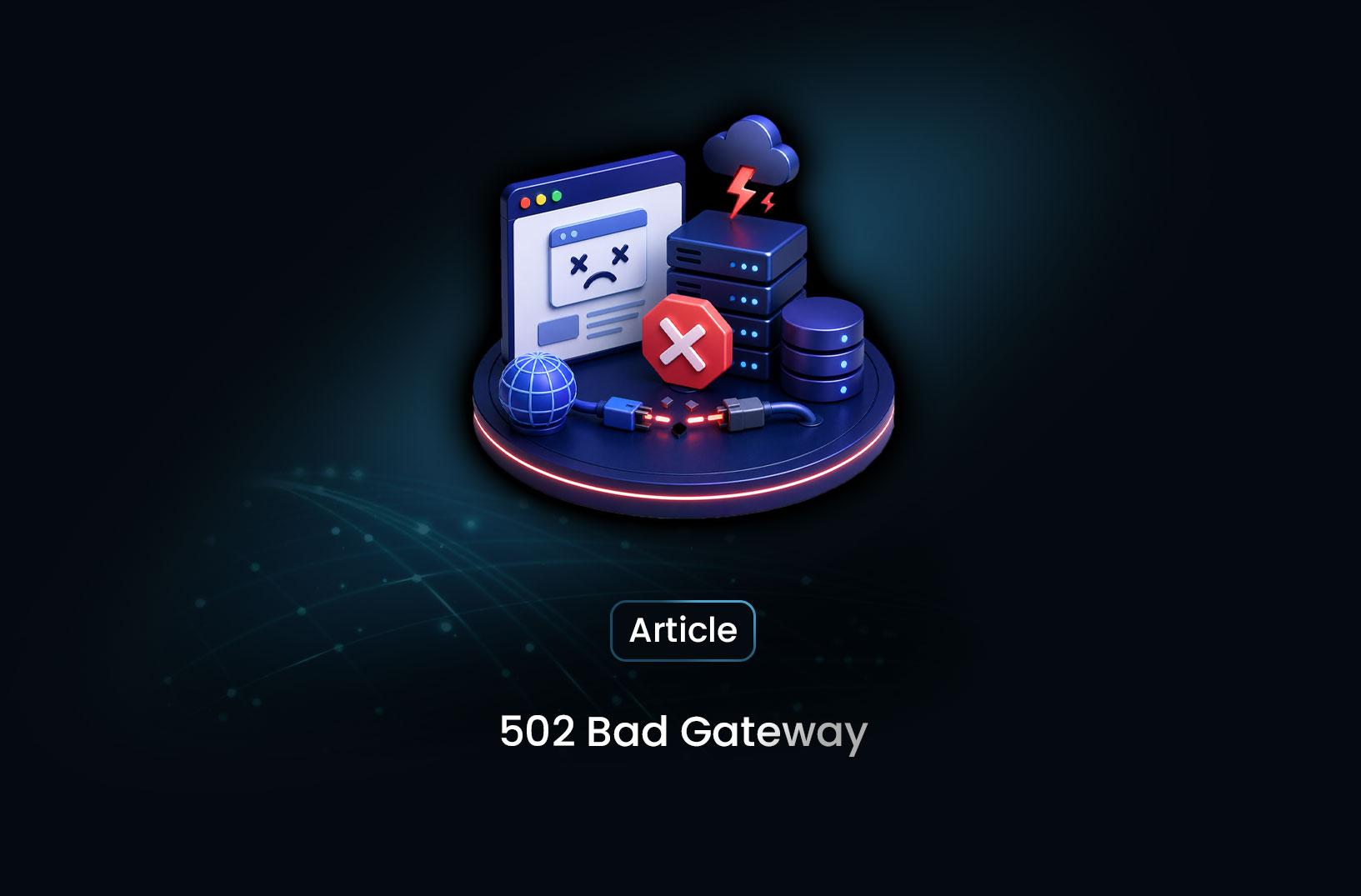
What Is a 502 Bad Gateway Error? Causes and How to Fix It
Web ScrapingA 502 Bad Gateway means one server got an invalid response from another. Learn the real causes, how to fix it, and how to avoid it.
A 502 Bad Gateway error means a server acting as a gateway or proxy received an invalid or empty response from the upstream server it forwarded your request to. It is one of the most common HTTP status codes on the web.
This error impacts website visitors, site owners, developers debugging reverse proxies, and automated scraping or API clients. If you are asking what is 502 bad gateway or trying to understand the 502 bad gateway meaning for a failing service, this guide explains what does 502 bad gateway mean, what causes 502 failures, and how to fix 502 bad gateway errors step-by-step.
What a 502 Bad Gateway error actually means
Modern web infrastructure relies on proxy chains. When your browser requests a webpage, it connects to an edge component like a reverse proxy, load balancer, or CDN (such as Nginx, Cloudflare, or AWS ALB) that routes traffic to an origin server.
The 502 status code originates from the proxy server. It signals that the proxy communicated with the origin server, but received a payload that was corrupt, incomplete, or formatted incorrectly.
A 502 error is a server-side failure. It indicates an issue within the host infrastructure, not the visitor's computer.
To clarify the 502 bad gateway meaning, distinguish it from related status codes:
- Not a 404 (Not Found): the target URL exists, but backend routing failed.
- Not a 403 Forbidden error: the client is not blocked by access rules; the proxy cannot process the origin's response.
- Not a 503 Service Unavailable: the origin server is not necessarily undergoing maintenance or overloaded.
- Not a 504 (Gateway Timeout): the upstream server sent an invalid payload rather than timing out.
How a 502 error looks in the wild
Different web servers format the error 502 bad gateway differently:
- 502 Bad Gateway: Standard unstyled response from default proxy setups.
- 502 Bad Gateway nginx: Default Nginx error template displaying the status code and server version.
- Error 502 / HTTP Error 502 / 502 Server Error: Custom web application error pages or browser fallback screens.
- 502 Bad Gateway Cloudflare: Branded Cloudflare page with a Ray ID, indicating Cloudflare failed to receive a valid origin response.
- 502 Bad Gateway (microsoft-azure-application-gateway/v2): Header output from Azure Application Gateway when backend pool targets fail.
- "That's an error": Simplified error notice returned by Google infrastructure when internal service proxies fail.
Regardless of styling, every variation confirms that the reverse proxy received an invalid response from the upstream application.
What causes a 502 Bad Gateway error?
Understanding what causes 502 issues helps engineers isolate infrastructure failures quickly.
The origin server is down or crashed
The backend application process (Node.js, PHP-FPM, Django, or Docker container) stopped running due to an unhandled exception or out-of-memory (OOM) event.
How to check: Run systemctl status your-app or docker ps to verify process status. Review application logs for crash traces.
The upstream server returned an invalid response
The application process is active, but its response violates HTTP specifications. Common causes include malformed HTTP headers, broken chunked transfer encoding, or premature socket closure.
How to check: Review proxy error logs. Nginx logs these as upstream sent invalid header or upstream prematurely closed connection.
Proxy or reverse-proxy misconfiguration
An incorrect IP address, port, or socket path in proxy directives. A mismatch in proxy_pass directs traffic to an unassigned port.
# ❌ Incorrect: backend app listens on port 3000, not 8080
location / {
    proxy_pass http://127.0.0.1:8080;
}

# ✅ Correct
location / {
    proxy_pass http://127.0.0.1:3000;
}
How to check: Verify that proxy_pass matches the local socket or port configured in your backend application.
Firewall, DNS, or network issues between the servers
Internal firewalls (iptables, security groups) dropping traffic between proxy and origin instances. Alternatively, internal DNS resolves to an outdated IP address following server migration.
How to check: Run curl -I http://origin-ip:port from the proxy instance. Inspect firewall rules using iptables -L -n.
Traffic spikes and resource limits
High concurrent traffic saturating backend worker pools. When all PHP-FPM workers or Node event loop threads are occupied, incoming proxy connections stall and drop.
How to check: Monitor worker pool status using pm.status_path for PHP-FPM, or track CPU and RAM saturation on the origin host.
CDN and Cloudflare-specific causes
Cloudflare returns two types of gateway errors. A branded Cloudflare page indicates an edge-to-origin network failure. A plain text 502 indicates the origin server generated the 502 code, which Cloudflare passed through. Additionally, Cloudflare Workers return 502 when scripts exceed CPU memory limits.
How to check: Inspect the error page for Cloudflare branding and Ray IDs to determine whether the failure occurred at the CDN edge or origin host.
Bot protection and anti-scraping systems
Web security tools occasionally return a bad gateway error code 502 instead of HTTP 403 or 429 to disguise anti-bot blocking as infrastructure failure.
How to check: Inspect response bodies. Anti-bot block pages contain JavaScript challenges or CAPTCHA forms rather than standard web server error strings.
How to fix a 502 Bad Gateway error as a visitor
When encountering a 502 error on a website, perform these client-side steps:
- Reload the page: Refresh after 30 seconds to bypass transient server restarts.
- Perform a hard refresh: Use
Ctrl+F5(Windows/Linux) orCmd+Shift+R(macOS) to bypass local browser cache. - Clear browser cache and cookies: Delete cached cookies that point to invalid edge states.
- Try incognito mode: Rule out browser extension interference.
- Disable VPN or proxy connections: Resolve routing issues caused by faulty intermediary nodes.
- Flush local DNS cache:
# Windows
ipconfig /flushdns

# macOS
sudo dscacheutil -flushcache; sudo killall -HUP mDNSResponder

# Linux
sudo systemd-resolve --flush-caches
- Verify global availability: Use external tools like
downforeveryoneorjustme.comto confirm whether the site is down for everyone.
If these steps fail, the issue is on the server side.
How to fix a 502 Bad Gateway error as a site owner or developer
System administrators should follow this diagnostic sequence to resolve gateway errors:
1. Verify origin process status
systemctl status your-app     # systemd
docker ps -a | grep your-app  # Docker
pm2 status                    # Node.js PM2
Restart dead services and inspect system logs for crash triggers.
2. Analyze proxy error logs
tail -f /var/log/nginx/error.log
A standard Nginx 502 log entry:
2024/03/15 14:22:01 [error] 1234#0: *5678 connect() failed (111: Connection refused)
while connecting to upstream, upstream: "http://127.0.0.1:3000/"
This confirms Nginx attempted to connect to port 3000 on localhost, but the connection was refused because no backend process was active.
3. Test backend directly
Bypass the reverse proxy by querying the backend service directly:
curl -I http://127.0.0.1:3000
An HTTP 200 response isolates the issue to proxy configuration. A connection failure confirms an application process crash.
4. Adjust proxy buffer limits
Increase buffer sizes if application response headers exceed default proxy limits:
proxy_buffer_size   16k;
proxy_buffers       4 16k;
proxy_connect_timeout 60s;
proxy_read_timeout    60s;
Reload Nginx: sudo nginx -t && sudo systemctl reload nginx
5. Expand worker capacity and pause CDN
Increase worker pool allocations in PHP-FPM, Gunicorn, or PM2. If using Cloudflare, temporarily pause CDN proxying to confirm whether the timeout occurs at the CDN edge or origin host.
How to handle 502 errors when scraping or calling APIs
Automated scripts must handle 502 bad gateway error occurrences programmatically.
Treat 502 errors as retryable. Unlike HTTP 404 or 403, HTTP 502 represents transient gateway instability. Implement retries using exponential backoff with randomized jitter:
import requests
import time
import random

def fetch_with_retry(url, max_retries=4):
    """Fetch URL with automatic retries on 502 Bad Gateway responses."""
    for attempt in range(max_retries):
        response = requests.get(url, timeout=30)
        if response.status_code != 502:
            return response

        wait = (2 ** attempt) + random.uniform(0, 1)
        time.sleep(wait)
    return response

result = fetch_with_retry("https://example.com/api/data")
Cap retries at 3–5 attempts to prevent worker starvation during server outages. If 502 errors correlate with high request rates or specific proxy IPs, rotate IP addresses and reduce request velocity.
For production scraping pipelines, MrScraper's Web Unblocker handles IP rotation, proxy retries, and anti-bot challenge solving automatically.
How to prevent 502 errors on your own site
Implementing infrastructure safeguards minimizes gateway downtime:
- Configure load balancer health checks: Remove failing origin nodes automatically.
- Enable automated process recovery: Use
Restart=alwaysin systemd orrestart: unless-stoppedin Docker. - Set appropriate proxy timeouts: Align proxy read timeouts with maximum application execution limits.
- Scale worker pools: Allocate sufficient worker threads for peak traffic volume.
- Implement rolling deployments: Prevent dropped connections during application updates.
- Set up real-time monitoring: Configure alerts for elevated 5xx error rates.
502 vs other 5xx and 4xx errors
| Code | Meaning | Primary Fault | Typical Resolution |
|---|---|---|---|
| 500 Internal Server Error | Origin process hit an unhandled exception | Application Server | Inspect application logs |
| 502 Bad Gateway | Proxy received invalid upstream response | Proxy / Infrastructure | Verify origin process and proxy routing |
| 503 Service Unavailable | Server overloaded or under maintenance | Server Capacity | Scale infrastructure or wait |
| 504 Gateway Timeout | Proxy timed out waiting for upstream | Infrastructure / Database | Optimize database queries or raise timeouts |
| 403 Forbidden | Server denied request access | Client Permission | Check authentication or access lists |
| 429 Too Many Requests | Client exceeded rate limits | Client Velocity | Reduce request rate and add backoff |
Frequently asked questions
Does 502 Bad Gateway mean I'm blocked?
Usually not. A 502 error indicates a gateway network or backend application fault. However, certain security systems deliberately return a bad gateway error code 502 to block automated web scrapers. If 502 errors occur only during high-frequency requests, anti-bot rate limiting is likely occurring.
Will a 502 error fix itself?
Often, yes. Many 502 gateway failures stem from brief process restarts or transient network congestion. When process supervisors and health checks are configured, services recover automatically.
How long does a 502 Bad Gateway error last?
Duration depends on the cause. Auto-restarted process crashes recover in seconds, while misconfigured proxy rules remain broken until updated. Persistent errors lasting longer than several minutes require manual intervention.
Is 502 Bad Gateway my fault or the website's?
It is almost always a server-side infrastructure failure. Visitors should clear local DNS and browser caches to rule out local caching issues before assuming host outage.
What is the difference between 502 and 504?
A 502 Bad Gateway indicates the proxy received an invalid or corrupt response from the upstream host. A 504 Gateway Timeout indicates the proxy received no response before the socket timeout expired.
Can a VPN cause a 502 Bad Gateway error?
Yes. Faulty VPN exit nodes or proxy intermediaries can drop upstream connections or trigger target site security blocks that return 502 errors.
A 502 Bad Gateway error confirms that a reverse proxy failed to receive a valid response from an upstream server. Visitors should perform browser and DNS checks, while site operators inspect process availability, Nginx error logs, and backend port bindings.
To learn more about adjacent HTTP failures, read our guide on 503 Service Unavailable. For scrapers requiring robust retry strategies and proxy management, explore MrScraper Documentation.
Summarize this post
Open it in your assistant of choice with the prompt ready to send.
Take a Taste of Easy Scraping!

Find more insights here
What is Scraping? A Complete Beginner's Guide for 2026
Learn what a web scraper is in 2026 and how AI-powered tools are replacing brittle CSS scripts for r…

The Ultimate Web Crawlers List: 15 Tools for Every Data Need
Compare the best web crawlers for 2026. Learn the difference between open-source, managed APIs, and…
Web Scraping MCP Server: Giving AI Agents Direct Access to Live Web Data
Learn how a Web Scraping MCP Server gives AI agents live web access while reducing token costs by 87…