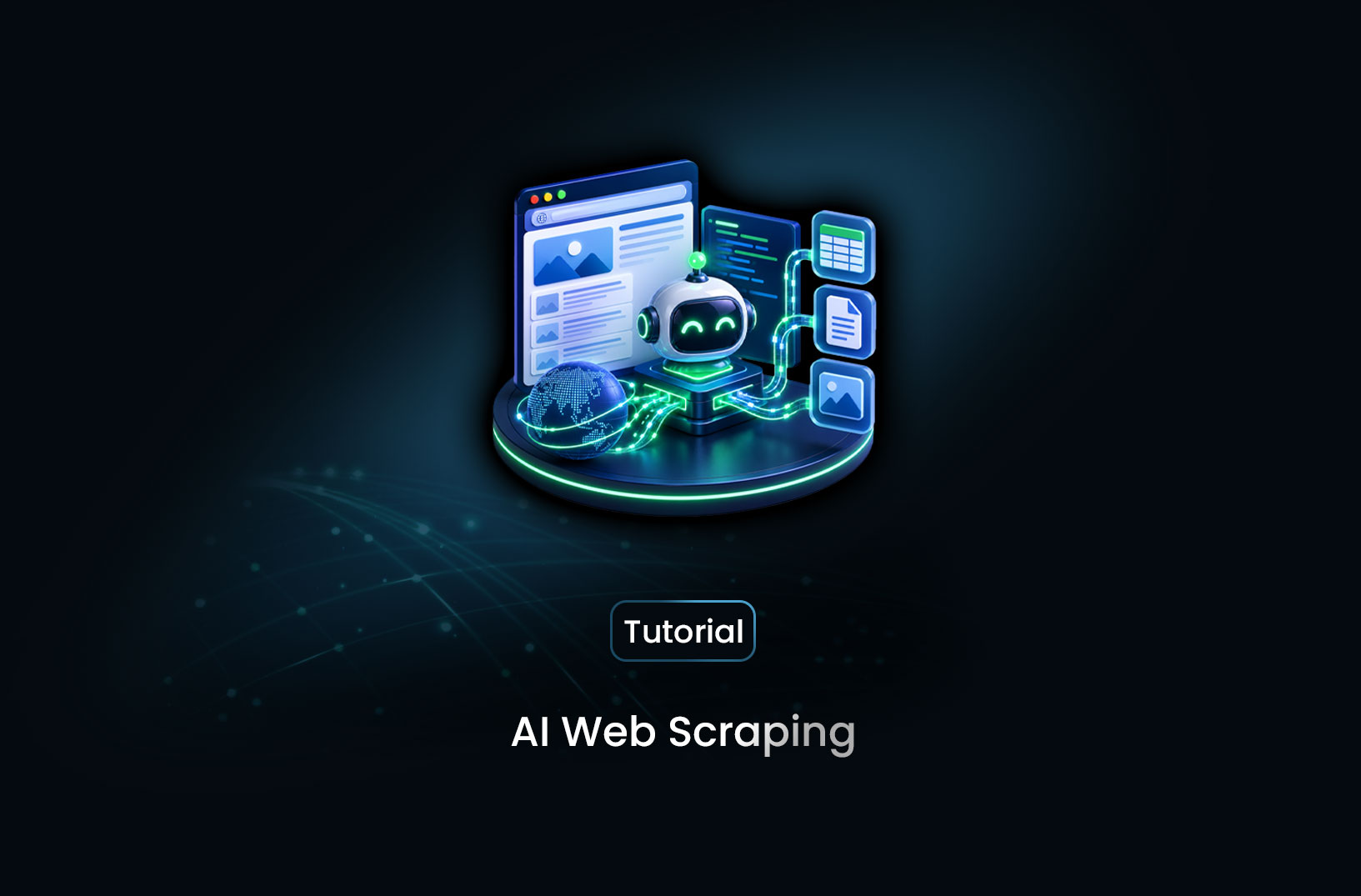
AI Web Scraping: The Complete Guide
AI & Machine LearningA complete guide to AI web scraping — how LLMs enable selectorless data extraction, schema-driven output, and adaptive parsing that survives layout changes.
Traditional web scraping has a maintenance problem. You write CSS selectors for a product page's price element, and the scraper works perfectly — until the site redesigns its frontend and renames its class attributes. Then you start over. For any scraping operation running against many sites or the same site over a long time, the accumulated cost of selector maintenance often exceeds the cost of the original build.
AI web scraping replaces fragile structural instructions ("find the element with class price-current") with semantic understanding ("extract the price for this product"). Instead of brittle selectors that break when page structure changes, an AI extraction layer reads the page content the same way a human researcher would — understanding what the text means and which parts answer the question you asked. This guide covers how AI web scraping works, how it differs from traditional extraction approaches, how to implement it, and when it's the right choice for your data collection requirements.
Table of Contents
- What Is AI Web Scraping?
- How AI Web Scraping Works
- AI Scraping vs. Traditional Selector-Based Scraping
- Step-by-Step Guide: Building an AI-Powered Extraction Pipeline
- Best AI Web Scraping Tools in 2026
- Free vs. Paid: What Each Tier Provides
- Key Features to Look For in an AI Scraping Solution
- When Should You Use AI Web Scraping?
- Common Challenges and Limitations
- Conclusion
- What We Learned
- FAQ
What Is AI Web Scraping?
AI web scraping is the use of large language models (LLMs) or other AI systems to extract structured data from web pages through semantic understanding rather than structural pattern matching.
In traditional web scraping, you instruct a parser to find specific HTML elements based on their structural position, CSS class names, ID attributes, or XPath expressions. The extraction rule is structural: "find the <span> with class product-price." In AI web scraping, you instruct a language model to extract specific information based on its meaning: "find the current price of the product." The model reads the page content and understands what the price is, regardless of which HTML element wraps it or what class name it carries.
This semantic approach changes the maintenance equation. Structural selectors break when the DOM changes. Semantic extraction — given good page content and a well-specified schema — is resilient to most presentation changes because the meaning of "current price" doesn't change when an engineer renames a CSS class.
AI web scraping is also distinct from AI-assisted scraping tools that use machine learning to suggest selectors or classify page types, but still execute extraction through structural rules. The defining characteristic of AI extraction is that a language model reads and interprets the page content directly, not through an intermediate structural representation.
How AI Web Scraping Works
The technical pipeline for AI web scraping has three stages that sit on top of standard web page retrieval:
Stage 1: Page retrieval and content preparation. The target page is fetched — using a browser rendering layer if JavaScript execution is required — and the HTML is converted to clean text or markdown. This conversion strips navigation, advertisements, cookie banners, and boilerplate, reducing a 50KB HTML file to 2–5KB of meaningful content. This reduction serves two purposes: it cuts the token cost of the subsequent LLM call significantly, and it improves extraction accuracy by removing noise that the model would otherwise have to filter.
Stage 2: Schema-constrained LLM extraction. The cleaned page content is sent to an LLM API (GPT-4o, Claude, Gemini, or a smaller local model) along with a prompt that describes the target data fields — their names, types, and descriptions — and instructs the model to return only valid JSON conforming to the schema. The model reads the content semantically and maps the page's information to your schema's fields.
Stage 3: Validation and storage. The model's JSON output is parsed and validated against the schema — checking that required fields are present, types are correct, and values are within expected ranges. Only validated records proceed to storage; validation failures surface as actionable field-level errors rather than silent bad data.
The quality of Stage 2 depends heavily on the quality of Stage 1: clean, relevant content in produces accurate extraction out. And the reliability of Stage 3 determines whether the extracted data is actually trustworthy for downstream use.
AI Scraping vs. Traditional Selector-Based Scraping
Understanding when each approach is better suited requires a direct comparison across the dimensions that matter for real scraping operations:
| Dimension | Traditional (Selectors) | AI (LLM Extraction) |
|---|---|---|
| Setup cost | Medium — must find and test selectors | Low — describe fields in plain language |
| Maintenance cost | High — breaks on layout changes | Low — semantic understanding adapts to most changes |
| Accuracy on matched pages | Very high — deterministic | High but variable — depends on content clarity |
| Per-page cost | Very low — local computation | Higher — LLM inference per page |
| Speed | Very fast | Slower — LLM API latency |
| Multi-site generalization | None — selectors are site-specific | High — same schema prompt works across sites |
| Output structure | Requires normalization | Typed, schema-conforming JSON directly |
| Handles ambiguous content | No | Yes — LLM resolves ambiguity through context |
Traditional selectors are still the right choice for stable, high-volume scraping of sites with consistent HTML structure where the maintenance cost is predictable and acceptable. AI extraction earns its cost premium when you're scraping across many sites with different structures, when targets change frequently, or when the data you need requires interpretation that selectors can't provide.
Step-by-Step Guide: Building an AI-Powered Extraction Pipeline
Step 1: Define Your Extraction Schema
Before any code, define exactly what fields you want to extract. AI extraction quality is determined largely by schema quality — clear field descriptions produce more accurate results than field names alone:
from pydantic import BaseModel, Field
from typing import Optional

class ProductExtraction(BaseModel):
    """Schema for AI extraction of product page data."""
    product_name: str = Field(
        description="The full product title as displayed on the page"
    )
    price: float = Field(
        description="Current selling price in USD, numeric only, no currency symbol"
    )
    original_price: Optional[float] = Field(
        default=None,
        description="Original price before discount, or null if no discount shown"
    )
    availability: str = Field(
        description="Product availability status: one of in_stock, out_of_stock, preorder, or limited"
    )
    brand: Optional[str] = Field(
        default=None,
        description="Brand or manufacturer name, or null if not clearly stated"
    )
    rating: Optional[float] = Field(
        default=None,
        description="Average star rating from 0.0 to 5.0, or null if no rating shown"
    )
Field descriptions are read by the LLM as extraction instructions — the more specific and clear they are, the more reliably the model maps page content to the right fields.
Step 2: Fetch and Clean the Page Content
import requests
import trafilatura

def fetch_and_clean(url: str) -> str | None:
    """
    Fetch a page and convert it to clean text for LLM consumption.
    Uses trafilatura to strip navigation, ads, and boilerplate.
    """
    try:
        response = requests.get(
            url,
            headers={"User-Agent": "Mozilla/5.0 (compatible; research-bot/1.0)"},
            timeout=15
        )
        response.raise_for_status()
        # Extract main content, removing surrounding noise
        clean = trafilatura.extract(
            response.text,
            include_tables=True,
            include_links=False,
            no_fallback=False,
        )
        return clean or response.text[:8000]  # Fallback: truncate raw HTML
    except Exception as e:
        print(f"Fetch failed for {url}: {e}")
        return None
trafilatura.extract() typically reduces HTML from 20–100x its original size in characters to just the main content — the key transformation that makes LLM-based extraction both accurate and affordable.
Step 3: Build the Extraction Prompt and Call the LLM
import json

def build_extraction_prompt(schema_class, page_content: str) -> str:
    """Generate an extraction prompt from a Pydantic schema and page content."""
    schema = schema_class.model_json_schema()
    return f"""Extract the following structured data from the web page content below.
Return ONLY valid JSON conforming to this schema. For optional fields that are not present
on the page, include them as null rather than omitting them entirely.
Do not include any text, explanation, or markdown outside the JSON object.

Schema:
{json.dumps(schema, indent=2)}

Page content:
{page_content}"""

def extract_with_llm(prompt: str, llm_client) -> dict | None:
    """
    Call the LLM with JSON output mode and parse the response.
    Replace llm_client.complete() with your specific provider's API call.
    Most providers (Anthropic, OpenAI, Google) support a JSON/structured output mode.
    """
    try:
        # Enable JSON output mode — parameter name varies by provider
        response = llm_client.complete(prompt=prompt, output_format="json")
        raw = response.text.strip()
        # Remove any accidental markdown code fences before parsing
        raw = raw.replace("```json", "").replace("```", "").strip()
        return json.loads(raw)
    except json.JSONDecodeError as e:
        print(f"JSON parse failed: {e}")
        return None
    except Exception as e:
        print(f"LLM call failed: {e}")
        return None
Step 4: Validate the Extracted Data
from pydantic import ValidationError

def validate_extraction(raw_data: dict, schema_class) -> tuple:
    """
    Validate LLM output against the Pydantic schema.
    Returns (validated_record, error_detail) — one will be None.
    """
    try:
        record = schema_class(**raw_data)
        return record, None
    except ValidationError as e:
        error_detail = {
            "field_errors": [
                {"field": err["loc"][0], "error": err["msg"]}
                for err in e.errors()
            ]
        }
        return None, error_detail
Step 5: Assemble the Full Pipeline
def extract_product_data(url: str, llm_client) -> ProductExtraction | None:
    """Full AI extraction pipeline: fetch → clean → prompt → extract → validate."""
    # Step 1: Fetch and clean
    content = fetch_and_clean(url)
    if not content:
        return None

    # Step 2: Build prompt and call LLM
    prompt = build_extraction_prompt(ProductExtraction, content)
    raw_data = extract_with_llm(prompt, llm_client)
    if not raw_data:
        return None

    # Step 3: Validate
    record, error = validate_extraction(raw_data, ProductExtraction)
    if error:
        print(f"Validation failed for {url}: {error}")
        return None

    return record
This pipeline is generic — the same code with a different schema class extracts different data from any type of page. One extraction engine, any data target.
Best AI Web Scraping Tools in 2026
1. MrScraper
MrScraper's AI extraction layer combines semantic field identification with managed browser rendering and anti-bot bypass — addressing the three layers that AI scraping requires together. You describe the fields you want, provide a URL, and MrScraper handles page rendering (including JavaScript execution), residential proxy routing, and AI extraction, returning structured data conforming to your schema. This is the most complete managed AI scraping solution available for teams that don't want to assemble the rendering, proxy, and extraction layers independently. Documentation at https://docs.mrscraper.com.
Best for: Teams that want full-stack AI scraping — rendering, bypass, and semantic extraction — from a single managed API.
2. Firecrawl
Firecrawl provides both clean markdown conversion (optimized for LLM consumption) and an extract endpoint that accepts a schema and returns structured data. Its strength is producing high-quality HTML-to-markdown conversion that minimizes token waste and improves extraction accuracy. Documentation at https://docs.firecrawl.dev.
Best for: Developers who want managed HTML-to-markdown conversion as infrastructure, with the extraction layer on top.
3. LangChain + Instructor
For teams building custom AI extraction pipelines, LangChain's document loaders and web retrieval integrations combined with the instructor library (which enforces Pydantic schema compliance in LLM outputs) provide a flexible framework for any extraction use case. More assembly required than managed platforms, but maximum flexibility. Instructor documentation at https://python.useinstructor.com.
Best for: AI engineering teams that want full control over the LLM provider, schema design, and extraction logic, assembled into a custom pipeline.
4. OpenAI / Anthropic APIs With Structured Output Mode
Most major LLM providers now support structured output modes — JSON mode in OpenAI's API, tool use with schema in Anthropic's Claude API — that constrain the model's response to valid JSON. Building directly against these APIs with Pydantic schema validation gives you extraction with minimal dependencies, at the cost of managing the cleaning and rendering layers yourself.
Best for: Teams already using a major LLM API who want to add extraction capability without adopting a new platform dependency.
Free vs. Paid: What Each Tier Provides
The cost structure of AI web scraping has two components: LLM inference cost per page and content preparation infrastructure cost (proxy, rendering).
LLM inference cost is real but typically modest at moderate scale — most pages, after cleaning with trafilatura, require 2,000–5,000 tokens for extraction. At standard API pricing for modern capable models, this translates to fractions of a cent per page at typical rates. At very high volume (millions of pages), this cost is meaningful and may justify smaller or self-hosted models.
Content preparation — browser rendering for JavaScript-heavy pages and residential proxy routing for protected targets — has its own cost structure separate from AI inference. Managed platforms bundle these costs into per-page pricing.
Free evaluation paths: Most LLM providers offer free credits sufficient to test extraction quality on real pages. Firecrawl has a free tier for limited monthly pages. MrScraper offers trial access. These free tiers are genuinely sufficient for evaluating whether AI extraction meets your quality bar before committing to production infrastructure.
Key Features to Look For in an AI Scraping Solution
- Schema-driven output with type enforcement: The LLM returning valid JSON that doesn't conform to your schema is a silent quality failure. Schema enforcement at the API level (not just prompt instruction) is the difference between "usually returns valid JSON" and "always returns parseable, schema-conforming data."
- Content quality before the LLM: The quality of cleaned input content determines extraction accuracy more than model choice. Evaluate how well a solution's content preparation removes noise before the LLM ever sees the page.
- Field-level validation with actionable errors: When extraction fails, knowing which field failed and why (wrong type, value outside range, required field missing) makes debugging and correction possible.
- Null handling for optional fields: Clear instruction that absent optional fields return
nullrather than being omitted produces database-friendly output that doesn't require downstream field-existence checks. - JavaScript rendering for dynamic pages: Most commercial data exists on JavaScript-rendered pages. AI extraction quality is only as good as the content it receives — rendered HTML is required for most valuable targets.
- Cost per page transparency: LLM inference cost scales with page token count, which varies significantly by page type. Understand the pricing model and typical page cost for your target type before committing to production volume.
When Should You Use AI Web Scraping?
AI extraction is the right choice when:
- Scraping across many sites with different structures: A single schema prompt works across diverse page layouts because understanding is semantic, not structural. Traditional selectors require per-site customization.
- Target sites update their frontend frequently: Semantic extraction is resilient to layout changes that break CSS selectors. For sites that redeploy constantly, the maintenance savings compound quickly.
- The data requires interpretation, not just location: Semi-structured fields (product specifications written in natural language, availability expressed in non-standard phrases, nested product options) that selectors can't cleanly isolate are natural fits for LLM extraction.
- Structured JSON output is the delivery format: AI extraction returns typed, schema-conforming JSON directly — no post-processing, normalization layer, or type coercion required.
- Development speed matters more than per-page inference cost: A schema definition in one afternoon versus per-site selector research, testing, and maintenance indefinitely.
Traditional selector-based scraping is better when:
- You're scraping at very high volume from stable sites: The per-page inference cost of LLM extraction adds up at millions of pages per month; a maintained selector on a stable site has near-zero marginal cost per page.
- Extraction needs to be deterministic and predictable: LLM outputs, while typically accurate, have a small variance rate that deterministic selectors don't. For applications where exact consistency matters more than maintenance savings, selectors are more reliable.
- The target site's structure is well-maintained and predictable: If a site hasn't changed its product listing structure in two years and doesn't plan to, the maintenance argument for AI extraction is weaker.
- Latency is a binding constraint: LLM API calls add 500ms–3s of latency per page that selector extraction doesn't have. For high-throughput pipelines with tight timing requirements, this matters.
Common Challenges and Limitations
LLM inference cost is material at high volume. At 5,000 tokens per page at standard pricing, extracting 1 million pages per month through an LLM API produces real cost. This is manageable for most commercial use cases (the cost of the data is typically a small fraction of its value) but should be modeled explicitly before scaling. Smaller models (Llama 3, Mistral, Phi) run at lower cost and can match larger models' accuracy on structured extraction tasks with appropriate prompting.
Extraction accuracy requires well-prepared input content. The most common AI extraction failure mode is inaccurate results caused by noisy input — navigation text, advertisement content, and boilerplate mixed into the content sent to the LLM. A model asked to extract a product price from content that includes five different price mentions from ads, recommendations, and the product itself can return the wrong one. Content cleaning quality matters as much as model quality.
JSON mode doesn't guarantee schema conformance. Provider-level JSON output modes ensure the model returns parseable JSON. They don't ensure the JSON conforms to your specific schema — required fields may be missing, types may be wrong, or values may be outside expected ranges. Pydantic validation at the output is non-optional for production use where data quality matters.
Ambiguous page content produces variable output. When a page genuinely has ambiguous content — two prices with no clear indication of which is current, availability language that can be read multiple ways — the LLM will make a choice based on context. This produces a correct answer some percentage of the time, which is better than a selector that would consistently return nothing, but worse than a page with unambiguous content.
Conclusion
AI web scraping changes the extraction paradigm from "tell the machine where to find data in the structure" to "tell the machine what data to find in the content." The result is a maintenance profile that's fundamentally different from traditional selectors: setup is faster, maintenance is dramatically lower as sites evolve, and the same extraction logic generalizes across sites with different structures.
The trade-off is real: per-page inference cost, latency, and output variability are all higher than deterministic selectors on stable pages. The right choice depends on your specific combination of target count, site stability, volume, and time available for maintenance. For most scraping operations that span multiple sites or operate over extended time horizons, AI extraction's maintenance advantage compounds into a clear productivity advantage.
The pipeline in this guide — clean page content, schema-defined extraction prompt, LLM inference with JSON mode, Pydantic validation — is the production-ready pattern for AI web scraping today. It's generic enough to handle any data target with a schema change, and robust enough to catch extraction failures before they reach your data.
What We Learned
- AI scraping replaces structural instructions with semantic understanding: Instead of "find element with class X," you tell the LLM "find the current product price" — the model interprets content meaning rather than HTML structure.
- Content cleaning quality determines extraction quality: Noisy input produces inaccurate output more reliably than model choice. Stripping boilerplate with trafilatura before sending to the LLM is the highest-leverage preprocessing step.
- Schema design is the most important extraction decision: Clear field descriptions (not just field names) directly determine how accurately the model maps page content to your data structure.
- JSON mode at the API level prevents parse failures; Pydantic validation prevents schema mismatches: Both layers are necessary — JSON mode ensures parseable output, Pydantic ensures that output conforms to your specific schema.
- AI extraction's cost advantage is in maintenance, not inference: The per-page LLM cost is real; the maintenance savings across many sites and over time are what make it economical for the right use cases.
- Traditional selectors win on stable, high-volume, latency-sensitive single-site scraping: AI extraction earns its premium when selector maintenance is the real cost driver — multi-site, frequently-changing, or structurally ambiguous targets.
FAQ
What is AI web scraping?
AI web scraping is the use of large language models (LLMs) to extract structured data from web pages through semantic understanding rather than CSS selectors or XPath. You describe the data fields you want in plain language (with field names, types, and descriptions), and an LLM reads the page content and extracts those fields as typed, schema-conforming JSON — regardless of which HTML elements happen to contain the data on any specific page.
How is AI web scraping different from traditional scraping?
Traditional web scraping uses CSS selectors or XPath to locate specific elements in a page's HTML structure. These rules are site-specific and break when HTML structure changes. AI web scraping uses a language model to read page content semantically — the model understands what "the current price" means and can find it regardless of which element wraps it. This semantic approach is more resilient to layout changes and works across sites with different structures, at the cost of higher per-page inference cost and some output variability.
Does AI scraping require selectors?
No. Selectorless extraction is AI scraping's primary advantage over traditional methods. You define a Pydantic schema (or equivalent) with field names, types, and descriptions, and the LLM maps page content to those fields semantically. No CSS selectors, XPath expressions, or element-specific rules are required — and none need to be updated when the target site's HTML structure changes.
What tools are best for AI web scraping?
For a fully managed solution combining AI extraction with browser rendering and anti-bot bypass: MrScraper. For LLM-optimized HTML-to-markdown conversion with an extraction endpoint: Firecrawl. For custom pipelines with full control over the LLM provider and extraction logic: LangChain with the Instructor library or direct LLM API usage with Pydantic validation. For teams already using OpenAI or Anthropic: structured output modes (JSON mode, tool use) combined with custom prompting.
When is AI web scraping better than traditional scraping?
AI extraction earns its cost premium when: (1) you're scraping many sites with different HTML structures where per-site selector maintenance would be substantial; (2) target sites update their frontend frequently and selector maintenance is a recurring cost; (3) the data fields you need require interpretation (semi-structured specifications, non-standard availability language); or (4) you need typed, schema-conforming JSON output directly without a normalization layer.
Summarize this post
Open it in your assistant of choice with the prompt ready to send.
Take a Taste of Easy Scraping!

Find more insights here
What is Scraping? A Complete Beginner's Guide for 2026
Learn what a web scraper is in 2026 and how AI-powered tools are replacing brittle CSS scripts for r…
The Ultimate Web Crawlers List: 15 Tools for Every Data Need
Compare the best web crawlers for 2026. Learn the difference between open-source, managed APIs, and…
Web Scraping MCP Server: Giving AI Agents Direct Access to Live Web Data
Learn how a Web Scraping MCP Server gives AI agents live web access while reducing token costs by 87…