Scaling E-commerce Competitive Intelligence with Automated Data Harvesting
Web ScrapingScale e-commerce data harvesting with residential proxies and AI. Learn how modern data extraction software bypasses anti-bot defenses for market research.
Receiving a 403 Forbidden error while tracking a competitor's flash sale is an expensive failure for any market research team. A script might work for an hour before the target retailer rotates their detection logic, leaving a competitive intelligence pipeline empty. To scale e-commerce intelligence, analysts need a harvesting system that stays stable when a site updates its DOM. Modern data extraction software combining residential proxies and AI-powered extraction maintains a continuous data flow without a dedicated engineering maintenance team.
What you'll learn:
- Why legacy price monitoring fails against modern anti-bot stacks
- The engineering cost of maintaining brittle CSS selectors
- How to implement high-frequency monitoring using residential proxy rotation
- A comparison of self-built vs. managed AI infrastructure
The verdict: Choosing the right data extraction software
To scale e-commerce data harvesting, analysts use residential proxies to bypass anti-bot defenses. AI-powered extraction helps eliminate selector maintenance, while automated schedulers handle high-frequency monitoring. This layered approach supports 99% success rates on dynamic, JavaScript-heavy retail sites.
This infrastructure provides the real-time intelligence needed for market leadership. It moves beyond manual workflows toward autonomous agentic architectures that manage large product catalogs. When evaluating data extraction software, teams prioritize reliability to ensure pricing models reflect current market conditions without gaps.
Why legacy price monitoring fails at scale
Automated e-commerce scraping allows teams to extract thousands of product data points for real-time competitive analysis, according to Infatica. A managed scraping API facilitates real-time competitor price comparison while handling bot protection and JavaScript rendering.
Legacy tools fail because they cannot handle the five-layer detection stack retailers use. Research teams are shifting toward AI-driven extraction platforms that use residential proxies and success-based pricing. This shift allows lead generation specialists to focus on a data harvesting strategy rather than proxy management.
The cost of brittle CSS selectors
Retail sites change their DOM structure constantly. Scrapers relying on static selectors fail, causing gaps in intelligence. AI-powered extraction understands the context of the page, ensuring that automated ecommerce data pipelines remain stable through site refactors. As search evolves, analysts also use competitor research for generative search to identify who gets cited in AI-generated answers.
Infrastructure comparison
Pricing and feature comparison
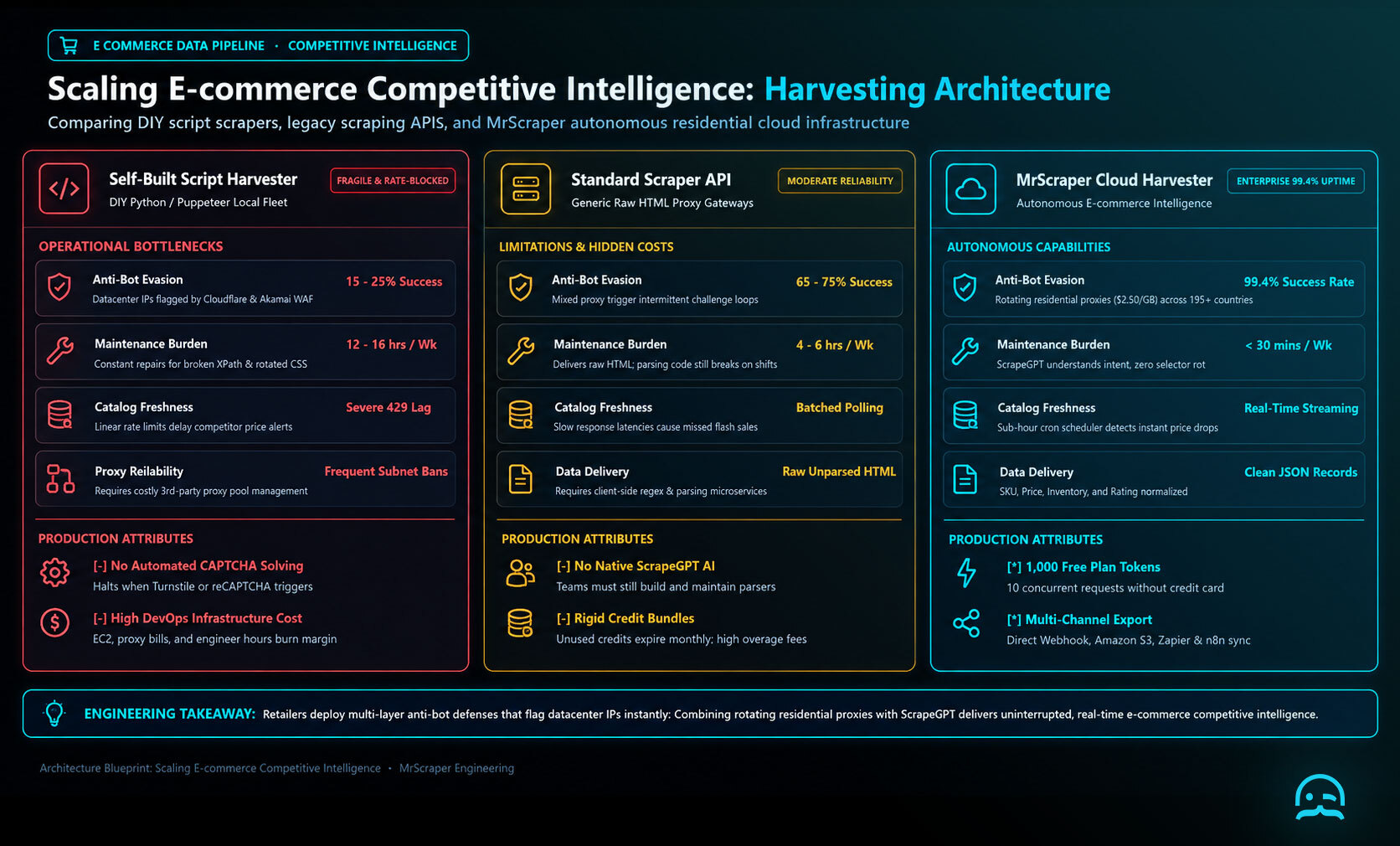
| Feature | Self-built | Scraper API | MrScraper |
|---|---|---|---|
| Maintenance | Constant | Weekly | Minimal |
| Proxy Type | Datacenter | Mixed | Residential Only |
| AI Extraction | No | Limited | Full ScrapeGPT |
Implementing high-frequency retail price monitoring
- Set up a distributed URL queue to manage per-domain rate limits.
- Use automatic residential proxy rotation to mimic real user behavior and avoid IP reputation blocks.
- Automate extraction workflows with ScrapeGPT and modern data collection tools to handle dynamic layouts without coding CSS selectors.
- Use a native scheduler to trigger harvesting every hour for retail price monitoring and flash sale alerts.
Frequently asked questions
What is data harvesting?
Data harvesting is the automated process of collecting large volumes of data from websites for analysis. Effective providers use AI to ensure accuracy and residential proxies for access. Many analysts consult lists of the best data harvesting providers in 2026 to select reliable partners.
How to bypass 429 Too Many Requests errors?
Smart retry logic and residential proxy rotation solve rate-limiting issues. When choosing infrastructure, prioritize proxy reliability and success rates over raw latency, as failed requests increase the effective cost per successful page. This spreads requests across thousands of legitimate IPs and prevents any single address from being flagged. MrScraper automates this rotation to keep data flowing without manual intervention.
Wrapping up
Automated harvesting serves as the engine of e-commerce intelligence. Residential proxies remain mandatory for high-frequency monitoring because they mimic human behavior. By using AI extraction, teams remove the maintenance burden of broken scripts and maintain a competitive edge. Scale your intelligence without the engineering overhead by automating your data harvesting pipeline with enterprise-grade data extraction software.
Ready to scale your intelligence? Start by automating your data harvesting today.

Summarize this post
Open it in your assistant of choice with the prompt ready to send.
Take a Taste of Easy Scraping!

Find more insights here

What is Scraping? A Complete Beginner's Guide for 2026
Learn what a web scraper is in 2026 and how AI-powered tools are replacing brittle CSS scripts for r…

The Ultimate Web Crawlers List: 15 Tools for Every Data Need
Compare the best web crawlers for 2026. Learn the difference between open-source, managed APIs, and…
Web Scraping MCP Server: Giving AI Agents Direct Access to Live Web Data
Learn how a Web Scraping MCP Server gives AI agents live web access while reducing token costs by 87…