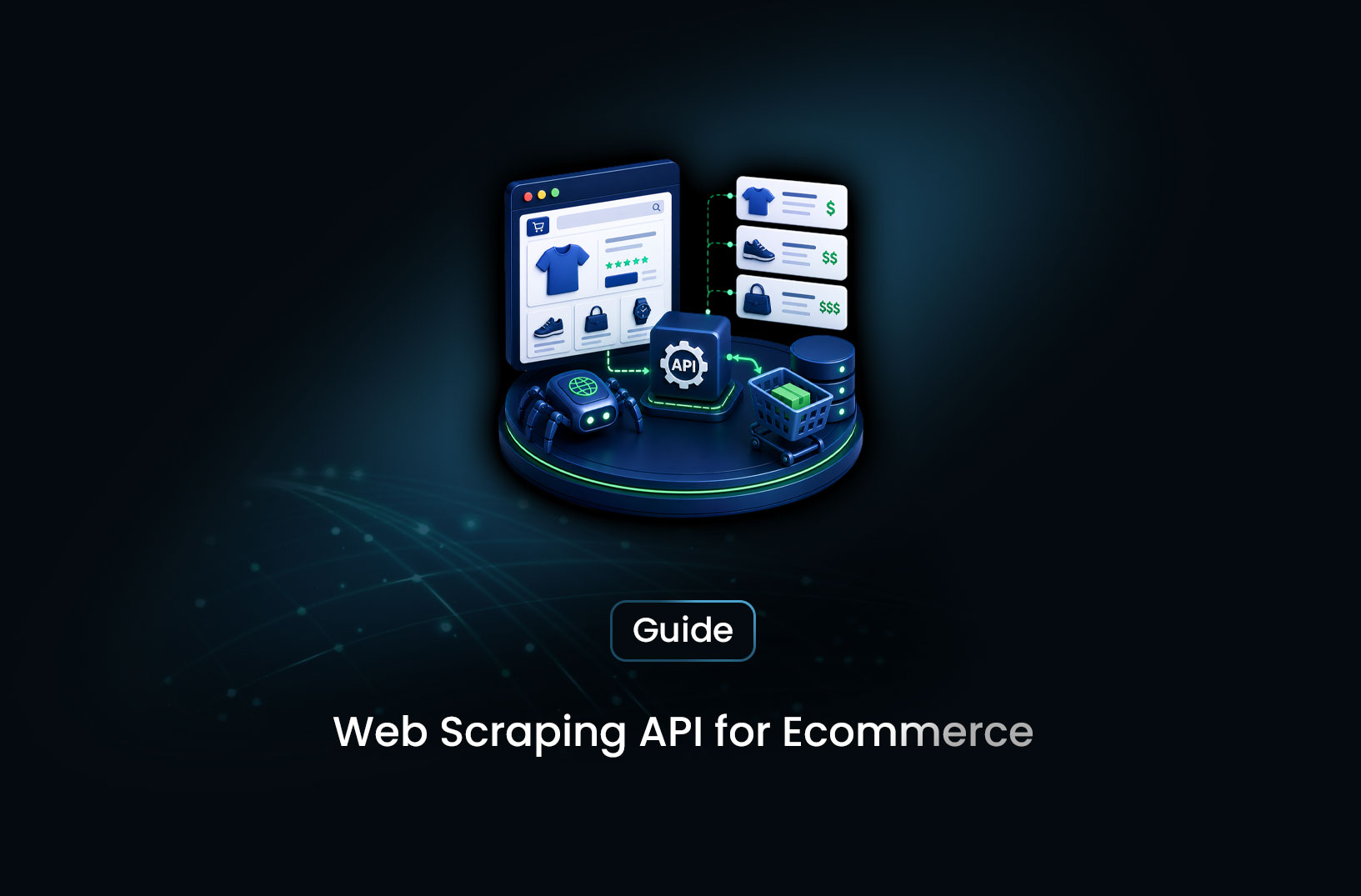
Collect Ecommerce Data With a Web Scraping API
Web ScrapingLearn how to use an ecommerce data scraping API to collect product pricing, inventory, and competitor data at scale — tools, setup, and best practices.
Pricing intelligence that's a week old is competitive intelligence that's already stale. Product availability that updates monthly can't inform a real-time replenishment decision. For ecommerce teams that operate on market data, the difference between useful intelligence and useless noise often comes down to whether data collection is fast, automated, and comprehensive enough to reflect what's actually happening on the web today.
An ecommerce data scraping API is what makes that possible at scale. It's a managed web scraping service that handles the infrastructure complexity of extracting product data, pricing, inventory signals, reviews, and catalog information from ecommerce sites — rotating IPs, rendering JavaScript, bypassing bot protection, and returning clean structured data — so your team focuses on analysis rather than pipeline maintenance. This guide covers what ecommerce scraping APIs do, how to build a practical data collection workflow with one, which platforms are worth evaluating, and the operational realities of running product data extraction at meaningful scale.
By the end, you'll have a clear blueprint for building an ecommerce scraping pipeline that's fast enough to be useful, scalable enough to cover your full competitive landscape, and reliable enough to run unattended.
Table of Contents
- What Is an Ecommerce Data Scraping API?
- How Ecommerce Scraping APIs Work
- Step-by-Step Guide: Building an Ecommerce Data Pipeline
- Best Scraping APIs for Ecommerce Data Collection
- Free vs. Paid: What You Actually Need for Ecommerce at Scale
- Key Features to Look For in an Ecommerce Scraping API
- When Should You Use an Ecommerce Data Scraping API?
- Common Challenges and Limitations
- Conclusion
- What We Learned
- FAQ
What Is an Ecommerce Data Scraping API?
An ecommerce data scraping API is a managed web scraping service specifically suited — or specifically configured — for extracting structured data from ecommerce websites: product names, prices, descriptions, SKUs, availability status, review counts and ratings, image URLs, category hierarchies, and any other data visible on product and catalog pages.
The "API" framing means this extraction is accessible programmatically: you send a request with a target URL, your code receives structured JSON back. Your application — whether it's a pricing dashboard, a competitive intelligence database, a dynamic repricing system, or a research pipeline — integrates scraping as a component rather than as a separate manual process. This is what distinguishes a scraping API from a no-code scraping tool: the former integrates into your systems, the latter produces files you work with manually.
Ecommerce is one of the most demanding environments for web scraping. Retailers invest significantly in bot-protection — Cloudflare, PerimeterX, Akamai Bot Manager, and proprietary challenge systems are standard on any ecommerce site with meaningful traffic. Product pages are almost universally JavaScript-rendered through React, Next.js, or custom SPA frameworks. Prices are frequently personalized based on user history, geographic location, or session behavior, making geo-targeted scraping from appropriate residential IPs critical for accurate pricing intelligence. And ecommerce sites change — sales, restocks, catalog updates, layout redesigns — frequently enough that stale data is a real operational problem.
A well-chosen ecommerce data scraping API abstracts all of this complexity. According to Shopify's commerce research, dynamic pricing and real-time competitive intelligence have become baseline capabilities for growth-oriented ecommerce teams — which means the demand for reliable, scalable product data collection isn't a niche technical concern but a mainstream business requirement.
How Ecommerce Scraping APIs Work
The pipeline behind an ecommerce scraping API has more moving parts than generic web scraping, because ecommerce targets are more adversarial and more complex than informational sites.
Request routing through residential infrastructure. Most ecommerce sites serve different prices, availability, and sometimes different product catalogs based on the geographic location of the visitor. A scraping API for ecommerce pricing intelligence needs to route requests through residential IPs in the target geography — not data-center addresses that are immediately flagged, and not the wrong region that returns irrelevant local pricing. Quality residential proxy infrastructure is foundational, not optional.
Bot protection bypass. Cloudflare's Bot Management, PerimeterX, and similar systems evaluate dozens of signals to distinguish human from automated traffic: TLS fingerprinting, browser behavior patterns, mouse movement, JavaScript execution environment characteristics, and IP reputation. A headless browser that passes these checks on basic sites will fail on advanced ecommerce protection. Scraping APIs that are specifically effective for ecommerce have invested in fingerprint management that makes their browser sessions credibly human to these detection layers.
Full JavaScript rendering. Prices, stock status, and product variants on most modern ecommerce sites are loaded by JavaScript after the initial page response. A raw HTTP request returns the page skeleton — prices as placeholder elements, inventory as empty divs. A rendering engine that executes the full JavaScript environment, including dynamic price calculation, inventory API calls, and variant selection, returns what the user actually sees. This is non-negotiable for accurate ecommerce data.
Structured data extraction. After rendering, the HTML needs to be parsed into clean, typed fields — price as a number, not a string with a currency symbol; availability as a boolean or enum, not a CSS class name; rating as a float, not a nested div stack. This parsing layer is where generic scraping APIs and specialized ecommerce scraping solutions diverge most.
Step-by-Step Guide: Building an Ecommerce Data Pipeline
Step 1: Define Your Data Model Before Writing Code
The most common mistake in ecommerce scraping projects: starting with "let's see what we can get" rather than "here's the exact schema we need." Define your target fields first.
For a competitive pricing pipeline, the minimum viable schema typically includes: product identifier (name, brand, or SKU), current price, sale price if present, availability status, URL, retailer, and timestamp. For a full product intelligence database, you'd add: image URLs, category path, review count and average rating, product variants and their individual prices, and key specification fields relevant to your category.
A defined schema does three things: it tells you which fields you need the scraping API to reliably extract, it gives you a validation template to check each extraction against, and it defines the database structure you'll write data into. Building without a schema produces a pile of inconsistently structured data that requires a painful normalization pass before it's usable.
Step 2: Select and Configure Your Scraping API
Authenticate with your chosen scraping API and verify the connection with a single product page before building out the pipeline:
import requests
import json

API_KEY = "your-api-key"
ENDPOINT = "https://your-scraping-api.com/v1/scrape"

def scrape_product_page(url: str) -> dict:
    """Fetch a product page via scraping API and return the response."""
    response = requests.post(
        ENDPOINT,
        headers={"Authorization": f"Bearer {API_KEY}"},
        json={
            "url": url,
            "render_js": True,          # Required for dynamic price loading
            "country": "US",            # Geo-target for US pricing
            "extract_rules": {          # Provider-specific extraction config
                "price": "span.price",
                "availability": "div.stock-status",
                "title": "h1.product-title",
            }
        }
    )
    response.raise_for_status()
    return response.json()

# Test with a single page before scaling
result = scrape_product_page("https://example-retailer.com/product/12345")
print(json.dumps(result, indent=2))
The exact request parameters (render_js, extract_rules, country) vary by provider — always configure from your provider's documented API reference. The pattern is consistent; the parameter names are not universal.
Step 3: Scale Across Category Pages and Pagination
A competitive pricing operation doesn't scrape one product — it scrapes entire categories. The practical approach is two-phase: first scrape category/search result pages to collect product URLs, then scrape each product URL for detailed data.
from concurrent.futures import ThreadPoolExecutor, as_completed
import time

def scrape_category_for_urls(category_url: str) -> list[str]:
    """Scrape a category page and extract product URLs."""
    result = scrape_product_page(category_url)
    # Parse product URLs from the category page response
    # Exact parsing depends on the site structure and API response format
    return result.get("product_urls", [])

def scrape_products_concurrent(urls: list[str], max_workers: int = 5) -> list[dict]:
    """Scrape multiple product URLs concurrently with rate limiting."""
    results = []
    with ThreadPoolExecutor(max_workers=max_workers) as executor:
        futures = {executor.submit(scrape_product_page, url): url for url in urls}
        for future in as_completed(futures):
            url = futures[future]
            try:
                data = future.result()
                results.append(data)
            except Exception as e:
                print(f"Failed for {url}: {e}")
            time.sleep(0.5)  # Brief pause between completions
    return results
Concurrency is necessary at scale — scraping ten thousand products serially would take hours. But aggressive concurrency triggers rate limiting. Five to ten concurrent workers is a reasonable starting point; tune based on your API provider's rate limits and the target site's tolerance.
Step 4: Validate and Store Extracted Data
Every extraction result needs validation before storage. Ecommerce data has natural constraints that catch extraction failures:
from datetime import datetime
import sqlite3

def validate_product(data: dict) -> tuple[bool, list[str]]:
    """Validate extracted product data. Returns (is_valid, errors)."""
    errors = []
    if not data.get("title"):
        errors.append("Missing product title")
    price = data.get("price")
    if price is None or not isinstance(price, (int, float)) or price < 0:
        errors.append(f"Invalid price: {price!r}")
    if data.get("rating") and not (0 <= data["rating"] <= 5):
        errors.append(f"Rating out of range: {data['rating']}")
    return len(errors) == 0, errors

def store_product(conn: sqlite3.Connection, product: dict, url: str):
    """Write a validated product record to the database."""
    conn.execute("""
        INSERT OR REPLACE INTO products
            (url, title, price, sale_price, availability, rating, review_count, scraped_at)
        VALUES (?, ?, ?, ?, ?, ?, ?, ?)
    """, (
        url,
        product.get("title"),
        product.get("price"),
        product.get("sale_price"),
        product.get("availability"),
        product.get("rating"),
        product.get("review_count"),
        datetime.utcnow().isoformat(),
    ))
    conn.commit()
INSERT OR REPLACE (SQLite) or INSERT ... ON CONFLICT DO UPDATE (PostgreSQL) handles idempotent writes — running the same scrape twice doesn't duplicate rows, it updates the existing record with fresher data.
Step 5: Schedule for Continuous Intelligence
Pricing data has a half-life. For fast-moving categories, prices change hourly; for stable categories, daily or weekly monitoring is sufficient. Match your scraping cadence to the price velocity of your category.
APScheduler handles scheduling for Python-based pipelines. For production ecommerce intelligence at scale, a task queue (Celery with Redis or RabbitMQ) distributes scraping jobs across workers, decouples scheduling from execution, and provides retry handling when individual jobs fail:
# Minimal APScheduler setup for daily category monitoring
from apscheduler.schedulers.blocking import BlockingScheduler

def daily_pricing_run():
    """Full pipeline run: categories → product URLs → extraction → storage."""
    conn = sqlite3.connect("ecommerce_data.db")
    for category_url in MONITORED_CATEGORIES:
        product_urls = scrape_category_for_urls(category_url)
        products = scrape_products_concurrent(product_urls)
        for i, product in enumerate(products):
            is_valid, errors = validate_product(product)
            if is_valid:
                store_product(conn, product, product_urls[i])
            else:
                print(f"Validation failed for {product_urls[i]}: {errors}")
    conn.close()

scheduler = BlockingScheduler()
scheduler.add_job(daily_pricing_run, "cron", hour=6)  # 6am daily
scheduler.start()
Best Scraping APIs for Ecommerce Data Collection
1. MrScraper
MrScraper's Scraping Browser is built for the exact environment that makes ecommerce scraping difficult: heavy bot protection, JavaScript-rendered prices and inventory, and geo-sensitive pricing that requires residential IP routing. The AI-powered extraction layer adds resilience to layout changes — when a retailer updates their product page template, extraction continues accurately rather than breaking on changed class names. Official documentation and SDK coverage at https://docs.mrscraper.com.
Best for: Teams scraping bot-protected ecommerce targets at scale who want a single managed API covering rendering, anti-bot bypass, and intelligent extraction.
2. Oxylabs
Oxylabs offers a dedicated Ecommerce Scraper API alongside its residential proxy network — one of the largest by IP pool size. Their ecommerce API includes pre-built parsers for major retailer categories, returning typed structured data rather than raw HTML. For teams focused on major marketplace data (Amazon, major retailers), the pre-built parsing reduces integration time significantly. Documentation at https://oxylabs.io/products/scraper-api/ecommerce.
Best for: High-volume ecommerce scraping where pre-built parsers for major retailers reduce custom extraction work.
3. Bright Data
Bright Data's Web Scraper IDE and Dataset Marketplace serve different buyer types. The IDE lets technical teams build custom ecommerce scrapers with managed proxy infrastructure and scheduling. The Dataset Marketplace sells pre-collected ecommerce datasets (Amazon, Walmart, eBay product data) for teams that need historical data without building collection infrastructure. Documentation at https://brightdata.com/products/web-scraper.
Best for: Teams needing large pre-collected ecommerce datasets quickly, or enterprise technical teams with resources to build fully custom collection infrastructure.
4. ScrapingBee
ScrapingBee is a developer-focused scraping API with a clean, well-documented interface, residential proxy support, and JavaScript rendering. Less specialized for ecommerce than Oxylabs but simpler to integrate quickly. Appropriate for moderate-volume ecommerce scraping where the team is comfortable writing their own extraction logic. Documentation at https://www.scrapingbee.com/documentation/.
Best for: Developers building custom ecommerce scrapers at moderate volume who want a reliable managed proxy and rendering layer without specialized ecommerce-specific features.
Free vs. Paid: What You Actually Need for Ecommerce at Scale
Free tiers on scraping APIs are for evaluation, not production. The capabilities that matter for real ecommerce data collection — residential proxy routing, concurrent request support, high-volume extraction, and reliable bot bypass on major retailers — are universally behind paid plans.
The economics look like this. A competitive pricing operation monitoring 10,000 product SKUs daily at five major competitors generates 50,000 API calls per day. At a few cents per call (varying by provider and plan tier), that's hundreds to a few thousand dollars monthly — a cost that's typically trivial relative to the business value of accurate, timely pricing intelligence, but non-zero and worth modeling before committing to a pipeline architecture.
Free tiers let you evaluate extraction quality on your specific target sites, test bot bypass on your target retailers, and validate that the API's response schema matches your data model. This evaluation period is genuinely valuable — always test against your real targets before committing to a provider or building out your pipeline.
Paid tiers unlock the request volume, concurrency, and proxy quality that production ecommerce scraping requires. Residential proxy access specifically is almost always a paid feature, and it's non-optional for accurate geo-targeted pricing on major ecommerce platforms.
Key Features to Look For in an Ecommerce Scraping API
- Residential proxy coverage in your target markets: Geo-targeted pricing requires residential IPs in the right locations. Confirm coverage in your specific target countries and cities, not just "global" coverage.
- JavaScript rendering depth: Can it execute the full JavaScript environment including dynamic price loading, inventory API calls, and variant selection? Test rendering on your actual target product pages, not generic demos.
- Anti-bot success rate on major ecommerce platforms: Bot protection on Amazon, Walmart, Target, and major DTC brands is sophisticated. Ask providers for their success rates on your specific targets, or test directly.
- Extraction flexibility: Does the API return raw rendered HTML (you write extraction), typed structured fields (provider writes extraction), or both? Each has different integration implications.
- AI or adaptive extraction resilience: Ecommerce sites update their templates regularly. Extraction that adapts to layout changes without manual reconfiguration has a meaningfully lower maintenance cost over time.
- Webhook and async delivery for high-volume jobs: Synchronous request-response works for low volumes. At tens of thousands of daily calls, webhook-based async delivery is the production pattern.
- Rate limits and concurrent worker support: Know how many parallel requests your plan supports, and whether burst capacity is available for time-sensitive monitoring scenarios.
When Should You Use an Ecommerce Data Scraping API?
Use an ecommerce data scraping API when:
- You need competitive pricing data updated at least daily across multiple retailers and SKUs
- Your product catalog monitoring involves more than a few hundred pages — manual collection or no-code tools don't scale to this volume
- Target retailers use bot protection, JavaScript rendering, or geo-targeted pricing that requires managed infrastructure to bypass
- You're building a pricing dashboard, dynamic repricing system, or competitive intelligence database that needs data flowing in programmatically
- You're monitoring inventory levels, promotional pricing, or product availability signals that change frequently enough to matter
Consider alternatives when:
- You need data from only one or two URLs occasionally — a no-code tool or a simple Python script is faster to set up
- Your target sites are simple, unprotected, and static — a full managed API is more infrastructure than the use case requires
- You need historical ecommerce data rather than live scraping — pre-collected datasets from Bright Data's marketplace or similar sources are faster and cheaper than building collection infrastructure
Common Challenges and Limitations
Geo-targeted pricing requires accurate residential IP placement. Ecommerce platforms price by location — sometimes by country, sometimes by ZIP code, sometimes based on detected user segments. Scraping "US pricing" through a data-center IP, or through a residential IP that geolocates to the wrong state, produces inaccurate pricing data. Always verify the IP location your API is using for geo-targeted scraping by confirming the apparent location through the response content, not just the API's claimed routing.
Bot protection on major retailers improves continuously. Amazon, Walmart, and major DTC brands invest heavily in bot detection. A scraping API that works reliably today may face degraded success rates after a bot management update next quarter. No provider guarantees permanent access to heavily protected sites, and your ecommerce scraping pipeline needs monitoring infrastructure to detect drops in success rate before they silently corrupt your data with partial or failed extractions.
Variant and SKU-level data requires careful page interaction. A product listing page may show the base price; the actual price for a specific size, color, or configuration requires selecting that variant on the product page — a JavaScript interaction that must be triggered and waited on before extraction runs. Scraping APIs with browser automation capability handle this; simple rendering without interaction returns only the default variant's data. Verify your provider's variant selection support for the sites you're targeting.
Price personalization limits intelligence accuracy. Major retailers increasingly personalize prices based on browser history, account type, loyalty status, and session behavior. A scraping API operating as an anonymous session sees the "generic" price — which may differ from what your customers or specific competitor segments see. For most competitive intelligence use cases, the anonymous price is the right reference point. For price parity monitoring or detecting loyalty-tier pricing, this limitation requires explicit acknowledgment in how you interpret and report the data.
Legal and terms of service constraints vary by platform. Most major ecommerce platforms explicitly prohibit automated scraping in their Terms of Service. This is distinct from legality under applicable law — courts in the US have generally upheld the right to scrape publicly accessible data (see hiQ Labs v. LinkedIn), but ToS violations can result in account bans, IP blocks, and in some cases legal action. Build your pipeline to be respectful of rate limits, avoid scraping private or authenticated user data, and review the specific terms of each platform you target before operating at scale.
Conclusion
A well-built ecommerce data scraping pipeline is a competitive asset — it's how pricing intelligence stays current, how catalog monitoring covers the full competitive landscape, and how product data flows into the systems that make real-time decisions. The scraping API is the infrastructure layer that makes this possible without building and maintaining your own browser fleet, proxy network, and bot-bypass engineering.
The build is well-defined: choose an API that handles your targets reliably, define your schema before coding, validate every extraction, store a time series with timestamps, and schedule for the cadence your business decisions actually require. The ongoing challenges — geo-targeting accuracy, bot protection evolution, variant handling — are operational realities to manage, not blockers.
For teams where the alternative to a scraping API is manual data collection, static snapshots, or a homegrown scraper that consumes disproportionate engineering maintenance, the operational math is usually clear. The data you need exists on the web. The question is whether your collection infrastructure is fast and reliable enough to make it useful.
What We Learned
- Ecommerce scraping requires residential IPs, full JS rendering, and bot bypass as baseline capabilities: These aren't advanced features — they're the minimum viable infrastructure for accurate data from any significant ecommerce target.
- Schema definition before code is the most underrated step: Knowing exactly what fields you need, in what types and formats, determines your provider choice, validation logic, and database design before a line is written.
- Validation before storage prevents wrong data more effectively than any other technique: A pipeline that only stores validated extractions fails loudly on errors rather than silently accumulating bad data.
- Concurrent extraction is necessary at scale; rate limiting is non-optional: Five to ten workers is a reasonable starting point — tune against your API's rate limits and target site tolerance, not against your patience.
- Pricing data has a half-life — scraping cadence should match it: Daily monitoring is baseline for most categories; hourly for promotional periods and fast-moving SKUs; weekly is often sufficient for stable long-tail catalog items.
- Bot protection evolves faster than scraping infrastructure: Monitor success rates continuously and treat drops as incidents, not normal variance — silent extraction failures corrupt your intelligence database without triggering obvious errors.
FAQ
What is an ecommerce data scraping API?
An ecommerce data scraping API is a managed web scraping service that extracts structured product data — prices, availability, titles, SKUs, ratings, images — from ecommerce websites and returns it as clean JSON via HTTP requests. It handles the infrastructure complexity of ecommerce scraping: JavaScript rendering, bot bypass, residential IP routing, and data parsing — so your application receives usable structured data without managing browser infrastructure or proxy networks.
What ecommerce data can I collect with a scraping API?
Any data visible on a public ecommerce product page: product name, brand, price (including sale price and price history if it's on the page), availability status, SKU and variant information, product description, images, category path, review count and average rating, shipping information, and seller details on marketplace pages. Category and search result pages yield product URL lists, promotional badges, and aggregate availability signals. What's not accessible: account-specific pricing, order history, private seller data, and any content behind authenticated sessions you're not authorized to access.
How do I handle JavaScript-rendered prices on ecommerce sites?
Use a scraping API with full browser rendering capability — one that executes the complete JavaScript environment for the page, not just static HTML. JavaScript-rendered prices load after the initial page response through dynamic API calls from the browser. A rendering engine that waits for these calls to complete and the DOM to stabilize before extraction captures the actual displayed price. Verify your provider renders your specific target pages correctly by comparing the API's returned price against what you see in a real browser session on the same page.
What is the best scraping API for ecommerce pricing data?
The best option depends on your specific targets and volume. MrScraper is well-suited for bot-protected, JavaScript-heavy targets where AI extraction reduces maintenance overhead. Oxylabs provides pre-built parsers for major retailers and a large residential proxy pool for high-volume operations. Bright Data's Dataset Marketplace is valuable for teams that need historical ecommerce datasets rather than building live collection. Test any candidate against your actual target retailers before committing — anti-bot success rates vary significantly by site.
Is it legal to scrape ecommerce product data?
Scraping publicly accessible product data — prices, availability, product descriptions displayed without authentication — is generally legal in most jurisdictions based on US case law (notably hiQ Labs v. LinkedIn) and similar precedent in other countries. However, most ecommerce platforms prohibit automated scraping in their Terms of Service, which is a contractual constraint separate from legality. Building your pipeline to respect rate limits, avoid accessing private data, and review platform-specific terms is both good operational practice and appropriate legal hygiene. For commercial applications at scale, consult legal counsel regarding your specific targets and use case.
How often should I scrape ecommerce data for pricing intelligence?
Match scraping frequency to price velocity in your category. Fast-moving categories — electronics, consumer goods during promotional periods — may justify hourly monitoring for critical SKUs. Standard retail categories with relatively stable pricing are well-served by daily monitoring. Long-tail or stable catalog items can typically be monitored weekly without losing meaningful intelligence. Running everything at maximum frequency wastes API spend and infrastructure capacity; tiering by price velocity and business priority makes your collection cadence proportional to its value.
Summarize this post
Open it in your assistant of choice with the prompt ready to send.
Take a Taste of Easy Scraping!

Find more insights here
HTML to Markdown: Converting Scraped Web Pages for LLM Training
Learn how to convert html to markdown for LLM training. Reduce token usage by 90% and improve RAG ac…
What is Scraping? A Complete Beginner's Guide for 2026
Learn what a web scraper is in 2026 and how AI-powered tools are replacing brittle CSS scripts for r…
The Ultimate Web Crawlers List: 15 Tools for Every Data Need
Compare the best web crawlers for 2026. Learn the difference between open-source, managed APIs, and…