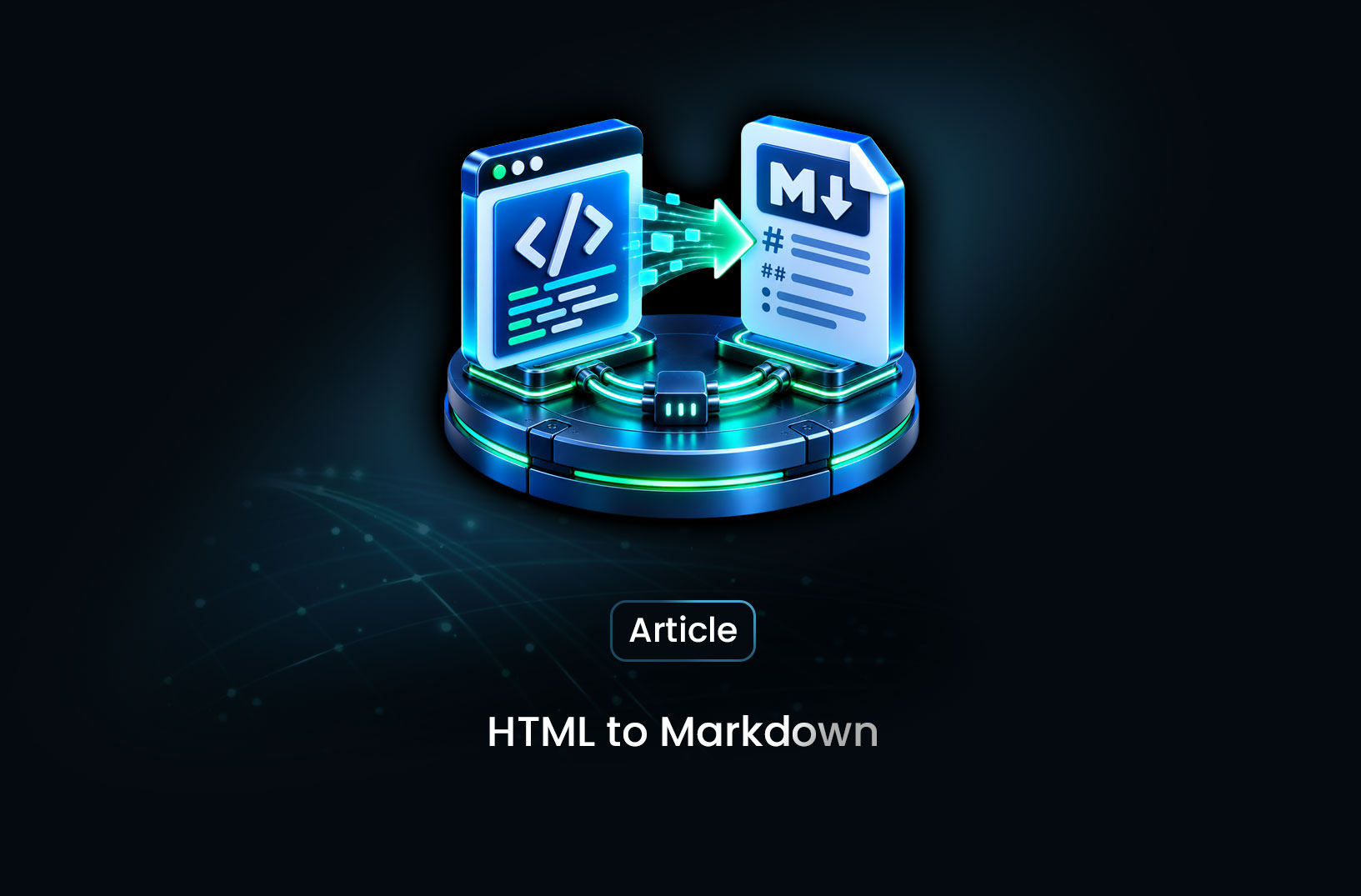
HTML to Markdown: Converting Scraped Web Pages for LLM Training
GuideLearn how to convert html to markdown for LLM training. Reduce token usage by 90% and improve RAG accuracy with clean, structured web scraping.
You are paying a maintenance tax every time you send raw HTML to an LLM. It is not just noisy; it is a drain on your context window and your budget. Analyzing the token overhead of raw markup shows that most pages are 85% boilerplate, including script tags, navigation menus, and tracking pixels. Understanding how to use html to markdown conversion is the first step in optimizing these expensive pipelines.
Converting source code into a structured format is the most effective way to cut inference costs by 90% and improve RAG accuracy. It works by stripping non-essential data while preserving semantic structure. This process ensures your models reason over actual content rather than parsing verbose DOM structures. For organizations scaling these systems, establishing financial data integrity through clean source material is an absolute prerequisite for effective automation.
What you'll learn:
- Why raw HTML bloats token usage and inference costs
- How markdown preserves semantic hierarchy for better retrieval
- A technical workflow for building a clean extraction pipeline
- The advantages of AI-native scraping tools
The hidden cost of raw HTML in AI pipelines
When you fetch a web page and pass the raw source to an LLM, you are wasting money on every request. A typical news article might contain 800 words of actual content, yet the raw HTML often exceeds 10,000 tokens due to headers, footers, and inline styles. This noise forces the model to ignore irrelevant data. This frequently leads to hallucinations or missed details in complex RAG workflows.
The token bloat problem
Clean markdown conversion can reduce raw HTML from 12,000 tokens to just 1,200. Adopting a strategy for efficient token management is not just a preference; it is a financial necessity when scaling agents that process thousands of pages. At current API rates, this reduction can drop your processing costs from $10 to $1 for every 10,000 pages.
Context window exhaustion
Raw HTML vs. markdown comparison
| Format | ~Tokens (800-word page) | Content Ratio | LLM Utility |
|---|---|---|---|
| Raw HTML | 6,000–12,000 | 10–15% | Low |
| Visible Text | 1,500–2,000 | 40–60% | Medium |
| Clean Markdown | 900–1,200 | 85–95% | High |
Why markdown is the native language of LLMs
Markdown is superior for LLM input because it strikes the perfect balance between raw text and structured data. Plain text loses the relationship between a header and its paragraph, but markdown preserves the document's semantic hierarchy, helping the model locate specific sections without the overhead of closing tags. Implementing this structured formatting for AI citation ensures content remains machine-parseable for modern discovery engines.
Semantic hierarchy preservation
Preserving headers and lists during conversion is critical for the LLM to understand document semantics. By using # and ## markers, you provide clear signals to the model about what information is primary versus supporting. Utilizing semantic understanding for layout changes ensures these markers are extracted accurately even when sites update their code. This keeps your prompts lean and relevant.
Improved retrieval accuracy
When designing a RAG pipeline for live web data, the quality of your vector chunks depends entirely on the cleanliness of your source. Building a technical memory graph from real data ensures your models cite authoritative relationships. Models like Reader-LM now use specific datasets to automate noisy HTML to structured markdown conversion, ensuring your database only stores high-signal information.
How to build an html to markdown pipeline
Building a robust pipeline requires moving past brittle selectors. The first step is clean extraction. This is followed by a secondary process to strip tags for AI readiness. I recommend using a tool that handles retrieval infrastructure and headless browser orchestration for you. This allows you to focus on the data transformation logic, such as extracting structured JSON directly from the source.
Step 1: Clean extraction
Modern extraction tools allow you to avoid the maintenance tax of constantly updating CSS selectors by using AI-powered semantic scraping. You can use APIs to fetch clean content directly. Here is how you can perform a basic conversion using Python and BeautifulSoup to handle raw HTML if you are not yet using a native markdown endpoint:
import requests
import os
from bs4 import BeautifulSoup

def clean_html_to_text(target_url):
    # Using MrScraper to get clean HTML
    api_token = os.environ["MRSCRAPER_API_TOKEN"]
    params = {"token": api_token, "url": target_url, "html": "true"}
    response = requests.get("https://api.mrscraper.com/", params=params)

    if response.status_code == 200:
        soup = BeautifulSoup(response.text, "html.parser")
        # Remove non-content elements
        for element in soup(["script", "style", "nav", "footer", "header"]):
            element.decompose()
        return soup.get_text(separator="\n").strip()
    return None

content = clean_html_to_text("https://example.com/blog-post")
print(content[:500])
This script fetches the page through a managed retrieval service. It then strips common noisy tags to prepare the text for further markdown formatting.
The rise of AI-native scrapers
New extraction tools represent a shift toward platforms designed specifically for LLMs. Many developers are moving toward tools like MrScraper to prioritize markdown output and automated crawling over raw data dumps. These AI use cases illustrate how structured data processing directly improves frontline productivity and coaching. Tools like ScrapeGPT now automate the heavy lifting of this semantic mapping.
- Built-in markdown output: Output clean markdown directly to eliminate the need for local parsing libraries.
- Semantic understanding: Use AI to understand page structure without writing a single CSS selector.
- Scalable web crawling: Automate the discovery of deep links across entire domains to build your training corpus.
- Residential proxy support: Access region-accurate content globally with reliable success rates.
This snippet demonstrates how to use a native markdown endpoint to directly retrieve clean, LLM-ready markdown from a target URL without local parsing. If you are building a custom ai web scraper, this approach is the most efficient.
import os
import requests

def fetch_markdown_content(target_url):
    api_token = os.environ["MRSCRAPER_API_TOKEN"]
    # Pass authentication and markdown flags via query parameters
    params = {"token": api_token, "markdown": "true"}
    payload = {"url": target_url}

    response = requests.post("https://api.mrscraper.com/", params=params, json=payload)
    response.raise_for_status()
    return response.json()

result = fetch_markdown_content("https://example.com/article")
print("Markdown content preview:")
print(result.get("markdown", "")[:200])
Frequently asked questions
What is a web scraper for LLMs?
A web scraper for LLMs is a specialized tool that extracts content from websites and converts it into AI-friendly formats like markdown. Traditional scraping tools target specific database fields. In contrast, these tools focus on preserving the semantic structure of a page while minimizing token usage for RAG and fine-tuning.
How to make a web scraper in Python for AI?
To build a scraper for AI, use a library like requests or httpx to fetch content through a proxy service. For production workloads, deploying a Python-based web crawler built for AI agents ensures you handle pagination and dynamic content correctly. Understanding what is firecrawl and how it compares to other scrapers can help you choose the right tool for your stack.
Key takeaways
- Raw HTML is a token drain that increases LLM inference costs and reduces accuracy.
- Markdown is the optimal format for AI because it preserves document hierarchy with minimal overhead.
- Converting HTML to markdown can reduce token usage by 80-90% compared to raw source code.
- AI-native scraping tools automate the cleaning process to provide LLM-ready data instantly.
Next steps:
- Audit your current RAG pipeline to calculate the token-to-content ratio of your inputs.
- Test a markdown converter on your most common data sources to measure token savings.
- Implement a structured extraction pipeline to automate your HTML to markdown conversion today.
Schedule a personalized demo today to see how MrScraper can automate your data extraction workflows with precision and speed.
Summarize this post
Open it in your assistant of choice with the prompt ready to send.
Take a Taste of Easy Scraping!

Find more insights here
What is Scraping? A Complete Beginner's Guide for 2026
Learn what a web scraper is in 2026 and how AI-powered tools are replacing brittle CSS scripts for r…
The Ultimate Web Crawlers List: 15 Tools for Every Data Need
Compare the best web crawlers for 2026. Learn the difference between open-source, managed APIs, and…
Web Scraping MCP Server: Giving AI Agents Direct Access to Live Web Data
Learn how a Web Scraping MCP Server gives AI agents live web access while reducing token costs by 87…