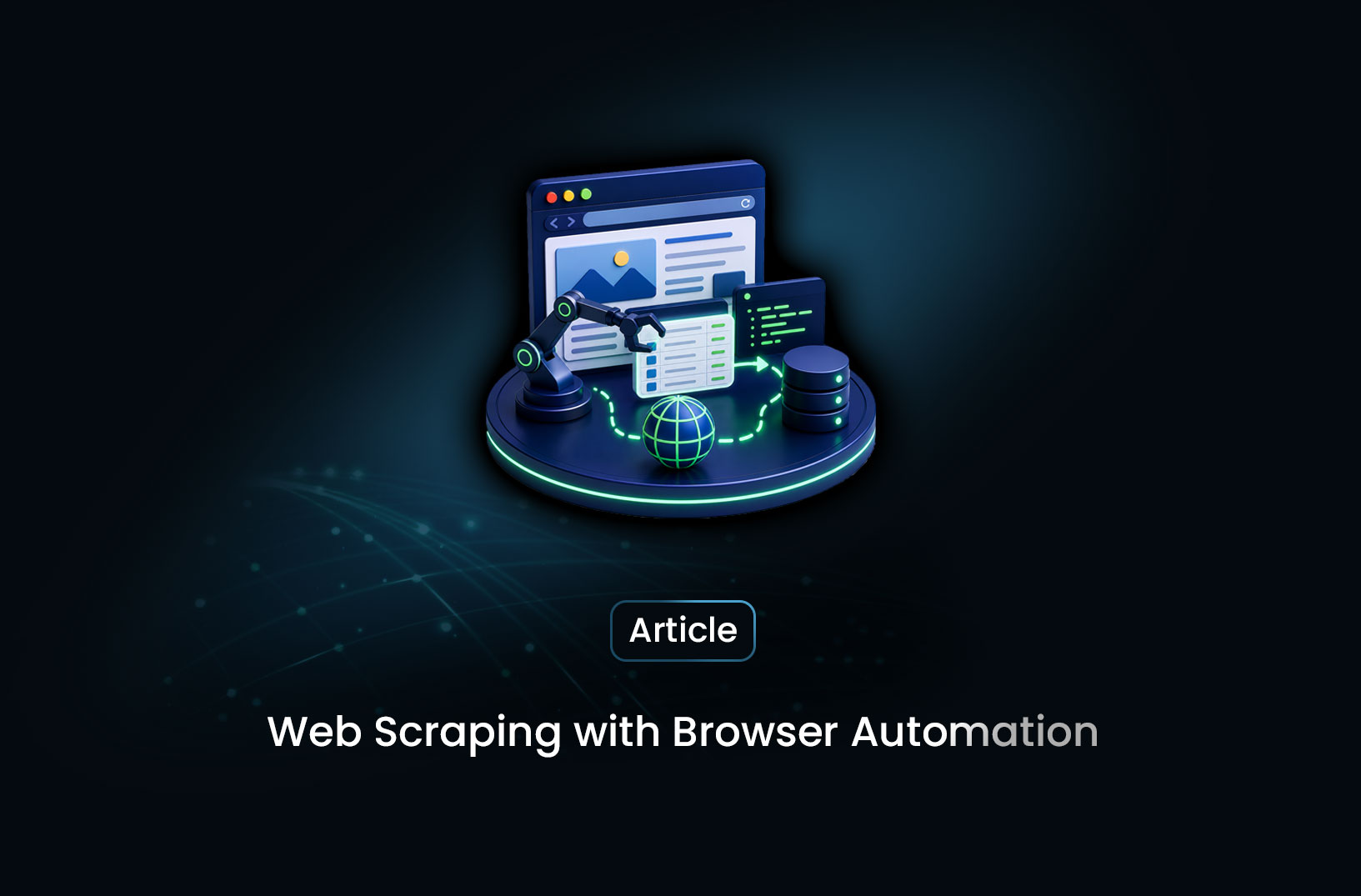
Browser Automation for Web Scraping: Top Tools
Web ScrapingA complete guide to browser automation for web scraping — Playwright, Puppeteer, Selenium compared, with best practices and code patterns for production use.
A plain HTTP request to a modern website returns an empty shell. The prices, product listings, search results, and articles that appear when you open the page in a browser are delivered by JavaScript that executes after the initial HTML loads. No JavaScript execution means no data — just a hollow document that contains placeholders where content should be.
Browser automation for web scraping is the practice of controlling a real browser programmatically to navigate pages, execute JavaScript, interact with elements, wait for dynamic content to load, and extract the data that only appears after the full rendering process completes. It's the technical solution to the single most common reason scrapers fail on modern websites: the content doesn't exist in the raw HTML. This guide covers how browser automation works for scraping, the tools that implement it, the best practices that make those tools reliable in production, and how to structure your scraping code for performance and maintainability.
Table of Contents
- What Is Browser Automation for Web Scraping?
- How Browser Automation Works for Data Extraction
- Step-by-Step Guide: Browser Automation Best Practices for Scraping
- Playwright, Puppeteer, and Selenium Compared
- Best Tools for Browser Automation Scraping
- Free vs. Paid: Options at Each Level
- Key Features to Evaluate in a Browser Automation Tool
- When Should You Use Browser Automation vs. Direct HTTP?
- Common Challenges and Limitations
- Conclusion
- What We Learned
- FAQ
What Is Browser Automation for Web Scraping?
Browser automation for web scraping is the use of programmatic browser control tools — software that drives a real browser like Chrome or Firefox through a documented API — to retrieve web page content including all dynamically generated elements that wouldn't be accessible through a plain HTTP request.
When you use requests.get() in Python to fetch a URL, you receive exactly what the web server sends in its initial HTTP response: typically the document skeleton with HTML markup and links to external resources. JavaScript files, CSS files, images, and fonts are not executed or evaluated — the request just captures the raw server response.
When a browser opens the same URL, it does much more: it parses the HTML, fetches and executes JavaScript bundles, makes additional API calls that JavaScript triggers, updates the DOM based on those API responses, handles conditional rendering based on device type and user state, processes lazy-loading triggers as the viewport scrolls, and produces the final visual representation of the page. Browser automation tools — Playwright, Puppeteer, Selenium — replicate this complete browser behavior under programmatic control, giving your scraper access to what a real user would see rather than just the initial server response.
How Browser Automation Works for Data Extraction
The pipeline for browser automation scraping differs from HTTP-based scraping in several important ways that affect both what you can extract and how you write extraction code.
Browser launch and context creation. The automation library launches a browser process (or connects to an existing one) and creates a browser context — an isolated session with its own cookies, local storage, and cache. Multiple contexts can run concurrently within a single browser process, enabling parallelism without the overhead of launching separate browser instances.
Navigation and page loading. The browser navigates to the target URL, triggering the full browser request-response cycle: TCP connection, TLS handshake, HTTP request, HTML parsing, resource loading, JavaScript execution, and rendering. Browser automation tools provide lifecycle hooks — wait_for_load_state(), wait_for_selector(), wait_for_network_idle() — that let you specify when the page is ready for extraction rather than guessing with a fixed sleep.
DOM access and element interaction. Once the page is in the target state, you interact with the rendered DOM using CSS selectors, XPath, text matching, or accessibility attributes. Unlike BeautifulSoup operating on static HTML, browser automation queries the live DOM — the same document tree the browser uses to paint the screen — so dynamic content injected by JavaScript is queryable immediately after it appears.
Extraction. You extract text content, attribute values, inner HTML, table data, or structured data through the automation API's element methods. For JavaScript-heavy applications, you can also execute arbitrary JavaScript in the browser context to retrieve state from application objects, read from localStorage, or call functions that the page's own JavaScript exposes.
Step-by-Step Guide: Browser Automation Best Practices for Scraping
Practice 1: Use wait_for_selector Instead of Fixed Sleeps
The single most common source of intermittent failures in browser-based scrapers is fixed delays — time.sleep(3) — that are too short on slow page loads and too long on fast ones. wait_for_selector() waits for a specific element to be present and visible before proceeding:
from playwright.sync_api import sync_playwright, TimeoutError as PlaywrightTimeout

def scrape_with_proper_waiting(url: str, target_selector: str) -> str | None:
    """Navigate to a page and wait specifically for the content you need."""
    with sync_playwright() as pw:
        browser = pw.chromium.launch(headless=True)
        page = browser.new_page()

        page.goto(url, wait_until="domcontentloaded", timeout=30_000)

        try:
            # Wait up to 15 seconds for the target element to appear and be visible
            page.wait_for_selector(target_selector, state="visible", timeout=15_000)
            content = page.inner_text(target_selector)
            return content
        except PlaywrightTimeout:
            print(f"Target selector '{target_selector}' didn't appear within timeout")
            return None
        finally:
            browser.close()
Waiting for specific elements rather than for arbitrary time intervals makes your scraper faster on pages that load quickly and more reliable on pages that load slowly.
Practice 2: Block Unnecessary Resources to Reduce Load Time
A typical product page loads dozens of resource types you don't need for data extraction: images, fonts, tracking scripts, video embeds, analytics libraries. Blocking these reduces both page load time and bandwidth consumption:
def create_optimized_context(browser):
    """Create a browser context that blocks non-essential resources."""
    context = browser.new_context()

    # Block resource types that don't affect the data you're extracting
    context.route(
        "**/*.{png,jpg,jpeg,gif,webp,svg,ico,woff,woff2,ttf,eot}",
        lambda route: route.abort()
    )

    # Block third-party tracking and analytics scripts
    def block_third_party_scripts(route):
        request_url = route.request.url
        blocked_domains = [
            "google-analytics.com", "googletagmanager.com",
            "facebook.com", "hotjar.com", "mixpanel.com",
            "segment.com", "fullstory.com",
        ]
        if any(domain in request_url for domain in blocked_domains):
            route.abort()
        else:
            route.continue_()

    context.route("**/*.js", block_third_party_scripts)

    return context
According to Playwright's network interception documentation, route() intercepts all matching network requests before they're sent — allowing you to abort, continue, or modify them. Blocking images alone typically reduces page load time by 40–70% for media-heavy pages.
Practice 3: Intercept API Calls for Cleaner Data Access
Many modern websites load their actual data not from HTML but from internal JSON API calls made by JavaScript. Intercepting these API responses directly is cleaner than parsing the rendered HTML — you get structured JSON rather than markup that wraps the data:
import json

def intercept_api_data(url: str, api_pattern: str) -> list[dict]:
    """
    Navigate to a page and intercept the JSON API call it makes to load its data.
    More reliable than HTML extraction for JavaScript-rendered data tables.
    """
    captured_data = []

    with sync_playwright() as pw:
        browser = pw.chromium.launch(headless=True)
        page = browser.new_page()

        def handle_response(response):
            """Capture responses matching the API pattern."""
            if api_pattern in response.url and response.status == 200:
                try:
                    data = response.json()
                    if isinstance(data, list):
                        captured_data.extend(data)
                    elif isinstance(data, dict):
                        # Handle paginated or wrapped responses
                        items = data.get("items") or data.get("data") or data.get("results")
                        if items:
                            captured_data.extend(items)
                except Exception:
                    pass  # Response wasn't JSON

        page.on("response", handle_response)
        page.goto(url, wait_until="networkidle", timeout=45_000)
        browser.close()

    return captured_data
This technique is particularly useful for ecommerce product listings, search results, and any page that loads its data through an observable API endpoint.
Practice 4: Manage Browser Context Lifecycle Carefully
Browser contexts accumulate state. Not closing contexts properly leads to memory leaks in long-running scrapers:
from playwright.sync_api import sync_playwright

def scrape_many_urls(urls: list[str], extract_func) -> list[dict]:
    """
    Scrape multiple URLs with proper context lifecycle management.
    Each URL gets a fresh context; the browser process is shared.
    """
    results = []

    with sync_playwright() as pw:
        browser = pw.chromium.launch(headless=True)

        for url in urls:
            # Fresh context per URL prevents cookie/state contamination
            context = browser.new_context(
                user_agent=(
                    "Mozilla/5.0 (Windows NT 10.0; Win64; x64) "
                    "AppleWebKit/537.36 (KHTML, like Gecko) "
                    "Chrome/124.0.0.0 Safari/537.36"
                )
            )
            page = context.new_page()

            try:
                page.goto(url, wait_until="networkidle", timeout=30_000)
                result = extract_func(page)
                if result:
                    results.append(result)
            except Exception as e:
                print(f"Failed on {url}: {e}")
            finally:
                context.close()  # Always close — even on exceptions

        browser.close()

    return results
The finally: context.close() pattern ensures context cleanup even when extraction raises an exception. Without this, failed URLs accumulate unclosed contexts that hold memory and browser process connections.
Practice 5: Handle Dynamic Content Patterns Correctly
Different types of dynamic content require different waiting strategies:
import time

def handle_dynamic_patterns(page, pattern_type: str):
    """Apply the correct waiting strategy based on how content loads."""

    if pattern_type == "network_idle":
        # For pages that load content via API calls after initial render
        page.wait_for_load_state("networkidle", timeout=30_000)

    elif pattern_type == "specific_element":
        # For pages where a specific element signals content is ready
        page.wait_for_selector("[data-loaded='true'], .content-loaded", timeout=15_000)

    elif pattern_type == "lazy_load":
        # For pages with lazy-loaded content that appears on scroll
        previous_height = 0
        for _ in range(10):
            page.evaluate("window.scrollBy(0, window.innerHeight)")
            time.sleep(1.0)
            current_height = page.evaluate("document.body.scrollHeight")
            if current_height == previous_height:
                break
            previous_height = current_height

    elif pattern_type == "loading_spinner":
        # For pages that show a spinner while data loads
        try:
            # Wait for spinner to appear, then disappear
            page.wait_for_selector(".loading, [aria-busy='true']", timeout=5_000)
            page.wait_for_selector(
                ".loading, [aria-busy='true']", state="hidden", timeout=30_000
            )
        except Exception:
            pass  # Spinner may have appeared and disappeared too quickly
Choosing the right waiting strategy based on how a specific page loads is the difference between reliable extraction and intermittent failures.
Playwright, Puppeteer, and Selenium Compared
These three tools are the primary options for browser automation scraping, each with meaningful differences:
| Feature | Playwright | Puppeteer | Selenium |
|---|---|---|---|
| Browser support | Chromium, Firefox, WebKit | Chromium only | Chrome, Firefox, Safari, Edge |
| Language support | Python, JS, Java, C#, Go | JavaScript/TypeScript | Python, Java, JS, C#, Ruby, Go |
| Anti-detection characteristics | Best among the three | Moderate | Weakest (oldest headless detection) |
| API design | Modern async-first | Modern async | Older WebDriver protocol |
| Active development | Very active (Microsoft) | Active (Google) | Active (multi-vendor) |
| Per-page speed | Fast | Fast | Slower (WebDriver overhead) |
For new scraping projects in 2026, Playwright is the recommended starting point — it has the best anti-detection configuration options, the most ergonomic API for scraping patterns, and the broadest browser and language support. Puppeteer is the right choice for existing Node.js codebases. Selenium remains relevant for teams that need cross-browser testing compatibility alongside scraping or have significant existing Selenium infrastructure.
Best Tools for Browser Automation Scraping
1. Playwright
Microsoft's Playwright is the leading open-source browser automation library for scraping in 2026. The Python API supports Chromium, Firefox, and WebKit; provides robust element waiting methods; supports network interception; and offers the best anti-detection characteristics of any open-source option. The code examples in this guide use Playwright. Official documentation at https://playwright.dev.
Best for: Any developer-built scraping project on modern JavaScript-heavy targets. The right first choice for new browser automation scraping.
2. Puppeteer
Google's Puppeteer provides programmatic control of Chromium through the DevTools Protocol. Node.js-native, well-maintained, and broadly supported in the JavaScript ecosystem. Playwright's predecessor for many teams; appropriate for Node.js stacks with existing Puppeteer investment. Documentation at https://pptr.dev.
Best for: JavaScript/TypeScript teams with existing Puppeteer codebases or who prefer Node.js for backend automation.
3. Selenium
The oldest and most widely used browser automation framework. Supports the broadest set of browsers (via WebDriver) and languages. Less effective at avoiding headless browser detection than Playwright in default configuration; slower per-request than DevTools Protocol-based tools. Documentation at https://www.selenium.dev.
Best for: Teams that need cross-browser testing and scraping from the same framework, or that have significant existing Selenium infrastructure.
4. MrScraper Scraping Browser
For teams that need browser automation capabilities without managing browser processes, MrScraper's Scraping Browser provides Playwright-equivalent rendering through a managed API — JavaScript execution, dynamic content loading, and anti-bot bypass as infrastructure rather than something you run and maintain. You send a URL; the managed browser handles rendering and returns the content. Particularly relevant for high-volume scraping or for targets where maintaining consistent anti-detection configuration requires dedicated engineering attention. Documentation at https://docs.mrscraper.com.
Best for: Teams that want browser-rendered content without infrastructure ownership, or those scraping bot-protected targets where managed anti-bot bypass is necessary.
Free vs. Paid: Options at Each Level
Open-source browser automation (Playwright, Puppeteer, Selenium) is free in licensing cost. You pay in infrastructure: servers with sufficient CPU and RAM to run browser processes (1–2 GB RAM per Chromium instance), residential proxy costs for IP reputation management on protected targets, and engineering time for configuration, maintenance, and anti-detection upkeep.
Managed browser APIs (MrScraper, Browserless, ScrapingBee) charge per page or subscription, bundling the browser infrastructure, proxy routing, and maintenance. For teams where the engineering cost of managing browser infrastructure is significant relative to the per-page API cost, managed services are often more economical when total cost is accounted for.
Browser-as-a-service platforms (Browserless) provide cloud-hosted Chrome accessible via WebSocket that works with your existing Playwright or Puppeteer code — same API, no local browser installation. Pricing scales with concurrent browser sessions. Useful for teams that want to remove browser process management from their infrastructure without switching to an opaque scraping API.
Key Features to Evaluate in a Browser Automation Tool
- JavaScript rendering completeness: Does the tool wait for async API calls that populate data, or only for initial JavaScript execution? For data-heavy pages, completeness of rendering matters more than speed of rendering.
- Network interception capability: Can you intercept, block, or capture network requests? Resource blocking for speed and API interception for structured data access are both high-value capabilities.
- Element waiting methods: Does the tool support waiting for specific elements by state (visible, hidden, attached, detached) rather than just fixed delays?
- Context isolation: Can you run multiple independent browser sessions in parallel within the same browser process? Context isolation enables concurrency without proportional browser process overhead.
- Anti-detection characteristics: Does the tool minimize automation signals in the browser environment (navigator.webdriver, plugin fingerprints, TLS fingerprint)?
- Screenshot and trace capture for debugging: Can you capture screenshots or execution traces when scraping fails? This is critical for diagnosing why dynamic content isn't loading correctly in production.
When Should You Use Browser Automation vs. Direct HTTP?
Browser automation is necessary when:
- The page's target content is loaded dynamically by JavaScript after the initial HTML response — which includes most modern ecommerce, SaaS, and news pages
- The scraping workflow requires user interaction: clicking tabs, selecting filters, scrolling to load more content, submitting forms, or navigating multi-step sequences
- The target uses anti-bot detection that evaluates browser fingerprinting signals in addition to IP reputation
- Your extraction depends on the live state of the DOM after JavaScript modifies it — rendered element positions, computed styles, or application state
Direct HTTP scraping is better when:
- Your target is a static or server-rendered HTML page that includes all target data in the initial HTTP response
- Speed and throughput are critical and browser rendering latency (typically 3–10 seconds per page) isn't acceptable at your required request rate
- Your target is an API endpoint that returns structured JSON — no HTML parsing required
- You're doing initial rapid prototyping and want to validate data availability before adding browser overhead
Common Challenges and Limitations
Browser processes are memory-intensive. A Chromium instance at rest uses 150–300MB of RAM; pages with heavy JavaScript applications can push much higher during rendering. At concurrency levels above 5–10 simultaneous page loads, memory consumption becomes the primary infrastructure bottleneck. Monitor per-process memory usage and implement browser instance recycling (close and relaunch after N pages) to prevent memory accumulation in long-running scrapers.
Page load timing is variable and hard to predict. The same URL can load in 2 seconds or 15 seconds depending on network conditions, server load, JavaScript bundle size, and how many async API calls the page triggers. Building scrapers that depend on predictable timing — rather than explicit content-ready signals — leads to intermittent failures that are hard to reproduce and diagnose. Always use wait_for_selector or wait_for_load_state over fixed delays.
Headless detection is an ongoing arms race. Browser automation tools periodically update their anti-detection characteristics as detection systems improve. A Playwright configuration that reliably avoids detection today may require updates after a Chrome major version release or a bot-management vendor update. Tracking your block rate per target domain over time — not just at deployment — surfaces this degradation before it becomes a production incident.
Concurrency requires explicit process management. Browser processes don't scale linearly — each concurrent page load consumes substantial CPU and memory, and unmanaged concurrency leads to OOM crashes and degraded performance rather than linear throughput gains. Use explicit concurrency limits (ThreadPoolExecutor with bounded max_workers for sync Playwright, semaphores for async) rather than unbounded parallelism.
Conclusion
Browser automation is the technical solution to the fundamental challenge of modern web scraping: target content exists only after JavaScript executes, and plain HTTP requests never trigger that execution. Playwright is the recommended tool for Python-based browser automation scraping — it provides the most complete feature set, the best anti-detection characteristics among open-source options, and the most ergonomic API for the waiting and interaction patterns that scraping code requires.
The best practices in this guide — element-specific waiting, resource blocking, API interception, context lifecycle management, and dynamic pattern handling — aren't optional enhancements for production use. They're what separates a scraper that works in local testing from one that runs reliably at scale. Get these patterns right from the start; retrofitting them into a production scraper after intermittent failures start appearing is significantly more painful.
What We Learned
- Browser automation is necessary when target content is JavaScript-rendered: Plain HTTP requests never trigger the JavaScript execution that populates most modern page content — a browser is required to see what users see.
wait_for_selectoralways beats fixed delays: Waiting for specific content to appear adapts to variable page load times; fixed delays fail intermittently on both fast and slow pages.- Resource blocking reduces load time by 40–70%: Blocking images, fonts, and tracking scripts dramatically speeds up pages where you only need text data from the DOM.
- API interception often produces cleaner data than HTML parsing: Many pages load their data via observable JSON API calls — intercepting these gives you structured data directly without markup extraction.
- Context lifecycle management prevents memory leaks: Always close browser contexts in a
finallyblock — even on exceptions — to prevent unclosed contexts from accumulating and degrading long-running scrapers. - Playwright is the recommended choice for new projects in 2026: Broadest browser support, best anti-detection characteristics, most ergonomic API for scraping patterns — the right starting point for any new browser automation scraping project.
FAQ
What is browser automation for web scraping?
Browser automation for web scraping is the use of tools like Playwright, Puppeteer, or Selenium to control a real browser programmatically — navigating to URLs, executing JavaScript, waiting for dynamic content to load, and extracting data from the fully rendered page. It's necessary for modern websites where target content is loaded by JavaScript after the initial HTML response, which a plain HTTP request never captures.
What is the best browser automation tool for web scraping?
For new Python-based scraping projects in 2026, Playwright is the recommended choice — it supports Chromium, Firefox, and WebKit with a single unified API, provides the best anti-detection characteristics among open-source tools, and offers robust element waiting methods that are essential for reliable scraping. Puppeteer is better suited for Node.js teams with existing Puppeteer codebases. Selenium remains relevant for cross-browser compatibility requirements.
When should I use browser automation instead of a simple HTTP scraper?
Use browser automation when: the page's content is loaded by JavaScript after the initial HTTP response (most modern ecommerce, SaaS, and news pages); your scraping workflow requires clicking, scrolling, or form interaction; or the target uses browser fingerprint-based bot detection. Use a plain HTTP scraper when the target is static or server-rendered HTML, when you need maximum throughput, or when you're accessing a JSON API endpoint directly.
Why is
wait_for_selectorbetter thantime.sleep()in browser automation scraping?time.sleep()pauses for a fixed duration regardless of whether the target content has loaded — too short on slow pages causes extraction failures; too long on fast pages wastes time.wait_for_selector()blocks until a specific element is present and visible in the DOM, adapting automatically to variable page load times. This makes your scraper faster overall and more reliable across variable network conditions.Can browser automation handle infinite scroll and AJAX-loaded content?
Yes. Infinite scroll is handled by programmatically scrolling the page (
page.evaluate("window.scrollBy(0, window.innerHeight)")) and waiting for new content to appear between scroll events. AJAX-loaded content (data that appears after button clicks or user interactions) is handled by clicking the trigger element and waiting for the resulting content withwait_for_selector. Both patterns are supported in Playwright, Puppeteer, and Selenium.
Summarize this post
Open it in your assistant of choice with the prompt ready to send.
Take a Taste of Easy Scraping!

Find more insights here
HTML to Markdown: Converting Scraped Web Pages for LLM Training
Learn how to convert html to markdown for LLM training. Reduce token usage by 90% and improve RAG ac…
What is Scraping? A Complete Beginner's Guide for 2026
Learn what a web scraper is in 2026 and how AI-powered tools are replacing brittle CSS scripts for r…
The Ultimate Web Crawlers List: 15 Tools for Every Data Need
Compare the best web crawlers for 2026. Learn the difference between open-source, managed APIs, and…