What Is Data Parsing and Why It Matters?
Web ScrapingLearn what data parsing is, how the process works, why it matters, which tools support it, and how to address common challenges in web data extraction.
What Is Data Parsing and Why It Matters? Data parsing extracts specific information from larger datasets, then can clean it for analysis. It supports automated collection, competitive insight, decision-making, and research.
What is Data Parsing?
What Is Data Parsing and Why It Matters? Data parsing is the process of extracting specific pieces of information from a larger dataset and organizing them into a usable form. On the web, that often means locating selected values in a page's HTML rather than reviewing every page manually. For example, someone can compare laptop prices across several e-commerce sites. They can parse product and price fields, then analyze results side by side. This approach reduces repetitive searching and makes information easier to review.
Data parsing can help businesses and researchers analyze market trends, track competitors, and make more informed decisions. It is also a practical way to turn unstructured web content into data that can be compared and analyzed. Knowing what data parsing does can give you a competitive edge when web information is key to research or planning.
In this blog, you will learn how data parsing works, why it matters, and how it can support those activities. The article also introduces MrScraper, which makes the process simpler. It helps people without much technical experience use web data more easily. This overview was published on September 4, 2024.
Scraping Versus Parsing
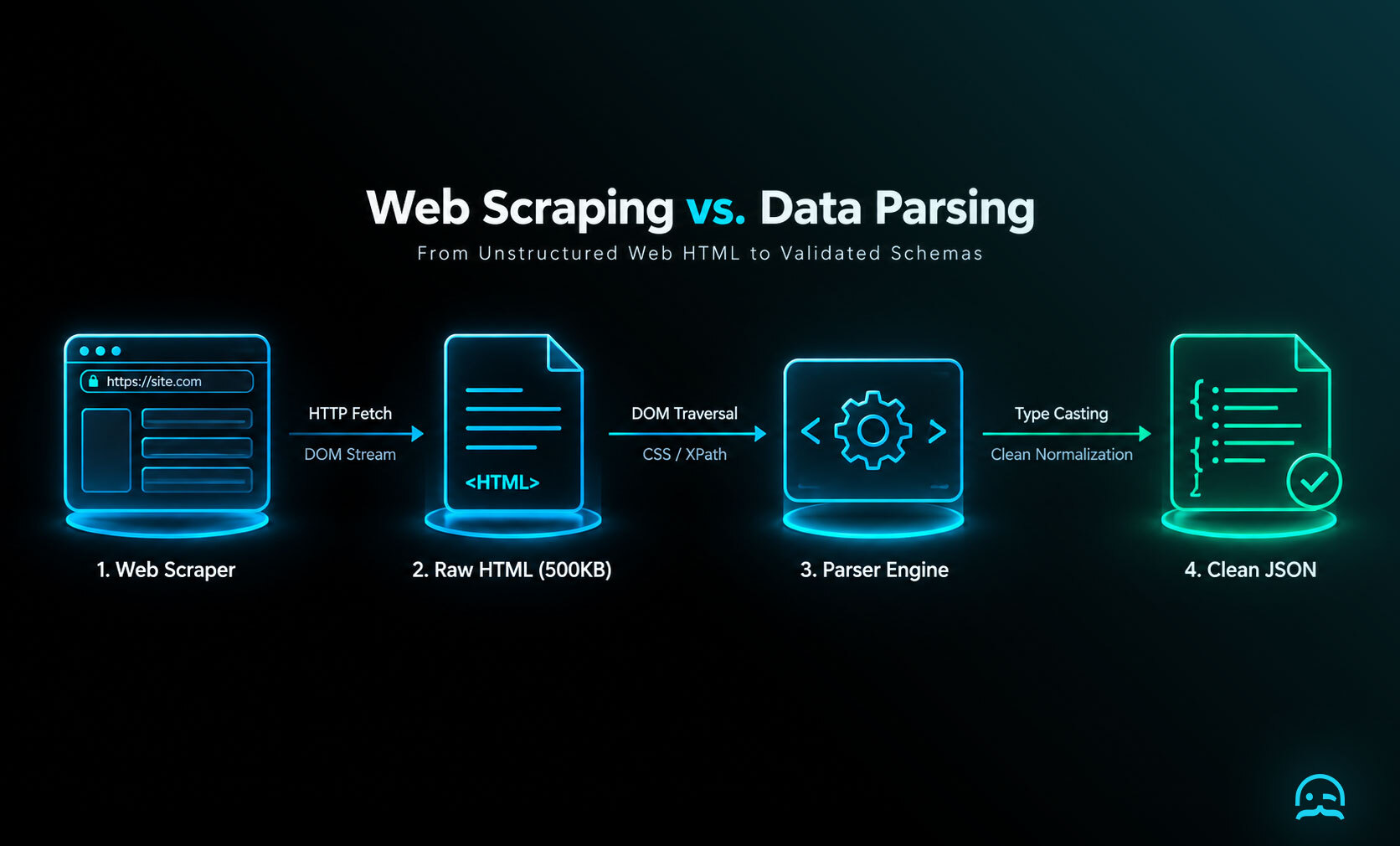
What Is Data Parsing and Why It Matters? Web scraping retrieves a page or response; data parsing turns that response into fields such as a title or price.
from html.parser import HTMLParser

html = """
<article>
  <h1>Noise-Cancelling Headphones</h1>
  <span class="price">$89.99</span>
</article>
"""

class ProductParser(HTMLParser):
    def __init__(self):
        super().__init__()
        self.field = None
        self.product = {}

    def handle_starttag(self, tag, attrs):
        attributes = dict(attrs)
        if tag == "h1":
            self.field = "title"
        elif tag == "span" and attributes.get("class") == "price":
            self.field = "price"

    def handle_data(self, data):
        if self.field:
            self.product[self.field] = data.strip()

    def handle_endtag(self, tag):
        if tag in {"h1", "span"}:
            self.field = None

parser = ProductParser()
parser.feed(html)
print(parser.product)
# {'title': 'Noise-Cancelling Headphones', 'price': '$89.99'}
Why is Data Parsing Important?
What Is Data Parsing and Why It Matters? Data parsing makes information usable for businesses and researchers. It can help you:
- Automate data collection instead of gathering information manually, saving time and reducing errors.
- Gain competitive insights by parsing competitors’ websites for pricing strategies, product availability, and related information.
- Enhance decision-making with informed choices based on current information.
- Support research by collecting large datasets for analysis, helping drive innovation and discovery.
The Data Parsing Process
The question “What Is Data Parsing and Why It Matters?” becomes practical through three steps. First, identify the target data by defining the specific fields or information to collect. Next, extract those fields from the source using an HTML parser, regular expressions, or another suitable parsing tool. Finally, clean the extracted data. Remove irrelevant content. Standardize values as needed. Check that the results are accurate and usable.
HTML, JSON, and XML Choices
What Is Data Parsing and Why It Matters? The answer depends partly on the source format. HTML parsing follows nested tags and attributes, making it useful for page content.
import json
import xml.etree.ElementTree as ET
from html.parser import HTMLParser

json_record = json.loads('{"name": "Ada", "active": true}')
xml_record = ET.fromstring('<user><name>Ada</name></user>')

class TitleParser(HTMLParser):
    def __init__(self):
        super().__init__()
        self.in_title = False
        self.title = []

    def handle_starttag(self, tag, attrs):
        self.in_title = tag == "title"

    def handle_data(self, data):
        if self.in_title:
            self.title.append(data)

parser = TitleParser()
parser.feed('<html><title>Example</title></html>')

print(parser.title[0], json_record["name"], xml_record.findtext("name"))
Tools Used for Data Parsing
Several tools can support data parsing, whether the input is a web page or plain text. HTML parsers analyze page structure and extract selected elements such as text, images, and links. Regular expressions match patterns in text, making them useful for locating specific values or repeated formats. Choose the parser according to the input structure and the consistency of the patterns being extracted.
Challenges and Solutions
Data parsing remains useful, but two challenges require ongoing attention. Website design or layout changes can break parsing scripts. Anti-scraping measures can block or limit automated data extraction. Scripts need maintenance as target sites evolve.
Solutions:
- Use proxies and rotate IP addresses to reduce detection and help prevent scraping activities from being blocked.
- Use a parsing tool that adapts to website changes. It keeps data parsing running when page layouts change.
Introducing MrScraper
MrScraper is designed to simplify data parsing for businesses and researchers. What Is Data Parsing and Why It Matters? In practice, parsing turns website information into usable data. A tool that streamlines this work helps users get started faster. MrScraper lets users extract product prices, reviews, and other selected information through an intuitive interface. Its built-in proxy support and rotating IPs help bypass anti-scraping measures. It also helps keep parsing activity from being noticed. Users can set up a parsing task in a few clicks. They can then extract information from target websites. This gives a quick look at the workflow.
Conclusion
Data parsing turns web data into structured information that supports business and research. What Is Data Parsing and Why It Matters? It matters because automated extraction can reveal competitive insights and support more informed decisions in a data-driven environment. A reliable parsing tool can simplify extraction, help manage common challenges, and provide the information your work requires. Ready to master data parsing? Choose a suitable tool, apply it to your workflow, and unlock more value from the web data you collect.
What We Learned
What Is Data Parsing and Why It Matters? In brief, parsing converts messy source content into fields that people or programs can use. This turns a one-off scrape into a maintainable data workflow.
- Define the output schema before collecting data.
- Keep extraction, normalization, and validation as separate steps.
- Review failed records when the source changes.
Start Exploring Data Parsing Workflows
Use the quickstart guide to explore how MrScraper can support the extraction tasks discussed in this article.
Summarize this post
Open it in your assistant of choice with the prompt ready to send.
Take a Taste of Easy Scraping!

Find more insights here
HTML to Markdown: Converting Scraped Web Pages for LLM Training
Learn how to convert html to markdown for LLM training. Reduce token usage by 90% and improve RAG ac…
What is Scraping? A Complete Beginner's Guide for 2026
Learn what a web scraper is in 2026 and how AI-powered tools are replacing brittle CSS scripts for r…
The Ultimate Web Crawlers List: 15 Tools for Every Data Need
Compare the best web crawlers for 2026. Learn the difference between open-source, managed APIs, and…