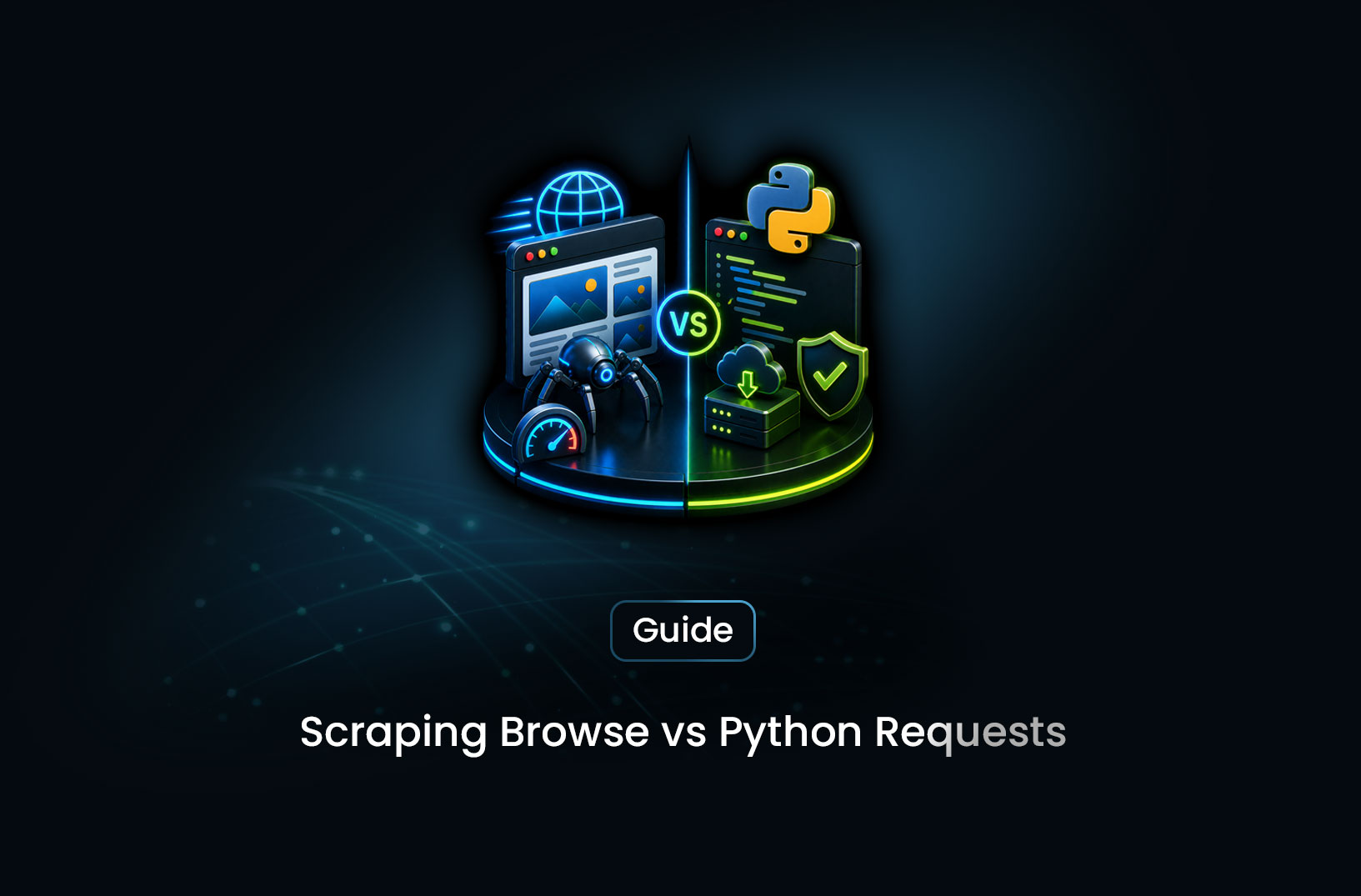
Scraping Browser vs Python Requests: When to Use
Web ScrapingA practical, developer-focused comparison of Python's requests library and browser-based scraping tools. Covers how each works, real code examples for both approaches, and clear guidance on which to choose based on the target website's complexity — from simple static pages to JavaScript-heavy, bot-protected platforms.
Here's a scenario every scraper developer has lived through at least once. You write a clean, elegant Python script using requests. It runs perfectly in your test. You deploy it against the real target and… blank page. Or worse, a 403. Or a JavaScript-rendered ghost town with no data in the HTML whatsoever.
So — which tool do you actually need? The short answer: if the page returns all its data in the initial HTML response, use requests. It's faster, lighter, and simpler. If the page requires JavaScript to render content, login sessions, or has aggressive bot detection, you need a scraping browser. That's the whole decision. Everything else below is the nuance.
What is the Python requests library?
requests is Python's go-to HTTP client library. When you call requests.get("<https://example.com>"), you're sending a raw HTTP GET request and getting back exactly what the server returns — HTML, JSON, XML, whatever the response body contains. No browser. No JavaScript. No rendering. Just a direct network call.
It's the equivalent of fetching a page with curl but with a much nicer Python API. You get headers, cookies, status codes, and the raw response body. If the data you want exists in that raw body, you're done. If it doesn't — because it's loaded dynamically via JavaScript after the initial page load — you have a problem.
What is a scraping browser?
A scraping browser is a real (or headless) browser — typically Chromium-based — that a scraping tool controls programmatically. Unlike requests, it actually loads the page the way a real user would: it runs JavaScript, executes API calls, renders the DOM, handles cookies and sessions, and interacts with the page.
Think of it as the difference between ordering a pizza ingredient list versus going to the restaurant and watching the chef assemble it in front of you. With requests you get the ingredient list. With a scraping browser, you see the finished dish.
Tools like Playwright and Puppeteer give you programmatic browser control. Cloud-based scraping browsers — like MrScraper's Scraping Browser — go further by adding anti-bot fingerprinting, CAPTCHA handling, and rotating infrastructure on top, so you don't have to manage any of that yourself.
Side-by-side: what each tool is good at
Python requests
Fast, lean, direct
- Static HTML pages
- Public APIs (JSON/XML responses)
- High-volume, low-latency jobs
- Minimal server footprint
- Simple pagination scraping
For dynamic sites
Scraping browser
Full rendering, bot bypass
- JavaScript-rendered content
- Infinite scroll / lazy load
- Login flows & session state
- Anti-bot / CAPTCHA pages
- SPAs (React, Vue, Angular)
Step-by-step: scraping with Python requests
Let's start with the simple case. Say you want to grab article headlines from a static news page. Here's the full workflow:
import requests
from bs4 import BeautifulSoup

url = "<https://example-news-site.com/tech>"
headers = {
    "User-Agent": "Mozilla/5.0 (Windows NT 10.0; Win64; x64) AppleWebKit/537.36"
}

response = requests.get(url, headers=headers)  # Send the HTTP request
response.raise_for_status()                    # Blow up loudly if something went wrong

soup = BeautifulSoup(response.text, "html.parser")  # Parse the HTML
headlines = soup.select("h2.article-title")         # CSS selector for the headlines

for h in headlines:
    print(h.get_text(strip=True))
Clean, right? The User-Agent header matters here — without it, many servers will reject your request outright or return a stripped-down response. According to the requests documentation, the library doesn't set a User-Agent by default, so adding one is a small but important habit to build.
Here's where this approach falls apart: if those headlines are loaded by a JavaScript fetch call after the initial page load, response.text won't contain them. You'll parse an empty shell and wonder what went wrong.
Step-by-step: scraping with a browser (Playwright + MrScraper)
Now let's tackle the harder case — a JavaScript-rendered product page. Using Playwright locally looks like this:
from playwright.sync_api import sync_playwright

with sync_playwright() as p:
    browser = p.chromium.launch(headless=True)
    page = browser.new_page()

    page.goto("<https://example-shop.com/products>")  # Full browser load
    page.wait_for_selector(".product-card")         # Wait until JS renders the cards

    products = page.query_selector_all(".product-card")

    for product in products:
        name = product.query_selector(".product-name").inner_text()
        price = product.query_selector(".product-price").inner_text()
        print(f"{name}: {price}")

    browser.close()
This works great for a handful of pages. But here's where it gets interesting — if the site has bot detection or rate limiting, your headless browser will start getting blocked pretty quickly. Real production scraping at scale means managing browser fingerprints, rotating IPs, handling CAPTCHAs, and dealing with session expiry. That's a lot of infrastructure to maintain yourself.
At this point, tools like MrScraper's Scraping Browser start to make a lot of sense. It handles all of that complexity under the hood — anti-bot evasion, CAPTCHA bypass, and residential proxy rotation — so you can focus on the extraction logic rather than fighting the infrastructure. You connect to it the same way you'd use a remote Playwright endpoint, and it does the heavy lifting.
The real decision: how to know which tool you need
Here's the fastest way to figure it out. Open your browser's DevTools, disable JavaScript (under Settings → Debugger → Disable JavaScript in Chrome), then reload the page. Does the content you want still appear? If yes — requests will work. If the page goes blank or loads without your target data — you need a browser.
A second quick check: open the Network tab in DevTools and look for XHR/Fetch requests. If the data is being loaded via a separate API call, you might actually be able to hit that API endpoint directly with requests — often cleaner than spinning up a full browser just to scrape the rendered output.
Common pitfalls to watch out for
With requests:
Forgetting headers. Some servers block requests with no User-Agent. Always set at least a User-Agent. Adding Accept and Accept-Language headers makes your request look even more like a real browser.
Not handling rate limiting. Hammering a server without delays will get your IP blocked fast. Add a time.sleep() between requests, or better yet, use exponential backoff on retries.
Assuming the HTML structure won't change. CSS selectors break when a site redesigns. Build in some resilience with try/except around your parsing logic.
With scraping browsers:
Not waiting for elements. Always use wait_for_selector() or wait_for_load_state("networkidle") instead of fixed time delays. Fixed delays are fragile — elements can take longer than expected, or arrive faster and waste time.
Over-engineering for simple sites. Spinning up a full browser for a basic static page is like using a sledgehammer to hang a picture frame. Match the tool to the target.
Conclusion
The choice between requests and a scraping browser isn't really about which is "better" — it's about matching the right tool to the right problem. Start with requests. It's faster to write, faster to run, and easier to debug. Only step up to a browser when the site forces your hand.
And when you do need a browser — especially at scale — don't underestimate the operational overhead. Managing headless browsers across dozens of concurrent sessions, with rotating proxies and CAPTCHA handling, is a full-time job. That's exactly the problem purpose-built scraping infrastructure is designed to solve.
What we learned
- Use
requestsfor static HTML pages and direct API endpoints — it's faster and simpler. - Use a scraping browser whenever JavaScript renders the content you need, or the site has bot protection.
- The DevTools "disable JavaScript" trick is the fastest way to determine which tool a site requires.
- Check for direct XHR/Fetch API calls first — sometimes you can skip the browser entirely by hitting the underlying API.
- Always set realistic HTTP headers with
requestsand always use element selectors (not fixed delays) with Playwright. - At scale, managing browser infrastructure yourself gets expensive fast — cloud scraping browsers handle the hard parts.
FAQ
Can I use requests with JavaScript-heavy sites if I find the API endpoint?
Yes, and this is often the best approach. Open DevTools → Network → XHR/Fetch and look for the API call that returns your data. If the endpoint is public, you can call it directly with requests and get clean JSON back — no browser needed.
Is Playwright always the right browser scraping tool?
Playwright is excellent for local development and moderate-scale jobs. For large-scale production scraping with anti-bot requirements, a managed scraping browser service handles fingerprinting, CAPTCHA solving, and proxy rotation so you don't have to.
Does requests work for sites that require login?
Sometimes. If the login form submits a plain POST request, you can replicate that with requests and maintain session state using a requests.Session(). But if the login flow uses JavaScript redirects, OAuth, or complex cookie handling, a browser is more reliable.
How much slower is a scraping browser compared to requests?
Significantly — a full browser page load typically takes 2–10 seconds versus milliseconds for a requests call. For high-volume jobs, this difference compounds quickly. Only use a browser when the site requires it.
Summarize this post
Open it in your assistant of choice with the prompt ready to send.
Take a Taste of Easy Scraping!

Find more insights here
The Ultimate Web Crawlers List: 15 Tools for Every Data Need
Compare the best web crawlers for 2026. Learn the difference between open-source, managed APIs, and…
Web Scraping MCP Server: Giving AI Agents Direct Access to Live Web Data
Learn how a Web Scraping MCP Server gives AI agents live web access while reducing token costs by 87…
Scaling E-commerce Competitive Intelligence with Automated Data Harvesting
Scale e-commerce data harvesting with residential proxies and AI. Learn how modern data extraction s…