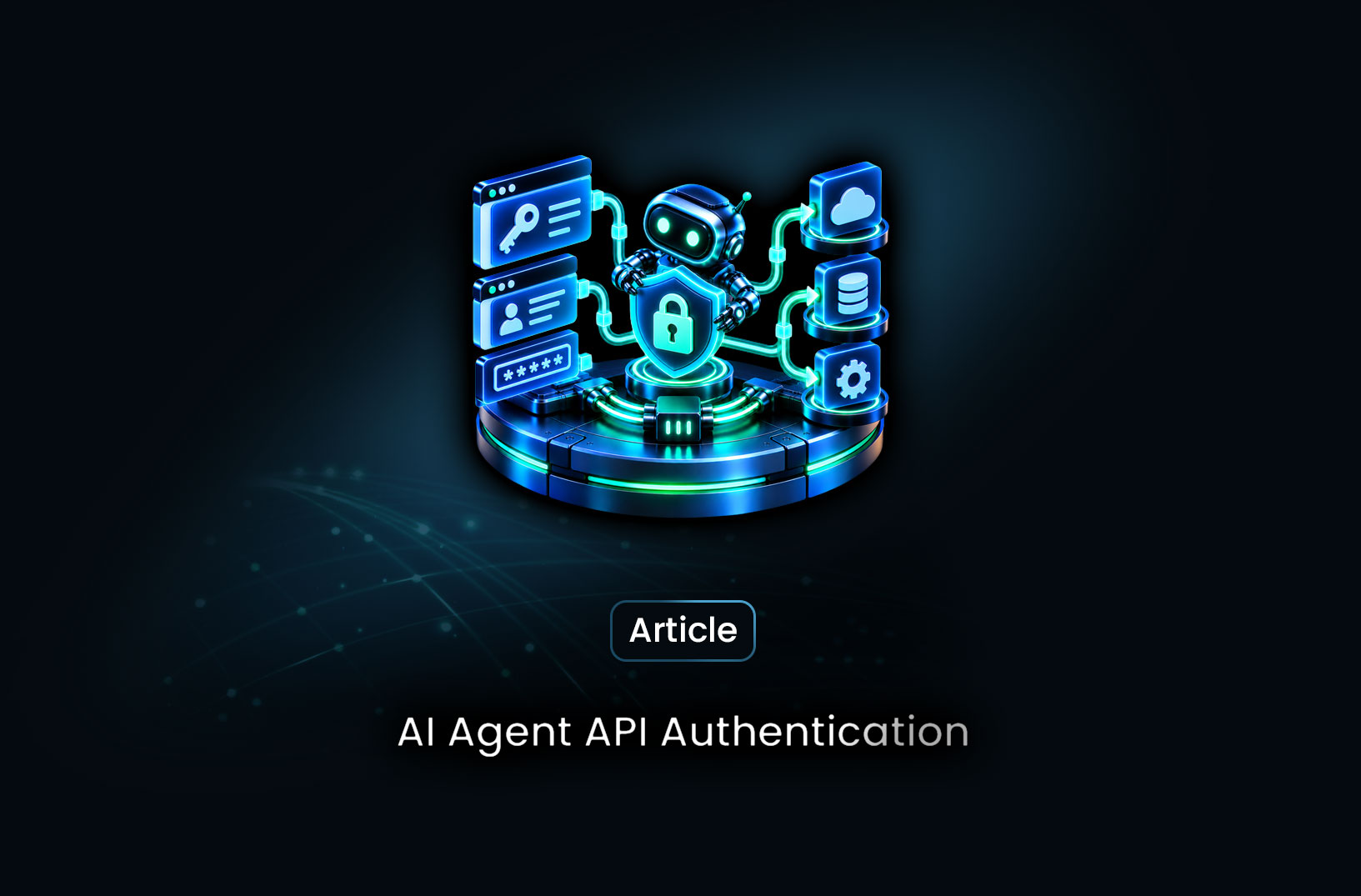
Authenticate Web Data Tools for AI Agents Without Exposing Secrets
AI & Machine LearningLearn when to use API keys or OAuth for AI agent tools, where credentials should live, how to separate user and service access, and how to audit every tool call.
An AI agent needs credentials to call a web data API. The hard part is keeping those credentials away from the agent itself.
Anything the model can see, it can repeat. A key in a system prompt can show up in an answer. A key in browser code can be copied by anyone who opens the developer tools. A key in a log file can be read by anyone with log access.
Scraped pages add another risk. A web page can contain text that tries to get the agent to reveal its instructions or secrets. If the model never has the key, it cannot leak it.
This guide shows how to set up authentication so the agent can use web data tools without ever seeing a secret.
Two ways to connect
Most teams use one of two patterns:
- Your backend owns the key. Your server holds a MrScraper API token. The agent calls your tools, and your server calls MrScraper.
- Each user connects their own account. A person signs in to MrScraper through their MCP client, such as Claude Code or Codex. The client handles the sign-in, and the agent uses that person's access. The next section covers when to use each one.
When should you use API keys or OAuth?
| Use an API key when | Use OAuth when |
|---|---|
| Your app calls MrScraper on its own behalf | A person connects their own MrScraper account |
| The call runs on your server, a job runner or CI | The call runs from that person's MCP client |
| One account pays for and owns the usage | Each person's usage should stay on their account |
| You control where the key is stored | You do not want anyone to copy or paste a key |
API keys for your backend
MrScraper API tokens are created in the dashboard under API Tokens. Each token has a name and an expiration date. You can create more than one, so you can give each environment or app its own token. See the API token docs for the steps.
The REST API reads the token from the x-api-token header. The Scraper API examples also pass it as a token query parameter. Your server sends both. The agent never sees either.
OAuth for people using MCP clients
The hosted MrScraper MCP server at https://mcp.mrscraper.com/mcp supports OAuth 2.1. The client opens a browser, the person signs in, and no key is copied anywhere.
To add it in Claude Code:
claude mcp add --transport http --scope user mrscraper https://mcp.mrscraper.com/mcp
To add it in Codex:
codex mcp add mrscraper --url https://mcp.mrscraper.com/mcp
OAuth access uses scopes:
scrape:readcovers thescraperAPIandwebSearchtools.account:readcovers thestatustool. If a client calls a tool without the right scope, the server refuses it with a 403insufficient_scopeerror. Grant only the scopes a person needs.
When a client does not support OAuth
Some MCP clients cannot do the browser sign-in. For those, the MCP server accepts an API key as a bearer token in the Authorization header. If you run it locally over stdio, it reads the key from the MRSCRAPER_API_KEY environment variable.
Point the client at the variable name, not the value, when it lets you. Codex supports this with a flag:
codex mcp add mrscraper --url https://mcp.mrscraper.com/mcp \
  --bearer-token-env-var MRSCRAPER_API_KEY
If a client config file must hold the key, keep that file out of version control and readable only by you.
Where should credentials live?
Keep credentials on the server, in one place, loaded once.
Safe places
- An environment variable on your server
- Your cloud provider's secrets manager
- Your CI system's secret store, for batch jobs
Unsafe places
- System prompts, user messages or tool results
- Tool input schemas, where the model would fill in the key
- Browser code, including front-end environment variables that get bundled into the page
- Your git repository
- Logs, error messages and analytics events MrScraper's docs say the same thing: never expose your API token in client-side code.
Load the key once and keep it out of tool inputs
Read the key when the server starts. If it is missing, fail right away. Your tool functions use it directly, so it never appears in a tool schema or in anything the model sends.
import os
import requests

MRSCRAPER_URL = "https://api.mrscraper.com/"
TOKEN = os.environ.get("MRSCRAPER_API_TOKEN")
if not TOKEN:
    raise RuntimeError("MRSCRAPER_API_TOKEN is not set")


def fetch_markdown(url: str) -> dict:
    response = requests.post(
        MRSCRAPER_URL,
        params={"token": TOKEN, "markdown": "true"},
        headers={"x-api-token": TOKEN, "Content-Type": "application/json"},
        json={"url": url, "maxRetries": 2},
        timeout=330,
    )
    response.raise_for_status()
    return response.json()
Notice that fetch_markdown takes only a URL. There is no api_key argument for the model to fill in.
Scrub secrets from anything that leaves the server
Because the Scraper API examples put the token in the URL, a raw request URL can contain your key. Error messages from HTTP libraries often include that URL. So scrub every string before it goes to the model, a log or the browser.
import re


def scrub(text: str) -> str:
    text = text.replace(TOKEN, "[REDACTED]")
    return re.sub(r"([?&]token=)[^&\s]+", r"\1[REDACTED]", text)


def safe_error(error: Exception) -> str:
    return scrub(str(error))
Use safe_error whenever you turn an exception into a tool result or a log line. Also check that your web server, load balancer and monitoring tools do not log full query strings for these requests.
Put a tool gateway between the browser and the API
If your agent runs in a web app, the browser should talk to your server, never to MrScraper. Your server checks who the user is, then runs the tool.
Browser  ->  Your server (checks user, runs tool)  ->  MrScraper API
            holds MRSCRAPER_API_TOKEN
The browser sends its own session cookie or token to your server. Your server holds the MrScraper token. These are two different credentials, and that difference is the key to the next section.
How do you separate user and service access?
There are two kinds of access in an agent app:
- User access answers "who is asking?" Your app's own login handles this.
- Service access answers "what is allowed to call MrScraper?" Your server's MrScraper token handles this. Never pass the service token to a user, and never let a user's request choose which token to use.
Decide what each user can do
Your app should decide which tools each user can run and how much they can use. MrScraper sees one token. Your app knows which person is behind each call.
ROLE_TOOLS = {
    "viewer": {"fetch_markdown"},
    "analyst": {"fetch_markdown", "extract_page"},
}
DAILY_TOKEN_LIMIT = {"viewer": 200, "analyst": 2000}


class AccessDenied(Exception):
    pass


def authorize(user: dict, tool: str, used_today: int) -> None:
    if tool not in ROLE_TOOLS.get(user["role"], set()):
        raise AccessDenied(f"{user['role']} cannot use {tool}")
    if used_today >= DAILY_TOKEN_LIMIT[user["role"]]:
        raise AccessDenied("Daily usage limit reached")
Each MrScraper response reports token_usage. Add it to the user's daily total after every call. That way one user cannot use up the whole account.
Use separate tokens for separate jobs
Create one MrScraper token for each environment and each app. For example:
prod-research-agentstaging-research-agentnightly-batch-jobsThis gives you three benefits. A leak in staging does not affect production. Each token's name shows up in your audit log. And you can replace one token without touching the others.
Set an expiration date on each token, and plan the swap before it expires. Create the new token, deploy it, check that calls succeed, and then retire the old one.
When users bring their own accounts
Sometimes each user should use their own MrScraper account. In that case, skip the shared service token. Have each person connect through the hosted MCP server with OAuth. Their usage stays on their account, and the scopes limit what the client can do.
How do you audit tool calls?
An audit log answers "who called which tool, on what, and what happened?" It is how you spot misuse, debug failures and explain costs.
Log what helps, skip what hurts
| Log this | Do not log this |
|---|---|
| Time, request ID and user ID | The API token or any part of it |
| Tool name | Full request URLs with query strings |
| Target host and path | Full tool arguments, if they may hold private data |
| A hash of the arguments | Full page content |
| Result: success or error code | Raw exception text before scrubbing |
token_usage and runtime |
|
The MrScraper token's name, like prod-research-agent |
Wrap every tool call
This wrapper checks access, runs the tool and writes one JSON line per call.
import hashlib
import json
import time
import uuid
from urllib.parse import urlparse

TOKEN_NAME = os.environ.get("MRSCRAPER_TOKEN_NAME", "unnamed")


def audited_call(user: dict, tool: str, fn, url: str, used_today: int, **kwargs):
    entry = {
        "time": time.strftime("%Y-%m-%dT%H:%M:%SZ", time.gmtime()),
        "request_id": uuid.uuid4().hex,
        "user_id": user["id"],
        "tool": tool,
        "target": urlparse(url).netloc + urlparse(url).path,
        "args_hash": hashlib.sha256(
            json.dumps({"url": url, **kwargs}, sort_keys=True).encode()
        ).hexdigest()[:16],
        "token_name": TOKEN_NAME,
    }
    try:
        authorize(user, tool, used_today)
        result = fn(url, **kwargs)
        entry.update(status="ok", token_usage=result.get("token_usage"),
                     runtime=result.get("runtime"))
        return result
    except AccessDenied as e:
        entry.update(status="denied", error=str(e))
        raise
    except requests.HTTPError as e:
        code = e.response.status_code if e.response is not None else None
        entry.update(status="error", http_status=code, error=safe_error(e))
        raise
    finally:
        with open("tool_audit.jsonl", "a") as log:
            log.write(json.dumps(entry) + "\n")
The finally block writes the entry whether the call worked, failed or was denied.
Review the log
Check for these patterns on a regular schedule:
- 401 errors. A token is missing, wrong or expired. Our guide to 401 Unauthorized vs 403 Forbidden explains what each code means.
- Usage spikes. One user or one token suddenly uses far more than normal.
- New targets. The agent starts calling hosts your team has not approved.
- Many denied calls. A user, or a prompt, keeps trying tools it should not use.
FAQs
When should you use API keys or OAuth?
Use an API key when your own server calls MrScraper for your app, such as a backend tool or a batch job. Use OAuth when a person connects their own MrScraper account through an MCP client. The hosted MrScraper MCP server supports OAuth 2.1 sign-in with scopes.
How do you audit tool calls?
Wrap every tool call in code that writes one log entry. Record the time, user, tool, target host and path, an argument hash, the result and the usage. Never record the token or full URLs with query strings. Review the log for 401 errors, usage spikes and unexpected targets.
Which parts does MrScraper provide, and which parts must my application implement?
MrScraper is a developer-focused web data API. It provides named API tokens with expiration dates, a REST API that reads the token from a request header, and a hosted MCP server with OAuth 2.1 sign-in and scopes. Each response reports token usage and runtime.
Your application owns everything around that. This includes where the key is stored, the tool gateway, user login, roles and limits, scrubbing secrets from errors and logs, the audit log and token swaps. Your team also decides which sources it has permission to collect from.
Summarize this post
Open it in your assistant of choice with the prompt ready to send.
Take a Taste of Easy Scraping!

Find more insights here
Build an Agent Harness for Repeatable Web Research
Build a small agent harness in Python that saves job state, enforces tool and page budgets, and chec…
Design Reliable Web Data Tools for AI Agents
Learn how to define clear inputs, structured results and honest errors for the web data tools your A…
Build a Context Layer for an AI Agent Using Web Data
Build a small context service that fetches web data for each agent task, tracks source versions per…