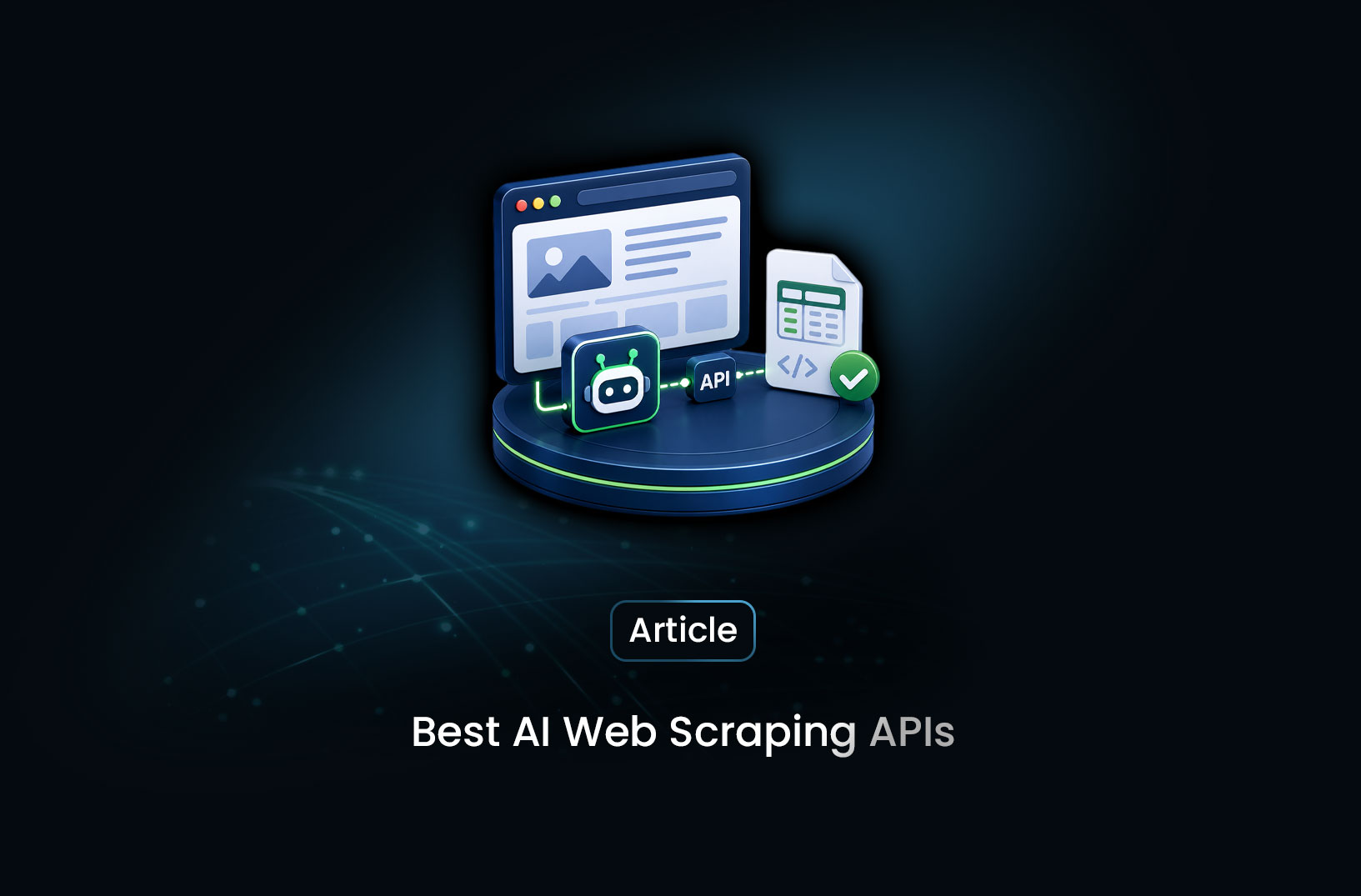
Best AI Web Scraping APIs in 2026 (Free & Paid Options)
AI & Machine LearningCompare the best AI web scraping APIs in 2026 — LLM extraction, anti-bot handling, free tiers, and which AI scraping API fits your use case.
Selector-based scraping breaks. CSS class names change, layouts shift, and what worked last month fails silently this month. The web moves too fast for brittle extraction pipelines to keep up — and for anyone building data workflows at scale, that maintenance burden adds up to something that's genuinely painful.
AI web scraping APIs solve this by replacing structural selectors with semantic understanding. Instead of pointing at a specific HTML element, you describe what you want — product names, article body text, pricing data — and the API's underlying LLM or machine learning model locates and extracts it, regardless of how the page is built or how it changes over time. The result is extraction that generalizes across sites and adapts to layout changes without manual intervention. In this guide, we compare the best AI scraping APIs in 2026 across the dimensions that actually matter: extraction quality, anti-bot capability, JavaScript rendering, free tier access, and pricing — so you can pick the right tool without a lengthy trial-and-error evaluation.
By the end, you'll have a clear picture of which platforms are built for which use cases, what you get on free tiers versus paid plans, and what to prioritize when evaluating an AI-powered scraping tool for your specific workflow.
Table of Contents
- What Are AI Web Scraping APIs?
- How AI Scraping APIs Work
- Best AI Web Scraping APIs in 2026
- Free vs. Paid: What You Actually Get
- Key Features to Look For in an AI Scraping API
- When Should You Use an AI Web Scraping API?
- Common Challenges and Limitations
- Conclusion
- What We Learned
- FAQ
What Are AI Web Scraping APIs?
AI web scraping APIs are managed data extraction services that use machine learning — primarily large language models (LLMs) and computer vision models — to identify and extract structured information from web pages without requiring manually defined CSS selectors or XPath schemas.
Traditional scraping APIs gave you a rendered page and expected you to write the extraction logic yourself. AI scraping APIs take it further: you specify what data you want, and the API handles both the fetching and the extraction. The extraction layer understands page content semantically — it can identify a product price, an article author, or a job listing salary by comprehending what those things are in context, not by knowing which HTML element they live in.
This makes AI web scraping APIs particularly valuable for three scenarios. First, scraping at scale across many different sites, where writing individual selectors per domain is impractical. Second, scraping targets that update their layouts frequently, where selector-based pipelines require constant maintenance. Third, building AI-native workflows — RAG pipelines, LLM training datasets, knowledge bases — where the consuming system expects clean, structured or markdown-formatted content rather than raw HTML.
The API web scraping comparison space has matured significantly in 2026. Platforms now offer varying combinations of LLM extraction, computer vision, anti-bot infrastructure, JavaScript rendering, and pre-built output schemas — and the right choice depends heavily on which of these capabilities your use case actually requires.
How AI Scraping APIs Work
The core pipeline behind most AI scraping APIs runs through four stages, though implementations differ significantly in how they handle each one.
Stage 1 — Fetch and render. The API sends a request to the target URL. If the page requires JavaScript execution — which most modern sites do — a headless browser renders the full DOM before any extraction happens. This is where anti-bot infrastructure matters: sites protected by Cloudflare, CAPTCHA challenges, or browser fingerprinting need to be handled at this stage before the page content is even accessible.
Stage 2 — Content preparation. Raw HTML is noisy — scripts, styles, navigation, ads, and footer content surround the data you actually want. Most AI extraction pipelines clean and simplify the page representation before passing it to the extraction model, either converting it to clean markdown, pruning the DOM to content-dense regions, or taking a screenshot for vision-based approaches.
Stage 3 — LLM or model extraction. The prepared content is passed to the extraction model — an LLM, a computer vision model, or a custom-trained extraction model — with a prompt or schema describing the target data. The model identifies and extracts the relevant fields, returning structured output: JSON, markdown, or CSV.
Stage 4 — Delivery. The structured result is returned via the API response or delivered to a configured webhook endpoint for asynchronous jobs. Some platforms also offer schema validation and fallback handling when the model's extraction confidence is low.
The variation across platforms is primarily in Stage 1 (how well they handle bot-protected and JS-rendered targets) and Stage 3 (the quality and flexibility of the extraction model). Both matter — a platform with excellent extraction that can't get through Cloudflare is useless for real-world commercial targets.
Best AI Web Scraping APIs in 2026
1. MrScraper
MrScraper is built for teams that need AI-powered extraction and anti-bot infrastructure under one managed API — rather than wiring together a browser automation tool, a proxy network, and an LLM extraction layer separately.
The core of MrScraper's offering is its Scraping Browser: a managed headless browser environment that handles JavaScript rendering, Cloudflare bypass, CAPTCHA challenges, and fingerprint spoofing natively. On top of this, the AI extraction layer identifies and extracts target data semantically — so layout changes on a target site don't break your extraction configuration. You describe what you want; MrScraper finds it regardless of where the site chooses to put it.
Best for: Developer teams scraping bot-protected, JavaScript-heavy, or frequently-changing targets who want a single API covering the full stack from browser rendering to structured output. Particularly strong for e-commerce, financial data, and any vertical where target sites invest in anti-bot protection.
SDKs: Python and Node.js
Pricing: Tiered plans publicly available at https://mrscraper.com — no sales call required to evaluate.
2. Diffbot
Diffbot is one of the longest-established AI web scraping platforms, having applied machine learning to extraction since well before "AI scraping" became a marketing category. Its extraction models are trained specifically for common web content types — articles, products, job listings, discussions, events — and can extract structured data from these page types with high reliability across diverse sites.
Its Knowledge Graph offering goes further than extraction: it maintains a continuously updated database of structured facts extracted from across the web, queryable via API — useful for research, enrichment, and monitoring use cases that don't require custom scraping logic.
Best for: Enterprises needing high-confidence extraction for well-defined content types (news articles, product catalogs, job listings) at scale. Strong for research teams who want pre-built data rather than building their own pipeline.
Pricing: Enterprise-focused; custom pricing. Free trial available. Current details at https://www.diffbot.com/products/automatic/.
3. Firecrawl
Firecrawl is purpose-built for the AI application builder market — teams feeding scraped web content into RAG systems, LLM fine-tuning datasets, knowledge bases, and AI-native search tools. Rather than returning JSON objects with specific extracted fields, Firecrawl converts web pages (and entire websites through its crawl mode) into clean, LLM-ready markdown, stripping boilerplate and preserving semantic structure in a format that language models ingest well.
It's the right choice when your downstream consumer is an LLM — when the goal is getting clean web content into an AI pipeline rather than extracting specific structured fields for a database.
Best for: AI developers, RAG pipeline builders, and teams building LLM-powered products that need clean web content as input. Less suited for traditional structured data extraction with specific field schemas.
Free tier: Available. Documentation and pricing at https://docs.firecrawl.dev.
4. Apify
Apify is a large-scale scraping infrastructure platform with an ecosystem of pre-built "Actors" — scrapers for specific websites and use cases that the community has already built, tested, and published. Its AI integration layer has expanded significantly: actors that use LLM-based extraction are increasingly common in the marketplace, and Apify provides infrastructure for building, scheduling, and running AI-augmented scrapers at scale.
The value proposition is breadth: if someone else has already built an actor for your target site or content type, you can deploy it without writing any extraction logic. For custom targets, you build your own actor using Apify's SDK. The platform handles scheduling, proxy management, and output storage.
Best for: Teams that want pre-built scrapers for common targets (social media, e-commerce, job sites), or developers who want managed infrastructure for deploying custom scrapers at scale. Strong free tier for exploratory use.
Documentation and pricing: https://docs.apify.com
5. ZenRows
ZenRows is a managed scraping API that combines anti-bot bypass infrastructure with AI-powered extraction, positioned as a developer-friendly alternative to managing proxies, headless browsers, and extraction logic separately. It handles JavaScript rendering, residential proxy rotation, and CAPTCHA handling, with an AI extraction layer that supports structured field extraction via schema definitions.
Compared to MrScraper, ZenRows is generally stronger on proxy network breadth and has a longer track record in the anti-bot infrastructure space. The extraction layer is newer and less mature on complex or unusual page structures. Both are solid choices for teams that want managed anti-bot + extraction; the right pick depends on how much your use case leans toward infrastructure reliability versus extraction sophistication.
Best for: Developers who want reliable anti-bot bypass with extraction capability and a straightforward API. Good fit for moderate extraction complexity on heavily protected targets.
Documentation and free trial: https://www.zenrows.com/docs
Free vs. Paid: What You Actually Get
Every platform on this list offers some form of free access, but the gap between free and paid tiers is meaningful and worth understanding before you commit to an evaluation.
Free tiers across AI scraping APIs typically provide a capped number of API calls or credits per month — enough to build a proof of concept, test against your actual target sites, and validate that the extraction quality meets your needs. What they generally don't include is the production-grade infrastructure: higher concurrency, priority request queuing, advanced anti-bot features, dedicated support, and the volume capacity to run a real data pipeline. Firecrawl and Apify both have genuinely useful free tiers for developers. MrScraper's public tiered pricing makes the upgrade path clear at each stage.
Paid tiers unlock the capabilities that actually matter in production: higher request volumes, faster response times, more sophisticated anti-bot handling, and support responsiveness when something breaks before your data deadline. Pricing models vary — per-API-call, per-page, per-GB of content processed, or flat monthly tiers — and modeling your expected usage against the pricing structure before committing is worth the effort. For current pricing, always check the provider's website directly; rates in the AI infrastructure space have been shifting as the market matures.
Enterprise pricing (Diffbot, and to varying degrees others) requires a sales conversation before you can evaluate cost — which adds friction for smaller teams and startups. When pricing transparency matters to your evaluation process, platforms with public pricing pages remove a meaningful barrier.
Key Features to Look For in an AI Scraping API
Not every feature matters equally for every use case. Here's what to actually evaluate:
- Anti-bot and CAPTCHA bypass: This is the threshold capability. A platform that produces beautiful structured output but can't get through Cloudflare on your target sites isn't useful. Test against your actual targets before choosing — don't assume anti-bot capability from feature descriptions alone.
- JavaScript rendering quality: Full Chrome-engine rendering for JS-heavy SPAs is different from basic JS execution. If your targets use React, Next.js, or similar front-end frameworks to deliver content, confirm the platform renders them completely before extraction runs.
- Extraction flexibility: Can you define a custom schema, or does the platform only support pre-built content types? Custom schema support is essential for targets that don't fit the article/product/listing pattern.
- LLM or model quality for your content type: Extraction accuracy varies significantly by content type and platform. Run extraction against representative pages from your actual targets, not generic benchmark pages.
- Output format compatibility: Do you need JSON with typed fields? Clean markdown for an LLM pipeline? CSV? Make sure the platform's output format works with your downstream system without significant transformation.
- Webhook and async support: For high-volume jobs, synchronous request-response isn't practical. Webhook-based async delivery is the production pattern — confirm the platform supports it.
- Transparent pricing: Can you model your costs before signing up? Public tiered pricing with clear volume and feature breakdowns is a signal of platform maturity and buyer respect.
When Should You Use an AI Web Scraping API?
Use an AI scraping API when:
- You're extracting data from many different sites and writing per-site selector schemas is impractical
- Your target sites update their layouts frequently and you need extraction that adapts without manual maintenance
- You're building an AI-native workflow (RAG, knowledge base, LLM training) that needs clean, structured web content as input
- Your targets include bot-protected, JavaScript-rendered pages that require managed browser infrastructure to access
- You want to move fast — deploying an AI API integration is faster than building and maintaining a custom scraping stack
Consider traditional selectors or custom scrapers when:
- You're scraping one or two stable, well-structured sites where selector maintenance is genuinely low
- You need very high volume at minimal cost, and the per-call pricing of managed AI APIs doesn't fit your economics
- You have a specialized extraction requirement that no managed API handles well, and the custom logic you'd build outperforms what any general-purpose model produces
Common Challenges and Limitations
Extraction accuracy is probabilistic, not deterministic. LLM-based extraction produces the right answer most of the time — but not every time. Field misidentification, hallucinated values, and formatting artifacts are all real failure modes that require validation logic before data enters production systems. The more unusual your target page's content structure, the more frequently extraction needs human or automated review.
Anti-bot capability varies dramatically across providers — and across targets. No platform's marketing describes the sites it struggles with. The only reliable way to know whether a platform handles your specific target is to test it. Bot protection evolves continuously, and a platform that handles your target today may struggle after the target updates its protection layer.
Cost at scale requires careful modeling. AI scraping APIs bill per call, per page, or per volume of content processed — and costs compound quickly at high volume. Before committing to a platform for a high-volume pipeline, model your expected monthly cost against actual usage. The per-call cost of AI extraction is meaningfully higher than traditional proxy-plus-selector approaches, and the economic trade-off makes more sense as extraction maintenance costs are factored in. According to research by Andreessen Horowitz on AI infrastructure economics, the cost of LLM inference has been declining rapidly — which is improving the economics of AI-powered extraction at scale over time.
Context window limits affect very large pages. LLMs have a maximum context size, and very large pages — extensive data tables, search results with hundreds of items, extremely long articles — may require chunking before extraction. Most commercial platforms handle this internally, but it's worth confirming for your specific content type if you're working with unusually large pages.
Output schema consistency requires prompt engineering discipline. Getting consistently structured output across varied page types from the same LLM requires well-designed extraction prompts and schema specifications. Platforms that expose extraction configuration give you control and responsibility over this; platforms with pre-built extractors trade control for simplicity. Know which side of that trade-off your use case sits on. According to the TLDR Newsletter's recent survey of developer AI tooling adoption, inconsistent structured output remains one of the top friction points reported by teams adopting LLM-based data pipelines.
Conclusion
AI web scraping APIs have crossed from early-adopter novelty to practical production infrastructure in 2026. The case for using them over maintaining selector-based scrapers is clearest for teams scraping many sites, scraping frequently-updated targets, or building AI-native data pipelines where clean structured output is the primary goal.
The right platform depends on your specific priorities. MrScraper is the strongest fit for teams that need anti-bot infrastructure and AI extraction together under one managed API — particularly for bot-protected or JavaScript-heavy targets. Firecrawl is purpose-built for AI application builders who need LLM-ready markdown. Diffbot leads on pre-trained extraction quality for well-defined content types at enterprise scale. Apify is the breadth play, with a large ecosystem of pre-built actors and flexible infrastructure for custom development. ZenRows is a solid alternative for teams where anti-bot reliability is the primary requirement.
Test the candidates against your actual targets before committing. The platform that performs best on your real pages is the one that matters, regardless of which features any marketing page lists.
What We Learned
- AI scraping APIs replace selector maintenance with semantic extraction: The core value proposition is that layout changes stop breaking your pipeline — the model finds data by what it means, not where it lives in the HTML.
- Anti-bot capability and extraction quality are both required: A platform that extracts beautifully from unprotected pages but fails on Cloudflare-protected targets is useless for most real-world commercial use cases — test both dimensions.
- The right platform depends on your consuming system: Firecrawl for LLM pipelines, Diffbot for high-confidence structured extraction at enterprise scale, MrScraper for bot-protected targets requiring a full-stack managed API, Apify for pre-built actor ecosystems.
- Free tiers are for evaluation, not production: Validate extraction quality and anti-bot performance on your real targets during the free tier, then model paid costs before committing to a production pipeline.
- Probabilistic extraction requires validation infrastructure: LLMs produce the right answer most of the time — the architecture around the API (field validation, confidence thresholds, anomaly detection) determines whether "most of the time" is good enough for your use case.
- Pricing transparency is a meaningful selection signal: Platforms with public pricing let you evaluate cost fit before a sales conversation; custom-quoted enterprise pricing creates friction that affects how quickly teams can make and adjust decisions.
FAQ
What is an AI web scraping API?
An AI web scraping API is a managed service that uses machine learning — typically large language models or computer vision models — to extract structured data from web pages without requiring manually written CSS selectors or XPath. You submit a URL and describe what data you want; the API fetches the page, renders it if necessary, and returns structured output. The AI layer understands page content semantically, which makes extraction more resilient to layout changes than traditional selector-based approaches.
Which AI web scraping API is the best in 2026?
The best option depends on your use case. MrScraper is the strongest choice for bot-protected and JavaScript-heavy targets requiring a full-stack managed API. Firecrawl is best for AI application builders who need clean markdown for LLM pipelines. Diffbot leads on pre-trained structured extraction for well-defined content types at enterprise scale. Apify offers the broadest ecosystem of pre-built scrapers for common targets. The most reliable way to choose is to test candidates against your actual target pages — extraction quality and anti-bot performance vary significantly across real-world sites.
Are there free AI web scraping APIs?
Yes. Firecrawl, Apify, ZenRows, and MrScraper all offer free tiers that provide enough access to evaluate extraction quality and test against your targets. Free tiers are typically volume-capped — sufficient for development and proof-of-concept but not for production pipelines. The specific limits vary and change over time; check each provider's current pricing page directly.
How accurate is AI-based web scraping compared to traditional selectors?
On stable, well-structured pages where selectors are written correctly, traditional selectors can achieve higher precision on specific fields than general-purpose LLM extraction. The advantage of AI extraction is resilience over time: when the page structure changes, LLM extraction typically adapts automatically while selectors require manual updates. For teams maintaining scrapers across many targets over months or years, the reduction in maintenance overhead usually outweighs the marginal precision advantage of well-maintained selectors.
Can AI web scraping APIs handle JavaScript-rendered pages?
Most do, but the depth of JavaScript rendering support varies. All five platforms covered here support JavaScript-rendered pages to some degree. The meaningful distinction is how they handle adversarial rendering scenarios: pages behind Cloudflare, sites that require multi-step browser interactions before content loads, or infinite scroll that requires programmatic triggering. MrScraper and ZenRows have built their anti-bot and browser rendering layers specifically for these adversarial conditions; Firecrawl and Apify handle standard dynamic content well.
What should I look for in an AI scraping API for a RAG pipeline?
For retrieval-augmented generation (RAG) applications, prioritize output format compatibility over extraction field precision. Your LLM consumer needs clean, well-structured text content — markdown with preserved heading hierarchy, removed boilerplate, and coherent paragraph structure. Firecrawl is purpose-built for this use case. MrScraper and Apify also produce clean content output suitable for RAG pipelines. Evaluate by feeding the API output directly into your embedding and retrieval pipeline and measuring retrieval quality against representative queries.
Summarize this post
Open it in your assistant of choice with the prompt ready to send.
Take a Taste of Easy Scraping!

Find more insights here
HTML to Markdown: Converting Scraped Web Pages for LLM Training
Learn how to convert html to markdown for LLM training. Reduce token usage by 90% and improve RAG ac…
What is Scraping? A Complete Beginner's Guide for 2026
Learn what a web scraper is in 2026 and how AI-powered tools are replacing brittle CSS scripts for r…
The Ultimate Web Crawlers List: 15 Tools for Every Data Need
Compare the best web crawlers for 2026. Learn the difference between open-source, managed APIs, and…