Oxylabs Alternatives for Scraping Teams
Web ScrapingOxylabs alternatives evaluated on what breaks in a team: cost attribution, shared rate limits, renewal pricing, onboarding time, and parser maintenance.
The best Oxylabs alternatives in 2026 depend on your primary operational friction point: MrScraper (transparent per-request token attribution, AI prompts, $2.50/GB proxies), Bright Data (enterprise proxy catalog and Web Unlocker per-request tiers), Zyte (automated unblocking strategy selection), Apify (serverless Docker Actor marketplace), ScrapingBee (simple HTML API), and Firecrawl (LLM markdown ingestion)
Every comparison of Oxylabs alternatives is written for one engineer evaluating one API. Technical teams do not have that simple problem. A solo developer picks the product with the best success rate and moves on; a team of five discovers six months later that nobody can say which project spent $400 last month, that one person's backfill throttles everyone else's production job, and that the scrapers written by the engineer who left are now nobody's responsibility.
None of those failures are extraction failures. They are operational failures in the engineering layer around the scraper, and they remain invisible in standard feature comparison tables because feature tables measure what a product does rather than what it does to a team.
This comparison is organized around the operational friction points that break at team scale, followed by six alternative platforms that address each challenge. To explore overall provider architectures, visit our web scraper comparison hub or read our head-to-head MrScraper vs Oxylabs comparison.
What actually breaks at team scale
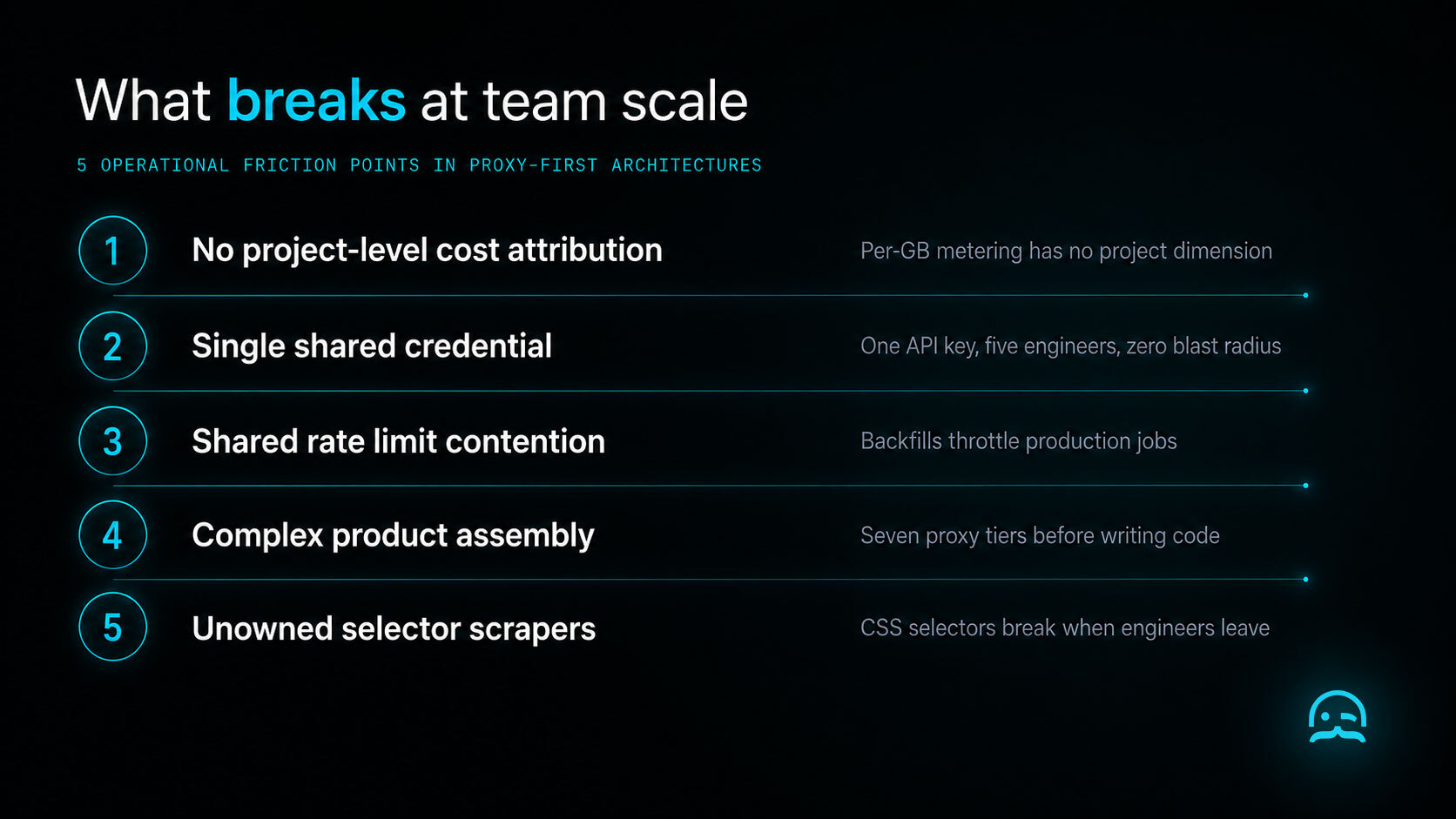
1. Cost attribution has no project dimension
Per-GB billing meters bytes against an entire account. It does not distinguish whether 40 GB belonged to a core pricing intelligence pipeline or 8 GB to an ad-hoc marketing experiment. When finance asks which project to charge, the data to answer it was never recorded.
Cost attribution is a write-time decision, not a read-time query: if you did not tag requests by project when making them, no amount of invoice analysis reconstructs it later. You can approximate from timestamps and target domains temporarily, but as soon as projects share target domains, attribution breaks down.
2. One credential, five engineers
A single API key shared across a team has no blast radius protection. You cannot revoke one developer's access without rotating credentials for the entire team, you cannot rate-limit an experimental script separately from production, and you cannot identify which environment leaked a token if it surfaces somewhere unauthorized.
3. Shared rate limit contention
Oxylabs enforces account-level rate limits across unblocking tiers. While sufficient for one engineer, shared account limits create contention for a team: a developer initiating a 200,000-page historical backfill on a Tuesday afternoon consumes the request capacity required by nightly production jobs.
4. Onboarding starts with a complex product assembly decision
Before a new engineer writes code on Oxylabs, they must choose between residential proxies, datacenter proxies, ISP proxies, mobile proxies, SOCKS5, Web Unblocker, and Scraper API tiers. That decision requires deep familiarity with target anti-bot protections and account billing: context a new joiner lacks.
5. Selector-coupled scrapers become unowned
When the engineer who wrote custom CSS selectors leaves the organization, the scraper runs until the target site updates its DOM structure. When it breaks, nobody understands why .price-now was chosen over .price. A prompt reading price (NUMBER, the current selling price, not the crossed-out original) survives employee departures because engineering intent is captured directly in the artifact.
Oxylabs Web Unblocker pricing: what happens in month seven
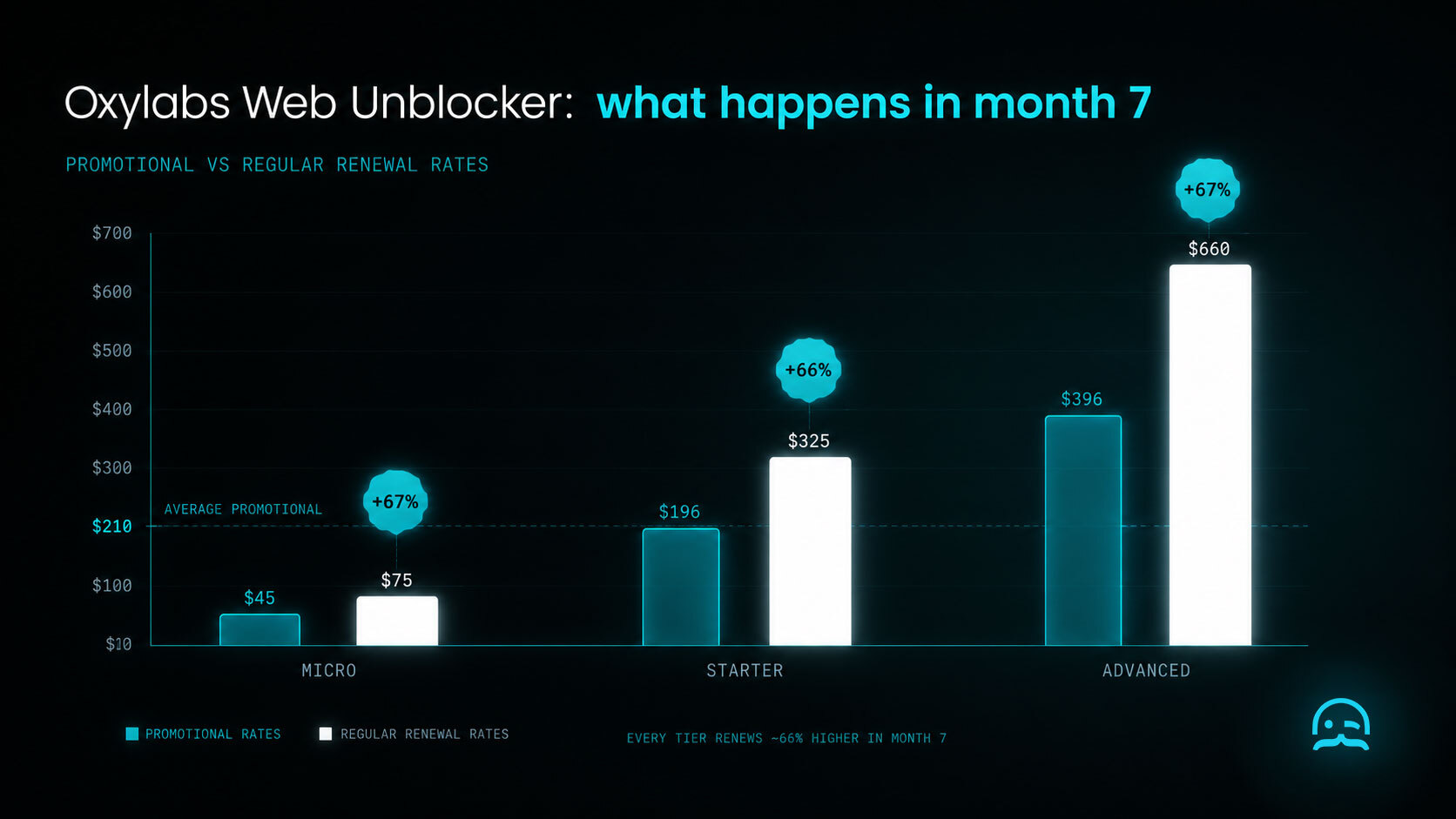
Oxylabs Web Unblocker is billed per GB, with published pricing showing both promotional and regular rates (verified via official Oxylabs official pricing and Oxylabs Web Unblocker documentation):
| Oxylabs plan tier | Included bandwidth | Promotional rate | Regular renewal rate | Promotional rate per GB | Regular rate per GB |
|---|---|---|---|---|---|
| Micro | 8 GB | $45/mo | $75/mo | $5.63/GB | $9.38/GB |
| Starter | 38 GB | $196/mo | $325/mo | $5.16/GB | $8.55/GB |
| Advanced | 88 GB | $396/mo | $660/mo | $4.50/GB | $7.50/GB |
Pricing verified August 2026 via official public documentation for Oxylabs Pricing and Web Unblocker.
Promotional rates apply to the initial 6-month billing cycle for new subscriptions. The risk is what happens to a team budget built on promotional figures: every tier renews at roughly 66% above the promotional rate in month seven. A $396 monthly line item becomes $660 in month seven.
The annual budget math
Planning an annual budget around promotional pricing creates a significant deficit:
- Advanced Tier at promotional rate: 12 months at $396 = $4,752 / year
- Advanced Tier actual 12-month cost: 6 months at $396 + 6 months at $660 = $6,336 / year
Planning around the promotional figure leaves an engineering team 33% short on annual budget before month twelve. Note that while custom enterprise proxy tiers traditionally involve committed annual contracts ($300+/month minimum spend), Oxylabs self-serve Web Unblocker plans begin at the Micro tier ($45 promo / $75 regular).
Budget against regular rates and treat initial promotional periods as recovered margin. The rate you plan with should be the rate you pay in month twelve.
Six Oxylabs alternatives compared
1. MrScraper
Replaces: Web Scraper API, Web Unblocker, and proxy assembly under a unified resource token model.
MrScraper integrates anti-bot unblocking, JavaScript rendering, and residential routing natively into its managed endpoints. Instead of managing separate proxy and unblocker invoices, account allocations provide 1,000 Plan Tokens/month on Scraper Free ($0/mo, no credit card required) and 200,000 Plan Tokens/month on Scraper Pro ($199/mo), with flat $0.001 per token overages.
Every response includes real-time token_usage, bandwidth_usage, and runtime headers for precise project-level cost attribution. Standalone MrScraper Residential Proxies start from $2.50/GB (compared to Oxylabs Pay-as-You-Go at $6.00/GB), while the cloud-hosted MrScraper Scraping Browser connects Playwright or Puppeteer via WebSocket (CDP) without self-hosting browser nodes.
Gives up: MrScraper is optimized for web data collection and browser automation. It is not designed as a raw VPN proxy network for non-scraping application traffic or sub-city ASN routing.
2. Bright Data
Replaces: Enterprise proxy infrastructure and Web Unlocker per-request tiers.
Bright Data offers a massive global proxy catalog and an established Web Unlocker billed per 1,000 requests ($1.50/1K requests on Pay-as-You-Go). This provides predictable cost modeling for heavy pages above 400 KB.
Gives up: Account setup requires manual business verification (KYC) and sales onboarding, increasing initial setup time.
3. Zyte
Replaces: Custom unblocking infrastructure for automated request strategy selection.
Zyte (formerly Scrapinghub) automatically selects the optimal proxy tier and unblocking strategy per target domain. It features deep integration with Python's Scrapy framework and offers mature headless browser management.
Gives up: Custom enterprise pricing models can be difficult to forecast prior to sales onboarding, and initial API integration requires more setup than simple REST endpoints.
4. Apify
Replaces: Serverless data pipelines via a serverless actor marketplace.
Apify provides a marketplace of pre-built serverless Docker containers (Actors) for crawling major platforms. It handles cloud scheduling, request queuing, and dataset storage out of the box.
Gives up: Community-maintained Actor quality varies, and billing combines Compute Units (CUs) with proxy bandwidth, making monthly cost forecasting complex.
5. ScrapingBee
Replaces: Web Unblocker for low-to-medium volume developer pipelines.
ScrapingBee provides a developer-friendly single-endpoint HTML API. Pricing is based on credit multipliers: basic requests consume 1 credit, JavaScript rendering consumes 5 credits, and premium residential proxy requests consume 10 to 25 credits.
Gives up: Returns raw HTML rather than structured JSON data, requiring custom parser maintenance. High credit multipliers (up to 25×) reduce effective request volume on protected targets.
6. Firecrawl
Replaces: Web Scraper API when extracting web content for LLM ingestion.
Firecrawl crawls target websites and converts raw HTML into clean Markdown, making it ideal for RAG applications, vector databases, and AI agent knowledge bases.
Gives up: Optimized specifically for document and content extraction rather than heavily protected e-commerce targets requiring complex form interaction.
Side-by-side on team axes
| Platform | Primary team strength | Billing unit | Onboarding & Setup | Target extraction format |
|---|---|---|---|---|
| MrScraper | AI prompt extraction & token_usage headers |
Transparent Plan Tokens | Instant self-serve | Structured JSON & Markdown |
| Oxylabs | Enterprise global proxy scale | Per GB & Per request | Sales / KYC verification | Raw HTML & Parsed Targets |
| Bright Data | Web Unlocker per-request pricing | Per GB & Per 1k requests | Sales / KYC verification | Raw HTML & Parsed Datasets |
| Zyte | Automated unblocking strategy selection | Per request / success | Self-serve & Enterprise | Raw HTML & Scrapy Output |
| Apify | Marketplace of serverless Docker Actors | Compute Units + Storage | Self-serve | Actor-dependent JSON / CSV |
| ScrapingBee | Simple single-endpoint REST API | Credit multipliers (1× to 25×) | Instant self-serve | Raw HTML |
Migrating: what the code looks like
Migrating from raw proxy or Scraper API requests to MrScraper's official Python SDK (mrscraper-sdk) replaces fragile DOM selector parsing with structured AI prompts:
Oxylabs Query Request (Before)
import requests

# Oxylabs Scraper API call requiring manual selector parsing downstream
endpoint = "<https://realtime.oxylabs.io/v1/queries>"
headers = {"Authorization": "Bearer YOUR_OXYLABS_API_KEY"}
payload = {
    "source": "universal",
    "url": "<https://example.com/products>",
    "render": "html"
}

response = requests.post(endpoint, json=payload, headers=headers, timeout=30)
print("Oxylabs Raw HTML Length:", len(response.json().get("results", [{}])[0].get("content", "")))
MrScraper Managed Async SDK (After)
import asyncio
import os
from mrscraper import MrScraper

async def main():
    # Initialize MrScraper client using environment token
    client = MrScraper(token=os.getenv("MRSCRAPER_API_TOKEN"))

    # Extract structured JSON natively using AI prompt instructions
    result = await client.create_scraper(
        url="<https://example.com/products>",
        message="Extract all product titles, prices, and availability as a JSON array.",
        agent="listing",
        proxy_country="US"
    )

    print("MrScraper AI Result:", result)

if __name__ == "__main__":
    asyncio.run(main())
For custom Playwright scripts, developers can also point browser instances directly to MrScraper's Web Scraper API endpoints or connect via WebSocket to the MrScraper Scraping Browser.
Which failure is yours?
| What breaks on Oxylabs | Underlying operational cause | Recommended alternative |
|---|---|---|
| "Nobody knows which project spent the budget" | Account-level per-GB metering without request tagging | MrScraper (Transparent token_usage response headers) |
| "High annual contract spend on custom proxy tiers" | Enterprise subscription commitments ($300+/mo) | MrScraper (1,000 Free tokens + $0.001 overage) or ScrapingBee |
| "Backfills throttle production jobs" | Shared rate limit contention across team credentials | MrScraper (Isolated concurrency limits per plan tier) |
| "Target pages require pre-built scraper actors" | Missing specialized scrapers for niche platforms | Apify (Marketplace Actors for community targets) |
| "Scrapers break when engineers leave" | DOM CSS selectors coupled to unowned HTML | MrScraper (AI prompt extraction resilient to layout shifts) |
| "We need massive legacy proxy infrastructure for non-scraping tasks" | Specialized network routing requirements | Oxylabs or Bright Data (Dedicated global proxy networks) |
Frequently asked questions (FAQ)
What is the best Oxylabs alternative for technical teams?
MrScraper is the best overall Oxylabs alternative for developer teams because it unifies Web Scraper API, Web Unblocker, cloud Scraping Browsers (CDP), and AI prompt parsing under a single transparent token meter—eliminating complex proxy assembly and providing real-time token_usage headers for per-project cost attribution.
How does MrScraper pricing compare to Oxylabs?
Oxylabs self-serve Web Unblocker plans range from $45/mo promo ($75/mo regular) to $396/mo promo ($660/mo regular), renewing 66% higher in month seven. MrScraper operates on a resource token model based on compute runtime (1 token per 30s) and bandwidth (1 token per 0.2 MB), with 1,000 Free Plan Tokens ($0/mo), flat Pay-as-You-Go overages ($0.001/token), and standalone residential proxies starting from $2.50/GB.
Does MrScraper include cloud headless browser support?
Yes. MrScraper includes a cloud-hosted Scraping Browser endpoint (wss://browser.mrscraper.com) allowing you to connect Playwright or Puppeteer over WebSocket (CDP) to automate browser tasks without self-hosting browser infrastructure.
Does MrScraper manage anti-bot protection automatically?
Yes. MrScraper includes a built-in Web Unblocker layer (https://api.mrscraper.com) that automatically manages browser TLS fingerprints, HTTP/2 headers, user agents, and IP proxy routing natively within API requests.
Ready to eliminate high subscription lock-in and automate your web scraping infrastructure? Try MrScraper free today—claim your 1,000 free Plan Tokens with no credit card required, or schedule a demo to see how MrScraper can scale your data extraction with precision and speed.
Summarize this post
Open it in your assistant of choice with the prompt ready to send.
Take a Taste of Easy Scraping!

Find more insights here
Return Verbatim Evidence Highlights in Web Research Answers
Build an evidence step that picks supporting passages, checks every quote against the source page, a…
Build an AI Agent That Finds Contradictions Across Website Pages
Build a workflow that pulls pricing, plan and policy claims from your own website, flags pages that…
Benchmark Heading-Aware and Semantic Chunking for Web Documentation
Run a fair test of heading-aware and semantic chunking on the same documentation pages, with a retri…