E-commerce Data Extraction: Scaling Price and Inventory Monitoring
Web ScrapingLearn how to scale e-commerce data extraction using AI and residential proxies to maintain real-time price and inventory monitoring without getting blocked.
You set up a price monitor for a major retailer, only to have your IP flagged and your CSS selectors break within 48 hours. For business analysts performing market research, scaling e-commerce data extraction requires building a resilient infrastructure that expects resistance. Choosing the right data extraction software is critical because traditional scrapers fail when they lack necessary anti-bot triggers and regional visibility.
The verdict: How to scale e-commerce monitoring
To scale e-commerce monitoring, you need a stack that combines residential proxies for geotargeting and AI-powered extraction to handle DOM changes. Implementing retail price monitoring allows businesses to react to market shifts instantly. You also need headless browsers for JavaScript rendering. This resilient pipeline ensures real-time data flow and helps you bypass 403 errors and regional blocks common in high-velocity markets. Establishing continuous price tracking is the only way to maintain a competitive edge when competitors update catalogs hourly.
Real-time product data extraction is essential for maintaining competitive pricing strategies in high-velocity e-commerce markets, according to Retail Gators. Without immediate access to competitor shifts, pricing engines rely on stale information, leading to lost margins or missed sales.
Why legacy data extraction software fails
Legacy tools rely on static CSS selectors that break the moment a retailer changes a class name. This creates a massive maintenance tax. It often costs firms several engineer-weeks per month just to keep data flowing. High-velocity e-commerce markets require immediate extraction to maintain pricing strategies and autonomous architectures to manage large product catalogs without increasing headcount. By using modern data collection tools like MrScraper, teams can automate the gathering of SKU details across thousands of URLs without manual intervention. Beyond retail, these tools can adapt to invoice data extraction methods for back-office automation.
The fragility of CSS selectors
Retailers frequently update their front-end architecture. If your code is hardcoded to a specific div ID, it will fail. AI-powered extraction, such as ScrapeGPT, eliminates this problem by using semantic understanding to find product names and prices. This works regardless of the underlying , providing a way to extract data without selectors that remains resilient against layout shifts. Using these methods for competitor price comparison ensures your internal benchmarks are always based on the most current web data available.
Sophisticated anti-bot defenses
Modern retailers use multi-layered defenses. These include TLS fingerprints and behavioral analysis. Simple request-based scrapers trigger 429 status codes almost immediately. A professional e-commerce scraping API is necessary to manage these complexities automatically.
Building the resilient pipeline: A technical blueprint
To scale real-time monitoring across thousands of dynamic e-commerce catalog pages, your extraction architecture must decouple request routing, headless rendering, and semantic extraction into dedicated layers.
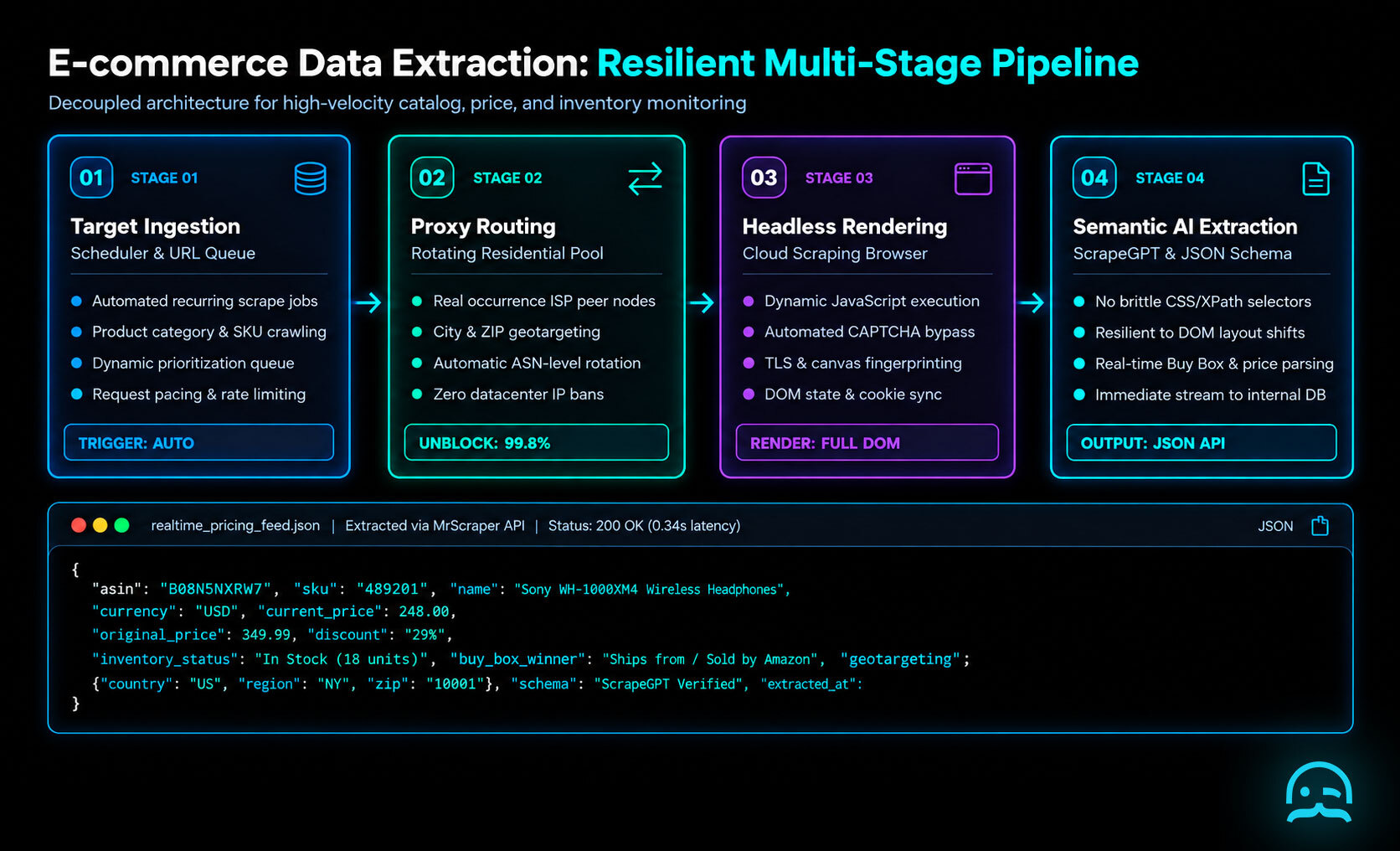
Proxy type comparison
| Attribute | Datacenter Proxies | Residential Proxies |
|---|---|---|
| Cost | Low | Moderate |
| Detection Rate | High | Very Low |
| Geotargeting | Limited | Precise |
Handling regional price and inventory variations
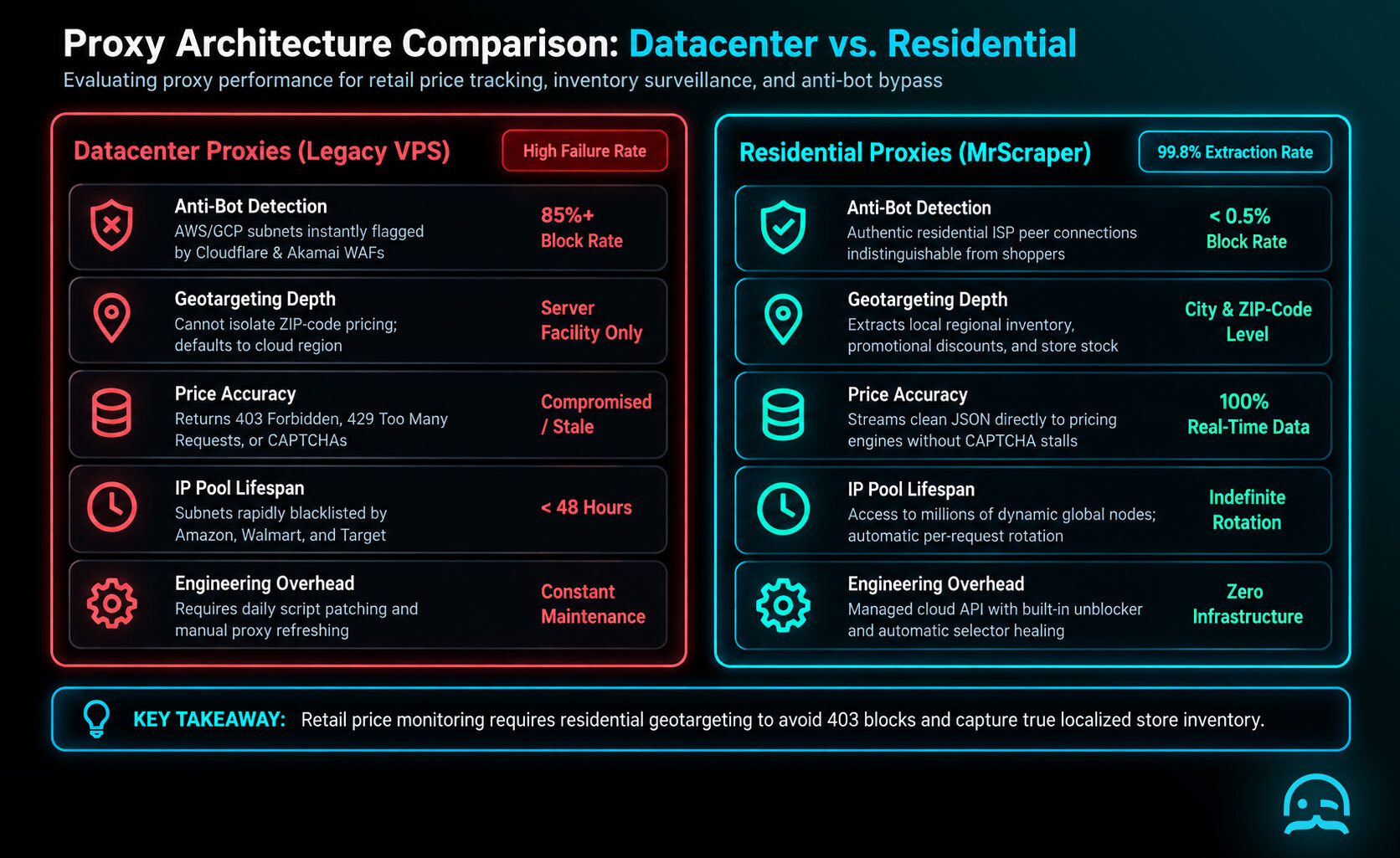
Major retailers serve different prices based on the user's geographic location, which makes residential proxies with precise geotargeting a requirement for accuracy. For analysts, the following process ensures data integrity across regions:
- Identify the target regions and their specific ZIP codes or coordinates.
- Configure your residential proxies with precise geotargeting to match those locations.
- Trigger the scraping browser to render the page as a local user would.
- Route the structured JSON output into your pricing engine.
Frequently asked questions
What is the best data extraction software for retail?
The best software integrates AI extraction with localized residential proxies. Modern systems like MrScraper automate the bypass of anti-bot measures while maintaining data accuracy. When evaluating software, analysts look for the ability to handle DOM changes automatically and manage TLS fingerprinting via a visual interface.
How to handle 403 forbidden errors?
Switch from datacenter IPs to residential proxies. Most retailers block datacenter ASNs entirely to prevent automated price harvesting. Using a managed scraping API can automate this rotation process.
Key takeaways
- Real-time data is the baseline for e-commerce competition.
- AI extraction stops the cycle of broken CSS selectors.
- Residential proxies are mandatory for regional price accuracy.
Reliability comes from the infrastructure layer. Managed pipelines and powerful schedulers allow you to scale without the maintenance headache of legacy scripts. Advanced llm feature extraction of legal text for structured data can also be integrated into these pipelines for diverse document processing.
Ready to scale your market research? Start scraping today with our resilient data extraction tools.
Summarize this post
Open it in your assistant of choice with the prompt ready to send.
Take a Taste of Easy Scraping!

Find more insights here

Build an Agent Harness for Repeatable Web Research
Build a small agent harness in Python that saves job state, enforces tool and page budgets, and chec…

Authenticate Web Data Tools for AI Agents Without Exposing Secrets
Learn when to use API keys or OAuth for AI agent tools, where credentials should live, how to separa…

Design Reliable Web Data Tools for AI Agents
Learn how to define clear inputs, structured results and honest errors for the web data tools your A…