
Modern Market Research Data Tools for 2026
Data ExtractionLearn how AI-assisted data extraction, dynamic page rendering, and responsible collection practices fit into a modern market research and retail monitoring workflow.
Manual market research does not scale. Copying prices, product details, and reviews by hand is slow, and scripts built on fixed page layouts break whenever a retailer redesigns its site. The result is that analysts spend time fixing tools instead of interpreting data.
Modern data collection tools address this with AI-assisted extraction, browser rendering for dynamic pages, and scheduling, so research teams can focus on analysis. This article covers how those tools work, how to choose data sources, and how to build a research pipeline responsibly.
What you'll learn:
- Why AI-assisted extraction is replacing fixed CSS selectors
- How to collect data from JavaScript-heavy pages without missing content
- How to choose between official, licensed, and public-page data sources
- A checklist for building a responsible research pipeline
Why AI-assisted extraction is gaining ground
Traditional scrapers locate data with CSS selectors, which break when a site's layout changes. AI-assisted extraction identifies fields such as product name, price, and rating from the meaning and context of the page instead. Tools such as MrScraper's ScrapeGPT let analysts describe the fields they want in plain language and receive structured data without writing selectors.
This can reduce how often pipelines need fixing after a site changes, which lets analysts spend more time on research. It does not remove the need to validate results, especially for prices and other numbers that feed decisions. For a deeper look, see our guide to extracting web data with AI.
Core data collection capabilities for research
Handling single-page applications
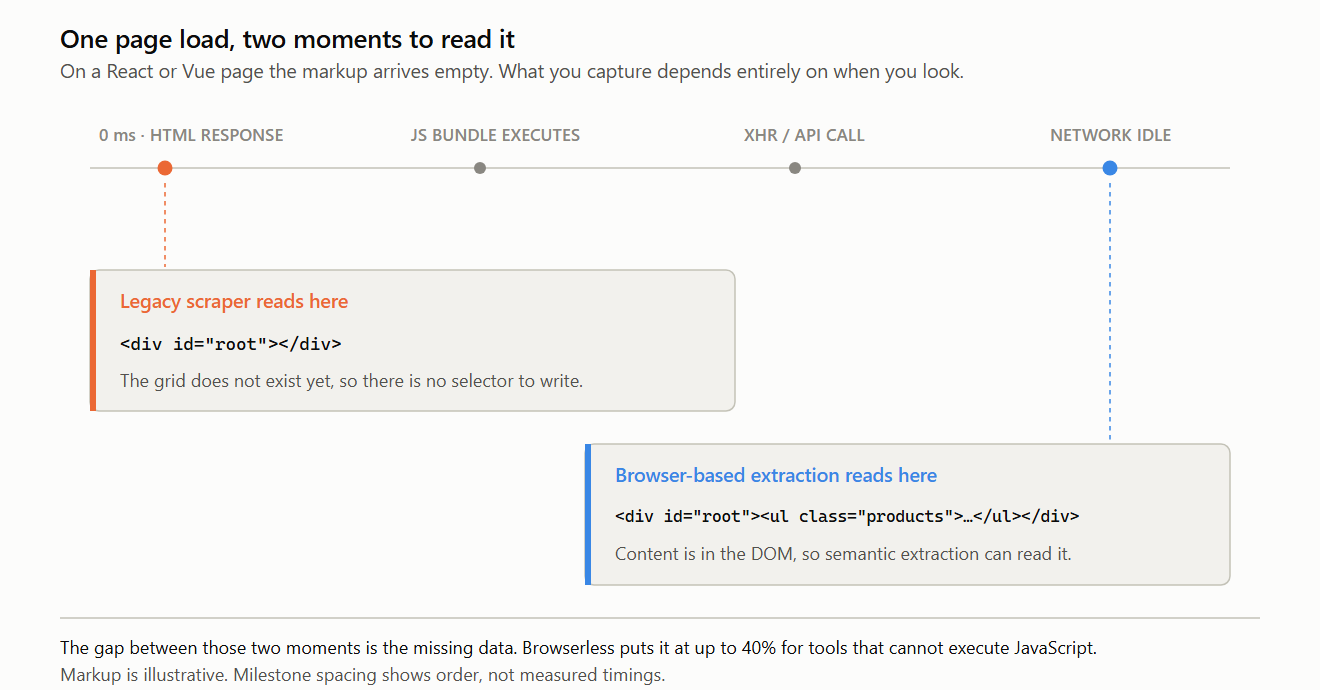
Many modern sites are built with frameworks such as React and Vue, which load content with JavaScript after the initial page arrives. A tool that only downloads the initial HTML can miss prices, inventory, and reviews entirely.
Research tools need to render pages in a browser and wait until the content has loaded, for example by waiting for network activity to settle or for a specific element to appear. This matters for e-commerce data pipelines, where prices and stock levels change often.
Turning unstructured content into structured data
Research often depends on content that is not neatly structured, such as product descriptions, specifications, and review text. AI-assisted extraction can turn this content into clean JSON with consistent fields, which is easier to analyze, compare, and feed into reporting tools.
Regional views of public content
Prices, availability, and promotions can differ by country. Tools with country selection, such as MrScraper's residential proxies, let researchers see the public version of a site that local shoppers see, for example for travel fare comparisons across countries. Use regional views for localized public content only, at reasonable volumes, and not to get around a site's decision to limit or refuse automated traffic.
Choosing data sources
Before collecting from public pages, check whether a better source exists:
- Official APIs and data programs: Many marketplaces and platforms offer documented APIs that provide stable, clearly permitted access.
- Licensed datasets and panels: Research firms and data providers sell market, pricing, and consumer data collected under their own agreements.
- Surveys and first-party data: Your own customers and research panels remain essential for qualitative insight.
- Public pages: For information displayed openly to any visitor, managed extraction can turn pages into structured data. Use it within each site's terms.
Tool comparison
| Consideration | Basic scripts | Managed AI extraction |
|---|---|---|
| Dynamic pages | Often miss JavaScript-loaded content | Render pages in a browser before extracting |
| Layout changes | Selectors need manual fixes | AI-assisted extraction can reduce fixes |
| Setup | Coding required | Plain-language field descriptions or API |
| Scheduling | Build your own | Built-in scheduling |
| Output | Whatever you build | Structured JSON or CSV, Webhooks, Amazon S3 |
What to do next: building your research pipeline
- Define the research question: Decide which markets, competitors, products, and metrics you need, such as prices, availability, ratings, or listings on real estate portals.
- Check sources and rules: Look for official APIs or licensed data first, and review each site's terms of use and robots.txt.
- Set up extraction: Use a visual tool or API to define the fields you need, and validate a sample of results by hand.
- Schedule sensibly: Collect at the lowest frequency that supports your research. Daily is enough for many categories.
- Connect to analysis: Send structured output to your data warehouse, spreadsheets, or business intelligence tools for reporting.
- Monitor quality: Track empty fields, out-of-range values, and failed requests, and review the pipeline regularly.
Collecting research data responsibly
- Collect public data only: Limit collection to information any visitor can see without signing in.
- Protect personal data: Avoid collecting information that identifies individuals, such as reviewer names, unless you have a clear lawful basis.
- Keep volumes reasonable: Use modest concurrency and schedules, and avoid collecting more often than you use the data.
- Treat refusals as signals: If a site returns
403or429, slow down and review whether the collection is permitted. See our guide to the 429 Too Many Requests error. - Respect content rights: Review text, images, and descriptions may be protected by copyright, so check before republishing them.
- Get legal advice: Rules vary by jurisdiction. This is general information, not legal advice. See our guide on web scraping and the law.
Frequently asked questions
What is the best data extraction software for market research?
It depends on your sources, volume, and team. Look for tools that render dynamic pages, offer structured output, support scheduling and validation, and give you controls to keep request volumes reasonable. Managed AI extraction suits analysts who want results without writing code, while developers may prefer an API.
Are residential proxies necessary for market research?
No. Many public pages can be collected without them. Residential proxies with country selection are mainly useful when you need to see localized public content, such as prices in a specific market. They should not be used to get around a site's rate limits or restrictions.
How often should I collect market data?
As often as your research requires, and no more. Daily collection covers many use cases, and short-term events may justify more frequent runs for a limited time.
Can AI extraction replace manual research entirely?
No. It can automate collection and structuring, but analysts still need to validate data, interpret results, and combine web data with surveys, interviews, and first-party data.
Summarize this post
Open it in your assistant of choice with the prompt ready to send.
Take a Taste of Easy Scraping!

Find more insights here

Build a Context Layer for an AI Agent Using Web Data
Build a small context service that fetches web data for each agent task, tracks source versions per…

Context Engineering for Agents That Use Live Web Data
Learn what web data belongs in an AI agent's context window, how to pick the right passages, and how…

Agentic vs Deterministic Web Data Workflows: How to Choose
Learn when a fixed web data pipeline is enough, when an AI agent adds value, and how to compare spee…