Google Shopping Scraper: How to Use It
Web Scrapingearn how a Google Shopping scraper automates the extraction of product data, pricing, and seller reviews to gain a competitive edge in global e-commerce markets.
A Google Shopping scraper is an automated tool. It extracts product data from Google Shopping results. It can collect prices, availability, and seller ratings. It enables businesses to monitor competitors, analyze market trends, and refine pricing strategies efficiently.
What a Google Shopping Scraper Does
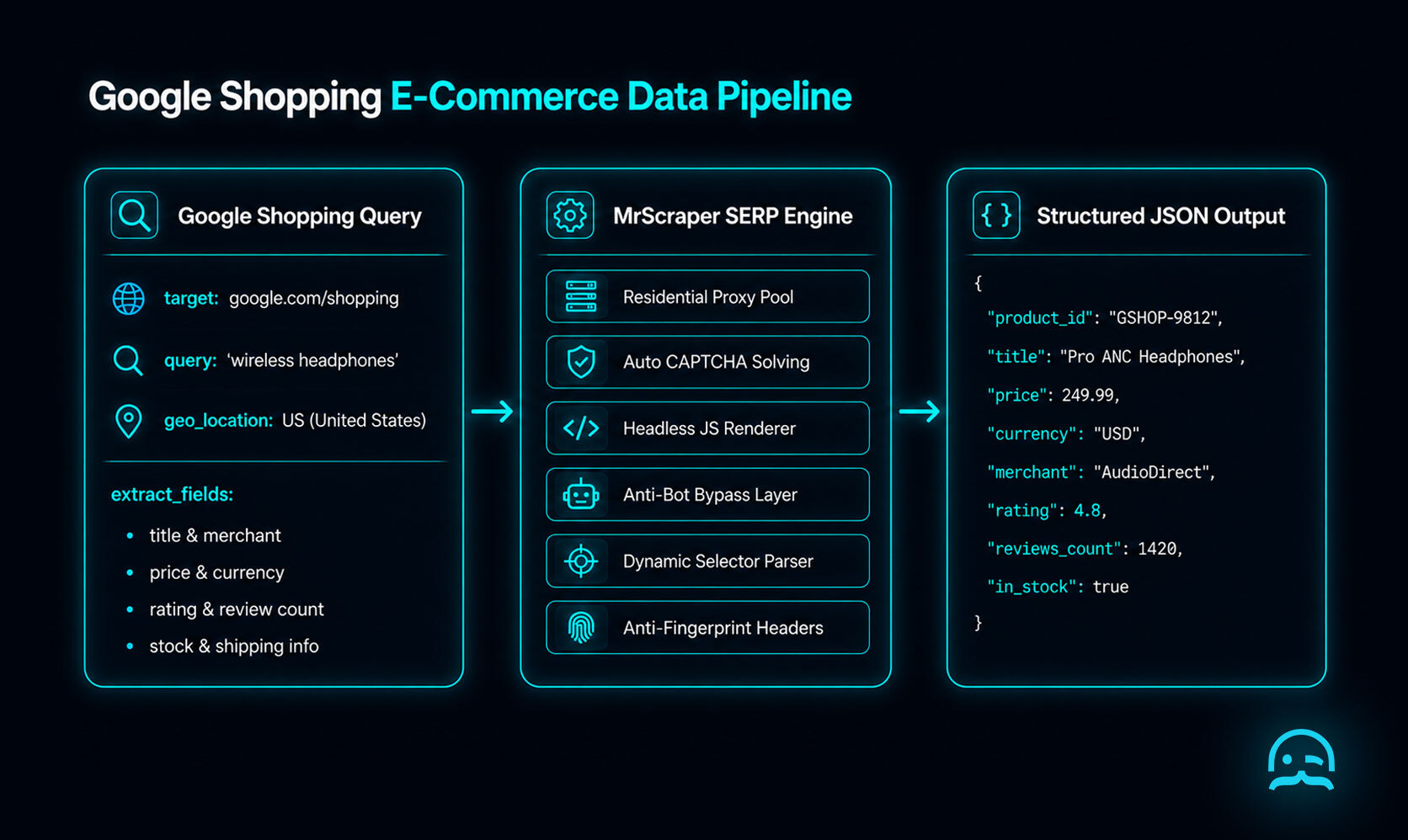
A Google Shopping scraper functions by automatically identifying and extracting structured data from product result pages that would otherwise require manual collection. These tools are designed to navigate the complex layout of the platform to isolate specific attributes for analysis. By automating this process, businesses can transform unstructured search results into organized datasets for market intelligence.
- Product titles and descriptions for cataloging and identifying specific items.
- Price and currency information, including current list prices, active sale prices, and visible discounts.
- Seller and retailer details to identify which competitors or third-party vendors are offering the product.
- Aggregate user ratings and review counts to gauge consumer sentiment and product performance.
- Availability status and shipping details to monitor stock levels and delivery speed across different regions.
Manual data collection is impractical due to the sheer volume of listings and the frequency with which information changes. Specialized scrapers streamline this workflow by gathering thousands of data points across different categories and geographic locations. This lets users avoid the technical challenge of parsing dynamic content. It also ensures the data is consistently formatted for business intelligence tools or pricing engines.
Why Businesses Use Google Shopping Scrapers
E-commerce businesses leverage Google Shopping scrapers to gain a competitive edge.
Competitive Price Monitoring
Competitive Price Monitoring
Maintaining a competitive edge requires constant awareness of market fluctuations. By scraping Google Shopping, online retailers and price comparison engines can track competitor pricing in real time. This automated visibility allows businesses to execute dynamic pricing strategies, optimize promotional schedules, and ensure their product offerings remain attractive to price sensitive consumers.
Market and Trend Analysis
Tracking price trends and product popularity across categories and regions gives a clear view of changing consumer demand. By using the best tools for scraping e-commerce product data, businesses get raw, structured data. This makes it easier to spot new market trends. It also helps them adjust pricing strategies faster.
Regional Market Research
Regional Market Research
Google Shopping displays different results based on a user's country, local currency, and language. A scraper with geotargeting lets global businesses collect local data. It gives a clear view of competitors and pricing trends in specific markets.
Product Data Enrichment
Product data enrichment bridges the gap between raw web information and actionable intelligence. By utilizing a scraper API to extract structured JSON or CSV data, organizations can automatically populate internal databases. This seamless integration supports advanced machine learning pipelines, business intelligence dashboards, and various automation workflows for data-driven decision making.
Approaches to Scraping Google Shopping
Approaches to Scraping Google Shopping
Acquiring structured data from Google Shopping involves different technical strategies depending on your resource constraints and required scale. Developers typically choose between managed services that handle infrastructure hurdles or custom software solutions that offer granular control. Each method has unique trade-offs in development speed, ongoing maintenance, and bypassing advanced anti-bot measures.
Technical Comparison of Top E-commerce Libraries
Selecting a library depends on the complexity of the target storefront.
import asyncio
from playwright.async_api import async_playwright

async def fetch_product_price(url):
    async with async_playwright() as p:
        browser = await p.chromium.launch()
        page = await browser.new_page()
        await page.goto(url)
        price = await page.locator('.price-display').inner_text()
        print(f'Current Price: {price}')
        await browser.close()
| Library | Primary Use-Case | Key Strength |
|---|---|---|
| BeautifulSoup | Simple data extraction | Low learning curve |
| Scrapy | Large scale e-commerce crawling | Asynchronous speed |
| Playwright | Dynamic JavaScript heavy sites | Reliable browser rendering |
For a closer look at how these frameworks differ in design, the Web Scraping with Python docs by Ryan Mitchell can help. It gives a clear guide to choosing the right tool for specific data extraction challenges.
1. Third-Party API Services
1. Third-Party API Services
For teams that want top tools to scrape e-commerce product data, third-party API providers can help. They reduce the need to manage internal infrastructure. Providers like ScraperAPI, ScrapingBee, Bright Data, Apify, and Oxylabs offer Google Shopping endpoints. These platforms manage the underlying scraping logic and technical barriers such as CAPTCHAs, header management, and anti-bot challenges.
Utilizing a dedicated API is a reliable strategy for businesses that prioritize speed and low maintenance. Most providers return results in structured JSON. This format allows quick integration into data dashboards, price monitoring software, or internal analytics pipelines. This approach lets developers focus on e-commerce insights, not fixing network blocks or changing site structures.
import requests

def get_shopping_data(api_key, query, country="us"):
    # Example integration with a third-party scraping API
    endpoint = "https://api.example-provider.com/google-shopping"
    params = {
        "api_key": api_key,
        "q": query,
        "gl": country,
        "output": "json"
    }

    response = requests.get(endpoint, params=params)
    if response.status_code == 200:
        return response.json()
    else:
        return {"error": "Failed to retrieve data", "status": response.status_code}

# Usage example
# product_results = get_shopping_data("YOUR_API_KEY", "mechanical keyboard")
2. Open-Source Projects and Libraries
2. Open-Source Projects and Libraries
Developers often utilize community-driven libraries and GitHub repositories to build independent scraping solutions. These tools offer granular control over data extraction workflows and storage architectures. While this approach removes third party subscription costs, it needs a lot of manual work. You must maintain selectors and respond to anti-scraping changes as Google Shopping evolves.
Developers who want a custom solution often use libraries like BeautifulSoup and Scrapy. These tools help with HTML parsing and crawl logic.
import requests
from bs4 import BeautifulSoup

def scrape_google_shopping(query, region="us"):
    # Define the target URL with search parameters
    url = f"https://www.google.com/search?q={query}&tbm=shop&gl={region}"
    headers = {
        "User-Agent": "Mozilla/5.0 (Windows NT 10.0; Win64; x64) AppleWebKit/537.36 (KHTML, like Gecko) Chrome/91.0.4472.124 Safari/537.36"
    }

    response = requests.get(url, headers=headers)
    if response.status_code == 200:
        soup = BeautifulSoup(response.text, "html.parser")
        # Selectors must be updated regularly to match Google's DOM
        products = soup.select(".sh-dgr__content")
        return products
    return []

# Example usage
results = scrape_google_shopping("mechanical keyboard")
3. Custom Scripts and Frameworks
Organizations with highly specialized requirements often build custom scraping architectures using libraries like Scrapy, Playwright, or Selenium. These frameworks provide granular control over complex interactions, such as simulating browser navigation and managing dynamic content rendering. This approach lets developers set clear extraction rules and data flows that match their e-commerce goals.
Success with custom scripts depends on sophisticated infrastructure to maintain access. Developers must use strong request patterns. These include planned delays, proxy rotation, and user-agent management. This helps avoid detection or IP blocking. By adding these safeguards to the scraping code, teams can collect Google Shopping data more reliably. They can also adjust when the site changes.
Implementing Dynamic Product Extraction
Extracting product titles and pricing from dynamically rendered results requires a headless browser to execute JavaScript. This script uses Playwright to open the results page. It waits for the product grid to load. Then it pulls data from specific CSS selectors in the localized DOM.
from playwright.sync_api import sync_playwright

with sync_playwright() as p:
    browser = p.chromium.launch(headless=True)
    page = browser.new_page()
    page.goto('https://www.google.com/search?q=laptop&tbm=shop')
    page.wait_for_selector('.sh-dlr__list-result')

    products = page.query_selector_all('.sh-dlr__list-result')
    for item in products:
        name = item.query_selector('h3').inner_text()
        price = item.query_selector('.a8sBsb').inner_text()
        print(f'Product: {name} | Price: {price}')

    browser.close()
For a closer look at how to manage browser contexts for large retail scraping, see the guide Web Scraping with Python by Ryan Mitchell. It explains the strategies clearly. It explains how to get past common DOM issues in e-commerce sites.
Best Practices for Google Shopping Scraping
Effective extraction of Google Shopping data requires a strategy that balances speed with technical discretion. Large scale scraping operations face sophisticated anti bot mechanisms designed to detect automated patterns and preserve server resources. To ensure high success rates and data integrity, developers must implement robust safeguards that go beyond simple request logic.
- Implement intelligent rate limiting by introducing randomized delays between requests to prevent triggering security challenges like CAPTCHAs.
- Use high-quality rotating proxies and varied User-Agent strings to avoid IP blocks. This helps keep your request profile less distinct.
- Establish monitoring systems for page structure changes, since search engines often update their DOM layout. This can break static selectors.
- Incorporate comprehensive error handling and exponential backoff retry logic to manage intermittent network failures or missing data elements without losing progress.
The following Python example demonstrates how to implement basic safety measures using common libraries. It focuses on header randomization and status code verification to build a more resilient scraping function.
import requests
import time
import random

def fetch_shopping_data(url, proxies=None):
    # Rotate common user agents to vary the fingerprint
    user_agents = [
        "Mozilla/5.0 (Windows NT 10.0; Win64; x64) AppleWebKit/537.36 (KHTML, like Gecko) Chrome/91.0.4472.124 Safari/537.36",
        "Mozilla/5.0 (Macintosh; Intel Mac OS X 10_15_7) AppleWebKit/537.36 (KHTML, like Gecko) Chrome/92.0.4515.107 Safari/537.36",
        "Mozilla/5.0 (X11; Linux x86_64) AppleWebKit/537.36 (KHTML, like Gecko) Firefox/89.0"
    ]

    headers = {"User-Agent": random.choice(user_agents)}

    try:
        # Introduce a randomized delay to simulate human pacing
        time.sleep(random.uniform(1.5, 4.0))
        response = requests.get(url, headers=headers, proxies=proxies, timeout=10)

        # Check for successful response before processing
        if response.status_code == 200:
            return response.text
        elif response.status_code == 429:
            print("Rate limited: slowing down requests")
            return None

    except requests.exceptions.RequestException as e:
        print(f"Connection error encountered: {e}")
        return None

# Example usage with a placeholder URL
# result = fetch_shopping_data("https://www.google.com/shopping/product/123")
Handling Dynamic Content and Structured Metadata
import json
from bs4 import BeautifulSoup

def extract_json_ld(html_content):
    soup = BeautifulSoup(html_content, 'html.parser')
    script = soup.find('script', type='application/ld+json')
    if script:
        data = json.loads(script.string)
        return data.get('offers', {})
    return None
For a deeper look at these technical hurdles, the Bright Data docs or Ryan Mitchell’s Web Scraping with Python guide offer proven ways. They explain how to handle dynamic content and schema-based extraction.
MrScraper’s Google Shopping Scraping Enhancements
For teams that want to scrape Google Shopping without building and maintaining their own scraper, this platform can help. It offers strong infrastructure. It also provides proxy support to make the process easier.
- Structured data extraction: The API returns clean JSON output. This means less time parsing HTML and more time generating insights.
- Proxy and anti-blocking support: Built-in proxy rotation and anti-bot features help cut CAPTCHAs and IP blocks.
- Geolocation and automation options: Users can target results from specific regions and automate scraping tasks on a schedule.
Instead of managing infrastructure, selectors, and request logic yourself, you can use this solution. It helps you focus on business use cases powered by Google Shopping data. By abstracting the complexities of request management, you can scale data collection to match market demands.
Conclusion
A Google Shopping scraper is an important tool. E-commerce teams, analysts, and developers use it. It helps them get structured, real-time product data. Organizations utilize this technology for comprehensive price tracking, competitive benchmarking, and global market research to maintain a distinct edge in crowded digital marketplaces.
The ideal scraping methodology depends on an organization's specific budget, scale, and technical proficiency. Third party API services like ScraperAPI, ScrapingBee, Bright Data, Apify, and Oxylabs offer fast integration. They also include built in anti bot management. Alternatively, custom scripts provide maximum flexibility for unique requirements. For teams that want power and ease of use, integrated platforms like the one in this guide are a good choice. They offer advanced tools. These tools help extract data reliably. Implementing these systems ensures that structured Google Shopping data becomes a foundational input for advanced business intelligence.
- Automated scraping enables real time price monitoring and competitive benchmarking across global markets.
- Choosing between third party APIs and custom scripts involves balancing ease of use against granular control.
- Reliable data extraction requires managing complex anti bot measures and regional variations.
- Structured product data from Google Shopping informs inventory decisions and pricing strategies.
Scale Your E-Commerce Intelligence
Optimize your data collection with a platform designed to handle complex extraction logic and proxy management automatically.
Frequently asked questions
What kind of data can you extract with a Google Shopping scraper?
A Google Shopping scraper can collect product titles and descriptions. It can also collect list prices and sale prices. It may collect seller details. It can collect user ratings and reviews. It can also collect stock status.
Why is scraping Google Shopping difficult?
Google uses dynamic rendering and sophisticated anti-bot defenses. Additionally, results vary significantly by region, requiring scrapers to handle proxy rotation and geotargeting to ensure data accuracy.
What are the common methods for scraping e-commerce data?
Businesses often use third-party API services for reliability. They use open-source libraries for more direct control. They also build custom scripts with tools like Scrapy and Selenium for special needs.
Summarize this post
Open it in your assistant of choice with the prompt ready to send.
Take a Taste of Easy Scraping!

Find more insights here

Score Company Websites Against Your ICP with Jev
Create a company scoring workflow using public website evidence, an explicit ICP rubric, Jev decisio…
Classify Web Data with Jev and MrScraper: A Python Tutorial
Build a Python workflow that extracts web records with MrScraper, classifies them with Jev, validate…

What Is Jev? A Practical Guide for Web Data Teams
Learn what Jev does, how Choice, Score and Noul work, and where structured web data fits into classi…