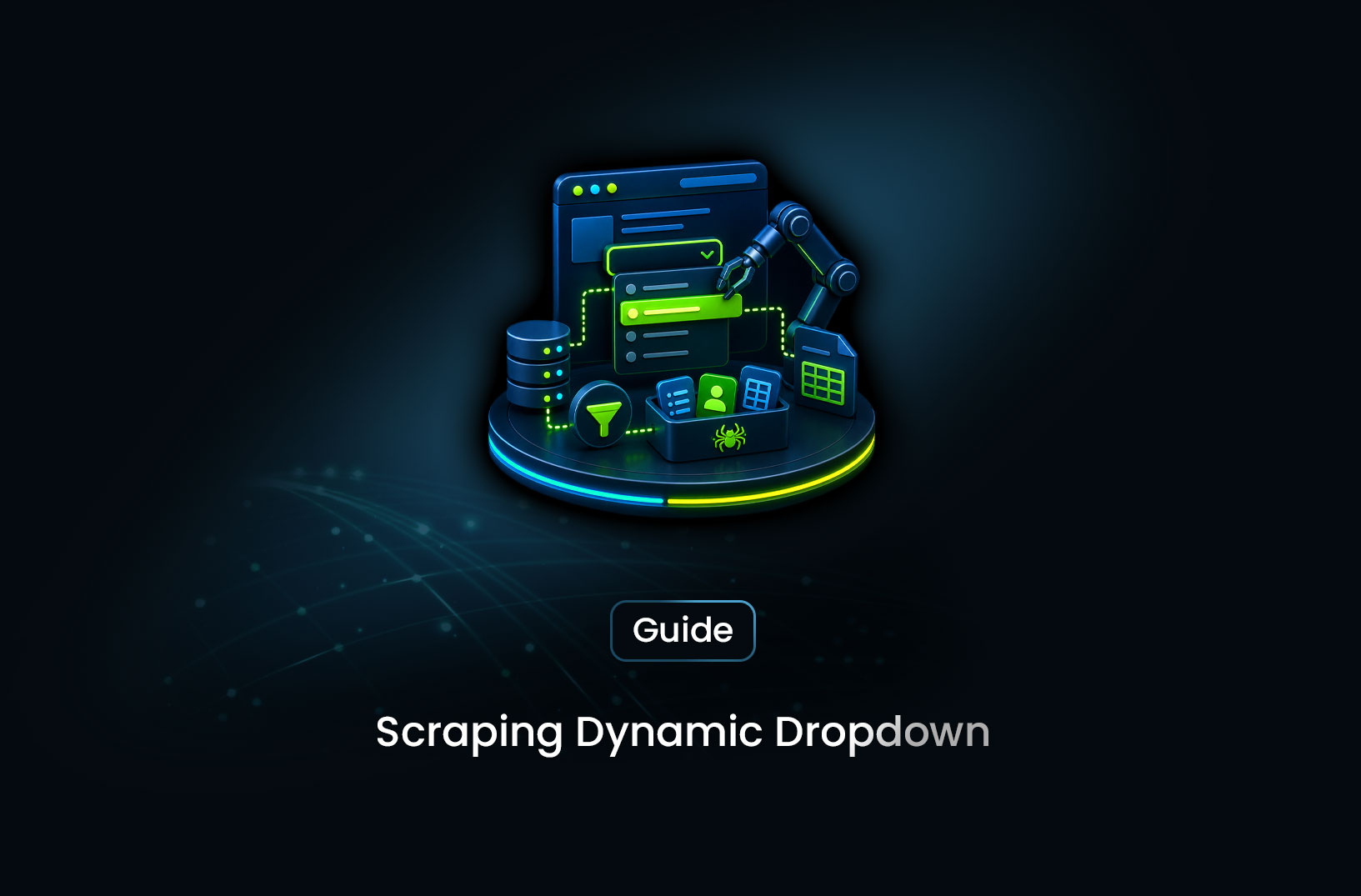
How to Scrape Dynamic Dropdowns on JavaScript Sites
Web ScrapingLearn how to scrape dynamic dropdowns and filters on JavaScript websites using headless browsers. A practical step-by-step guide for developers.
You've found the data you need. It's right there on the page — sitting inside a dropdown filter. You send your usual HTTP request, parse the HTML, and… nothing. The dropdown is empty. Or the results that should appear after selecting a filter simply never load.
That's the dynamic dropdown problem in a nutshell, and it trips up a lot of scrapers.
To scrape dynamic dropdowns, you need a tool that can behave like a real browser — one that executes JavaScript, fires DOM events, waits for content to render, and then pulls the data. A standard HTTP request only grabs the initial HTML shell; it can't interact with the page or trigger the JavaScript that loads the actual content you're after. The good news is that headless browser scraping makes this very doable, and once you understand the pattern, you can apply it to almost any site. In this guide, we'll walk through exactly how dynamic dropdowns work, how to interact with them programmatically, and how to handle the edge cases that cause most scrapers to fail.
Table of Contents
- What Is a Dynamic Dropdown?
- How Dynamic Dropdowns Work
- Step-by-Step Guide: How to Scrape Dynamic Dropdowns
- Common Challenges and Limitations
- Conclusion
- What We Learned
- FAQ
What Is a Dynamic Dropdown?
A dynamic dropdown is a UI control — typically a <select> element or a custom-built component — whose options, or whose resulting page content, are generated and updated by JavaScript rather than existing in the raw HTML from the start.
On older, server-rendered websites, a <select> tag would ship with all its <option> children already in the page source. You could grab everything with a basic HTML parser and be done in minutes. Dynamic dropdowns are a different animal. They might start empty and populate only after a JavaScript event fires. Or they might trigger a background API call the moment you select an option, rendering new results in the page without ever doing a full reload.
Think of a travel booking site. You pick a departure city, and the arrival dropdown refreshes with relevant destinations. You choose a date, and available flights appear below — all without the page reloading, all driven by JavaScript event listeners and fetch requests quietly running in the background. That's what we mean by dynamic.
This is what makes dropdown scraping genuinely tricky: the data you want doesn't exist yet when the page first loads. It only appears after you interact with the page.
How Dynamic Dropdowns Work
Here's the short version: when you interact with a dynamic dropdown, one of two things is happening under the hood.
Option A — Client-side rendering from local state. All the data is already loaded into the page's JavaScript memory (perhaps embedded in a <script> tag or a global JS object). Selecting a value just filters or re-renders what's already there. No network call needed — it's all local. This is actually the easiest type to scrape.
Option B — API call on selection. The dropdown fires a fetch() or XMLHttpRequest when you select an option. The browser hits an API endpoint — often something like /api/products?category=electronics — receives JSON or HTML back, and updates the DOM. The data lives server-side and is only delivered when requested. This is trickier, but also potentially exploitable: if you can identify the API endpoint, you might be able to call it directly and skip the browser interaction entirely.
Knowing which type you're dealing with shapes your whole strategy. You can spot Option B in seconds: open Chrome DevTools, go to the Network → Fetch/XHR tab, and make a selection in the dropdown. If requests fire, you've found your API.
The mechanism that makes both types work is the browser's event system. When a user selects an option, a change event fires. JavaScript listeners pick that up and execute whatever logic was wired to it — populate a secondary dropdown, trigger an API call, render results. Without triggering that event, nothing happens. This is precisely why headless browser scraping is the right tool here: a headless browser like Chromium executes JavaScript exactly as a real browser would, including firing and handling events. According to the Playwright documentation, interaction methods like select_option dispatch the full event chain — not just a value change.
Step-by-Step Guide: How to Scrape Dynamic Dropdowns
We'll use Playwright for Python throughout — it's well-maintained, handles both native <select> elements and custom JavaScript components, and has a clean, readable API. Install it with:
pip install playwright
playwright install chromium
Step 1: Inspect the Target Before Writing a Line of Code
Seriously — do this first. Open the target site in Chrome, right-click the dropdown, and hit Inspect. There are two things you need to know:
- Is it a native
<select>tag or a custom component built with<div>,<ul>, or similar elements? - Does selecting an option trigger a network request? (Network tab → Fetch/XHR)
This five-minute inspection can save you hours. If you catch an API call firing on selection and the endpoint doesn't require session state, you might be able to call it directly with requests and skip browser automation entirely. Always check.
Step 2: Launch a Browser and Load the Page
from playwright.sync_api import sync_playwright

with sync_playwright() as p:
    browser = p.chromium.launch(headless=True)
    page = browser.new_page()
    page.goto("https://example.com/products")
This spins up a headless Chromium instance and loads the page fully — JavaScript included. The page's DOM, event listeners, and any pre-loaded state are all ready for you to interact with.
Step 3: Interact with a Native <select> Dropdown
If the dropdown is a standard <select> element, Playwright handles it cleanly:
# Select by visible label
page.select_option("select#category", label="Electronics")

# Or select by the option's value attribute
page.select_option("select#category", value="electronics")
The key here is that select_option doesn't just flip a value — it dispatches the correct DOM events (input, change) so any JavaScript listeners attached to that element fire exactly as they would for a real user. That's what makes the downstream content load.
Step 4: Wait for the Content to Appear
This is the step most scrapers get wrong. After selecting an option, results don't appear instantly. There's a network request in flight, or a render cycle running. You have to wait for the content to actually exist before trying to read it.
# Wait until a results element is present in the DOM
page.wait_for_selector(".product-card", timeout=10000)
Avoid time.sleep() here — it's brittle and slow. wait_for_selector resolves the moment the element appears and throws a clear TimeoutError if it doesn't. It's the right mental model: wait for a condition, not an arbitrary duration.
Step 5: Handle Custom Dropdown Components
Custom dropdowns — the kind built with <div> elements, CSS, and click handlers — don't respond to select_option. You need to simulate real user interactions:
# Open the dropdown by clicking its trigger
page.click(".dropdown-trigger")

# Wait for the options list to become visible
page.wait_for_selector(".dropdown-menu")

# Click the specific option you want
page.click(".dropdown-menu li[data-value='electronics']")
The selector you use here will depend entirely on the site's markup. Inspect carefully — look for data-* attributes or unique class names that reliably identify each option.
Step 6: Extract the Loaded Data
Once the results are in the DOM, pulling them out is straightforward:
items = page.query_selector_all(".product-card")

for item in items:
    name = item.query_selector(".product-name").inner_text()
    price = item.query_selector(".product-price").inner_text()
    print(name, price)

browser.close()
Common Challenges and Limitations
Dynamic dropdowns follow a predictable pattern, but there are a handful of failure modes that catch people off guard. Here's what to watch out for.
1. Chained dependent dropdowns These are nested dropdowns where selecting option A changes what's available in dropdown B — think country → state → city. You have to interact with them sequentially, waiting for each level to finish loading before moving to the next.
page.select_option("select#country", label="United States")
# Wait until the state dropdown is enabled (not disabled)
page.wait_for_selector("select#state:not([disabled])")
page.select_option("select#state", label="California")
Skip the wait and you'll try to interact with a dropdown that isn't ready yet.
2. Bot detection blocking your browser Sites with rich filtering UIs are often also running Cloudflare, DataDome, or similar bot protection. A bare headless browser is detectable — browser fingerprinting, TLS fingerprinting, and behavioral signals can all give you away, especially at scale. This is exactly where tools like MrScraper come in handy. Their Scraping Browser handles anti-bot bypass and CAPTCHA solving at the infrastructure level, so your scraping logic doesn't have to.
3. Timing edge cases
Some dropdowns close automatically after selection, and the loading window is short. If your wait_for_selector is targeting the wrong element, or the element appears and then disappears before you grab it, you'll get inconsistent results. Use stable, unique selectors. When needed, wait_for_selector accepts a state parameter ("visible", "attached", "hidden") to give you more precise control.
4. Iframes and shadow DOM
Some dropdown components live inside <iframe> elements or use Web Components with an encapsulated shadow DOM. Standard CSS selectors won't reach them. Playwright provides page.frame() for iframe navigation, and supports special >> shadow-piercing syntax for shadow DOM — but these take extra care to get right. If the DevTools inspector shows your element is inside a shadow root or frame, note that before writing your selectors.
5. Iterating across all dropdown values If you need data for every option in a dropdown (all 40 product categories, say), you'll need to scrape them all programmatically. Grab all option values first, then loop:
options = page.query_selector_all("select#category option")
values = [opt.get_attribute("value") for opt in options if opt.get_attribute("value")]

for value in values:
    page.select_option("select#category", value=value)
    page.wait_for_selector(".results-container")
    # extract data for this selection...
Add a short pause between iterations and be mindful of the site's request rate to avoid triggering detection.
Conclusion
Scraping dynamic dropdowns comes down to one core insight: you need a real browser, not an HTTP client. Once you have Playwright running, the pattern is consistent — interact, wait, extract. Whether the dropdown is a native <select> or a custom component, whether it chains into dependent fields or fires API calls, the tools to handle it are all there.
Inspect before you code, use wait_for_selector over sleep, and keep an eye on the Network tab for shortcuttable API endpoints. When bot detection enters the picture, treat it as a separate problem with separate solutions. Get those two layers right, and dynamic dropdown scraping stops being a blocker.
What We Learned
- Headless browsers are non-negotiable here: Static HTTP requests can't trigger JavaScript events, so tools like Playwright that run a real browser engine are the correct foundation for dropdown scraping.
- Inspect before you code: Knowing whether the dropdown is a native
<select>or a custom component — and whether it fires API calls — determines your entire strategy. wait_for_selectorbeatstime.sleep(): Waiting for a specific DOM condition is faster and far more reliable than waiting a fixed number of seconds.- Chained dropdowns need sequential handling: Each level must fully populate before you interact with the next one; rushing this step causes subtle, hard-to-debug failures.
- The Network tab can reveal a faster path: If a dropdown selection fires an identifiable API endpoint, you may be able to call it directly — no browser needed.
- Bot detection is a separate problem: Dynamic UIs and anti-bot protection often appear together; plan for both, but handle them with different tools and strategies.
FAQ
How do I scrape dynamic dropdowns without using a headless browser?
In some cases you can avoid browser automation entirely. If selecting a dropdown option fires an API call — visible in Chrome DevTools under Network → Fetch/XHR — you can replicate that request directly using Python's
requestslibrary. You'll need to match the headers and any required query parameters, but if the endpoint is unauthenticated, this is often faster and more stable than running a full browser.What's the best Python library for scraping dynamic dropdowns?
Playwright is currently the most widely recommended option for Python developers. It supports Chromium, Firefox, and WebKit, handles both native and custom dropdown components, and has an active maintenance team at Microsoft. According to the Playwright Python documentation, it also offers async support for high-throughput scraping workflows — a useful feature when iterating across many dropdown values.
Why is my dynamic dropdown scraper returning empty results?
The most common culprit is a timing issue. Your code is reading the DOM before JavaScript has finished rendering the results. Add a
wait_for_selectorcall after your dropdown interaction, targeting an element that only exists in the loaded state. Also double-check that your CSS selector is correct and that the target element isn't nested inside an iframe or shadow DOM, which standard selectors won't reach.Can I scrape every option in a dropdown automatically?
Yes. Use
query_selector_all("option")on the<select>element to collect all option values, then loop through them, selecting each one and running your extraction logic per iteration. Add a reasonable delay between iterations and usewait_for_selectorto confirm results load before each extraction. This approach scales cleanly to dropdowns with dozens of options.Does this work on single-page applications (SPAs)?
Absolutely — most SPA content is delivered through exactly this kind of dynamic interaction. The main difference is that SPAs often don't update the URL when filters change, so you can't rely on URL-based navigation to know when content has updated. Focus on DOM state instead: wait for a results container to appear, or for a loading spinner to disappear, before extracting.
Is it legal to scrape websites with dynamic dropdowns?
The legality of scraping depends on the site's terms of service, the nature of the data, and the jurisdiction you're operating in. Scraping publicly accessible, non-personal data for research or personal use is generally treated differently than scraping behind authentication or collecting personal data at scale. The Electronic Frontier Foundation has noted that US courts have broadly upheld the legality of scraping publicly available data, though the legal landscape continues to develop. Always review a site's ToS and
robots.txtbefore proceeding.
Summarize this post
Open it in your assistant of choice with the prompt ready to send.
Take a Taste of Easy Scraping!

Find more insights here
What is Scraping? A Complete Beginner's Guide for 2026
Learn what a web scraper is in 2026 and how AI-powered tools are replacing brittle CSS scripts for r…
The Ultimate Web Crawlers List: 15 Tools for Every Data Need
Compare the best web crawlers for 2026. Learn the difference between open-source, managed APIs, and…
Web Scraping MCP Server: Giving AI Agents Direct Access to Live Web Data
Learn how a Web Scraping MCP Server gives AI agents live web access while reducing token costs by 87…