
Concurrency vs Parallelism in Web Scraping: Key Differences
Web ScrapingLearn the difference between concurrency and parallelism in web scraping, when to use each approach, and how to choose an architecture for collection and processing tasks.
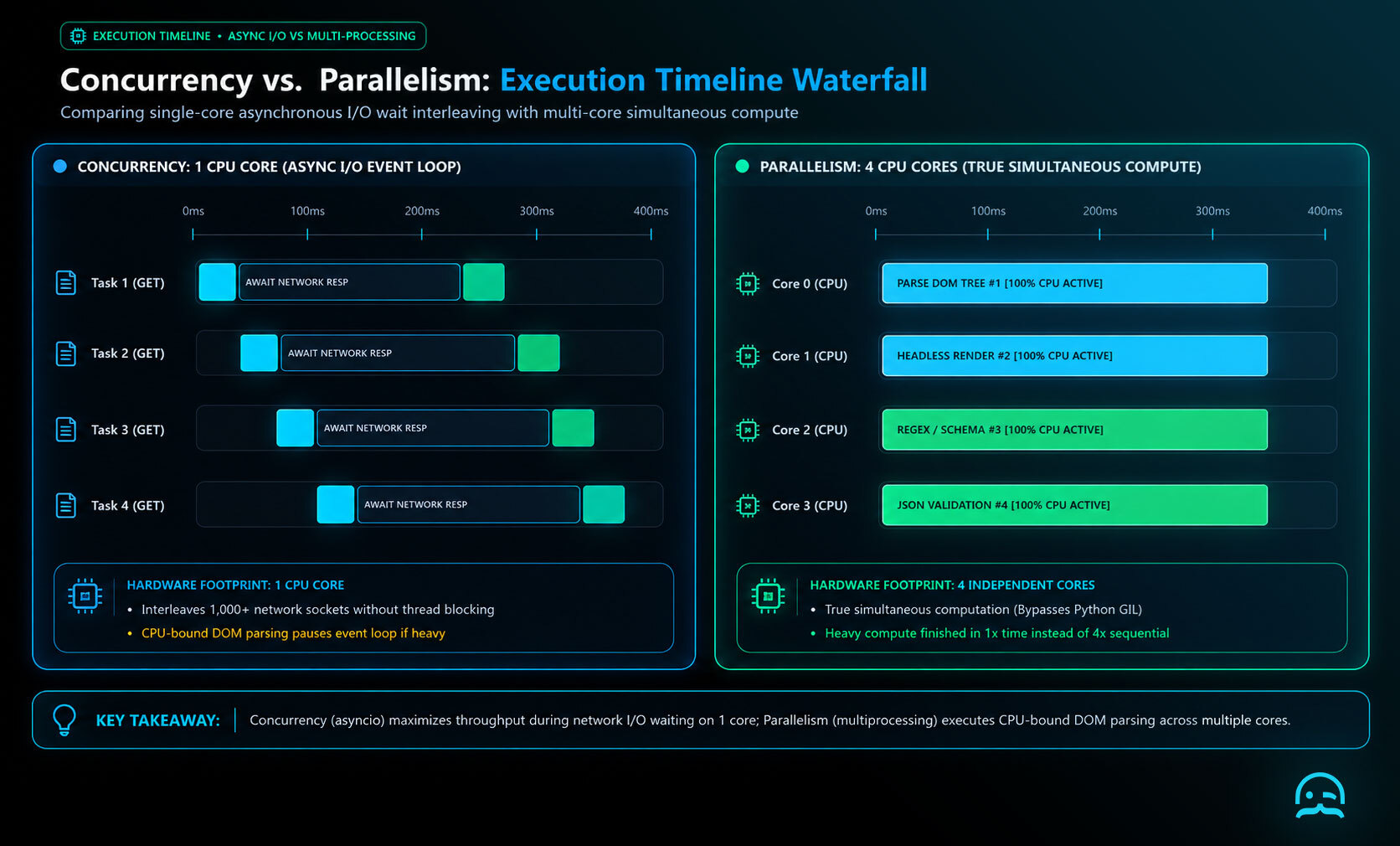
Concurrency and parallelism in web scraping are different. Concurrency overlaps I/O tasks. Parallelism runs CPU tasks at the same time. The right choice depends on what slows you down most. That could be data collection, processing, or both.
What Is Concurrency?
Concurrency means managing multiple tasks at once by rapidly switching between them. The system doesn't necessarily run tasks simultaneously, but it handles them in overlapping time periods.
Imagine you're handling multiple customer chats. You respond to one, then another, and rotate quickly between them without waiting too long on any one conversation.
In the context of web scraping, concurrency is about non-blocking I/O:
- Sending multiple HTTP requests at the same time
- Using libraries like
aiohttporasyncioto handle responses efficiently - Great for I/O-bound tasks like waiting on websites to respond
What Is Parallelism?
Parallelism means running multiple tasks at the same time. This often happens on separate CPU cores or across multiple machines.
Picture a team of chefs in a kitchen, each cooking a different dish at the same time. Unlike concurrency, parallelism is true simultaneous execution.
In web scraping, parallelism looks like:
- Running separate scraping processes across cores
- Parsing or transforming data using multiprocessing
- Splitting tasks across distributed servers
It’s especially useful for CPU-bound tasks where each job needs heavy computation.
Key Differences
| Feature | Concurrency | Parallelism |
|---|---|---|
| Execution style | Tasks interleaved, not truly simultaneous | Tasks executed at the same time |
| CPU usage | Can run on a single core | Requires multiple cores |
| Ideal for | I/O-bound operations | CPU-bound operations |
| Example tools | asyncio, aiohttp |
multiprocessing, worker pools |
Why It Matters for Scraping
Consider a scraper that must collect 10,000 product pages. The concurrency vs parallelism in web scraping distinction matters. A scraper that waits for each page before starting the next could take hours. With concurrency, it can keep requests to many pages in flight while others wait for network responses. This reduces idle time. If each page has large JSON data, it may need extra processing. This processing can include currency conversion or discount calculations. Parallelism can run these tasks at the same time.
- Maximize request throughput.
- Handle more data with fewer delays.
- Scale operations without adding unnecessary complexity.
How MrScraper Handles This
At MrScraper, our scraping engine can handle millions of requests each day. It combines concurrency and parallelism behind the scenes
- We use async-based fetching to avoid bottlenecks caused by slow-loading websites.
- For tasks like file parsing or image processing, we switch to parallel processing.
- This hybrid model ensures stable, scalable performance across all scraping projects.
Whether you're scraping real estate listings, tracking price changes, or collecting leads, the performance difference is noticeable.
Choosing the Right Approach
For concurrency vs parallelism in web scraping, choose concurrency when you need to speed up network-bound data collection. Choose parallelism when the bottleneck is data processing. If your workflow requires faster collection and processing, combine both approaches. At scale, speed and reliability depend on an architecture designed to support them.
Final Thoughts
Understanding concurrency and parallelism helps you move beyond basic scripts and toward building robust scraping systems. When implemented right, these concepts unlock serious performance gains, especially at scale.
If you want scraping infrastructure that follows these best practices, try MrScraper. It is a powerful solution built for efficiency, scale, and flexibility.
What We Learned
- Concurrency overlaps tasks by switching between them quickly. It works well for I/O-bound scraping, like waiting for website responses.
- Parallelism runs tasks at the same time across CPU cores or machines. It is useful for CPU-bound work like parsing and data transformation.
- Concurrency can reduce delays when collecting data from many pages, while parallelism can speed up heavy processing afterward.
- Combining concurrency and parallelism can improve throughput, reduce delays, and support scalable scraping operations.
Choose the Right Scraping Approach
Explore a practical starting point for applying concurrency and parallelism to your data extraction workflow.
Summarize this post
Open it in your assistant of choice with the prompt ready to send.
Take a Taste of Easy Scraping!

Find more insights here
The Ultimate Web Crawlers List: 15 Tools for Every Data Need
Compare the best web crawlers for 2026. Learn the difference between open-source, managed APIs, and…
Web Scraping MCP Server: Giving AI Agents Direct Access to Live Web Data
Learn how a Web Scraping MCP Server gives AI agents live web access while reducing token costs by 87…
Scaling E-commerce Competitive Intelligence with Automated Data Harvesting
Scale e-commerce data harvesting with residential proxies and AI. Learn how modern data extraction s…