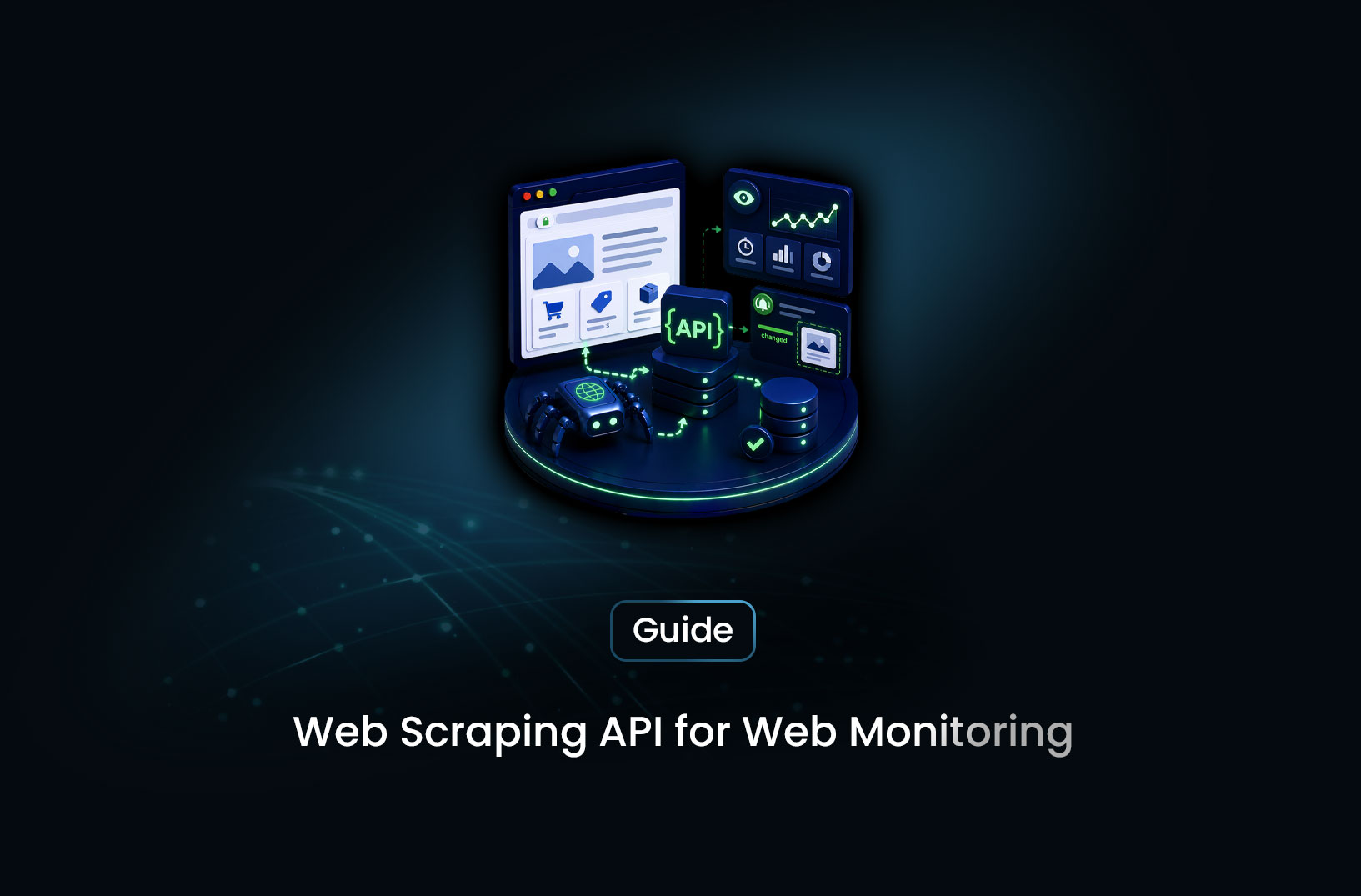
How to Monitor Website Changes Automatically
Web ScrapingLearn how to monitor website changes automatically using a web scraping API — content diffing, change detection, alerts, and scheduling for any site.
You check a competitor's pricing page manually every few weeks. You periodically visit a supplier's stock page to see if inventory is back. You occasionally scan a job board for roles that match your criteria. Multiply this across the dozen-plus URLs that actually matter to your business, and you've got a monitoring problem that no amount of browser bookmarks can solve cleanly.
Monitoring website changes with a web scraping API means automating the entire loop: fetch the page, compare its content to the last known version, and trigger an alert when something changes — without manual checking, on whatever cadence the information warrants. This guide covers the complete technical approach: how content diffing works, how to build a scheduled change-detection pipeline, how to handle JavaScript-rendered pages, and which tools fit which monitoring scenarios.
Table of Contents
- What Is Website Change Monitoring?
- How Automated Change Detection Works
- Step-by-Step Guide: Building a Website Change Monitor
- Best Tools for Automated Website Monitoring
- Free vs. Paid: What Each Approach Provides
- Key Features to Look For in a Change Monitoring Tool
- When Should You Build vs. Buy Website Monitoring?
- Common Challenges and Limitations
- Conclusion
- What We Learned
- FAQ
What Is Website Change Monitoring?
Website change monitoring is the automated practice of periodically fetching a web page's content and comparing it to a previously stored version to detect any differences — triggering a notification when something has changed.
The use cases span nearly every business function. Sales and marketing teams monitor competitor pricing pages, product announcements, and job postings for strategic signals. Legal and compliance teams track regulatory agency websites for policy updates. Procurement teams watch supplier inventory pages for availability changes. Developers monitor third-party API documentation and deprecation notices. E-commerce businesses watch competitor product listings for price drops and stock status shifts.
What makes automated monitoring valuable over manual checking is continuity and frequency. A manual check every two weeks misses a pricing change that appeared and reverted within a week. An hourly automated monitor catches it. A monitor running across twenty URLs simultaneously replaces twenty separate browser sessions with zero recurring manual effort — the monitoring runs whether or not anyone remembers to check.
How Automated Change Detection Works
The core detection loop has four steps that repeat on every scheduled run.
Step 1 — Fetch. The monitoring system retrieves the current content of each watched URL. For static HTML pages, a simple HTTP GET suffices. For JavaScript-rendered pages — which describes most modern competitor sites, product pages, and SaaS pricing pages — a browser rendering layer is required to produce the actual displayed content rather than an empty page shell.
Step 2 — Extract and normalize. Raw HTML contains noise that changes every run even when the meaningful content hasn't: dynamic ad slots, session tokens embedded in scripts, visitor tracking parameters, and timestamps. Extracting just the relevant content — the pricing table text, the product availability string, the job posting title — removes this noise before comparison. The cleaner and more targeted the extraction, the fewer false positives you'll get from irrelevant page elements changing.
Step 3 — Hash and compare. The extracted content is hashed (SHA-256 is standard) and compared against the stored hash from the previous run. If the hashes differ, content has changed. For more granular change reporting, a diff operation can identify which specific text changed rather than just confirming that something did.
Step 4 — Alert. When a change is detected, a notification is dispatched through whatever channel fits your workflow — Slack, email, SMS, webhook — carrying the URL, the timestamp, and ideally a summary of what changed.
According to Python's standard library documentation on the difflib module, the SequenceMatcher class and related utilities provide a straightforward way to compute human-readable diffs between text sequences — which is exactly the tool that powers the "what changed" detail in change notifications.
Step-by-Step Guide: Building a Website Change Monitor
Step 1: Build the Content Fetcher
Start with a fetcher that handles both static and JavaScript-rendered pages:
import requests
import hashlib
import trafilatura

SCRAPING_API_ENDPOINT = "https://your-scraping-provider.com/v1/scrape"
API_KEY = "your-api-key"

def fetch_static_page(url: str) -> str | None:
    """Fetch a static HTML page and extract clean text content."""
    try:
        response = requests.get(
            url,
            headers={"User-Agent": "Mozilla/5.0 (compatible; change-monitor/1.0)"},
            timeout=15
        )
        response.raise_for_status()
        # Extract clean text — removes nav, ads, boilerplate
        return trafilatura.extract(response.text) or response.text
    except requests.RequestException as e:
        print(f"Fetch failed for {url}: {e}")
        return None

def fetch_rendered_page(url: str) -> str | None:
    """Fetch a JavaScript-rendered page via scraping API."""
    try:
        response = requests.post(
            SCRAPING_API_ENDPOINT,
            headers={"Authorization": f"Bearer {API_KEY}"},
            json={"url": url, "render_js": True},
            timeout=30
        )
        if response.status_code == 200:
            html = response.json().get("html", "")
            return trafilatura.extract(html) or html
        print(f"API error {response.status_code} for {url}")
        return None
    except requests.RequestException as e:
        print(f"Rendered fetch failed for {url}: {e}")
        return None
trafilatura.extract() strips navigation, advertisements, sidebars, and boilerplate from the raw HTML, leaving only the main content. This dramatically reduces false positives from elements that change on every page load without affecting the content you're actually monitoring.
Step 2: Hash the Content for Change Detection
Convert the extracted content to a stable fingerprint:
def content_hash(content: str) -> str:
    """Generate a SHA-256 hash of extracted page content."""
    normalized = " ".join(content.lower().split())  # Normalize whitespace
    return hashlib.sha256(normalized.encode("utf-8")).hexdigest()
Lowercasing and normalizing whitespace before hashing prevents spurious change detections from minor formatting variations — an extra space or a capitalization difference in a dynamic element shouldn't trigger an alert. The hash of the actual meaningful text should be stable between runs if the content hasn't changed.
Step 3: Store Hashes and Detect Changes
import sqlite3
from datetime import datetime

def init_monitor_db(db_path: str = "change_monitor.db") -> sqlite3.Connection:
    conn = sqlite3.connect(db_path)
    conn.execute("""
        CREATE TABLE IF NOT EXISTS page_snapshots (
            id          INTEGER PRIMARY KEY AUTOINCREMENT,
            url         TEXT NOT NULL,
            content     TEXT,
            content_hash TEXT NOT NULL,
            checked_at  TIMESTAMP DEFAULT CURRENT_TIMESTAMP
        )
    """)
    conn.execute("""
        CREATE INDEX IF NOT EXISTS idx_url_date
        ON page_snapshots (url, checked_at)
    """)
    conn.commit()
    return conn

def check_for_change(conn: sqlite3.Connection, url: str, current_content: str) -> bool:
    """
    Compare current content against the last stored snapshot.
    Returns True if content has changed, False if unchanged.
    """
    current_hash = content_hash(current_content)

    previous = conn.execute("""
        SELECT content_hash FROM page_snapshots
        WHERE url = ?
        ORDER BY checked_at DESC LIMIT 1
    """, (url,)).fetchone()

    # Store current snapshot
    conn.execute("""
        INSERT INTO page_snapshots (url, content, content_hash)
        VALUES (?, ?, ?)
    """, (url, current_content[:5000], current_hash))  # Cap stored content size
    conn.commit()

    if previous is None:
        return False  # First run — no previous to compare against

    return previous[0] != current_hash  # True if hash differs
Capping stored content at 5,000 characters keeps the database from growing unbounded over many monitoring cycles, while preserving enough context for the diff step when reviewing what actually changed.
Step 4: Generate a Human-Readable Diff and Send an Alert
When a change is detected, produce a diff that explains what changed:
import difflib
import requests as http_requests

SLACK_WEBHOOK = "https://hooks.slack.com/services/YOUR/WEBHOOK/URL"

def generate_diff(old_content: str, new_content: str, context_lines: int = 3) -> str:
    """Generate a human-readable unified diff between two content versions."""
    old_lines = old_content.splitlines(keepends=True)
    new_lines = new_content.splitlines(keepends=True)
    diff = difflib.unified_diff(
        old_lines, new_lines,
        fromfile="previous", tofile="current",
        n=context_lines
    )
    return "".join(diff) or "Content changed but diff could not be generated."

def send_change_alert(url: str, diff_summary: str):
    """Send a Slack notification when a monitored page changes."""
    message = (
        f"🔔 *Change Detected*\n"
        f"URL: {url}\n"
        f"Time: {datetime.utcnow().strftime('%Y-%m-%d %H:%M UTC')}\n"
        f"```{diff_summary[:800]}```"  # Slack message length limit
    )
    http_requests.post(SLACK_WEBHOOK, json={"text": message}, timeout=10)
Step 5: Schedule the Full Monitoring Loop
Wrap everything into a scheduled job that runs continuously:
from apscheduler.schedulers.blocking import BlockingScheduler

MONITORED_URLS = [
    {"url": "https://competitor.com/pricing", "rendered": True},
    {"url": "https://supplier.com/inventory/product-x", "rendered": False},
    {"url": "https://regulator.gov/policy/updates", "rendered": False},
]

def run_monitor_cycle():
    conn = init_monitor_db()
    for item in MONITORED_URLS:
        url = item["url"]
        content = (
            fetch_rendered_page(url) if item["rendered"]
            else fetch_static_page(url)
        )
        if content is None:
            print(f"⚠️  Could not fetch {url}")
            continue

        changed = check_for_change(conn, url, content)
        if changed:
            # Get previous content for diff
            previous_row = conn.execute("""
                SELECT content FROM page_snapshots
                WHERE url = ?
                ORDER BY checked_at DESC LIMIT 1 OFFSET 1
            """, (url,)).fetchone()

            diff = generate_diff(
                previous_row[0] if previous_row else "",
                content[:5000]
            )
            send_change_alert(url, diff)
            print(f"✅ Change detected: {url}")
        else:
            print(f"— No change: {url}")
    conn.close()

scheduler = BlockingScheduler()
scheduler.add_job(run_monitor_cycle, "interval", hours=1, id="change_monitor")

if __name__ == "__main__":
    run_monitor_cycle()  # Run immediately on start
    scheduler.start()
Best Tools for Automated Website Monitoring
1. Python (Requests + trafilatura + difflib)
For static pages and developers comfortable with a Python environment, the standard library covers the full monitoring loop at zero cost. trafilatura handles content extraction, difflib handles change comparison, and APScheduler handles the recurring execution. The code examples in this guide use this stack.
Best for: Developers monitoring static pages who want full control at no tool cost.
2. Playwright + Python (JS-Rendered Pages)
For monitoring JavaScript-heavy targets — SaaS pricing pages, React-based competitor sites, dynamic product pages — Playwright provides the browser rendering layer that plain HTTP requests can't deliver. Pair with the extraction and diffing logic above for a complete JS-aware monitoring pipeline.
Best for: Developers who need to monitor JS-rendered pages and are comfortable managing browser processes.
3. MrScraper
For teams monitoring JS-rendered pages at scale without managing browser infrastructure, MrScraper's Scraping Browser renders pages through a managed API with anti-bot bypass included — particularly relevant for competitor and e-commerce monitoring targets that deploy Cloudflare or similar protection. Replace the fetch_rendered_page() function in the guide with a call to MrScraper's API and the rest of the pipeline (hashing, diffing, alerting) remains unchanged. Documentation at https://docs.mrscraper.com.
Best for: Teams monitoring protected or JS-heavy targets who want managed rendering infrastructure without self-hosted browser processes.
4. Commercial Monitoring Tools (Visualping, Hexowatch, Wachete)
For non-technical users or teams that don't want to write any code, visual website monitoring tools provide point-and-click monitoring setup, built-in notification delivery, and dashboards for reviewing change history. Less customizable than a custom pipeline but operational in minutes rather than hours.
Best for: Non-technical teams or small-scale personal monitoring where code development isn't warranted.
Free vs. Paid: What Each Approach Provides
The custom Python pipeline is entirely free for static page monitoring — requests, trafilatura, difflib, and APScheduler are all open-source, and the infrastructure cost is a small VPS running the scheduler. For JS-rendered pages, Playwright adds a browser process that increases server resource requirements modestly.
Managed scraping APIs like MrScraper have per-page costs that scale with monitoring frequency. For monitoring ten URLs hourly, the monthly page cost is modest; for monitoring thousands of URLs, cost modeling against your provider's pricing tier is worthwhile.
Commercial monitoring tools (Visualping, Hexowatch) offer free tiers with limited monitors and check frequency, and paid tiers that unlock more monitors, higher frequency, and richer notification options. They trade configurability for ease of setup.
Key Features to Look For in a Change Monitoring Tool
- Content extraction before comparison: Raw HTML comparison produces massive false-positive rates from dynamic elements; meaningful content extraction before diffing is what makes alerts actionable.
- Targeted selector monitoring: The ability to monitor a specific CSS selector or DOM element rather than the full page reduces noise further — you care about the price element, not the entire pricing page.
- JavaScript rendering for dynamic pages: Most modern monitoring targets render content after page load; a tool that can't render JavaScript will miss price and content changes on modern pages.
- Diff quality in notifications: Knowing a page changed is less useful than knowing what specifically changed — good monitoring tools include readable change summaries, not just "something changed."
- Configurable check frequency per URL: Different URLs warrant different monitoring cadences — hourly for competitor pricing, daily for regulatory sites. Per-URL frequency control keeps costs proportional to the actual value of each monitored source.
- Failure alerting for fetch errors: When a monitored URL becomes unreachable (server error, DNS failure, anti-bot block), this should also trigger a notification — silent failures accumulate undetected monitoring gaps.
When Should You Build vs. Buy Website Monitoring?
Build a custom pipeline when:
- You need to monitor JS-rendered pages or bot-protected targets that commercial tools can't reliably access
- Your monitoring requirements include custom extraction logic — specific fields, structured data, transformation before comparison
- You're integrating monitoring into a broader data pipeline where the output feeds into analysis, a database, or another system
- You have the technical capability and the monitoring scope is large enough that per-monitor pricing on commercial tools would be expensive
Use a commercial monitoring tool when:
- You need monitoring operational quickly without development time
- Your targets are standard publicly accessible pages without bot protection
- Non-technical team members need to manage monitored URLs without code changes
- Your monitoring scope is small and the simplicity of a commercial tool outweighs the configuration flexibility of a custom build
Common Challenges and Limitations
Dynamic page elements generate false positives. Pages that include ad slots, personalization, rotating content blocks, or session-based elements produce different HTML on every load even when the meaningful content is unchanged. Without effective content extraction before comparison, every monitoring run produces false alerts. trafilatura handles most common cases, but some targets require custom selector-level extraction to isolate only the content that actually matters.
Anti-bot measures block monitoring requests over time. Commercial and competitor pages that deploy bot protection will eventually flag and block monitoring requests, especially from static IPs or data-center infrastructure. The same IP hitting the same URL repeatedly at regular intervals accumulates a suspicious pattern history. For monitoring important targets, residential proxy rotation or a managed browser API that handles anti-bot bypass is more sustainable than hoping an unrotated IP continues working.
JavaScript-rendered content requires browser infrastructure. Sites that load their content dynamically — which includes most modern SaaS pricing pages, ecommerce product pages, and competitor sites — return empty content without a rendering layer. Plain HTTP requests monitor the wrong content, producing false "no change" readings while meaningful changes go undetected. Confirm whether your target requires rendering by checking the page source directly (Ctrl+U) for your target content.
Content that changes constantly produces monitoring fatigue. Some pages update frequently with minor content that isn't what you're actually watching — news site articles, social feed timestamps, rolling visitor counts. Either use targeted CSS selector extraction to watch only the specific element that matters, or implement change significance filtering that only alerts when the changed content exceeds a word-count threshold, to prevent alert fatigue from high-frequency minor changes.
Conclusion
Automated website change monitoring converts manual checking into a continuous background process — URLs are fetched on schedule, content is compared to previous versions, and alerts fire only when something actually changes. The pipeline is well-defined: extract, hash, compare, diff, alert, schedule. The complexity is calibrated to your targets: static pages in plain Python, JS-rendered pages with a rendering layer, bot-protected targets with managed browser infrastructure.
The practical starting point is one URL that matters to your business — a competitor's pricing page, a supplier's stock status, a regulatory update page. Get the detection loop working for that one URL, confirm the alerts are accurate and actionable, then scale outward. The infrastructure in this guide handles as many URLs as you add to the configuration.
What We Learned
- Website change monitoring automates the detection loop, not the response: The system tells you what changed and when — the decision about what to do with that information still belongs to you.
- Content extraction before comparison is what makes alerts accurate: Raw HTML comparison generates constant false positives; stripping dynamic noise to just the meaningful content is what makes the hash stable between runs.
- Static and JS-rendered pages need different fetchers:
requestscovers static pages; a browser rendering layer (Playwright or a managed API) is required for pages that load content via JavaScript. - Diff output in alerts is more valuable than change confirmation alone: Knowing a competitor's pricing page changed is less useful than knowing which specific plan price changed by how much.
- Silence from failed fetches is as important to catch as detected changes: When a monitored URL stops returning content, that's a signal that warrants attention — build explicit failure alerting alongside change alerting.
- Frequency should match the information's actual rate of change: Hourly monitoring of a regulatory page that updates quarterly wastes resources; daily monitoring of a competitor who changes pricing weekly misses the window when data matters.
FAQ
What is website change monitoring and how does it work?
Website change monitoring is the automated detection of changes to web page content by periodically fetching a page, comparing its current content to a stored previous version, and triggering a notification when differences are detected. It works through a four-step loop: fetch the page content, extract and normalize the meaningful text, hash it and compare to the previous hash, and send an alert when the hashes differ.
Why do I need a web scraping API to monitor website changes?
For JavaScript-rendered pages — which includes most modern SaaS, ecommerce, and competitor sites — a plain HTTP request returns an empty page shell rather than the actual displayed content. A web scraping API or browser automation tool that executes JavaScript is necessary to see the actual prices, stock status, or content that your monitor is watching. Static HTML pages can be monitored with simple HTTP requests, but any site built on React, Vue, or similar frameworks requires rendering to access its content.
How do I avoid false positives in website change monitoring?
False positives — alerts triggered by dynamic page elements that change on every load rather than by meaningful content changes — are reduced by extracting and normalizing content before comparison. Using a library like
trafilaturato strip navigation, ads, and boilerplate, monitoring specific CSS selectors rather than full-page HTML, and normalizing whitespace and casing before hashing all reduce the sensitivity of your detection to irrelevant changes.How often should I check for website changes?
Check frequency should match the actual rate of change you care about and the value of catching changes quickly. Competitor pricing pages that could shift any day warrant hourly or twice-daily checks. Regulatory pages that update occasionally warrant daily or weekly checks. High-frequency monitoring of slowly changing content is wasteful; low-frequency monitoring of fast-changing content misses the window when information is actionable. Configure per-URL frequency based on each source's actual change cadence.
Can I use Python to monitor website changes automatically?
Yes. Python's standard library includes
difflibfor content comparison, andhashlibfor stable content hashing. Combined withrequestsorplaywrightfor fetching,trafilaturafor content extraction,sqlite3for storing snapshots, andAPSchedulerfor recurring execution, a complete automated change monitoring pipeline is achievable in a few hundred lines of Python. The guide in this article covers the complete implementation across all five pipeline stages.
Summarize this post
Open it in your assistant of choice with the prompt ready to send.
Take a Taste of Easy Scraping!

Find more insights here

Build a Source-Led Deep Research Workflow With MrScraper
Build a deep research workflow that turns a question into a source plan, collects evidence from appr…
Choose an Agent Framework for a Web Data Application
Compare LangGraph, the OpenAI Agents SDK, Google ADK, CrewAI, Mastra and the Claude Agent SDK on too…

Design AI Research Loops That Stop, Recover and Produce Evidence
Learn how to build an AI research loop with clear states, firm stop conditions, safe retries after f…