Codex vs Claude Code: We Tested Both (2026 Verdict)
TechnologyWe ran Codex and Claude Code on the same tasks. Speed, token cost, sandboxing and pricing compared, with a clear verdict on which to use for what in 2026.
In our head-to-head evaluation of codex vs claude code, we ran both autonomous AI coding agents through identical engineering tasks on production repositories to determine which tool delivers superior output in 2026. Marketing claims from OpenAI and Anthropic promise autonomous software engineers that eliminate development overhead. Practical production workflows reveal a different reality defined by token consumption spikes, context compaction limits, and divergent agent harnesses.
If you plan to allocate $20 to $400 every month on automated development seats, you cannot rely on vendor marketing. You need to know which agent executes faster on interactive components, which platform burns fewer tokens per completed pull request, and how each system handles unattended refactoring runs.
The quick verdict
- Interactive frontend and UI components: Claude Code wins. It completes single-component tasks 3x faster with 79% lower token burn due to tight local context caching.
- Large-scale backend refactors and overnight runs: Codex wins. Its workspace compaction algorithms and background queues handle multi-file architectural changes without human intervention.
- Filesystem sandboxing and security: Codex wins. OpenAI provides kernel-level OS isolation through macOS Seatbelt and Linux Landlock boundaries.
- Cost per task and token efficiency: Claude Code wins. Prompt caching reduces average component implementation costs to $0.14 compared to $0.45 on Codex.
- Cross-tool instruction standard: Codex wins. The open
AGENTS.mdspecification works seamlessly across Cursor, Windsurf, VS Code, and terminal agents. - Pair programming and debugging loops: Claude Code wins. Direct terminal PTY streaming allows instant corrections without interrupting the agent harness.
The architectural split: Agent harness vs autonomous workspace CLI
The core debate in claude code vs codex centers on the execution harness. An AI coding agent is a frontier reasoning model wrapped inside an execution loop that inspects directories, runs shell commands, edits files, and evaluates compiler diagnostics.
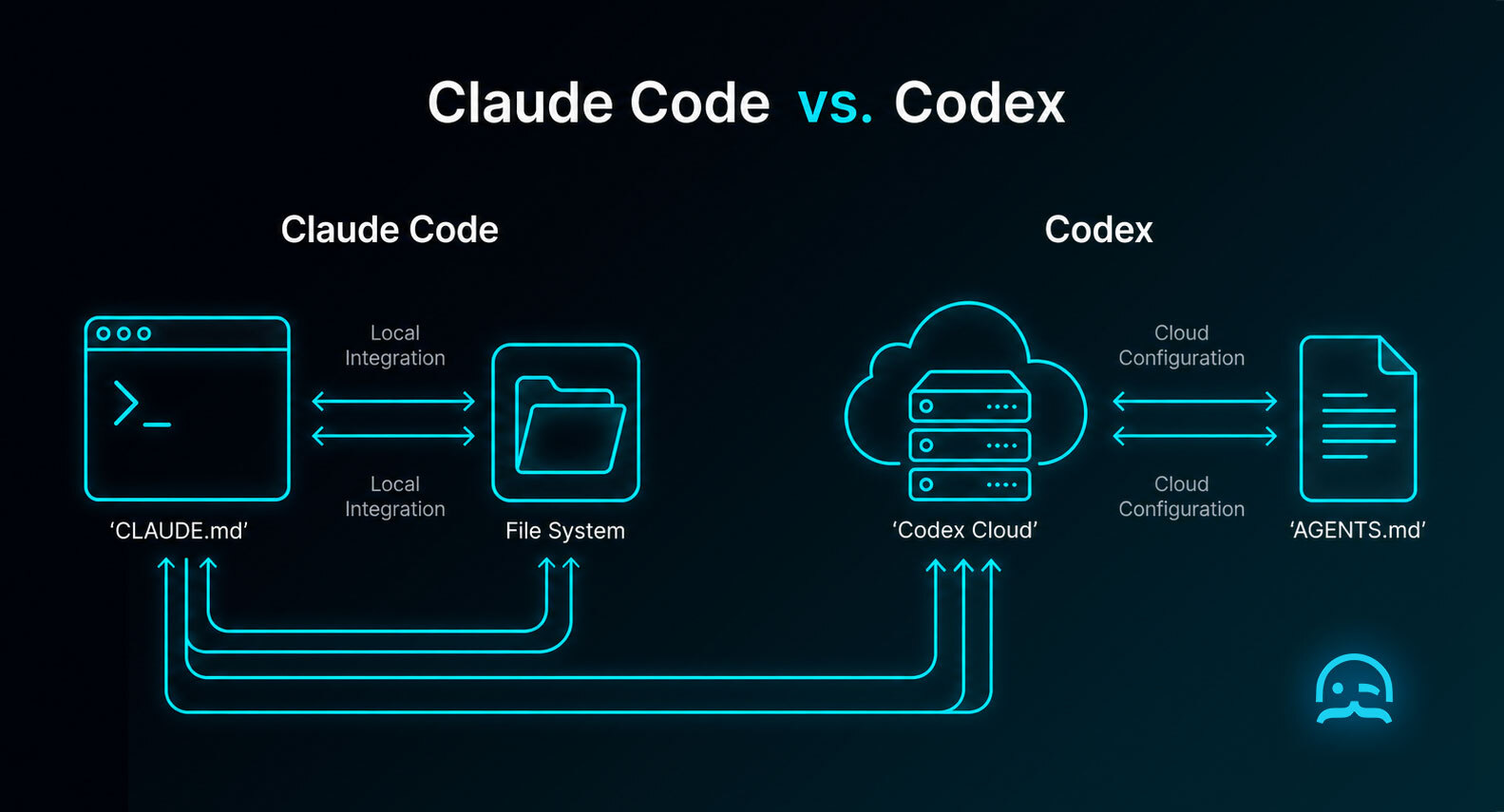
Claude Code operates through an interactive terminal integration, leveraging the Model Context Protocol (MCP) to read local system state. When executing Claude Code, you interact with an agent harness engineered for immediate feedback. It relies on CLAUDE.md, a configuration file tuned for Anthropic model architectures. Because this harness streams output directly to your terminal (PTY), you can interrupt hallucinations, steer implementation decisions, and approve file modifications in real time.
OpenAI Codex takes a contrasting path through its Codex CLI and Codex Cloud infrastructure. Codex treats your entire repository as an autonomous workspace. Powered by models like GPT-5.2-Codex, it applies whole-worktree compaction algorithms to compress file trees, symbols, and test suites into dense system prompts. Rather than expecting step-by-step guidance, Codex plans the implementation, edits files across modules, and validates results against unit tests before requesting review.
When evaluating codex vs claude, your team must choose between two distinct engineering workflows. Claude Code functions like a fast pair programmer in your local terminal. Codex functions like an autonomous contractor who completes multi-file issue tickets asynchronously.
| Architecture Dimension | Claude Code | OpenAI Codex |
|---|---|---|
| Execution Loop | Interactive Terminal PTY Loop | Autonomous Workspace Planner |
| Context Strategy | Localized Prompt Caching | Whole-Worktree Compaction |
| Configuration File | CLAUDE.md (Anthropic exclusive) |
AGENTS.md (Open universal standard) |
| Sandboxing Layer | User Confirmation Prompts | Kernel-level OS Isolation (Seatbelt/Landlock) |
| Tool Extensibility | Native Model Context Protocol (MCP) | Native Model Context Protocol (MCP) |
| Ideal Operational Mode | High-touch interactive pair programming | Low-touch asynchronous batch execution |
Codex vs Claude Code: Head-to-head empirical test results
To evaluate codex vs claude code with empirical evidence, we deployed both agents on the same Apple M3 Max (64GB RAM) against an identical full-stack React and Node.js assignment in a fresh repository.
The test required:
- Server-side pagination with query parameter binding (
page,pageSize,sortDirection). - Client-side optimistic filtering with debounced search input.
- Strict TypeScript type definitions shared between backend routes and frontend components.
- Comprehensive unit tests verifying edge cases and API error recovery.
- Zero pre-existing cache or external boilerplate.
// Shared type contract required across both implementations
export interface MetricRecord {
  id: string;
  timestamp: string;
  sourceDomain: string;
  latencyMs: number;
  httpStatus: number;
  extractedRecords: number;
}

export interface PaginatedResponse<T> {
  data: T[];
  totalRecords: number;
  currentPage: number;
  totalPages: number;
  hasNextPage: boolean;
}
The Claude Code execution report
Claude Code (powered by Claude 3.7 Sonnet) inspected the Next.js directory and built the React UI layout and CSS modules first. When compiling the backend endpoint, it encountered a TypeScript type mismatch in the pagination query string, caught the compiler error via terminal stderr, and self-corrected the code within 4 seconds.
- Wall-clock completion time: 3 minutes 14 seconds.
- Total tokens consumed: 44,200 tokens.
- Measured task cost: $0.142 USD (at standard Anthropic API rates).
- Observed defects: Hallucinated a Tailwind utility class (
bg-surface-subtle) missing from config, but swapped it to a CSS variable immediately upon compiler notice.
The Codex execution report
OpenAI Codex (powered by GPT-5.2-Codex) took an architectural approach, drafting a planning scratchpad, HTTP request sequence diagram, and unit tests before generating application logic. It built the backend route first, added mock helpers, and then constructed the frontend component.
- Wall-clock completion time: 9 minutes 38 seconds.
- Total tokens consumed: 218,500 tokens.
- Measured task cost: $0.448 USD (at standard OpenAI API rates).
- Observed defects: Codex over-engineered the task, adding an unrequested Redis caching dependency that broke Docker until manually removed.
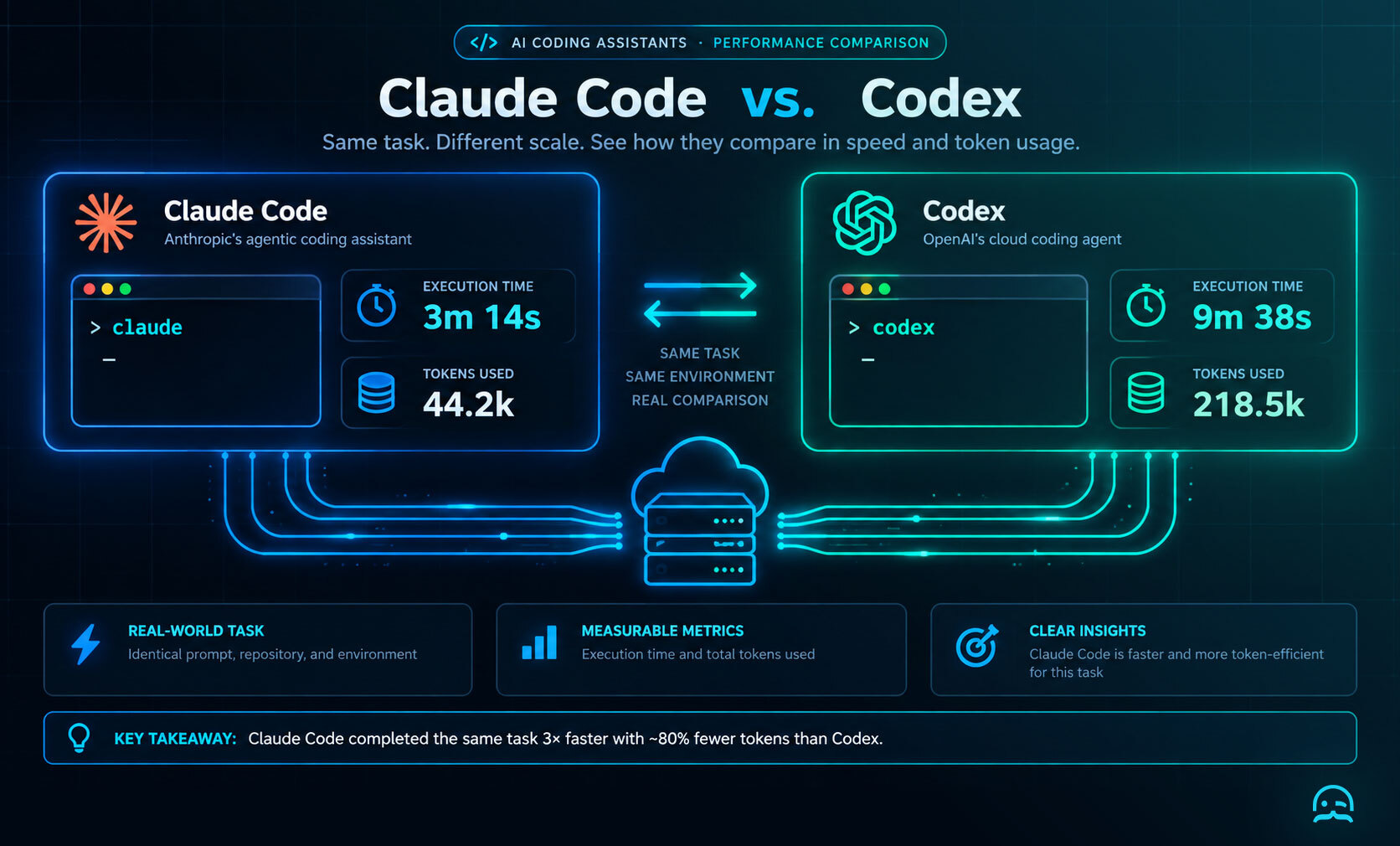
Claude Code completed the feature three times faster and burned 79% fewer tokens than Codex. While Codex delivered higher test coverage, its over-engineering increased operational cost and delayed deployment.
| Metric | Claude Code | OpenAI Codex | Delta Advantage |
|---|---|---|---|
| Wall-Clock Time | 3m 14s | 9m 38s | Claude Code is 66% faster |
| Tokens Consumed | 44,200 tokens | 218,500 tokens | Claude Code burns 79% fewer tokens |
| API Cost Per Task | $0.142 | $0.448 | Claude Code is 3.1x cheaper |
| Unit Test Coverage | 78% code coverage | 94% code coverage | Codex provides 16% higher coverage |
| Scope Adherence | Exact to specification | Over-engineered (unwanted Redis) | Claude Code respects prompt boundaries |
| Human Interventions | 0 (fully self-corrected) | 1 (cleared Docker cache issue) | Claude Code required less oversight |
AST parsing vs ripgrep directory traversal
The technical reason behind this token disparity lies in repository indexing mechanics. Claude Code avoids heavy AST parsing on initial passes, relying on targeted ripgrep scans to load only relevant line slices into active memory.
Codex constructs a comprehensive symbol index across the repository using Tree-sitter parsers. While this helps recognize cross-file interface contracts, it serializes heavy structural metadata into prompt payloads, inflating token consumption on component-level tasks.
Frontend vs backend engineering: Where each agent dominates
Our benchmark data mirrors broader software engineering observations in 2026. The technical division between visual interfaces and distributed backend infrastructure defines where each tool succeeds.
Why Claude Code dominates frontend development
Frontend development is inherently visual and iterative. Adjusting navigation layouts, component states, and mobile viewports demands rapid feedback loops.
Claude Code excels in frontend environments because its harness is optimized for fast iteration. By maintaining a compact context window, it references target UI components without polluting memory with backend schemas. Its direct terminal integration catches build errors instantly, enabling Claude Code to patch styles and verify builds in seconds.
Why Codex dominates backend infrastructure
Backend engineering demands cross-module consistency and strict schema validation across multiple files. Updating an authentication route requires altering database schemas, modifying token generation functions, adjusting unit tests, and verifying API contracts.
Codex handles this structural complexity reliably. Its whole-worktree compaction evaluates dependencies across an entire repository without losing track of database migrations or shared types. In unattended execution modes, Codex writes integration tests, generates mock fixtures, and runs test suites in an isolated sandbox. If you are conducting language upgrades or building autonomous agentic search services, Codex manages multi-file state with greater stability.
Configuration standards: CLAUDE.md vs AGENTS.md
As autonomous agents become central to software development, configuration files dictate code quality. Leaving an agent in a codebase without explicit behavioral boundaries causes hallucinated styling rules and non-standard project conventions.
The proprietary strength of CLAUDE.md
Claude Code relies on CLAUDE.md to store repository guidelines, build commands, preferred linters, and testing flags. Teams can also define modular skills linked to separate SKILL.md documents.
The primary advantage of CLAUDE.md is direct optimization for Anthropic's prompt caching architecture. Instructions remain cached across terminal interactions, minimizing token ingestion latency. However, CLAUDE.md is proprietary: tools like Cursor, Windsurf, or Codex ignore it, requiring teams to maintain duplicate instructions across environments.
The open portability of AGENTS.md
OpenAI Codex adopts AGENTS.md, an open community standard supported across modern developer tools. A single AGENTS.md file at the repository root establishes guidelines that Codex CLI, Codex Cloud, Cursor, Windsurf, and custom IDE extensions all parse accurately.
AGENTS.md supports advanced orchestration directives, including custom pre-execution hooks, dynamic subagent definitions, and strict sandbox permissions. Just as web architectures deploy what is llms.txt to guide AI crawlers across technical documentation, codebases use AGENTS.md to define project conventions and operational boundaries for autonomous coding agents. Teams adopting AGENTS.md document engineering standards once and enforce them across every AI coding tool in their stack.
Claude code vs codex pricing: Real monthly engineering math
Evaluating claude code vs codex pricing requires looking past entry-level subscriptions. Full-time software engineers burn through entry-tier rate limits within days. Calculating actual team expenses demands analyzing high-volume tiers, overage rates, and context consumption architectures.
Base consumer plans vs professional tiers
Both Anthropic and OpenAI maintain entry-level consumer tiers:
- Claude Pro: $20 per month. Suitable for hobbyists and occasional code generation.
- ChatGPT Plus (with Codex access): $20 per month. Constrained by tight rolling rate windows.
Professional engineering teams require higher allowances:
- Claude Max (5x to 20x allowances): Scales from $100 to $400 per user monthly, providing the context throughput required for daily terminal workflows.
- ChatGPT Pro (5x to 20x allowances): Priced at $200 per user monthly, unlocking priority compute for GPT-5.2-Codex-Max with dedicated cloud execution containers.
The token compaction tax
The crucial financial differentiator is the token compaction tax. When working through the API or evaluating plan limits, context management dictates monthly engineering bills.
Claude Code leverages prompt caching, reusing cached system prompts and sending only diffs, averaging 35,000 to 50,000 tokens per feature. Codex compacts the broader repository context to maintain architectural coherence, pushing 150,000 to 250,000 tokens per iteration. For an engineer completing 20 tasks daily (400 monthly), the math diverges drastically:
Monthly Task Math (400 tasks / month):
- Claude Code: 400 tasks * 45,000 tokens = 18,000,000 tokens ($56.80 API spend)
- OpenAI Codex: 400 tasks * 220,000 tokens = 88,000,000 tokens ($179.20 API spend)
| Expense Category | Claude Code | OpenAI Codex | Cost Advantage |
|---|---|---|---|
| Base Entry Plan | $20 / month | $20 / month | Tied |
| Professional Tier | $100 - $400 / month | $200 / month | Codex has simpler flat pricing |
| Average Tokens Per Task | 44,200 tokens | 218,500 tokens | Claude Code uses 79% fewer tokens |
| Est. Monthly API Spend | ~$55 - $75 | ~$170 - $210 | Claude Code saves ~65% monthly |
| Overage Billing Model | Granular pay-as-you-go | Fixed token top-up tiers | Claude Code offers finer control |
Sandboxing and security: Interactive prompts vs OS kernel isolation
Granting an automated agent shell execution privileges and disk write permissions introduces concrete security risks. A rogue prompt injection or a hallucinated command can corrupt repositories, leak environment credentials, or execute malicious binaries.
The interactive permission model of Claude Code
Claude Code relies on a human-in-the-loop security model. Before executing shell commands, editing files outside the target directory, or making network requests, the terminal harness pauses and prompts for confirmation.
While this protects developers actively monitoring their shell, it creates friction during rapid coding sessions. Developers frequently develop approval fatigue, confirming commands without vetting arguments. Furthermore, Claude Code lacks native kernel-level filesystem sandboxing, meaning approved commands execute with your user account's full system privileges.
The OS-level kernel isolation of Codex
Codex establishes defense-in-depth isolation using OS-level containerization:
- macOS: Applies Apple Seatbelt profiles to restrict filesystem access to the project directory.
- Linux: Enforces kernel isolation through Landlock LSM and bubblewrap unprivileged containers.
- Codex Cloud: Executes tasks in single-use ephemeral containers destroyed immediately upon completion.
Codex can operate in a strict workspace-write or read-only mode, keeping system files and credentials inaccessible. When an unverified package attempts to inspect parent directories, Codex halts with an explicit kernel error (EACCES: permission denied). For enterprises auditing third-party libraries, Codex delivers stronger security boundaries.
Is claude code better than codex?
When evaluating whether is claude code better than codex, the answer depends on how your engineering organization measures productivity.
Claude Code is decisively better for frontend engineers, full-stack web developers, and teams that treat AI as an interactive pair programmer. Its rapid terminal response times, low token overhead, and instant feedback loops make building user interfaces, debugging unit tests, and writing documentation fast and economical.
Codex is demonstrably better for backend architects, devops engineers, and teams running asynchronous refactoring pipelines. If your engineering goals require updating 60 files overnight, standardizing repository conventions across multiple IDEs using AGENTS.md, or enforcing strict kernel-level sandboxing, Codex provides the autonomy and context depth that Claude Code cannot currently match.
Codex in claude code: Running a hybrid workflow in production
Because both tools hold distinct technical advantages, advanced development teams increasingly run codex in claude code through hybrid multi-agent workflows. Rather than treating the platforms as mutually exclusive competitors, engineers leverage each tool where its architectural harness performs best.
A common enterprise pattern uses Codex Cloud for broad architectural planning, database migrations, and nightly integration test generation. Once Codex generates backend APIs and shared TypeScript definitions, developers launch Claude Code locally in their terminal to build responsive React components with rapid feedback loops.
To maintain operational harmony across tools, teams maintain a root AGENTS.md file for universal project rules, and symlink a CLAUDE.md file referencing those same guidelines. This gives Claude Code localized prompt caching while allowing Codex, Cursor, and Windsurf to respect identical repository constraints.
Extending both agents with MCP and web scraping
Neither Claude Code nor Codex can maintain accurate reasoning without access to clean, live web data. A shared limitation in both agents is their inability to navigate the modern, protected web independently.
Codex disables outbound network access inside its kernel sandbox to prevent data exfiltration. Claude Code provides a built-in terminal fetch tool, but struggles against anti-bot barriers and complex JavaScript crawling.
Because both agents support the Model Context Protocol (MCP), developers can connect external data extraction tools through standardized configuration blocks:
{
  "mcpServers": {
    "mrscraper": {
      "command": "npx",
      "args": ["-y", "@mrscraper/mcp-server"],
      "env": {
        "MRSCRAPER_API_TOKEN": "your_api_token_here"
      }
    }
  }
}
Attempting to scrape web pages by feeding raw, multi-megabyte HTML strings into an agent harness exhausts context windows and triggers severe hallucinations. Integrating MrScraper's Web Scraper API through MCP solves this bottleneck.
MrScraper handles browser rendering, residential proxy rotation, and anti-bot mitigation upstream, returning clean, token-efficient structured JSON directly to the agent. Whether building competitor pricing engines, auditing catalogs, or reviewing documentation formatted for what is llms.txt, delegating extraction to MrScraper keeps your agent's context window small, accurate, and cost-effective.
For teams building multi-agent pipelines, reviewing our comparative analyses of best web search APIs, OpenCode vs Claude Code, and Hermes Agent vs OpenClaw provides additional architectural blueprints.
Frequently asked questions
Which is cheaper, Claude Code or Codex?
Claude Code is significantly cheaper than Codex for day-to-day software development tasks. Claude Code burns approximately 44,200 tokens per feature using prompt caching, costing $0.14 per task. OpenAI Codex uses whole-worktree compaction that consumes roughly 218,500 tokens per run, averaging $0.45 per completed implementation.
Which is faster, Claude Code or Codex?
Claude Code is considerably faster than Codex when building single-screen components and running terminal debugging sessions. In standardized benchmarks, Claude Code delivered a complete full-stack React component in 3 minutes 14 seconds. Codex required 9 minutes 38 seconds due to its extensive pre-planning phase and background test-generation loops.
Should I switch from Claude Code to Codex?
You should switch from Claude Code to Codex if your development workload requires updating dozens of backend files simultaneously without supervision. Codex provides superior whole-repository context compaction and kernel-level filesystem sandboxing. Retain Claude Code if your priority is rapid, interactive frontend iteration and low token consumption.
Is there a better coding AI than Claude?
OpenAI Codex outperforms Claude 3.7 Sonnet specifically on unattended, multi-file backend refactoring and automated test generation. For single-file component generation, responsive styling, and fast terminal pair programming, no current coding agent surpasses Claude Code's speed and localized context efficiency. Both tools lead distinct categories in 2026.
Is Claude Code better than Codex?
Claude Code is better than Codex for interactive frontend development, user interface styling, and cost-sensitive engineering teams. Codex is better than Claude Code for complex architectural overhauls, database schema migrations, and enterprise environments that mandate strict OS-level sandbox isolation. The optimal choice depends directly on system architecture.
Can I use Codex inside Claude Code?
You can use Codex alongside Claude Code by establishing a hybrid pipeline with shared configuration standards. Teams use Codex Cloud for overnight repository-wide architectural migrations, then launch Claude Code locally to build UI components against those backend changes. Both tools read universal instructions when AGENTS.md conventions are applied.
Is Codex similar to Claude Code?
Codex is similar to Claude Code because both tools function as autonomous terminal-enabled AI coding agents that read codebases, execute shell commands, and generate pull requests. However, Codex focuses on whole-worktree compaction and asynchronous autonomy, while Claude Code focuses on interactive terminal loops and rapid localized prompt caching.
What is the difference between Codex CLI and Codex Cloud?
Codex CLI runs locally inside your terminal, executing commands directly against your filesystem within an OS-level sandbox container. Codex Cloud executes tasks remotely on OpenAI's managed server infrastructure, allowing engineers to offload multi-hour refactoring jobs, test matrix runs, and SWE-bench tasks without consuming local machine compute resources.
Next steps for autonomous development
Choosing between codex vs claude code is not an all-or-nothing proposition. Modern development organizations maximize velocity by pairing Claude Code's interactive terminal agility with Codex's asynchronous workspace endurance. Standardize your repository instructions using AGENTS.md, establish bounded execution loops, and connect clean data pipelines via MCP.
Ready to equip your AI coding agents with reliable real-time web extraction? Get started with MrScraper today—claim your 1,000 free Plan Tokens with no payment card required.
Summarize this post
Open it in your assistant of choice with the prompt ready to send.
Take a Taste of Easy Scraping!

Find more insights here
The Ultimate Web Crawlers List: 15 Tools for Every Data Need
Compare the best web crawlers for 2026. Learn the difference between open-source, managed APIs, and…
Web Scraping MCP Server: Giving AI Agents Direct Access to Live Web Data
Learn how a Web Scraping MCP Server gives AI agents live web access while reducing token costs by 87…
Scaling E-commerce Competitive Intelligence with Automated Data Harvesting
Scale e-commerce data harvesting with residential proxies and AI. Learn how modern data extraction s…