Best Web Search APIs for AI Apps in 2026 (Tested)
AI & Machine LearningThe leading web search APIs compared on result quality, freshness, latency and price per query. Tested for AI agents and RAG, with real cost at real volumes.
Choosing the right web search api has become a critical architectural decision for developers building AI agents, RAG pipelines, and autonomous research tools. An LLM is only as reliable as the external data injected into its context window. Incomplete snippets, stale pages, or noisy HTML boilerplate lead directly to hallucinations, wasted tokens, and bloated infrastructure costs.
When selecting a search backend for production AI workloads, engineering teams must evaluate four questions:
- Relevance and Recall: Which engine returns the highest quality sources for factual, breaking news, code, or deep research queries?
- True Operational Cost: What will the complete pipeline cost at scale factoring in search queries, full-page crawling, and proxy bandwidth?
- Payload Structure: Does the API return metadata snippets requiring secondary scraping, or clean Markdown?
- Agent Integration: Does the provider maintain native tool bindings for LangChain, LlamaIndex, and the Model Context Protocol (MCP)?
We benchmarked leading search providers across twenty standardized query archetypes, measuring p95 latency, semantic recall, extraction accuracy, and total monthly costs. This guide compares the best web search api options available in 2026.
Two architectural paradigms: AI-native vs traditional SERP APIs
The search API ecosystem in 2026 has bifurcated into two distinct categories designed for fundamentally different engineering requirements:
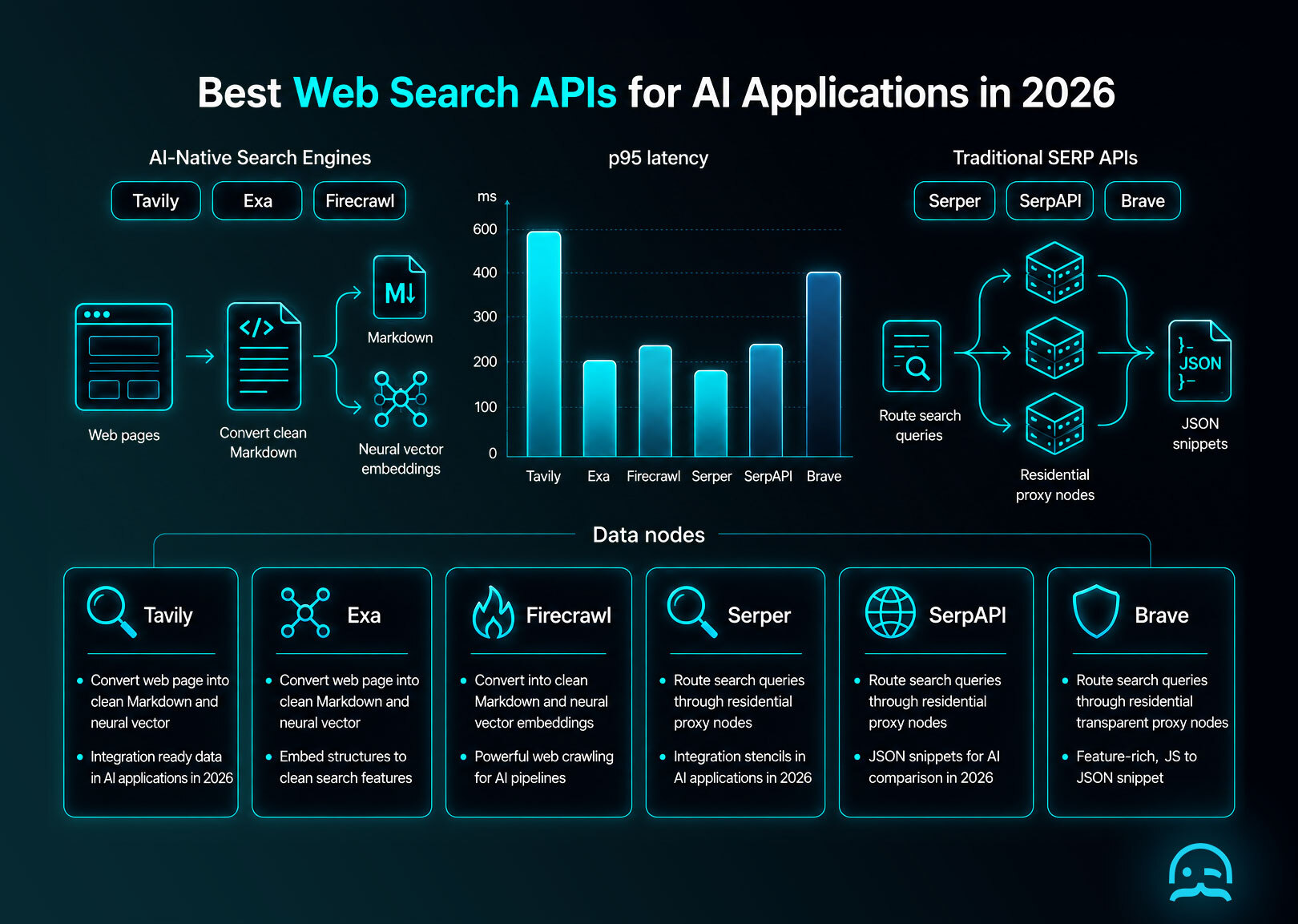
- AI-native search APIs: Purpose-built for LLMs. Rather than returning blue links, they execute neural semantic reranking, crawl web pages in real time, and strip boilerplate HTML, outputting structured Markdown with verified citations.
- Traditional SERP scraping APIs: Route queries through residential proxy networks to scrape live search results from Google or Bing. They return comprehensive JSON at low query prices, delivering metadata snippets rather than full page contents.
The 20-query real-world benchmark test
To evaluate result quality objectively, we executed twenty standardized test queries across four distinct archetypes: factual knowledge, breaking news (<2 hours old), niche technical code lookups, and deep exploratory research.
The following matrix summarizes benchmark results, average p95 response latency, and output payload characteristics across leading search providers:
| Provider | Factual Recall | Breaking News | Technical Code | Deep Research | p95 Latency | Payload Type |
|---|---|---|---|---|---|---|
| Tavily | Excellent | Excellent | Good | Superior | 1,250ms | Clean Markdown Chunks |
| Exa | Good | Moderate | Superior | Superior | 420ms | Neural Embeddings & Text |
| Parallel AI | Excellent | Good | Excellent | Superior | 1,650ms | Structured Agent Synthesis |
| Firecrawl | Good | Good | Excellent | Excellent | 2,100ms | Full Page Markdown |
| Serper | Superior | Superior | Superior | Moderate | 45ms | Raw JSON Snippets |
| SerpAPI | Superior | Superior | Superior | Moderate | 1,150ms | Rich SERP Feature JSON |
| ScrapingDog | Superior | Superior | Good | Moderate | 850ms | JSON Snippets & HTML |
| Brave Search API | Good | Moderate | Good | Good | 280ms | JSON Snippets (Independent) |
| Google Custom Search | Superior | Good | Excellent | Fair | 190ms | Official Google JSON |
- For RAG and synthesis: AI-native search engines like Tavily and Exa consistently surfaced authoritative primary sources and technical documentation without ad spam.
- For latency-critical workflows: Traditional SERP scrapers like Serper delivered sub-50ms responses, making them ideal for high-throughput URL discovery.
- For breaking events: Google-backed SERP scrapers indexed breaking news articles within minutes, whereas independent web crawlers exhibited discovery lag.
AI-native search APIs reviewed
AI-native search engines act as the cognitive retrieval layer for autonomous agents and LLM applications.
Tavily
Tavily is the premier search api for ai agents, retrieving and filtering web content for direct LLM ingestion.
- Best for: Autonomous research agents and RAG pipelines requiring cited real-time grounding.
- Pricing (as of 2026): Free tier includes 1,000 queries/mo; Researcher plan is $29/mo (4,000 queries, $7.25/1k), scaling to $0.005/query.
- Pros: Direct
include_answer=Truesummaries; automatic HTML cleaning; native LangChain/LlamaIndex bindings. - Cons: 800ms–1,800ms p95 latency due to real-time page crawling; higher cost than bare SERP scrapers.
Exa (formerly Metaphor)
Exa is an embedding-based neural search engine searching by semantic meaning rather than exact keywords.
- Best for: Deep exploratory research, competitive intelligence, and finding semantically similar URLs.
- Pricing (as of 2026): Free tier provides 1,000 searches/mo; paid plans start at $20/mo (~$5.00/1k), scaling to $1.00–$2.00/1k at volume.
- Pros: Superior semantic prompt understanding;
find_similarendpoint; returns clean Markdown in one call. - Cons: Less effective for localized geographic lookups; neural prompt syntax requires developer adjustment.
Parallel AI
Parallel AI is an emerging search engine built for multi-step deep research and provenance verification.
- Best for: Enterprise AI workflows requiring multi-source synthesis and audit-ready data lineage.
- Pricing (as of 2026): Free trial with 500 requests; commercial plans start at $49/mo for 5,000 requests ($9.80/1k).
- Pros: Recursive multi-hop querying to verify contradictory claims; structured entity extraction with provenance scores.
- Cons: Higher p95 latency (1,500ms–3,000ms) due to verification loops; higher starting monthly commitment.
Firecrawl (Search Endpoint)
Firecrawl combines web search with immediate page scraping and dynamic JavaScript rendering.
- Best for: Workflows needing to search the web and immediately read full documentation pages or single-page apps.
- Pricing (as of 2026): Free tier provides 500 credits; Hobby plan is $16/mo (3,000 credits); Standard is $99/mo for 100,000 credits (~$0.99/1k).
- Pros: Handles client-side JavaScript execution and cookie popups; clean vector-ready Markdown; native MCP server support.
- Cons: p95 latency ranges from 1,500ms to 3,500ms with JavaScript rendering; multi-page crawls consume credits rapidly.
Traditional SERP APIs reviewed
Traditional SERP APIs scrape major search engines at scale, delivering massive index coverage and near-instant response times.
Serper (serper.dev)
Serper is an ultra-fast Google serp api and low-cost google search api alternative.
- Best for: High-volume keyword monitoring, real-time search, and URL discovery.
- Pricing (as of 2026): 2,500 free queries on sign-up; flat $1.00 per 1,000 queries.
- Pros: Sub-50ms p95 latency across Search, News, Places; flat $1.00/1k pricing; clean JSON.
- Cons: Snippets only; requires secondary scraping layer for full content.
SerpAPI
SerpAPI is a comprehensive SERP scraper supporting over 40 search engines.
- Best for: Enterprise extraction of complex widgets (Maps local packs, Shopping grids).
- Pricing (as of 2026): Free tier includes 100 searches/mo; plans start at $75/mo (5,000 searches, $15.00/1k).
- Pros: Exhaustive parsing of interactive SERP components; multi-engine support.
- Cons: Higher cost per query; slower latency (800ms–2,000ms) due to browser rendering.
ScrapingDog (SERP API)
ScrapingDog provides a hybrid web scraping and search engine api platform.
- Best for: Teams seeking a combined credit pool for web scraping and Google SERPs.
- Pricing (as of 2026): Free trial with 1,000 credits; plans start at $40/mo ($1.00–$2.00/1k searches).
- Pros: Unified billing covers SERP queries and web scraping; proxy management.
- Cons: Credit multiplier applies for JavaScript rendering; smaller SDK ecosystem.
Brave Search API
The Brave Search API provides access to Brave's independent web index.
- Best for: Privacy-centric applications and platforms requiring neutral search rankings.
- Pricing (as of 2026): $5.00 per 1,000 queries ($5.00 minimum spend). No perpetual free web search api tier.
- Pros: Independent search index with zero query logging; strong community forum recall.
- Cons: Strict 1 req/sec baseline rate limit; smaller long-tail index coverage.
Google Programmable Search Engine (Custom Search JSON API)
Google Custom Search JSON API is the official Google API.
- Best for: Enterprise compliance forbidding scraping proxies, or curated domain lists.
- Pricing (as of 2026): Free tier of 100 queries/day (3,000/mo); paid requests cost $5.00/1k queries.
- Pros: 100% compliant with Google terms; native Google Cloud IAM and billing.
- Cons: Hard limit of 10,000 queries per day; returns metadata snippets only.
Total cost analysis: Unmasking the hidden scraping layer
When engineering teams compare web search api pricing, they frequently make a critical architectural miscalculation: comparing sticker prices without accounting for the extraction layer.
A traditional SERP API returns only short metadata snippets (150 to 250 characters). For production RAG or agent synthesis, snippets do not provide sufficient depth. Your pipeline must fetch each target URL, execute JavaScript, strip boilerplate HTML, and extract structured text.
| Provider | Search Sticker Price (100k) | Scraping Layer Cost (5 URLs/query) | True Total Cost (100k) | True Total Cost (1M) |
|---|---|---|---|---|
| Serper (SERP only) | $100.00 | +$1,000.00 (DIY scrapers) | $1,100.00 | $11,000.00 |
| Brave Search API | $500.00 | +$1,000.00 (DIY scrapers) | $1,500.00 | $15,000.00 |
| SerpAPI | $650.00 | +$1,000.00 (DIY scrapers) | $1,650.00 | $16,000.00 |
| Google Custom Search | $500.00 | +$1,000.00 (DIY scrapers) | $1,500.00 | $15,000.00 |
| Tavily (Integrated) | $500.00 | $0.00 (Included in payload) | $500.00 | $4,000.00 |
| Exa (Integrated) | $500.00 | $0.00 (Included in payload) | $500.00 | $2,000.00 |
| Firecrawl (Integrated) | $99.00 | $0.00 (Included in payload) | $99.00 | $850.00 |
If your workflow is search then fetch, the fetch step is usually the larger cost. MrScraper's Web Scraper API returns clean structured content from the URLs a search API gives you, so you are not building and maintaining that layer yourself.
To learn more about downstream data pipelines, explore our companion guides on Brave Search API alternatives, building a production RAG pipeline with web data, agentic search architectures, choosing the best web scraping API, handling dynamic content with JavaScript crawling, and our head-to-head review of codex vs claude code for agentic engineering workflows.
Market context: The Bing Search API retirement and proxy economics
To understand why the search API market has become intensely competitive in 2026, engineers must examine the major structural disruption caused by Microsoft.
On 11 August 2025, Microsoft officially retired the standalone Bing Web Search API on Azure Cognitive Services. For over a decade, Bing served as the foundational backend for developer search tools, DuckDuckGo, and AI startups. Microsoft migrated its search capabilities into Azure AI Agent Service and Grounding with Bing, requiring enterprise contracts and substantially increasing per-query costs.
Following Bing's standalone retirement, developers migrated in two directions: teams needing raw keyword data adopted low-cost Google SERP proxy engines like Serper, while AI engineering teams transitioned directly to neural engines like Tavily and Exa.
What to check before you commit
Before standardizing on a search API provider for production AI applications, audit the following four operational criteria:
1. Free tier for prototyping
Verify whether the provider offers a free tier or trial credits to test prompt engineering and latency benchmarks before committing budget. Serper (2,500 queries), Tavily (1,000 queries/mo), and Exa (1,000 searches/mo) provide accessible testing tiers.
2. Rate limits and concurrency ceilings
Evaluate baseline rate limits and queries per second (QPS). If your autonomous agent executes concurrent tool-calling loops across multiple workers, a strict 1 request-per-second limit causes severe throughput bottlenecks. Ensure your provider supports at least 20 to 50 QPS.
3. Data retention and query privacy
Review whether the provider logs search terms or uses developer queries to train internal AI models. For healthcare (HIPAA) or financial applications, select a zero-logging engine like Brave Search API.
4. Officially maintained SDKs and framework bindings
Check whether the vendor maintains official Python and TypeScript SDKs alongside native integrations for LangChain, LlamaIndex, and the Model Context Protocol (MCP).
How to choose the best web search API for your workload
Selecting the ideal search API depends on your application's technical bottleneck and data pipeline design:
Development Objective                       Recommended Solution
─────────────────────────────────────────────────────────────────
Clean Markdown & direct answers for RAG ──► Tavily
Semantic prompt discovery & similarity  ──► Exa
Single-step search + dynamic page crawl ──► Firecrawl
Lowest cost Google SERP monitoring ($1) ──► Serper
Complex multi-engine SERP features      ──► SerpAPI
Zero-logging privacy & independent index──► Brave Search API
Official Google enterprise compliance   ──► Google Custom Search
Frequently asked questions
Is there a free web search API?
Yes, several search APIs provide free tiers for developers. Serper offers 2,500 free queries upon registration, Tavily includes 1,000 free monthly requests for AI agent workflows, Exa provides 1,000 free neural searches every month, and Google Custom Search JSON API includes 100 free queries daily (approximately 3,000 queries per month).
Is the Google web search API free?
The official Google Custom Search JSON API offers a free tier of 100 queries per day. Beyond that daily allowance, requests cost $5.00 per 1,000 queries up to a standard limit of 10,000 queries per day configured within the Google Cloud Console.
Which AI API is best for web search?
Tavily and Exa are the best search APIs for AI applications. Tavily specializes in extracting clean content passages and generating cited factual summaries for LLM context windows, while Exa utilizes neural embedding models to discover semantically relevant web documents based on natural language meaning rather than exact keywords.
Can the ChatGPT API search the web?
OpenAI provides web search capabilities within ChatGPT and through specific assistant tool integrations, but integrating a dedicated search API (like Tavily or Exa) gives engineering teams complete programmatic control over query routing, domain filtering, extraction depth, citation provenance, and latency optimization.
What is the difference between a SERP API and a search API?
A SERP API specifically scrapes search engine results pages (such as Google or Bing) and returns structured JSON containing titles, URLs, and text snippets. A search API can also refer to an independent search engine (like Brave) or an AI-native retrieval engine (like Tavily) that parses full page content directly.
Do web search APIs return full page content or just snippets?
Most traditional SERP APIs (including Serper and Google) return only short 150–250 character text snippets. AI-native engines like Tavily, Exa, and Firecrawl can retrieve full parsed page Markdown, but standard data pipelines typically require a dedicated web scraper to extract complete structured web data.
What happened to the Bing Search API?
Microsoft officially retired the standalone Bing Web Search API on Azure Cognitive Services on 11 August 2025. Search functionality transitioned into Azure AI Agent Service and Grounding with Bing, requiring developers to adopt new enterprise SDKs with higher integration complexity and updated pricing structures.
How much do web search APIs cost in production?
In production, bare SERP scrapers like Serper cost $1.00 per 1,000 queries. AI-native engines like Tavily and Exa range from $5.00 to $7.25 per 1,000 queries on entry plans, dropping to $1.00 to $2.00 per 1,000 queries at high volume. Factoring in secondary page scraping typically adds $10.00 per 1k runs.
Which web search API is best for RAG?
Tavily is widely considered the best search API for RAG workflows because it automatically crawls target URLs in real time, strips away HTML boilerplate noise, and returns clean, pre-chunked passages with verified citations, significantly lowering LLM hallucination rates and prompt token consumption.
How do I use a web search API with LangChain?
Leading search providers like Tavily, Exa, Brave Search, and SerpAPI offer official LangChain tool packages. Developers can install the integration package, initialize the tool with an API key, and pass it directly to LangChain agent executors for automated search tool calling.
Summary and next steps
Evaluating the best web search api 2026 requires matching your technical architecture to the appropriate search engine paradigm:
- For LLM agents and RAG grounding: Deploy Tavily or Exa to receive pre-cleaned Markdown, neural embeddings, and verified source citations.
- For single-step documentation ingestion: Use Firecrawl to execute JavaScript rendering and extract complete web pages as clean Markdown.
- For high-throughput keyword monitoring and URL discovery: Deploy Serper to access Google search results at flat $1.00 per 1,000 queries with 30ms latency.
- For privacy-critical and zero-logging applications: Standardize on Brave Search API for complete independence from Big Tech tracking.
Ready to transform search discovery into production-grade structured datasets? Schedule a personalized demo today to see how MrScraper automates full-page extraction with speed and precision.
Summarize this post
Open it in your assistant of choice with the prompt ready to send.
Take a Taste of Easy Scraping!

Find more insights here
The Ultimate Web Crawlers List: 15 Tools for Every Data Need
Compare the best web crawlers for 2026. Learn the difference between open-source, managed APIs, and…
Web Scraping MCP Server: Giving AI Agents Direct Access to Live Web Data
Learn how a Web Scraping MCP Server gives AI agents live web access while reducing token costs by 87…
Scaling E-commerce Competitive Intelligence with Automated Data Harvesting
Scale e-commerce data harvesting with residential proxies and AI. Learn how modern data extraction s…