7 Brave Search API Alternatives Compared (2026)
TechnologyBrave Search API alternatives compared on index coverage, latency, pricing and rate limits. Which search API fits which workload, and when to stay with Brave.
Finding reliable brave search api alternatives has become essential for engineering teams whose data pipelines and autonomous agents have outgrown Brave's platform constraints. While Brave established itself as an early pioneer in privacy-centric web search, developers evaluating or running the API in production frequently hit three distinct operational barriers:
- Pricing friction: Brave removed its free tier, requiring developers to pay upfront rather than testing on complimentary credits.
- Restrictive rate limits: The baseline tier enforces a strict 1 request-per-second limit that bottlenecks parallel scrapers and agent loops.
- Index coverage gaps: Because Brave relies on an independent search index, it lacks Google's crawl depth across niche documentation and localized directories.
Note
The Honest Verdict on Brave Search: Brave provides a true independent search index with zero query logging. If strict privacy compliance, GDPR isolation, or independence from Big Tech are mandatory, staying on Brave is often the correct engineering decision.
However, if your workload demands higher throughput, broader index freshness, or AI-native document synthesis, several robust alternatives to brave search api deliver superior capabilities. This guide compares the top seven search APIs across real pricing, rate limits, latency benchmarks, and index characteristics as of 2026.
Cost comparison at 1k, 100k, and 1M queries
Under standard brave search api pricing, the Search Data API costs $5.00 per 1,000 queries. Because Brave discontinued the brave search api free tier, developers must purchase credits upfront.
The following table compares total monthly costs and operational limits across three usage tiers as of 2026:
| Provider | Free Tier | 1k Queries | 100k Queries | 1M Queries | Rate Limit | Primary Index |
|---|---|---|---|---|---|---|
| Brave Search API | None ($5 min spend) | $5.00 | $500.00 | $5,000.00 | 1 req/sec | Independent index |
| Serper | 2,500 queries | $1.00 | $100.00 | $1,000.00 | 20–50 req/sec | Google SERP scrape |
| Tavily | 1,000 queries/mo | $0.00 | $500.00 | $4,000.00 | 20 req/sec | Hybrid aggregated & AI |
| Exa | 1,000 queries/mo | $0.00 | $500.00 | $2,000.00 | 10–20 req/sec | Custom neural embeddings |
| Firecrawl | 500 credits/mo | $16.00 | $99.00 | $850.00 | 10–50 req/sec | Multi-engine & Markdown |
| SerpAPI | 100 queries/mo | $75.00 | $650.00 | $5,000.00 | 20 req/sec | Multi-engine SERP scrape |
| ScrapingDog | 1,000 credits | $40.00 | $120.00 | $1,100.00 | 10–20 req/sec | Google SERP scrape |
| Google Custom Search | 100 queries/day | $0.00 | $500.00 | Capped | 10 req/sec | Official Google index |
For raw search volume on a budget, Serper offers the lowest cost per query ($1.00 per 1k), while AI-native engines like Tavily and Exa provide higher context value per dollar.
Independent index vs SERP scrapers vs AI search engines
Modern web search APIs fall into three distinct architectural categories:
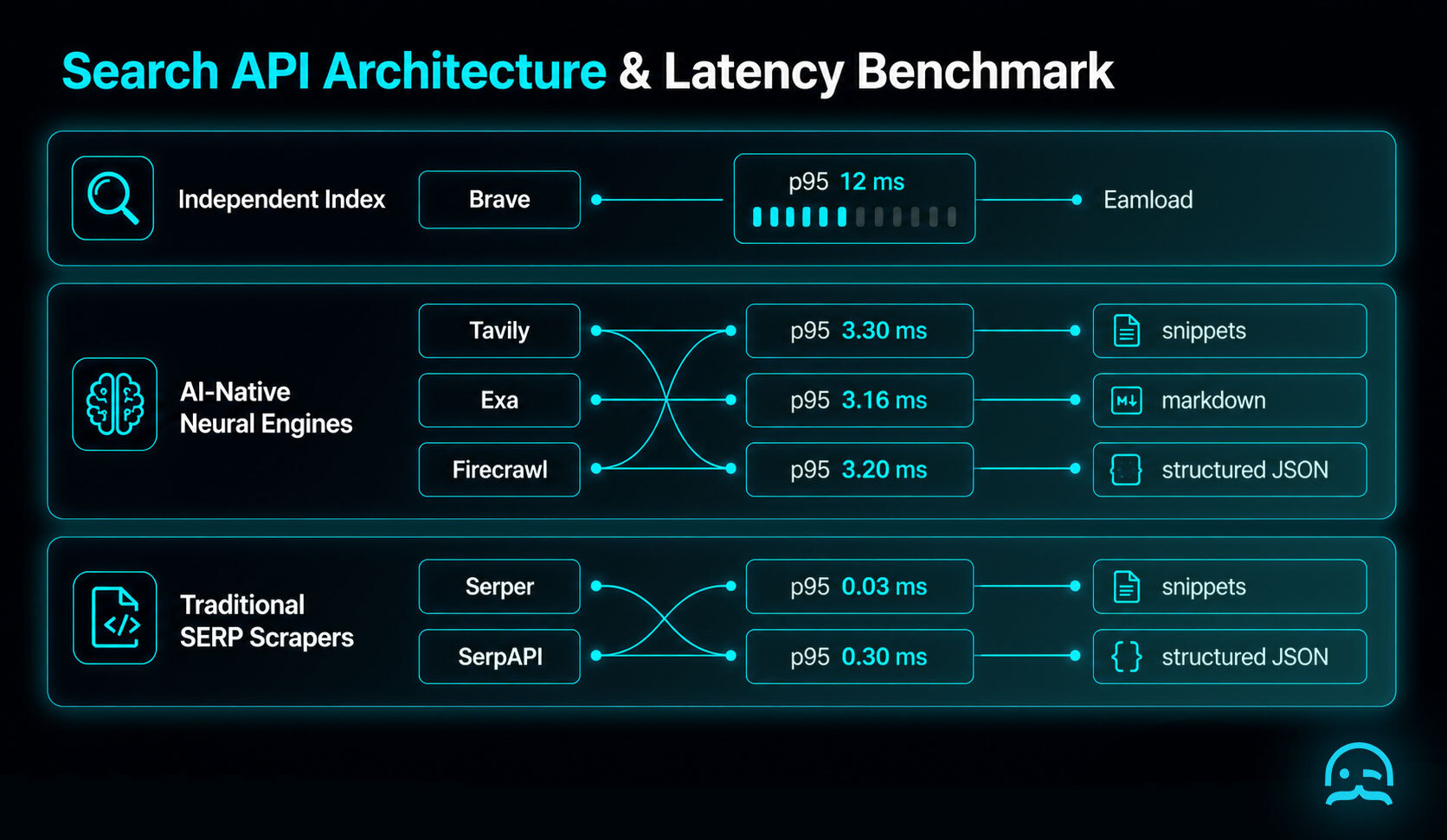
- Independent web indexes: Crawl the web autonomously (Brave), ensuring privacy and platform independence.
- SERP scraping APIs: Scrape Google in real time via proxies (Serper, SerpAPI), offering maximal crawl depth.
- AI-native neural engines: Parse clean Markdown and dense vector embeddings for LLM context (Tavily, Exa, Firecrawl).
Side-by-side coverage test across 10 query archetypes
| Query Archetype | Brave Search (Independent) | Google Scrapers (Serper/SerpAPI) | Neural Engines (Exa/Tavily) |
|---|---|---|---|
| Breaking news (<1 hr) | Moderate (crawler lag) | Excellent (Google News) | Good (news-filtered RAG) |
| Niche GitHub repo / code | Moderate | Excellent | Excellent (semantic match) |
| Local business coordinates | Fair (OpenStreetMap) | Excellent (Google Local Maps) | Poor (not built for geo) |
| Academic research papers | Good | Excellent (Google Scholar) | Superior (semantic discovery) |
| Reddit & forum threads | Good (Brave Discussions) | Excellent (Discussions filter) | Excellent (deep extract) |
| Obscure e-commerce SKUs | Poor | Excellent (Google Shopping) | Fair |
| Semantic intent queries | Poor (lexical BM25) | Moderate | Superior (vector embeddings) |
| Developer error strings | Moderate | Excellent | Excellent |
| Structured entity graphs | Fair | Excellent (Knowledge Graph) | Good (LLM synthesis) |
| High-volume rank checks | Good | Excellent | Inefficient (too costly) |
The 7 best Brave Search API alternatives compared
We have categorized the top seven brave search api alternatives into two groups: AI-native engines optimized for LLMs and RAG pipelines, and traditional SERP APIs built for high-throughput data collection.
AI-native search APIs for LLM agents and RAG
Autonomous agents and RAG pipelines require clean, boilerplate-free passages rather than simple links. The following options represent the best search api for ai agents needing automated research and synthesis.
1. Tavily
Tavily aggregates search results, extracts page content in real time, and returns clean passage chunks formatted for LLM context windows.
- Pricing & Limits (as of 2026): Free tier includes 1,000 credits/mo; paid plans start at $29/mo for 4,000 credits ($7.25/1k), scaling to $0.005/query. Concurrency is 20 req/sec with 800ms–1,800ms latency.
- Capabilities & Fit: Features
include_answer=Truefor direct summaries, domain filtering, and native LangChain/LlamaIndex support. Best for autonomous research agents and real-time RAG pipelines.
2. Exa (formerly Metaphor)
Exa uses neural embedding models trained on link graphs to search by semantic meaning rather than exact keywords.
- Pricing & Limits (as of 2026): Free tier includes 1,000 searches/mo; paid plans start at $20/mo (~$5.00/1k), dropping to $1.00–$2.00/1k at scale. Concurrency is 10–20 req/sec (350ms p95 for search, 1,200ms for full content).
- Capabilities & Fit: Offers
find_similarfor discovering identical URLs, date filtering, and live markdown extraction. Best for deep exploratory research and semantic discovery.
3. Firecrawl (Search Endpoint)
Firecrawl combines web search with automated scraping, converting top search results into clean Markdown in a single API call.
- Pricing & Limits (as of 2026): Free tier provides 500 credits; Hobby plan is $16/mo (3,000 credits) and Standard is $99/mo for 100,000 credits (~$0.99/1k). Concurrency is 10–50 req/sec.
- Capabilities & Fit: Executes dynamic JavaScript and outputs clean Markdown with native MCP server support. Best for AI agents that need to ingest complete web documentation.
Traditional SERP APIs for high-volume data collection
When workloads demand rank tracking, price monitoring, or high-throughput SEO auditing, traditional SERP APIs deliver maximum index coverage at minimal latency.
4. Serper (serper.dev)
Serper is a lightweight Google SERP API designed specifically for fast structured JSON extraction.
- Pricing & Limits (as of 2026): Includes 2,500 free queries on sign-up; paid usage costs flat $1.00 per 1,000 queries ($50 for 50,000 queries). Latency is 30ms–60ms with 20–50 req/sec concurrency.
- Capabilities & Fit: Extracts Google Search, News, Places, and Shopping in structured JSON. Best budget search api alternative for high-volume keyword monitoring and low-cost retrieval.
Tip
Serper vs SerpAPI: Serper is a lightning-fast raw JSON extraction engine with flat $1.00/1k pricing. SerpAPI provides comprehensive multi-engine parsing across dozens of global search platforms.
5. SerpAPI
SerpAPI handles CAPTCHAs, proxy rotation, and browser fingerprinting across Google, Bing, Baidu, Yahoo, Yandex, eBay, YouTube, and Google Maps.
- Pricing & Limits (as of 2026): Free tier includes 100 searches/mo; Starter plan is $75/mo for 5,000 searches ($15.00/1k), scaling to $130/mo for 15,000 searches ($8.66/1k). Rate limit is 20 req/sec.
- Capabilities & Fit: Exhaustive parsing of local map packs, shopping carousels, and rich snippets. Best for enterprise teams needing localized geo-targeted scraping across postal codes.
6. ScrapingDog (SERP API)
ScrapingDog provides a hybrid web scraping and SERP API platform for protected HTML pages and Google search endpoints.
- Pricing & Limits (as of 2026): Free trial includes 1,000 credits; paid plans start at $40/mo for 200,000 credits (effective rate of $1.00 to $2.00 per 1k Google searches). Rate limit is 10–20 req/sec with 500ms–1,200ms latency.
- Capabilities & Fit: Built-in residential proxy unblocking and unified billing. Best for teams needing both a Google SERP API and a general web scraper under one subscription.
7. Google Programmable Search Engine (Custom Search JSON API)
Google Custom Search JSON API provides an official developer interface to Google's index.
- Pricing & Limits (as of 2026): Free tier provides 100 queries/day (3,000/mo); paid requests cost $5.00 per 1,000 queries up to a standard quota of 10,000 queries/day. Rate limit is 10 req/sec with 120ms–250ms latency.
- Capabilities & Fit: 100% Google ToS compliant with domain filtering and Google Cloud IAM billing. Best for enterprise environments where compliance strictly forbids scraping proxies.
Why the search API ecosystem shifted: Bing API retirement and proxy economics
To understand why selecting a search API is challenging today, engineers must examine two major industry shifts between 2025 and 2026.
First, Microsoft retired the standalone Bing Web Search API on Azure Cognitive Services in August 2025. Bing previously powered independent search tools and DuckDuckGo. Microsoft shifted search into Azure AI Agent Service and Grounding with Bing, substantially raising costs for independent developers.
Second, search API operational economics bifurcated:
+-------------------------------------------------------------+
| 1. Independent Index (Brave): High fixed server crawler cost|
| 2. SERP Proxy Model (Serper): Low crawl cost, variable proxy|
+-------------------------------------------------------------+
Maintaining an independent crawler requires petabytes of storage and continuous compute. Conversely, SERP scrapers incur zero crawler costs but pay for rotating residential proxy bandwidth. This explains why Serper offers $1.00 per 1,000 queries while Brave charges $5.00 per 1,000 queries.
Search snippets vs full-page data extraction
A critical limitation shared by almost all search APIs is that they return only short text snippets (typically 150 to 250 characters). For comprehensive RAG pipelines, market intelligence, and candidate sourcing, snippets fail to deliver the depth required by modern LLMs.
When building real-world applications, your architecture almost always requires a two-step data pipeline:
- Discovery Step: The search API identifies relevant URLs based on keyword or semantic intent.
- Extraction Step: A web scraper fetches each target URL, executes dynamic JavaScript, strips boilerplate HTML, and extracts structured data.
Most search APIs return links and snippets, so you still need a second step to fetch the pages. MrScraper's Web Scraper API handles that step and returns clean structured content, which is usually where the real cost sits.
To learn more about connecting search data with downstream extraction systems, explore our companion guides on best web search APIs, agentic search architectures, building a production RAG pipeline with web data, and handling dynamic content with JavaScript crawling.
When you should stay with Brave Search API
Despite alternative tools, the brave api remains the premier choice for several technical scenarios:
- Strict zero-logging privacy: Brave does not log query strings, IP addresses, or browser fingerprints. For healthcare (HIPAA) or legal discovery, Brave is an unmatched privacy focused search api.
- Neutral search results: If your product needs search results untainted by Google's personalized algorithms or ad-heavy SERP layouts, Brave's independent search index delivers clean data.
- Moderate query volume: If your application consumes under 30,000 queries per month, the $5.00 per 1k price is negligible compared to the simplicity of a single developer-friendly REST API.
How to choose the right search API alternative for your workload
Selecting the ideal replacement depends on your application's technical bottleneck:
Development Priority                        Recommended Solution
─────────────────────────────────────────────────────────────────
Cheapest Google SERP volume ($1.00/1k)  ──► Serper
AI agent research & cited direct answers──► Tavily
Semantic similarity & prompt discovery  ──► Exa
Single-step search to clean Markdown    ──► Firecrawl
Deep multi-engine parsing (Maps, eBay)  ──► SerpAPI
Official Google enterprise compliance   ──► Google Custom Search
Zero-logging privacy & independent index──► Brave Search API
Frequently asked questions
Is the Brave Search API free?
No, the Brave Search API is not free. Brave previously offered a free tier with complimentary monthly queries, but discontinued it to sustain its independent web crawling infrastructure. As of 2026, paid plans start at $5.00 per 1,000 queries with a minimum initial credit purchase.
Is there a free alternative to the Brave Search API?
Yes, several search APIs offer free tiers. Serper provides 2,500 free queries upon registration, Tavily includes 1,000 monthly API calls for AI workflows, Exa offers 1,000 monthly neural searches, and Google Custom Search JSON API provides 100 free queries daily (roughly 3,000 per month).
Is the Brave Search API good?
Yes, the Brave Search API is highly capable for privacy-focused developers. It provides clean JSON responses directly from an independent multi-billion page index with zero query tracking. However, it enforces a 1 req/sec baseline rate limit and has smaller index coverage than Google for obscure queries.
Is Brave Search better than Google Search?
Brave Search is better than Google for privacy, independence, and clean ad-free results because it operates an independent index without building tracking profiles. However, Google remains superior for index scale, breaking real-time news freshness, localized map results, and indexing obscure long-tail technical queries across the web.
What is the cheapest search API per 1,000 queries?
Serper is the cheapest search API for raw web queries, priced at $1.00 per 1,000 queries ($0.001 per request) in prepaid credit packages. In comparison, Brave Search API and Google Custom Search JSON API cost $5.00 per 1,000 queries, while SerpAPI starts at $15.00 per 1k.
Which search API is best for AI agents and RAG?
Tavily and Exa are the best search APIs for AI agents and RAG pipelines. Tavily optimizes search results for LLM context windows by extracting clean passages and generating citations. Exa uses neural embeddings to retrieve semantically relevant pages and markdown content without requiring exact keyword matches.
What happened to the Bing Search API?
Microsoft retired the standalone Bing Web Search API on Azure Cognitive Services in August 2025. Developers must now use Azure AI Agent Service or Grounding with Bing, which introduced higher integration complexity and increased per-query costs compared to the original standalone REST search endpoint.
Do search APIs return full page content or just snippets?
Most traditional search APIs (including Brave, Serper, and Google) return only titles, URLs, and 150–250 character text snippets. AI-native engines like Tavily, Exa, and Firecrawl retrieve full parsed markdown, but standard pipelines typically require a dedicated web scraper to extract complete structured web data.
Which search APIs work with LangChain?
Tavily, Exa, Brave Search, SerpAPI, and Google Custom Search all feature official tool integrations within LangChain and LlamaIndex. Tavily and Exa provide the deepest integrations, allowing autonomous agents to perform search, content filtering, and question answering out of the box with minimal Python boilerplate.
Summary and next steps
- Brave Search API: Zero-logging privacy and independent indexing at $5.00/1k.
- Serper: Most cost-effective Google SERP data ($1.00/1k).
- Tavily & Exa: Premier AI agent context retrieval and semantic discovery.
- SerpAPI: Deepest multi-engine localized parsing.
Ready to turn search results into production-ready datasets? Schedule a personalized demo today to see how MrScraper automates full-page web extraction with structured precision.
Summarize this post
Open it in your assistant of choice with the prompt ready to send.
Take a Taste of Easy Scraping!

Find more insights here

Score Company Websites Against Your ICP with Jev
Create a company scoring workflow using public website evidence, an explicit ICP rubric, Jev decisio…
Classify Web Data with Jev and MrScraper: A Python Tutorial
Build a Python workflow that extracts web records with MrScraper, classifies them with Jev, validate…

What Is Jev? A Practical Guide for Web Data Teams
Learn what Jev does, how Choice, Score and Noul work, and where structured web data fits into classi…