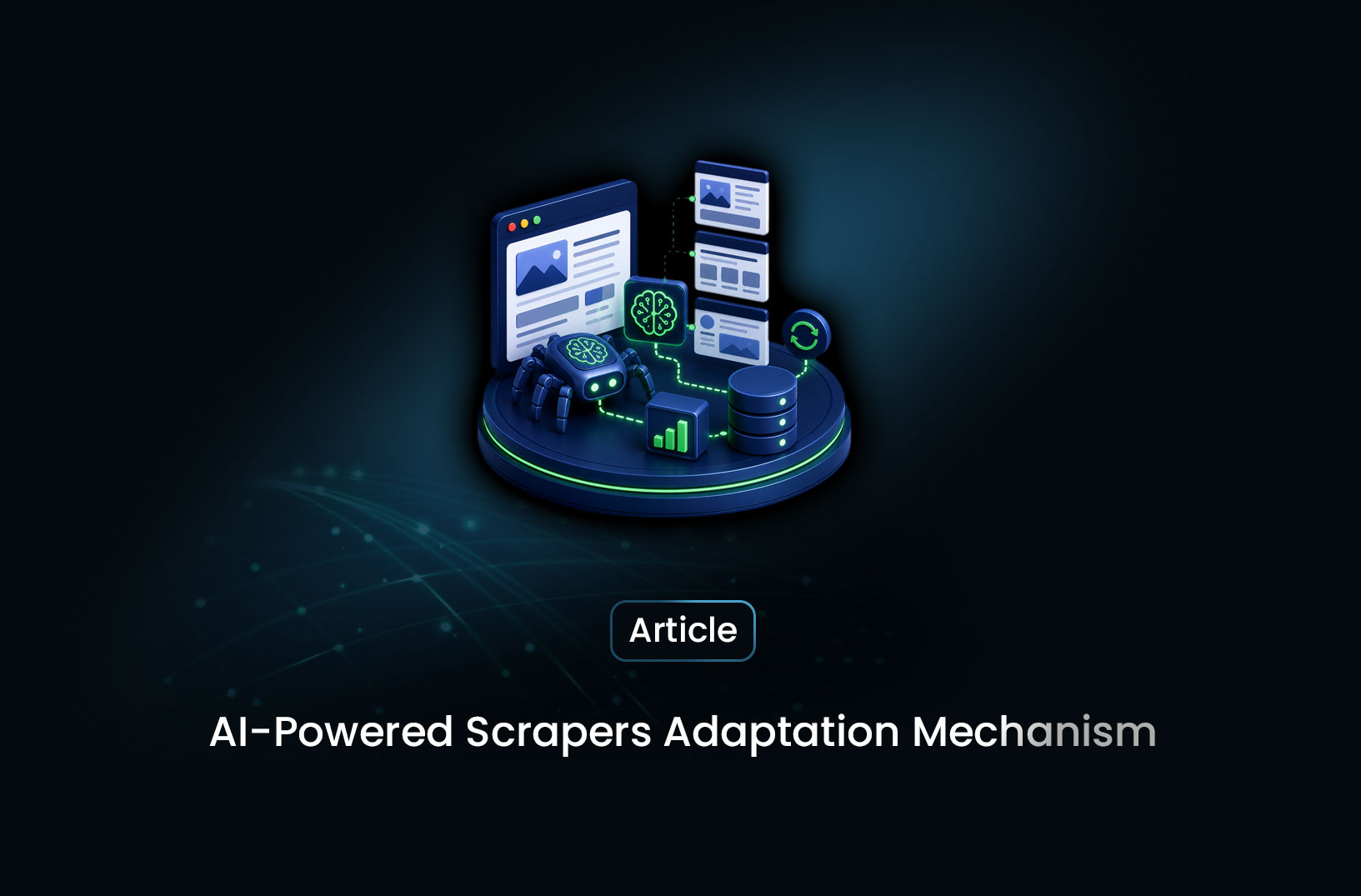
How AI Scrapers Adapt When Site Layouts Change
AI & Machine LearningAI-powered web scrapers use adaptive parsing and self-healing techniques to handle layout changes automatically. Here's how the technology actually works.
If you've maintained a production scraping pipeline for more than a few months, you know the experience: everything runs smoothly until a site updates its front end, a class name changes, a wrapper div disappears — and suddenly your perfectly tuned scraper returns empty fields or throws errors. Silently, if you're unlucky. You fix it, redeploy, and wait for the next site update to do it again.
AI web scraper adaptive parsing is the technical answer to this problem. Rather than relying on fixed CSS selectors or XPath expressions that break when page structure changes, AI-powered scrapers understand the meaning of page content and extract data by semantic comprehension — finding the product price because it knows what a price looks like in context, not because it knows which class it lives in this week. This self-healing approach turns what was a constant maintenance burden into a one-time configuration. In this article, we'll break down exactly how adaptive parsing works at the technical level — the approaches, the mechanisms, the trade-offs — so you can make informed decisions about building or adopting resilient web scraping infrastructure.
Table of Contents
- The Problem with Traditional Web Scraper Selectors
- How AI Adaptive Parsing Works
- Step-by-Step: How Self-Healing Scrapers Detect and Recover from Layout Changes
- Common Challenges and Limitations
- Conclusion
- What We Learned
- FAQ
The Problem with Traditional Web Scraper Selectors
Before covering the adaptive parsing solution, it's worth being precise about the problem it's solving — because the failure mode of selector-based scraping is more insidious than it first appears.
A CSS selector like div.product-card > span.price is a precise structural address. It works exactly when the HTML matches that structure and fails exactly when it doesn't. The failure can look like several things: the selector returns nothing (visible as empty fields in your output), it matches the wrong element (invisible in output — the data looks plausible but is wrong), or the scraper throws an exception and halts. The silent wrong-data case is the most dangerous, because it passes your validation checks and enters your database without triggering any alerts.
What causes these failures? Front-end redesigns are the obvious case, but they're far from the only one. A/B testing frameworks serve different HTML variants to different users — meaning your scraper might see layout A eighty percent of the time and layout B twenty percent, producing inconsistent extraction without any deliberate site change. JavaScript frameworks that generate class names dynamically (CSS Modules, styled-components, and similar tools) produce class names like Price__value--2KSdc that change with every build. Internationalization that adapts page structure for different locales. Responsive layout variants served based on detected device type. Any of these can invalidate a selector without anyone on the site's engineering team thinking of it as a "scraping-breaking change."
The aggregate effect: teams maintaining large scraping operations at scale spend a disproportionate fraction of their engineering time on selector maintenance — a task that produces no business value beyond keeping the pipeline alive. According to research published in the Journal of Web Engineering, structural changes to web pages are among the primary drivers of web scraper failure in production environments, with teams reporting frequent maintenance incidents tied to front-end updates.
How AI Adaptive Parsing Works
Adaptive parsing is an umbrella term covering several distinct technical approaches that share the same goal: decoupling the extraction target from the page structure. Understanding each approach helps you evaluate which makes sense for your specific architecture.
Approach 1: LLM-Based Semantic Extraction
The most powerful adaptive parsing approach uses a large language model to read the page content and identify target data by semantic understanding rather than structural position. The scraper passes cleaned page content — typically the rendered HTML converted to markdown or simplified text — to an LLM with a prompt describing what to extract.
The LLM identifies the product price because it understands that a dollar amount appearing in close proximity to a product name and description is almost certainly the price — not because it knows which CSS class the price lives in. When the site redesigns, the semantic relationship between the product name, description, and price hasn't changed. The LLM finds it in the new layout just as it found it in the old one.
This is why LLM-based extraction is genuinely resilient to layout changes rather than merely tolerant of minor variations. The model is reasoning about meaning, not matching structure. A complete front-end rewrite that changes every class name and nesting level on the page doesn't affect an LLM extraction that was never reading class names in the first place.
The trade-off is inference cost and latency. Every page requires an LLM API call, and at high extraction volumes, the cost-per-page compounds significantly. Production AI scraping systems often use LLM extraction as a first-class approach for moderate volumes and as a fallback for cases where lighter approaches fail.
Approach 2: Visual Layout Analysis
Rather than reading HTML markup, some adaptive parsers take a screenshot of the rendered page and use a vision-language model to identify and extract target data visually — the way a human would read a page by looking at it.
This approach is particularly powerful for pages where the visual presentation carries more information than the HTML does: pages with complex custom styling, canvas-rendered content, or heavily graphical layouts where semantic content is distributed across visual regions in ways that don't map cleanly to HTML hierarchy.
Visual analysis also sidesteps the entire category of class-name and structure changes — a vision model doesn't care how the page is built in markup, only what it looks like. The limitation is cost and speed: vision model inference is computationally heavier than text-based LLM extraction, and taking high-quality screenshots adds overhead to the fetch pipeline.
Approach 3: Schema Inference and Structural Fingerprinting
A lighter approach that sits between traditional selectors and full LLM extraction: rather than specifying a fixed selector, the system maintains a schema description — "a product price is a numeric value with a currency symbol appearing in the vicinity of the product title" — and infers the correct selector for each page it encounters by matching that description against the page's structure.
When the page changes, the schema inference engine re-derives the appropriate selector from the new structure, guided by the semantic description. This approach is faster and cheaper than full LLM extraction and handles a wide range of layout variations, but it's less robust than LLM-based extraction for major structural changes and requires well-designed schema specifications.
Approach 4: DOM Diffing with Change Detection
A complementary mechanism (rather than a replacement): the scraper monitors the structural fingerprint of target pages between runs and flags when the fingerprint changes significantly — indicating a layout update that may invalidate existing selectors. When a significant change is detected, the system either triggers an automated re-derivation of the extraction configuration or alerts the team to review and update it.
This approach doesn't make extraction automatically resilient, but it transforms the failure mode from silent wrong data to explicit change alerts. Combined with any of the above approaches as the extraction layer, DOM diffing provides the monitoring foundation for a self-healing pipeline.
Step-by-Step: How Self-Healing Scrapers Detect and Recover from Layout Changes
A production-grade adaptive parsing system combines several of these mechanisms in a layered architecture. Here's how the pieces fit together.
Step 1: Establish a Structural Baseline
When a new target page is onboarded, the scraper captures a structural fingerprint — a representation of the page's HTML structure and content distribution that can be compared against future fetches. This might be a hash of the major structural elements, a representation of the DOM tree depth and element counts, or a simplified semantic map of content regions.
The baseline serves as the reference point for change detection. When future fetches produce a significantly different fingerprint, the system knows the page has changed and can respond accordingly rather than silently continuing with a potentially invalid extraction configuration.
Step 2: Run Extraction With Confidence Scoring
Each extraction run produces not just the extracted data but a confidence signal — an indicator of how certain the extraction layer is that it found the right data. For LLM-based extraction, this might be the model's own assessment of whether the target fields were clearly identified or ambiguous. For schema-based extraction, it might be whether the inferred selector matched a high-confidence structural pattern or required a fallback heuristic.
Low-confidence extractions are flagged for review rather than written directly to the database. This is the mechanism that prevents wrong data from entering your pipeline undetected — the failure mode that's more dangerous than no data at all.
Step 3: Detect Layout Changes and Trigger Re-Adaptation
When the structural fingerprint diverges beyond a configured threshold, the change detection layer fires. Depending on the system's architecture, this triggers one of three responses:
Automated re-adaptation: For LLM-based extraction, no re-adaptation is needed — the model extracts from the new layout without any configuration change, because it was never using layout-specific configuration in the first place. This is the pure adaptive case.
Automated selector re-derivation: For schema-based extraction systems, the inference engine re-derives the appropriate selector from the new page structure using the existing schema description, automatically updating the extraction configuration.
Alerting for human review: For cases where automated re-adaptation confidence is low — major structural changes that fall outside the model's or inference engine's comfortable operating range — the system alerts a human reviewer, providing the old and new page representations and the changed extraction behavior for review.
Step 4: Validate Extracted Data Against Expected Patterns
Regardless of which extraction approach runs, output validation is a non-negotiable layer. Define expected patterns for each extracted field — a price should be a positive numeric value, an article date should parse as a valid ISO date, a product name should be a non-empty string under some reasonable length limit — and validate every extracted value against these constraints before storage.
Validation catches cases where the adaptive extraction succeeded at the structural level but the extracted value is semantically wrong — a misidentified field that happens to be a number, a truncated or malformed value, or a field that was correctly located but returned HTML encoding artifacts. The validation layer is the final safety check before data enters your systems.
def validate_extracted_product(data: dict) -> tuple[bool, list[str]]:
    """Validate extracted product data. Returns (is_valid, list_of_errors)."""
    errors = []

    if not data.get("name") or len(data["name"].strip()) == 0:
        errors.append("Missing product name")

    price = data.get("price")
    if price is None or not isinstance(price, (int, float)) or price <= 0:
        errors.append(f"Invalid price: {price!r}")

    rating = data.get("rating")
    if rating is not None and not (0 <= rating <= 5):
        errors.append(f"Rating out of range: {rating}")

    return len(errors) == 0, errors
Step 5: Monitor Extraction Health Over Time
A self-healing scraper isn't "set and forget" — it's "set up monitoring and respond to signals." Track null rate per field (rising nulls for a specific field indicate a likely layout change), value distribution stability (prices that suddenly shift significantly may indicate mis-extraction), and confidence score trends (declining confidence scores are an early warning of degrading extraction reliability before null rates spike).
This is where platforms like MrScraper's managed AI extraction layer provide meaningful operational value: the monitoring, re-adaptation, and infrastructure maintenance for self-healing extraction are handled at the platform level, so teams focus on defining what they want to extract rather than maintaining the adaptive machinery that ensures extraction keeps working. For teams building extraction infrastructure at scale, that operational reduction compounds over time across many targets. More at https://docs.mrscraper.com.
Common Challenges and Limitations
Full LLM extraction is expensive at high volume. The per-page inference cost of calling an LLM for every extraction is manageable at thousands of pages per day and significant at millions. Production systems that use LLM extraction economically apply it selectively: LLM extraction for new or changed page layouts, lighter schema-based extraction for stable pages, and LLM as fallback when lighter approaches produce low-confidence results. Designing the architecture around this tiering from the beginning — rather than retrofitting it — is important.
Confidence scoring requires calibration per content type. A confidence threshold that works well for product page extraction may be too permissive or too strict for article extraction or directory listings. Different content types have different structural characteristics, and confidence signals that mean "this extraction is reliable" vary accordingly. Per-extraction-type calibration is necessary for a confidence system that actually catches failures reliably rather than flagging too many false positives or missing too many real problems.
Visual analysis doesn't generalize to all output formats. Vision-language models extract what they can see rendered in the viewport. Content below the fold, content inside collapsed accordions, data loaded by infinite scroll, and structured data in <script> tags are outside the viewport's scope. For pages where target data is partially off-screen or interaction-dependent, visual analysis needs to be combined with rendering controls (scroll, click, expand) before taking the screenshot — adding complexity to the pipeline.
Change detection thresholds require tuning. Too sensitive, and minor A/B test variants or ad layout changes trigger constant re-adaptation alerts for changes that don't actually affect extraction. Too insensitive, and genuine layout changes that break extraction slip through without triggering the self-healing mechanism. Finding the right threshold for each target page type requires observation of real change patterns rather than general defaults. According to Cloudflare's analysis of web infrastructure, the frequency and nature of web content updates varies enormously by site category — news sites update DOM structure frequently through ad delivery; e-commerce sites may maintain stable product page structures for months between redesigns.
Hallucination remains a risk in LLM-based extraction. LLMs don't retrieve facts — they generate text that's likely to be correct given their training and the input context. For most product pages, article pages, and directory listings, LLM extraction is accurate. For unusual page structures, ambiguous content, or pages where the target data is presented in non-standard ways, models can misidentify fields or generate plausible-sounding but incorrect values. The validation layer exists precisely to catch this, but validation rules need to be thoughtfully designed to cover the actual failure modes for each content type.
Conclusion
AI web scraper adaptive parsing isn't a single technology — it's a layered architecture combining semantic extraction, confidence scoring, structural change detection, validation, and monitoring into a system that maintains reliability over time without constant human intervention. The core insight is that extraction resilience comes from decoupling what you want (semantic target) from how the page is built (structural implementation), and that LLM-based approaches achieve this decoupling more completely than any selector-based approach can.
The implementation complexity is real. Each layer — the extraction model, the confidence system, the change detector, the validator, the monitor — needs to be designed, calibrated, and maintained. But the operational trade-off is favorable: investing in adaptive parsing infrastructure once, against the alternative of continuous selector maintenance across every target indefinitely. For teams operating at meaningful scale, the math is clear — and for teams that don't want to build it themselves, managed platforms that implement these layers are increasingly the practical path.
What We Learned
- Selector brittleness isn't a bug — it's an architectural mismatch: CSS selectors encode structural position, not semantic meaning, which is why they break on layout changes that preserve meaning while changing structure.
- LLM-based extraction achieves genuine resilience by operating at the semantic layer: A language model that identifies a product price by understanding what prices are doesn't break when the class name that contained the price changes.
- Four distinct approaches serve different trade-offs: LLM extraction (most resilient, highest cost), visual analysis (structure-independent, highest overhead), schema inference (lighter, moderately resilient), and DOM diffing (monitoring layer, not extraction).
- Confidence scoring is the mechanism that prevents wrong data from entering your pipeline: Low-confidence extractions flagged for review are the safety valve that makes adaptive parsing trustworthy, not just adaptive.
- Self-healing requires a feedback loop, not just a smarter extractor: Change detection, re-adaptation triggers, validation, and monitoring work together — any one of them alone is insufficient.
- Volume determines architecture: LLM extraction for everything is correct at moderate scale; tiered approaches (LLM for changes and fallbacks, lighter extraction for stable pages) are necessary at high volume for economic viability.
FAQ
What is adaptive parsing in web scraping?
Adaptive parsing is an approach to web data extraction that adjusts automatically when the target page's structure changes, rather than failing or requiring manual reconfiguration. Instead of fixed CSS selectors that break when HTML changes, adaptive parsers use semantic understanding — often via LLMs or vision models — to identify and extract target data based on its meaning, so layout changes don't invalidate the extraction configuration.
What is a self-healing web scraper?
A self-healing web scraper is a scraping system that detects when its extraction is failing or producing low-confidence results due to page changes, and automatically re-adapts its extraction configuration rather than continuing to fail or alerting humans for every maintenance task. Self-healing systems combine change detection, automated re-adaptation (usually via AI extraction or schema inference), validation, and monitoring into a feedback loop that maintains reliability over time.
How do AI scrapers handle website layout changes?
AI scrapers handle layout changes by extracting data through semantic understanding rather than structural selectors. When a page redesigns, the LLM or vision model re-identifies the target data in the new layout by understanding what it means rather than where it was positioned. For LLM-based extraction, this adaptation requires no configuration change at all — the model reads the new layout and extracts correctly without knowing the layout changed. For schema-based adaptive systems, the inference engine re-derives the appropriate structural selector from the semantic description when the page fingerprint changes.
What is the difference between a self-healing scraper and a traditional scraper?
A traditional scraper uses fixed CSS selectors or XPath expressions to locate data at specific structural positions in the HTML. When that structure changes, the scraper fails — either returning nothing or returning the wrong data. A self-healing scraper uses semantic extraction (AI-based), confidence scoring, change detection, and automated re-adaptation to maintain correct extraction when the page structure changes. The self-healing system may still require human review for major changes that fall outside its confidence range, but it eliminates the routine maintenance burden of selector updates.
Is AI-based adaptive parsing accurate enough for production use?
Yes, with appropriate validation infrastructure. LLM-based extraction produces correct results for the vast majority of standard web content types — product pages, article pages, directory listings — and handles structural variations that would break traditional selectors. The failure mode (occasional field misidentification or low-confidence extraction) is caught by validation rules and confidence scoring before bad data reaches production systems. The accuracy is high enough for production use when combined with proper validation; it's not a replacement for validation, just a more resilient extraction layer.
When does adaptive parsing fail?
Adaptive parsing works best on content-rich pages with clear semantic structure. It struggles more with: highly ambiguous content where the target field isn't distinguishable from surrounding content, content that's only visible after specific user interactions the scraper hasn't performed, very large pages where the target data is buried in content that exceeds the model's context window, and sites that use anti-scraping techniques that prevent the page from rendering correctly regardless of the extraction approach. In these cases, adaptive parsing may require supplemental rendering controls, chunking strategies, or human-in-the-loop review.
Summarize this post
Open it in your assistant of choice with the prompt ready to send.
Take a Taste of Easy Scraping!

Find more insights here

HTML to Markdown: Converting Scraped Web Pages for LLM Training
Learn how to convert html to markdown for LLM training. Reduce token usage by 90% and improve RAG ac…
What is Scraping? A Complete Beginner's Guide for 2026
Learn what a web scraper is in 2026 and how AI-powered tools are replacing brittle CSS scripts for r…
The Ultimate Web Crawlers List: 15 Tools for Every Data Need
Compare the best web crawlers for 2026. Learn the difference between open-source, managed APIs, and…