Price Scraping: What It Is, How It Works, and the Best Tools in 2026
Web ScrapingPrice scraping collects competitor prices automatically. Learn how it works, what it costs, whether it's legal, and compare the 7 best price scraping tools for 2026.
Price scraping is the automated collection of product prices from websites, so a business can track competitors, monitor its own listings across retailers, or feed pricing decisions with current market data instead of manual checks. Rather than checking competitor catalogs manually, automated scrapers query online storefronts, parse price tags and stock numbers, and deliver structured records directly into spreadsheets, internal databases, or dynamic repricing engines.
Note
Key Takeaways
- Core mechanism: Automated scrapers request product pages, render dynamic JavaScript, and extract price elements into structured rows.
- Beyond headline price: Production monitoring captures shipping fees, stock availability, seller identity, and promotional coupons.
- Defense hurdles: E-commerce storefronts defend price pages with TLS fingerprinting, IP rate limits, and geographic price fences.
- Real-world cost: Total monthly expense depends on request volumes, browser rendering overhead, and residential proxy bandwidth.
- Tool selection: Engineering teams favor developer APIs, while retail teams without developers need no-code scrapers or dedicated monitoring suites.
What is price scraping?
Price scraping is the programmatic extraction of pricing data, product availability, and related catalog metadata from online stores and digital marketplaces. Scraping tools visit target product pages, parse the underlying HTML or embedded JSON-LD schema, and isolate numerical prices alongside currency codes, SKU identifiers, and timestamps.
Production price scrapers collect several critical fields beyond the headline price tag:
- Stock status: Verifying whether an item is in stock, low on inventory, or backordered.
- Seller identity: Identifying whether the product is sold directly by the marketplace or by a third-party merchant.
- Shipping cost: Calculating the true landed cost paid by the consumer.
- Promotions and vouchers: Capturing temporary coupons, basket discounts, and multi-buy savings.
- Ratings and review counts: Providing context on product demand and consumer sentiment.
Price scraping differs from consumer price comparison sites and browser extensions. Comparison sites rely on affiliate feeds or vendor agreements, while browser extensions track discounts locally inside an individual user's browser. Price scraping gives businesses autonomous, scalable extraction across any competitor domain on their own schedule without requiring merchant cooperation.
For retail merchandising teams tracking catalog assortment and competitive positioning, our dedicated guide on competitor price monitoring details matching rules and retail strategies.
How does price scraping work?
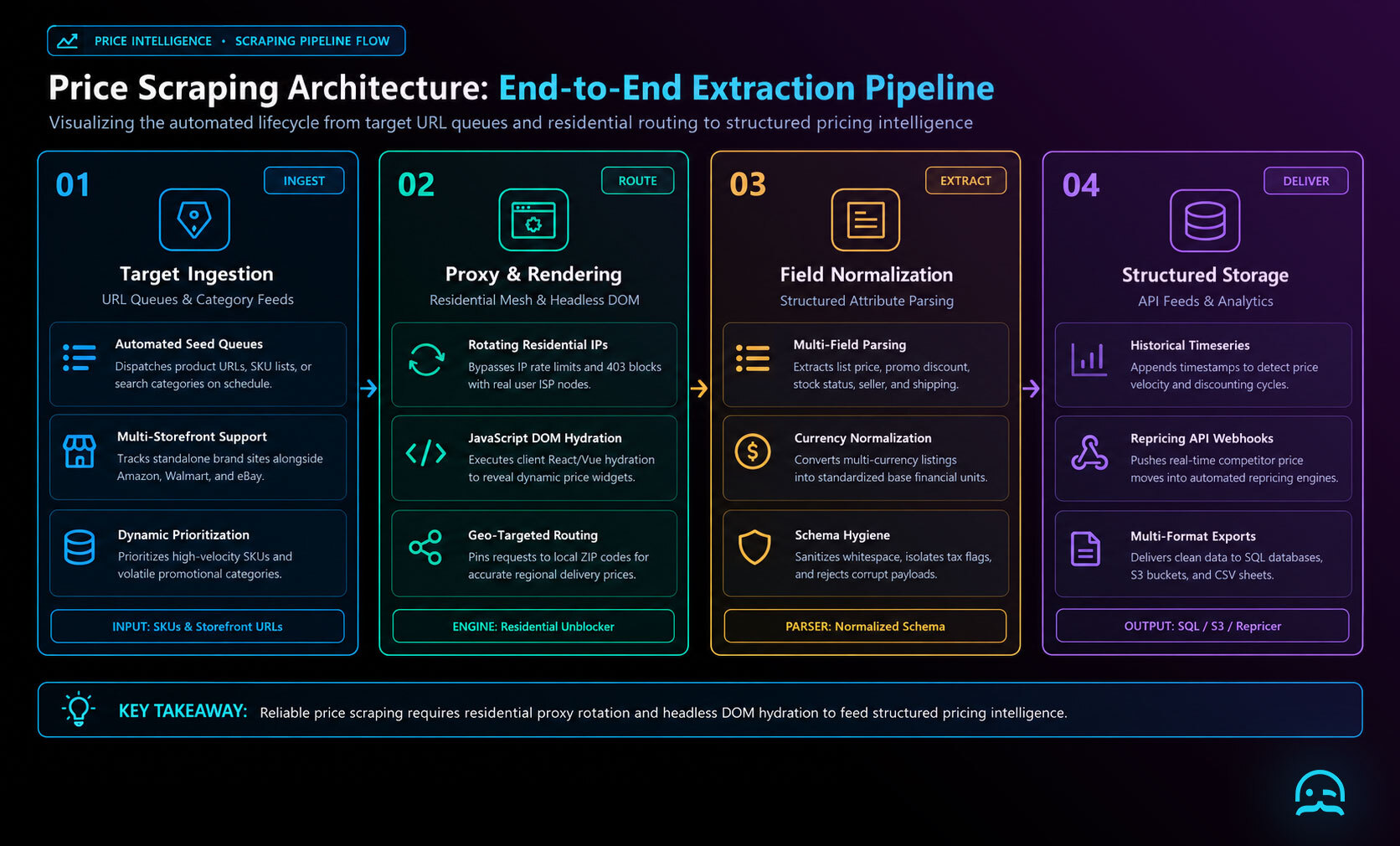
Price scraping works through an automated five-step pipeline that transforms raw public web pages into structured, machine-readable records:
- You give the tool a list of product URLs, search terms or categories.
- The tool requests each page, routing through proxies so requests aren't blocked.
- It renders the page if prices load via JavaScript.
- It extracts the price and related fields into structured rows.
- It runs on a schedule and exports to a file, sheet or API.
While the pipeline appears straightforward, extraction frequently breaks in production due to four common web defenses:
- Prices rendered after initial load: Modern storefronts send empty HTML containers initially and inject price tags hundreds of milliseconds later via private GraphQL or asynchronous API calls.
- Region-specific pricing: Retailers alter item prices, applicable taxes, and shipping rates based on the visitor's detected IP address or postal code.
- Logged-in pricing: Certain sellers hide promotional discounts behind account logins or require visitors to add items to a shopping cart before displaying final prices.
- Anti-bot blocks: Defenses like Cloudflare, DataDome, and Akamai inspect TLS client handshakes and browser canvas fingerprints, dropping non-human connections immediately.
Why do businesses use price scraping?
Businesses use price scraping to replace slow, error-prone manual market research with automated, real-time commercial intelligence that directly informs pricing and inventory decisions:
- Repricing against competitors without manual checks
- Catching resellers breaking minimum advertised price rules
- Watching stock movements as a demand signal
- Market and category research before launching a product
- Feeding dynamic pricing rules
- Verifying your own listings show correctly across marketplaces
What data can you collect besides price?
Price scraping captures comprehensive product attributes because a standalone headline price provides an incomplete and misleading view of market competition.
| Field | Why it matters | How often it changes |
|---|---|---|
| Headline price | The primary public benchmark customers see on product pages. | Daily or multiple times per day during promotions. |
| Sale price | Indicates active promotional depth, original MSRP, and consumer discount perception. | Weekly, seasonally, or during holiday sales events. |
| Stock status | Out-of-stock competitors cannot fulfill orders, eliminating the need to discount your own price. | Hourly to daily depending on product velocity. |
| Seller name | Identifies whether the seller is the first-party merchant, an authorized reseller, or a grey-market vendor. | Daily on marketplaces with rotating buy-box ownership. |
| Shipping cost | Determines true landed consumer cost; free shipping thresholds alter purchasing decisions. | Monthly or seasonally as carrier contracts shift. |
| Star ratings | Contextualizes whether price differentials are justified by superior customer satisfaction. | Weekly to monthly as customer feedback accumulates. |
| Review count | Serves as an indirect proxy for sales volume and consumer validation. | Weekly to monthly on active retail listings. |
| Variant or SKU | Prevents comparing different sizes, colors, multi-packs, or refurbished units against standalone products. | Rarely; changes primarily when catalog specs are refreshed. |
| Promotions | Captures on-page checkboxes, promo codes, and basket-level discounts applied at checkout. | Daily during promotional campaigns. |
The 7 best price scraping tools in 2026
The best price scraping tools span visual no-code extractors, developer-first scraping APIs, managed proxy networks, and turnkey commercial monitoring platforms.
| Tool | Type | Entry price | Best for | Needs coding? | Handles anti-bot? |
|---|---|---|---|---|---|
| MrScraper | Visual + AI scraper with built-in proxies | Free (1,000 Plan Tokens), Pro at $199/mo (200,000 Plan Tokens) | Visual & AI scraping with built-in proxies and zero proxy configuration | No (visual/AI) or Yes (API/SDK) | Yes (built-in Web Unblocker, residential proxies, and headless rendering) |
| Octoparse | Desktop visual point-and-click scraper | Free (limited), Standard at $119/mo | Non-technical researchers building complex visual extraction routines on desktop | No | Moderate (requires paid plans for automated cloud IP rotation and CAPTCHA solving) |
| Apify | Cloud developer scraping platform (Actors) | Free ($5 credit), Starter at $49/mo | Developers building custom scrapers using pre-built open-source Actors | Yes (JavaScript/Python) | Yes (when configured with Apify Proxy and residential proxy add-ons) |
| Bright Data | Enterprise data collection and proxy network | Pay-as-you-go or $500/mo subscription commitments | Large enterprises running massive, distributed web extraction pipelines | Yes | Yes (industry-leading proxy infrastructure and anti-bot unblocking) |
| ParseHub | Desktop visual scraper client | Free (limited), Standard at $189/mo | Merchandisers extracting data behind nested menus, dropdowns, and logins | No | Moderate (built-in IP rotation on paid tiers; struggles on strict modern bot shields) |
| ScraperAPI | Developer proxy and rendering API gateway | Free (5,000 credits), Hobby at $49/mo | Software engineers integrating single-endpoint data fetching into existing codebases | Yes | Yes (automated proxy rotation, headless browser rendering, and CAPTCHA handling) |
| Prisync | Turnkey competitor price tracking software | Premium at $99/mo (100 products) | E-commerce brands wanting out-of-the-box competitor dashboards and automated price alerts | No | Yes (handled entirely behind the scenes by vendor infrastructure) |
1. MrScraper
MrScraper is an all-in-one web scraping platform combining visual point-and-click extraction, natural language AI scrapers, built-in residential proxies, and headless browser rendering in a unified cloud interface.
- Verdict: The most versatile scraping platform for teams that want visual setup, AI extraction, and residential proxy unblocking without managing third-party proxy subscriptions.
- Who it suits: Growth teams, e-commerce managers, and developers who need to extract pricing data reliably across modern JavaScript stores without writing boilerplate proxy or browser code.
- Entry price and billing model: Free tier includes 1,000 Plan Tokens per month with 10 concurrent requests. Scraper Pro is $199/month for 200,000 Plan Tokens with 100 concurrent requests, with pay-as-you-go overages at $0.001 per token and residential proxy bandwidth starting from $2.50/GB.
- Genuine strength: Built-in residential proxy rotation and automated browser rendering ensure requests blend with real consumer traffic, eliminating third-party proxy subscriptions.
- Genuine weakness: Focuses strictly on data extraction, API delivery, and export; it does not feature an out-of-the-box retail repricing dashboard with built-in rule engines for automatic e-commerce catalog repricing.
- Technical skill required: None for visual point-and-click and AI scrapers; optional Python and Node.js SDKs are available for software engineers.
2. Octoparse
Octoparse is a desktop-installed client application that enables users to visually extract web data by clicking directly on browser elements.
- Verdict: A mature, desktop-based visual scraping suite best suited for non-engineers extracting multi-level catalog data on manageable schedules.
- Who it suits: Business analysts, e-commerce category managers, and marketing teams who lack coding backgrounds and prefer desktop software over cloud consoles.
- Entry price and billing model: Free plan provides basic local scraping on up to 10 tasks. The Standard cloud plan begins at $119/month billed annually ($149 billed monthly) for 100 cloud tasks.
- Genuine strength: Intuitive visual workflow designer that handles pagination, infinite scrolls, dropdown selections, and table extraction with high visual fidelity.
- Genuine weakness: The desktop client is resource-intensive on local machines, and cloud extraction on strictly defended marketplaces requires expensive enterprise upgrades.
- Technical skill required: None; operates entirely through a visual GUI.
3. Apify
Apify is a developer-centric cloud platform hosting hundreds of containerized, open-source scraping tools known as Actors.
- Verdict: An exceptionally flexible developer ecosystem for engineering teams that want to deploy, customize, and orchestrate serverless scrapers at scale.
- Who it suits: Python and JavaScript developers who want ready-to-use scrapers for Amazon, Google Shopping, or Shopify stores without building code from scratch.
- Entry price and billing model: Free tier includes $5 of monthly platform usage credits. Paid plans start with the Starter tier at $49/month, moving to Scale at $499/month, with proxy usage billed on top.
- Genuine strength: The extensive Apify Store marketplace features hundreds of maintained, community-reviewed scrapers for specific retailers, drastically cutting initial development time.
- Genuine weakness: Non-technical users face an intimidating learning curve, and unexpected cost spikes can occur if an Actor enters an infinite loop or consumes heavy residential proxy bandwidth.
- Technical skill required: High; requires familiarity with code configuration, API endpoints, and cloud execution environments.
4. Bright Data
Bright Data is an enterprise data infrastructure provider operating the world's largest proxy network alongside managed data collection APIs and ready-made datasets.
- Verdict: The premier enterprise solution for organizations scraping millions of pricing records daily across globally restricted retail markets.
- Who it suits: Large retail enterprises, data brokers, and institutional pricing teams with dedicated engineering budgets and high-volume data needs.
- Entry price and billing model: Pay-as-you-go proxy and scraper options are available, with structured monthly commitments starting at $500/month for business accounts.
- Genuine strength: Unrivaled proxy network depth across more than 195 countries with precise city- and ASN-level targeting, paired with enterprise-grade anti-bot unblocking technology.
- Genuine weakness: High pricing and complex account management create steep entry barriers for small and mid-sized e-commerce sellers.
- Technical skill required: High; setting up custom scrapers, anti-bot bypass rules, and proxy routing requires experienced software developers.
5. ParseHub
ParseHub is a desktop visual scraper designed to extract data from websites that utilize complex JavaScript, AJAX, and nested dropdowns.
- Verdict: A reliable visual scraper for non-programmers who need to scrape dynamic e-commerce catalogs with intricate nested attributes.
- Who it suits: Researchers, marketing agencies, and small merchant teams seeking a guided point-and-click interface that runs on Windows, macOS, and Linux.
- Entry price and billing model: Free plan allows up to 200 pages per run across 5 public projects. Paid Standard plans start at $189/month.
- Genuine strength: Exceptional handling of conditional logic, multi-level dropdowns, tabs, and login-protected web pages within an intuitive desktop interface.
- Genuine weakness: Slower crawl speeds compared to headless cloud scrapers, and entry-level paid pricing ($189/month) is steep relative to competing cloud platforms.
- Technical skill required: None; operates entirely through visual point-and-click selection.
6. ScraperAPI
ScraperAPI is a developer-focused proxy and scraping API gateway that manages IP rotation, browser rendering, and CAPTCHA bypasses through a single API endpoint.
- Verdict: A clean, dependable proxy API for developers who want to write their own parsing logic without dealing with proxy pool rotation or browser farms.
- Who it suits: Backend engineers building proprietary price scrapers who need a simple API wrapper to handle anti-bot bypasses.
- Entry price and billing model: Free trial provides 5,000 API credits. Hobby plan starts at $49/month for 100,000 API credits, with higher tiers reaching $299/month for 3,000,000 credits.
- Genuine strength: Utterly simple developer experience: sending a standard GET request to their API endpoint with your target URL automatically handles rotating IPs, headers, and headless rendering.
- Genuine weakness: ScraperAPI returns raw HTML or JSON; it provides no built-in visual data extraction, parser rule builders, or automated price scheduling dashboards.
- Technical skill required: High; requires writing code in Python, Node.js, Go, or PHP to parse the returned HTML.
7. Prisync
Prisync is a dedicated, fully managed competitor price tracking and dynamic pricing software suite built specifically for retail e-commerce brands.
- Verdict: The top turnkey choice for merchants seeking an out-of-the-box pricing dashboard with automated alerts and repricing rules rather than a general scraper.
- Who it suits: E-commerce founders, Amazon sellers, and retail merchandising teams who want immediate pricing intelligence without managing data pipelines or scraper maintenance.
- Entry price and billing model: Premium plan starts at $99/month to track up to 100 products with 3 daily price updates. Platinum plan costs $199/month for up to 1,000 products.
- Genuine strength: Pre-configured dashboards that display competitor price changes, stock variances, exportable Excel reports, and automated dynamic repricing integrations with Shopify and Magento.
- Genuine weakness: Extremely expensive when scaling to large catalogs; monitoring 10,000 SKUs costs hundreds of dollars monthly, making it cost-prohibitive for high-volume catalog scraping.
- Technical skill required: None; fully managed commercial software service.
How much does price scraping cost?
Price scraping costs depend on catalog size, refresh frequency, target website defenses, and the software delivery model you select. Understanding these costs requires breaking down the core billing models and operational overheads involved.
Price scraping solutions operate on three primary pricing models:
- Per token or credit models: Platforms charge internal tokens per request. Static web pages typically consume 1 token, while JavaScript rendering or heavy anti-bot bypasses consume 5 to 10 tokens per page.
- Per successful request models: Scraping API gateways charge strictly for requests that return a successful 200 OK status code, absorbing the cost of failed retries and blocked connections.
- Per gigabyte proxy bandwidth models: In-house and open-source scrapers bill according to the volume of network data transferred through residential proxy pools, typically ranging from $2.50 to $10.00 per gigabyte.
Worked monthly cost example: tracking 1,000 products daily
Consider a mid-sized retail business monitoring 1,000 competitor product pages once per day across standard e-commerce websites:
- Monthly request volume: 1,000 products multiplied by 30 days equals 30,000 scraping requests per month.
- Data bandwidth footprint: With an average e-commerce page size of 200 KB, 30,000 requests generate approximately 6 GB of network traffic per month.
- Managed scraping platform cost: On MrScraper, tracking 1,000 products daily consumes 30,000 requests, representing only 15% of the 200,000 Plan Tokens included on the $199/month Pro tier.
- Dedicated monitoring software cost: On dedicated monitoring platforms like Prisync, tracking 1,000 products costs $199/month on a Platinum subscription.
- Developer API gateway cost: On developer gateways like ScraperAPI, 30,000 successful requests fall comfortably within a $49/month Hobby tier.
Why quoted prices understate reality
Baseline software subscription tiers rarely represent the final operational cost of scraping at scale:
- Retry rates and defensive soft-blocks: Heavily protected websites reject 10% to 30% of initial scraping attempts with CAPTCHAs, forcing automated retries that consume additional credits or bandwidth.
- Browser rendering overhead: Headless browsers download images, CSS stylesheets, and tracking scripts unless explicitly blocked, increasing bandwidth consumption per page from 100 KB to several megabytes.
- Geo-location switching: Verifying regional prices across multiple geographic territories requires running separate proxy sessions for each location, multiplying total request counts.
Build vs buy: the true cost of an in-house scraper
Building an in-house price scraper using open-source libraries (such as Scrapy, Playwright, or Puppeteer) appears inexpensive initially because the software libraries are free. However, ongoing maintenance creates substantial hidden costs:
- Engineering hours: Senior software developers spend 5 to 15 hours per month fixing broken selectors, updating session headers, and debugging bot blocks whenever target retailers change their website layouts. At an average developer rate of $75/hour, maintenance labor costs $375 to $1,125 each month.
- Dedicated infrastructure: Running containerized headless browsers on AWS ECS or Google Cloud Run typically incurs $50 to $200 per month in server compute and memory fees.
- Third-party proxy subscriptions: Maintaining rotating residential proxy pools to prevent IP bans adds $50 to $250 monthly for modest catalog volumes.
When developer salaries, server hosting, and proxy bandwidth are calculated together, maintaining an in-house scraper routinely costs $500 to $1,500 per month. Managed scraping platforms and scraping APIs consolidate these costs into predictable monthly subscriptions, freeing engineering teams to focus on core product features.
Is price scraping legal?
Price scraping publicly displayed product data is generally treated as lawful in many jurisdictions, and it is standard commercial practice across the retail industry. Legal precedents have affirmed that accessing public web data that does not require an account or password does not violate the Computer Fraud and Abuse Act (CFAA).
However, specific legal boundaries govern automated data extraction:
- Public vs authenticated data: Extracting prices visible to any casual website visitor is fundamentally different from scraping data behind a password-protected login portal. Bypassing authentication barriers can lead to breach-of-contract claims.
- Website Terms of Service: Many commercial websites prohibit automated scraping in their terms of use. While browsewrap agreements linked in website footers are difficult to enforce in some jurisdictions, clickwrap agreements where users click to accept represent binding contracts.
- Personal data and privacy regulations: Scraping numerical price tags and SKU numbers does not implicate privacy laws. However, scraping customer reviews, user names, or email addresses triggers compliance requirements under GDPR and CCPA.
- Copyright and intellectual property: Numerical facts, prices, and stock numbers cannot be copyrighted. In contrast, proprietary product descriptions and brand imagery enjoy copyright protection and should not be republished verbatim.
- Server burden and trespass: Aggressive concurrent requests that degrade website performance or cause outages can expose scrapers to legal claims of computer tampering or trespass to chattels.
To operate safely, implement practical guardrails: respect robots.txt guidelines, pace requests politely with rate limiting, collect only necessary public pricing fields, and never capture personal customer data.
Disclaimer: This section provides general educational information on web scraping practices and does not constitute formal legal advice. Jurisdictions differ significantly. Consult qualified legal counsel regarding your specific data collection activities.
How do you scrape prices without getting blocked?
Price pages are among the most heavily defended web assets because retailers actively monitor, detect, and restrict competitor data extraction. Major e-commerce platforms utilize anti-bot systems that analyze incoming IP reputation, TLS client hello fingerprints, HTTP header ordering, and browser execution environments to terminate non-human connections.
To scrape prices reliably without triggering blocks, implement five technical safeguards:
- Residential proxies: Datacenter IPs from cloud providers are immediately flagged. Routing requests through rotating residential proxy pools assigns real consumer IP addresses, blending requests with genuine shoppers.
- Realistic request pacing: Distribute requests across wide IP pools with randomized delays between page hits to mimic authentic human browsing.
- Headless browser rendering: Execute requests through headless browser instances that evaluate the DOM, run JavaScript, and wait for network idle states before parsing.
- Geo-targeting: Use geo-targeted residential proxies to capture accurate regional pricing and currency data based on consumer location.
- Intelligent retry logic: Configure exponential backoff algorithms that detect rate limits or CAPTCHA challenges, immediately switching proxy sessions before retrying.
For an in-depth breakdown of proxy pool selection and rotating IP strategies, explore our comprehensive guide to residential proxies for web scraping.
Running a price scraping request in Python
The following Python script demonstrates how to fetch a dynamic e-commerce product page safely using MrScraper's Web Scraper API, which handles proxy rotation and browser rendering automatically behind a single request:
import os
import requests

TARGET_PRODUCT_URL = "https://example-retailer.com/products/wireless-headphones-v2"
API_TOKEN = os.getenv("MRSCRAPER_API_TOKEN", "YOUR_ACTUAL_API_TOKEN")

# Dispatch request to MrScraper API with automated browser rendering
response = requests.get(
    "https://api.mrscraper.com",
    params={
        "url": TARGET_PRODUCT_URL,
        "render_js": "true",  # Executes JavaScript to capture dynamically injected prices
        "country": "us",       # Routes via US residential proxy for regional price parity
    },
    headers={
        "x-api-token": API_TOKEN,
        "Accept": "application/json",
    },
    timeout=45,
)

if response.status_code == 200:
    data = response.json()
    print("Scrape successful!")
    print(f"Delivered HTML length: {len(data.get('html', ''))} characters")
    print(f"Reported token usage: {response.headers.get('token_usage', '1')}")
else:
    print(f"Request failed with status {response.status_code}: {response.text}")
For advanced SDK configurations, automated CSS selector extraction, and webhook dispatching, refer directly to the official MrScraper Documentation.
How to choose the right price scraping tool
Choosing the right price scraping tool depends on your team's technical resources, catalog size, extraction frequency, and reporting requirements.
| If you… | Choose | Why |
|---|---|---|
| Have no developers | A no-code tool or managed service | Setup in hours, not sprints |
| Track a fixed competitor set | A dedicated price monitoring platform | Built-in dashboards and alerts |
| Need custom fields or odd sites | A scraping API | Full control over extraction |
| Scrape at high volume | A platform with built-in proxies | Blocking is the real bottleneck |
| Only need occasional one-offs | Pay-as-you-go | No monthly commitment |
How MrScraper handles price scraping
MrScraper handles price scraping through an integrated cloud infrastructure that eliminates the complexity of building and maintaining custom scrapers. Instead of stitching together separate headless browser servers, third-party residential proxy providers, and custom database parsers, MrScraper provides an end-to-end data extraction environment designed for reliability.
To scrape prices with MrScraper, you supply target product URLs or category sitemaps directly through the dashboard interface, via CSV batch uploads, or programmatically through our REST API. For complex storefronts with dynamic price elements, MrScraper offers two flexible setup paths: a visual point-and-click scraper that isolates CSS selectors with visual highlights, or an AI scraper that extracts prices, stock levels, and SKUs using natural language prompts without requiring selector maintenance when site layouts change.
Behind every request, MrScraper automatically routes traffic through our built-in residential proxy network with geo-targeting across major global markets. There is zero proxy configuration required on your end, eliminating third-party proxy subscriptions. Dynamic JavaScript rendering is executed automatically in cloud headless browser instances, ensuring that client-side price tags, currency dropdowns, and variant options render completely before extraction.
You can schedule recurring price scraping tasks to run on hourly, daily, or custom intervals, delivering clean structured datasets directly to Amazon S3 buckets, Google Sheets, or internal databases via webhooks. Billing is completely transparent and resource-based: the free Scraper Free tier includes 1,000 Plan Tokens each month with 10 concurrent requests, while the Scraper Pro tier provides 200,000 Plan Tokens for $199 per month with 100 concurrent requests. Predictable overages are billed at exactly $0.001 per token, with residential proxy bandwidth starting from $2.50 per GB.
Ready to eliminate scraper maintenance and capture competitor prices reliably? Try MrScraper free today—claim your 1,000 free Plan Tokens with no credit card required.
Frequently asked questions
What is price scraping?
Price scraping is the automated collection of product prices and related details from websites. Software visits product pages on a schedule, pulls out the price, stock status and other fields, and delivers them as structured data. Retailers, brands and marketplaces use it to track competitors and monitor their own listings.
Is price scraping legal?
Collecting publicly displayed prices is generally treated as lawful in many jurisdictions, and it is standard practice across retail. The picture changes when data sits behind a login, when a site's terms forbid it, when personal data is involved, or when request volume burdens the site. Check the target's terms and take legal advice for your situation.
How do I scrape prices from a website?
You supply product URLs or search terms to a scraping tool, which visits each page, renders it if the price loads dynamically, and extracts the price into structured rows. Most tools run on a schedule and export to a spreadsheet or API. No-code tools handle this without programming; scraping APIs give developers more control.
How much does price scraping cost?
Cost depends on how many products you track and how often. Tools charge per request, per credit, or per gigabyte of proxy traffic, and heavily defended sites cost more because they need residential proxies and browser rendering. Tracking a few hundred products daily is inexpensive; tracking millions across protected marketplaces is not.
What are the best price scraping tools?
The right tool depends on your technical resources. Dedicated price monitoring platforms suit teams who want dashboards and alerts with no setup. No-code scrapers suit one-off or small recurring jobs. Scraping APIs suit developers who need custom fields and high volume. Most teams pick on whether they have engineers available.
Can I scrape Amazon prices?
Amazon prices can be collected, but it is one of the harder targets — heavy bot protection, prices that vary by region and seller, and frequent layout changes. Doing it reliably needs residential proxies, browser rendering and maintenance. Amazon's terms restrict automated access, so review them and take advice before running at scale.
Does price scraping work on sites that load prices with JavaScript?
Yes, but only with a tool that renders the page the way a browser does. Many retail sites load prices after the initial page arrives, so a basic scraper that reads raw HTML returns an empty field or a placeholder. Check that any tool you evaluate handles rendered pages before committing.
How often should I scrape competitor prices?
Match the frequency to how fast prices actually move in your category. Fast-moving electronics and travel can justify several checks a day. Most retail categories are well served by daily or twice-daily collection. Scraping more often than prices change multiplies cost without improving the decisions you make from the data.
Why do my price scrapers keep getting blocked?
Price pages are among the most heavily defended on the web because scraping them is so common. Blocks usually come from datacenter IPs, request patterns that are too fast or too regular, or a client that doesn't look like a real browser. Residential proxies, realistic pacing and proper rendering resolve most cases.
What is the difference between price scraping and price monitoring?
Price scraping is the collection step — getting prices off websites into structured data. Price monitoring is what you do with it: tracking changes over time, setting alerts, comparing against your own prices and acting on the result. Monitoring platforms include scraping; scraping tools do not always include monitoring.
Can I scrape prices for free?
Free tiers and open-source libraries let you collect small volumes at no cash cost, which is fine for testing or a handful of products. They fail at scale, because the real expense is proxies and the maintenance of keeping extraction working as sites change. Free options rarely survive contact with well-defended retail sites.
What data should I collect alongside price?
Price alone is usually not enough to act on. Collect stock status, seller name, shipping cost and any promotion, because a lower price from an out-of-stock third-party seller is not a competitive threat. Capturing the product identifier and a timestamp also lets you build reliable price history.
Summarize this post
Open it in your assistant of choice with the prompt ready to send.
Take a Taste of Easy Scraping!

Find more insights here
The Ultimate Web Crawlers List: 15 Tools for Every Data Need
Compare the best web crawlers for 2026. Learn the difference between open-source, managed APIs, and…
Web Scraping MCP Server: Giving AI Agents Direct Access to Live Web Data
Learn how a Web Scraping MCP Server gives AI agents live web access while reducing token costs by 87…
Scaling E-commerce Competitive Intelligence with Automated Data Harvesting
Scale e-commerce data harvesting with residential proxies and AI. Learn how modern data extraction s…