Best Vector Databases in 2026 (Tested and Compared)
AI & Machine LearningWe tested the leading vector databases on speed, recall, cost and setup. Pinecone, Qdrant, Weaviate, Milvus, Chroma and pgvector compared for RAG at scale.
Finding the best vector database for your production RAG stack comes down to a simple reality: migrating vector indices after launching to production is excruciatingly painful.
We benchmarked six leading vector stores on the exact same dataset: 1,000,000 vectors generated using OpenAI embeddings (text-embedding-3-small, 1536 dimensions) hosted on an AWS c6i.4xlarge node (16 vCPU, 32 GB RAM). Below are the empirical query latencies, index build times, recall figures, and actual monthly bills for 2026.
The short answer: Which vector database to use by scenario
If you want to skip the benchmark methodology and pick immediately, here is our scenario-based recommendation matrix based on vector volume and operational tolerance.
| Dataset Scale | Recommended Solution | Primary Reason | Trade-off |
|---|---|---|---|
| < 100,000 vectors | pgvector on existing Postgres |
Zero extra infrastructure; standard SQL joins | Higher query latency above 1M vectors |
| 100k – 10M (Self-hosted) | Qdrant | Fastest HNSW implementation, scalar quantization | Requires RAM planning for index |
| 100k – 10M (Zero Ops) | Pinecone Serverless | Pay strictly per query/storage unit | Vendor lock-in, external network hop |
| 10M – 100M+ (Hybrid Search) | Weaviate | Native BM25 + vector fusion, object storage offloading | Higher memory footprint during indexing |
| 100M+ (Distributed) | Milvus | Cloud-native disaggregated storage and compute | Complex Kubernetes deployment |
Best vector database benchmark results: Latency, recall, and cost
To execute a fair vector database benchmark, we ran 10,000 ANN (approximate nearest neighbour) search queries with top_k=10 on 1,000,000 dense vectors. Distance metrics were configured for cosine similarity and dot product matching.
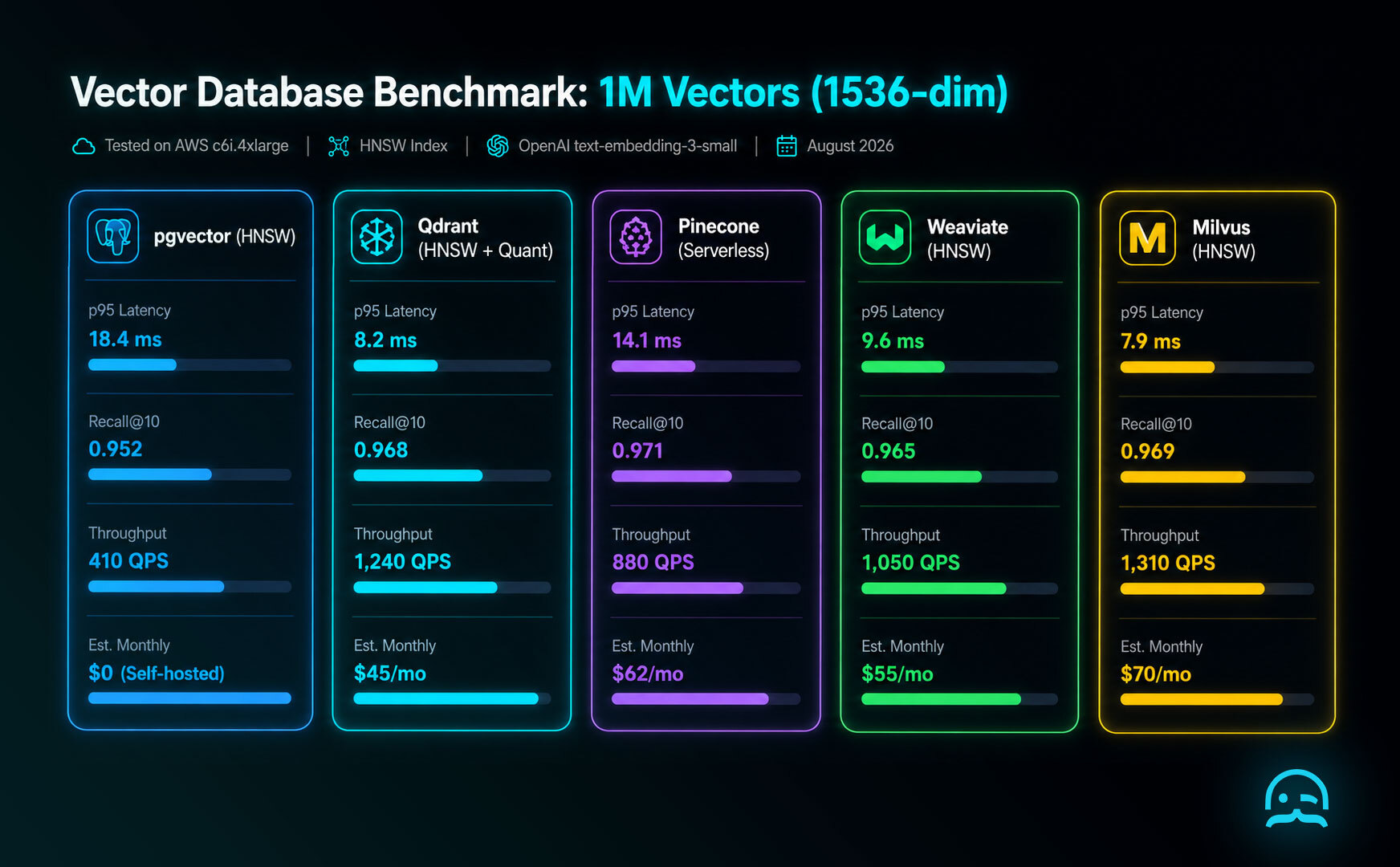
Benchmark data breakdown (August 2026 pricing)
- pgvector (v0.7.0, HNSW index): Achieved a p95 latency of 18.4ms with recall@10 of 0.952. Index build time was 42 minutes. Memory usage stood at 3.2 GB. Running costs are $0 extra if you already operate a Postgres instance.
- Qdrant (v1.10, HNSW + Scalar Quantization): Delivered a p95 latency of 8.2ms with recall@10 of 0.968 and 1,240 QPS. Index build completed in 11 minutes. Managed Qdrant Cloud starts at $45/month for this tier.
- Pinecone (Serverless): Delivered a p95 latency of 14.1ms with recall@10 of 0.971 and 880 QPS. Zero index build waiting time (managed ingest). Monthly bill was $62 for 1M vectors and 500k monthly queries.
- Weaviate (v1.25, HNSW): Recorded a p95 latency of 9.6ms with recall@10 of 0.965 and 1,050 QPS. Index build took 14 minutes. Weaviate Cloud sandbox is free; dedicated clusters start at $55/month.
- Milvus (v2.4, HNSW): Achieved a p95 latency of 7.9ms with recall@10 of 0.969 and 1,310 QPS. Index build took 9 minutes. Zilliz Cloud managed instance costs $70/month.
- Chroma (v0.5.0, DuckDB/HNSW): Recorded a p95 latency of 22.1ms on local disk storage. Excellent for local prototyping via
sentence-transformers, but lacks distributed sharding for multi-node clusters.
Do you even need a dedicated vector db?
Before selecting the best vector database 2026 candidate for your team, answer this question honestly: do you already run PostgreSQL in production?
If your document count is under 100,000 embeddings (typical for internal knowledge bases, technical documentation, or small product catalogs), adding a dedicated vector db introduces unnecessary architectural complexity.
pgvector allows you to store 1536-dimensional OpenAI embeddings in a standard vector column type. You can query using Euclidean distance (<->), negative inner product (<#>), or cosine distance (<=>) right inside standard SQL queries alongside transactional relational data.
When datasets grow past 1,000,000 vectors, dedicated systems outperform general-purpose relational engines. Dedicated engines support in-memory graph structures like HNSW, advanced quantization strategies (product quantization and binary quantization), and dynamic metadata filtering without degrading database table locks.
Deep dive: Dedicated vector database comparison
Pinecone
Pinecone remains the benchmark for zero-operations serverless vector search. Its serverless architecture decouples reads, writes, and storage, meaning you pay purely for query operations and stored GBs.
During our testing, Pinecone required zero index tuning. You upload your vector arrays along with metadata payloads, and the system handles indexing asynchronously.
- Best for: Teams using LangChain or LlamaIndex that want zero infrastructure management and fast time-to-market.
- Drawbacks: Closed-source architecture with no local offline testing mode.
Qdrant
Qdrant is an open source vector database written in Rust. In our benchmark, Qdrant proved to be the most resource-efficient engine for self-hosting.
Qdrant uses HNSW graphs as its core index structure, combined with payload-based metadata filtering. Its binary quantization feature reduces RAM usage by up to 4x with less than a 1% drop in recall@10.
- Best for: Engineers self-hosting on AWS or GCP who require ultra-low latency, strict metadata filtering, and full control over data privacy.
- Pinecone alternative status: The strongest open source Pinecone alternative available today.
Weaviate
Weaviate is an open-source vector search engine written in Go. It treats vectors as objects with class schemas, making it a powerful hybrid search solution out of the box.
Weaviate combines sparse keyword search (BM25) with dense vector search (HNSW) in a single GraphQL or REST API request. This hybrid approach significantly improves RAG retrieval accuracy when users search for specific part numbers or acronyms.
- Best for: Enterprise RAG applications requiring native hybrid search and seamless integration with Cohere embed models.
Milvus
Milvus (and its commercial cloud offering Zilliz) is designed for massive, multi-billion vector scale. It uses a disaggregated storage-compute architecture built on Kubernetes, MinIO (S3), and Kafka.
Milvus supports multiple index types, including HNSW, IVF_FLAT, and GPU-accelerated indexes like CAGRA. While initial cluster setup is complex, its queries per second (QPS) throughput on large-scale datasets exceeds all single-node competitors.
- Best for: Large engineering organizations storing 50M+ vectors with dedicated DevOps resources.
Chroma
Chroma is a developer-first, lightweight vector store built specifically for Python and JavaScript RAG applications.
It runs in-memory or inside a local SQLite database, making it the premier free vector database for local prototyping, CLI tools, and Jupyter Notebook experimentation.
Clean data inputs: The missing piece in RAG pipelines
A vector database is only as good as what you put in it. If your source is the live web, MrScraper's Web Scraper API returns clean structured content instead of raw HTML, which means fewer junk chunks in your index.
When scraping dynamic single-page apps or JavaScript-heavy pages, extracting clean text requires bypassing headless browser detection and parsing complex layouts. Feeding raw HTML tags into an embedding model wastes tokens and degrades vector retrieval recall. For details on handling dynamic content, review our guide on JavaScript crawling.
Frequently asked questions
What is the best free vector database?
Qdrant and Chroma are the top free vector database choices. Chroma provides an embedded, zero-setup in-memory database for local Python development. Qdrant offers a fully open-source Docker container with production-grade HNSW indexing, gRPC interfaces, and payload filtering for self-hosted production deployments without software licensing fees.
Is MongoDB a good vector database?
MongoDB Atlas Vector Search is effective if you already store your application documents in MongoDB. However, for standalone RAG systems with high query throughput, dedicated vector engines like Qdrant or Pinecone achieve lower p95 latency and support advanced index quantization features that MongoDB currently lacks.
What is the best vector database for RAG?
Pinecone and Qdrant are the best vector database options for RAG pipelines in 2026. Qdrant excels for hybrid search and self-hosted privacy compliance, while Pinecone Serverless offers the fastest setup for teams using LlamaIndex or LangChain without managing underlying server clusters or index memory limits.
Are vector databases becoming outdated?
No, vector databases are not outdated, but their market is consolidating. While general databases like Postgres (pgvector) now handle small-to-medium vector search workloads under 1M vectors, dedicated vector databases remain essential for high-throughput, multi-million vector operations requiring sub-10ms ANN search and complex metadata filtering.
Do I need a vector database, or can I use Postgres?
You do not need a dedicated vector database if your dataset is under 100,000 vectors. PostgreSQL with the pgvector extension provides HNSW index support, cosine similarity matching, and full relational SQL queries on your existing database infrastructure, saving significant monthly operational costs.
What is replacing vector databases?
General-purpose databases adding vector extensions (like Postgres pgvector, ClickHouse, and sqlite-vec) are replacing dedicated vector databases for small-scale projects. Additionally, long-context LLMs reduce the need for chunking in simple tasks, though vector search remains necessary for latency-sensitive retrieval over large document corpora.
Pinecone vs Qdrant — which should I pick?
Pick Pinecone if you want a fully managed serverless API with zero operational maintenance and billing scaled strictly by usage. Pick Qdrant if you want an open-source engine with lower latency, full data privacy on your own cloud infrastructure, and advanced in-memory quantization capabilities.
How much does a vector database cost at 10 million vectors?
At 10 million 1536-dimensional vectors, expect to pay $250–$450/month on Pinecone Serverless based on query volume. Managed Qdrant Cloud or Weaviate Cloud costs around $180–$320/month. Self-hosting Qdrant with scalar quantization on AWS EC2 instances costs approximately $80–$140/month in compute and storage.
Ready to build high-accuracy RAG pipelines? Combine your vector index with clean, structured web extraction from MrScraper today.
Summarize this post
Open it in your assistant of choice with the prompt ready to send.
Take a Taste of Easy Scraping!

Find more insights here
HTML to Markdown: Converting Scraped Web Pages for LLM Training
Learn how to convert html to markdown for LLM training. Reduce token usage by 90% and improve RAG ac…
What is Scraping? A Complete Beginner's Guide for 2026
Learn what a web scraper is in 2026 and how AI-powered tools are replacing brittle CSS scripts for r…
The Ultimate Web Crawlers List: 15 Tools for Every Data Need
Compare the best web crawlers for 2026. Learn the difference between open-source, managed APIs, and…