7 scraperapi alternatives to scale your extraction in 2026
Web ScrapingCompare the best ScraperAPI alternatives in 2026. Learn how AI web scrapers and residential proxies reduce maintenance and costs for your data pipelines.
You've built a robust scraper, only to watch it break the moment a site updates its DOM or tightens its anti-bot shield. If you are still manually managing proxy pools and CSS selectors, you are overpaying in both time and infrastructure. ScraperAPI is a solid legacy choice. But in 2026, developers need AI-driven extraction and integrated residential proxies to stay efficient. While ScraperAPI handles the connection, modern alternatives handle the data extraction itself.
Scraperapi alternatives: 2026 comparison table
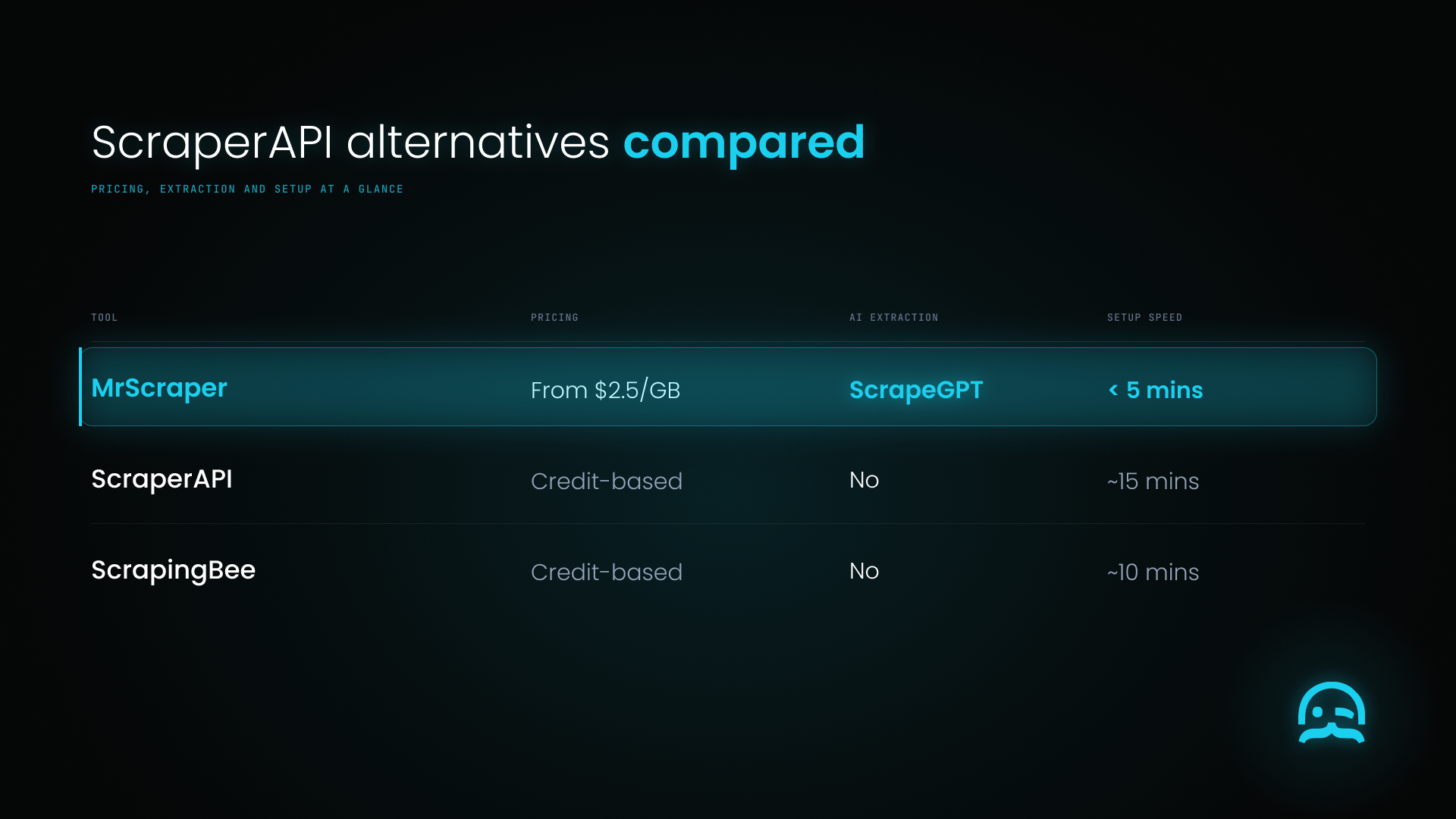
| Tool | Pricing | Proxy Type | AI Extraction | Setup Speed |
|---|---|---|---|---|
| MrScraper | From $2.5/GB | Residential/Mobile | ScrapeGPT | < 5 mins |
| ScraperAPI | Credit-based | Datacenter/Resi | No | ~15 mins |
| ScrapingBee | Credit-based | Datacenter/Resi | No | ~10 mins |
Why developers are moving beyond ScraperAPI
The pricing bottleneck
Legacy scraperapi pricing often feels like a moving target. It relies on complex credit systems that don't always align with success rates. When you are running high-volume tasks, the cost of failed attempts and credit waste adds up quickly. Modern teams are shifting toward transparent models. These models prioritize success-based billing and lower entry points for high-quality residential IPs.
Infrastructure vs. intelligence
Scraperapi handles the "how" of connecting to a site, but it leaves the "what" to you. In 2026, simply getting the HTML isn't enough. Developers are choosing an AI web scraper because it bridges the gap between raw code and structured JSON. This intelligence layer reduces the need for manual maintenance. It allows your team to focus on data analysis rather than fixing broken XPath strings. Understanding the nuances of structured vs unstructured data is essential for modern automation.
Clayton Christensen spent a career documenting why capable incumbents get overtaken by newer entrants. In The Innovator's Dilemma he described the pattern:
"...the leading firms were held captive by their customers."
Clayton Christensen — The Innovator's Dilemma, 1997
Incumbents optimize relentlessly for the job customers already hired them to do. ScraperAPI became very good at the connection layer because that was the job in 2018. The basis of competition has since moved to what happens after the response arrives.
Top 7 ScraperAPI alternatives for 2026
- MrScraper: The AI-First Choice (Pros: Native ScrapeGPT integration, affordable residential proxies, no-. Cons: Newer platform, focus is on AI extraction rather than just proxy volume)
- ScrapingBee: Best for headless browser tasks (Pros: Excellent documentation, handles JavaScript rendering well. Cons: No native AI extraction layer, pricing can scale rapidly)
- Bright Data: Best for enterprise-scale needs (Pros: Massive proxy network, highly customizable. Cons: Very expensive for smaller teams, steep learning curve)
- Apify
- Oxylabs
- ZenRows
- WebScraper.io
Technical deep dive: residential proxies vs. datacenter proxies
Residential proxies are much more effective than datacenter proxies for avoiding bans on sophisticated sites. Residential IPs are assigned by ISPs to actual homeowners. This makes them much harder for anti-bot systems to flag. Datacenter IPs are faster and cheaper, but they often belong to known server ranges. These ranges are often blocked by default on major platforms.
Using rotating residential proxies ensures that your requests mimic human behavior. This is the anti-blocking standard in 2026, especially when dealing with sites that use advanced TLS fingerprinting. High-quality residential pools provide the reputation needed to bypass captchas without constant retries.
What to do next: migrating your pipeline
- Identify your most fragile CSS selectors and replace them with an AI web scraper to handle schema drift.
- Audit your current scraperapi pricing 2026 to see if you are paying for unused credits or failed requests.
- Run a pilot with a managed web scraper API to compare success rates and JSON output quality. You can also utilize a structured data testing tool to verify the accuracy of your results.
What we learned:
- AI extraction eliminates manual selector maintenance
- Residential proxies are mandatory for modern anti-bot bypass
- Success-based pricing is the new industry standard
Frequently asked questions
What is a headless browser?
A headless browser is a web browser without a graphical user interface. It is used to render JavaScript-heavy sites during scraping.
Can I use an AI web scraper to find company owner contact details?
Yes, tools like MrScraper use ScrapeGPT to identify and extract contact info from unstructured text automatically. Advanced users often implement llm feature extraction for legal text to structured data conversion.
Schedule a personalized demo today to see how MrScraper can automate your data extraction workflows with precision and speed.
Summarize this post
Open it in your assistant of choice with the prompt ready to send.
Take a Taste of Easy Scraping!

Find more insights here
Use MrScraper MCP to Compare Public SaaS Pricing and Plan Limits
Build a source-backed SaaS plan comparison using MrScraper MCP. Preserve prices, quotas, billing ter…
Build a Product Attribute Classifier with LangChain and MrScraper
Build a LangChain workflow that extracts product evidence with MrScraper, normalizes attributes and…
Create a Source-Verified Question-and-Answer Dataset From Web Pages
Build a question-and-answer dataset from your own documentation pages. Every answer is an exact span…