Structured Data Extraction: Turning HTML Into Clean Records
Web ScrapingLearn how modern data extraction turns raw HTML into clean JSON records. Use AI scrapers and automated tools to build resilient, production-grade pipelines.
Raw HTML is a liability, not an asset. You send a request, receive a 2MB blob of nested tags, and realize your pipeline spends more time cleaning text than analyzing it. If your scraping architecture relies on the fragile hope that a site's structure never changes, it is effectively broken. In the current landscape, the focus has shifted from simple data collection to automated data extraction. This transition delivers production-grade records directly to your database without the manual cleaning bottleneck.
Modern data extraction: From unstructured HTML to clean JSON
Structured data extraction is the process of converting raw, messy HTML into a queryable format like JSON or SQL. Modern extraction focuses on structured records to eliminate manual cleaning in market research pipelines. Advanced methods now prioritize clean records over raw text, which significantly reduces downstream processing time. This involves identifying entities, normalizing dates, and ensuring that every field matches a predefined schema.
Why raw text is a bottleneck
When you scrape raw text, you inherit every formatting inconsistency on the web. A price might be listed as "$20.00" on one page and "20 USD" on another. Without a structured conversion engine, your data engineers must write endless scripts to normalize this information. This creates massive technical debt. It slows down analysis and increases the risk of error in your final reports.
The cost of brittle CSS selectors
Traditional scrapers rely on CSS selectors and XPath to find data. This approach is fundamentally fragile for several reasons:
- DOM hydration issues: Single-page applications often load data asynchronously. This causes selectors to miss elements that have not rendered yet.
- Frequent layout changes: A simple class name change in a site update will break your entire extraction script. Like testing behavior instead of implementation makes software more stable, scraping must avoid rigid DOM paths.
- Engineering overhead: Maintaining a fleet of scrapers requires constant monitoring and manual selector updates.
- Data leakage: Brittle selectors often capture unwanted HTML tags or hidden elements that pollute your clean records.
AI-powered extraction: The ScrapeGPT framework
Mapping messy data to schemas
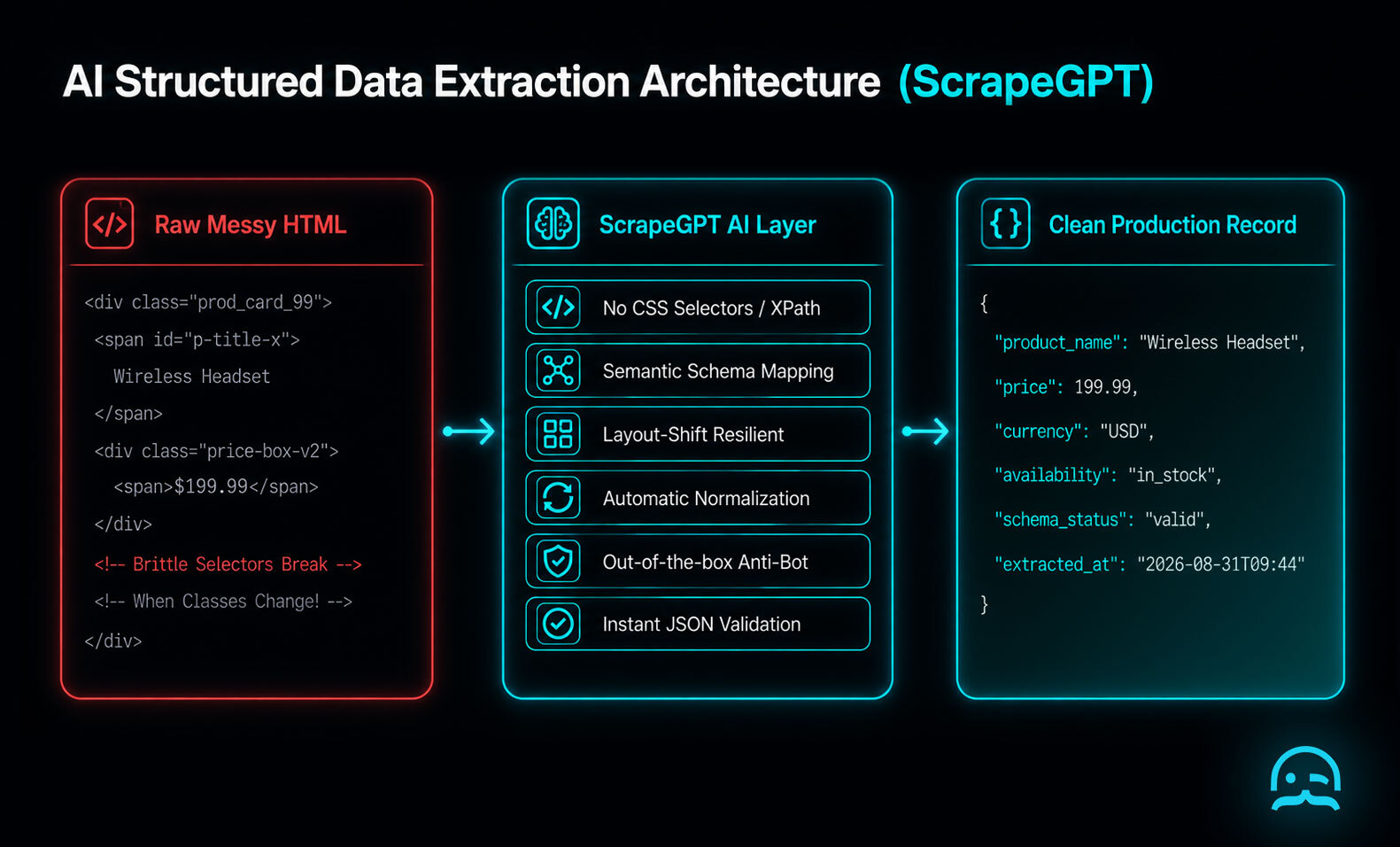
Tools allow for resilient scraping by mapping unstructured HTML directly to predefined JSON schemas. Instead of telling the scraper where to look, you tell it what to find. A modern ai scraper uses semantic understanding to identify the correct data points. By scraping the web with AI, systems can identify data regardless of how they are nested in the DOM. This ensures that your pipeline continues to function even if the target website undergoes a total redesign.
Eliminating downstream processing
By using AI-driven data extraction, you can move the cleaning step to the point of extraction. The output is no longer a string of text; it is a validated object ready for ingestion. Many developers now use a web scraping API to simplify this workflow. It helps ensure high availability and handles proxy management automatically.
Example JSON output
{
  "product_name": "Headless Browser API",
  "price": 49.99,
  "currency": "USD",
  "availability": "in_stock"
}
Building a resilient data pipeline
- Define the schema: Clearly map out the fields you need and their data types.
- Configure the request: Use professional data extraction tools like MrScraper. They can handle browser rendering, residential proxies, and anti-bot bypass.
- Apply AI extraction: Pass the raw HTML through an engine like ScrapeGPT that performs semantic data parsing to map it to your schema.
- Database ingestion: Direct the clean JSON records into your production environment for immediate analysis.
Wrapping up
The shift toward AI-native scraping is inevitable. The goal isn't just to get the data; the goal is to get it in a format that is immediately actionable for your business. Using an AI layer also helps bypass common hurdles like DataDome or Cloudflare. It reduces suspicious DOM interactions when finding a specific element.
Key takeaways
- Identify your most frequent selector failure points in your current scripts.
- Implement an AI-driven extraction layer to handle these high-maintenance targets.
- Monitor the data pipeline to ensure that schema drift is caught before it impacts your reports.
Related reading
- Data extraction guide: Tools and best practices
- Structured vs unstructured data: What is the difference?
- AI web scraper: Adaptive parsing when layouts change
- Scraping the web using AI
- AI web data extraction without CSS selectors
- AI web scraping: The complete guide
Frequently asked questions
What is web scraping in Python?
In Python, web scraping typically involves using libraries like BeautifulSoup or Scrapy to parse HTML. However, modern engineers are increasingly moving toward API-based solutions like MrScraper. These handle anti-bot bypass and AI extraction automatically.
Is web scraping illegal?
Web scraping itself is a tool and is not illegal. However, scraping private data or violating specific site terms can lead to legal issues. Using an LLM for feature extraction of legal text to structured data can help clarify these complex compliance requirements. Always scrape public data responsibly and check robots.txt.
What is data extraction?
Data extraction is the process of retrieving data from various sources. In the context of the web, it refers to turning unstructured website content into structured datasets.
Ready to automate your workflow? Start your data extraction today.
Summarize this post
Open it in your assistant of choice with the prompt ready to send.
Take a Taste of Easy Scraping!

Find more insights here
HTML to Markdown: Converting Scraped Web Pages for LLM Training
Learn how to convert html to markdown for LLM training. Reduce token usage by 90% and improve RAG ac…
What is Scraping? A Complete Beginner's Guide for 2026
Learn what a web scraper is in 2026 and how AI-powered tools are replacing brittle CSS scripts for r…
The Ultimate Web Crawlers List: 15 Tools for Every Data Need
Compare the best web crawlers for 2026. Learn the difference between open-source, managed APIs, and…