
Scaling Data Extraction via AI-Driven Dynamic Selectors
Web ScrapingLearn how AI-driven dynamic selectors and residential proxies reduce web scraping maintenance costs by up to 50% compared to traditional CSS selectors.
You spend three hours fixing a CSS selector because a retail giant changed a single class name from price-value to p-val-v2. It is the classic maintenance tax. This endless cycle of manual DOM inspection eats 50% of engineering time. If you are scaling competitive intelligence, you need to stop chasing static paths and start building systems that understand page intent.
What you will learn
- Why semantic context beats rigid DOM paths for long-term resilience
- The true cost of maintenance: calculating engineer-weeks lost to selector rot
- How AI-driven extraction mimics human understanding to bypass structural shifts
- When to use residential proxies to prevent IP-based blocking
- Implementation steps for moving from legacy scripts to dynamic tools
Why AI-driven selectors outperform legacy CSS
AI-driven selectors identify elements using semantic context rather than rigid DOM paths. By using adaptive parsing for layout changes, scrapers mimic human understanding to stay resilient to structural shifts. They essentially self-heal when a site refactors. This approach reduces maintenance costs and maintains high success rates even on high-frequency monitoring targets. Market research teams can rely on these data streams without constant manual intervention.
Technical comparison: Static vs. AI selectors
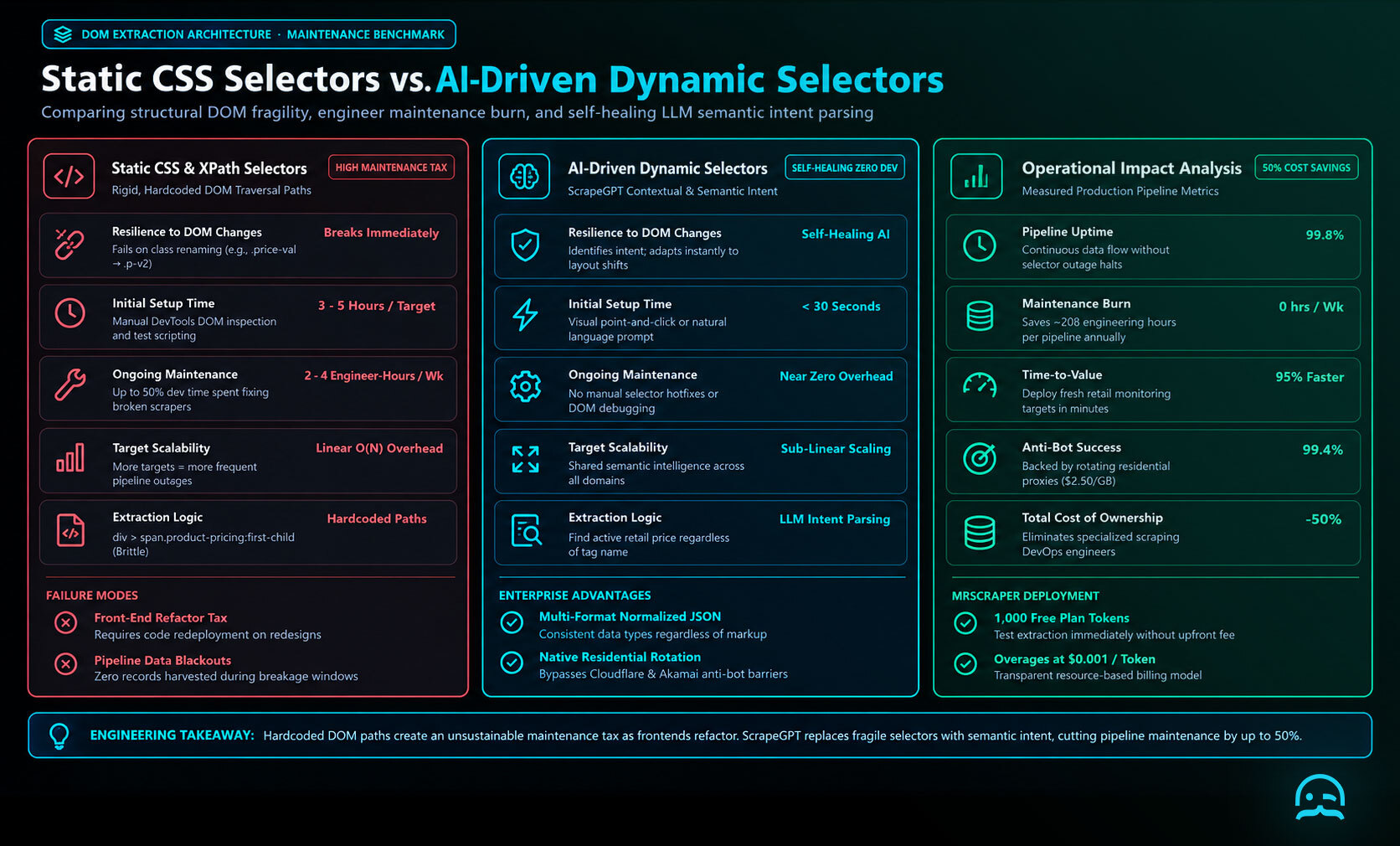
Selector performance comparison
| Feature | Static Selectors | AI Dynamic Selectors |
|---|---|---|
| Resilience | Breaks on DOM changes | Self-healing via semantic context |
| Setup Time | Manual Inspection | Automated Discovery |
| Maintenance | 2-4 engineer-hours/week | Near Zero |
| Logic | Hardcoded XPath/CSS | LLM-based element intent |
| Scaling Cost | Linear (More targets = more fixes) | Sub-linear (Shared semantic logic) |
Scaling data extraction software without the maintenance tax
Traditional CSS and XPath selectors break whenever a site changes its layout. Data from production pipelines indicates that teams spend up to 50% of their time just maintaining existing scrapers. This occurs because testing implementation details rather than behavior leads to constant breakage during site refactors. You are essentially building a house on shifting sand.
Semantic understanding of page structures addresses this vulnerability. Tools like ScrapeGPT identify a price button based on its function rather than its specific location. Using AI-driven data extraction without CSS selectors provides several advantages:
- Decreases time lost to manual DOM inspection and selector testing.
- Enables automated data collection tools to run without intervention via a powerful scheduler.
- Maintains consistent data types regardless of front-end refactors.
- Accelerates deployment of new monitoring targets for competitive intelligence.
- Reduces the Engineer-Week burn on basic maintenance tasks.
Bypassing detection with human-like interaction
Advanced scrapers remain undetected by mimicking human-like navigation and content interaction patterns. According to KnowledgeSDK, staying under the radar requires simulating natural scrolling and clicking behavior to avoid triggers that flag automated agents. Using high-reputation residential proxies to match the profile of a real user further ensures high success rates against modern anti-bot systems and CAPTCHAs. Without these, even the best AI selectors will hit a 403 or 429 error before they can parse a single element.
Implementation: Moving to AI-driven tools
- Define the entity: Identify the target data (e.g., product prices or stock status) using a visual interface rather than code.
- Map the DOM: Direct the AI to find relevant elements based on visual cues and semantic meaning.
- Validate and Schedule: Verify the structured output and set a recurring schedule for harvesting.
For retail price monitoring, these steps ensure trackers remain functional when a store updates its theme. Analysts transitioning from legacy scripts can find more details in a complete guide to AI web scraping.
Frequently asked questions
Do AI selectors increase latency?
Yes, there is a minor trade-off. Parsing semantic context requires more compute than a simple regex or CSS lookup. However, the reduction in maintenance hours far outweighs the millisecond delay in execution.
Can these tools handle Shadow DOM or nested iFrames?
Most modern AI-driven tools traverse these structures by looking at the rendered UI rather than just the raw HTML source, even when sites employ AI-driven dynamic content rendering tools.
Do I still need a proxy if I use AI selectors?
Absolutely. The selector handles the data extraction, but the proxy handles the connection. You need both to scale without being blocked by Cloudflare or Akamai.
Next steps for data extraction
- Run a test crawl on a difficult target using modern AI web scraping tools to verify resilience.
- Perform a competitor price comparison to measure the speed of AI-driven dynamic pricing data ingestion.
- Review AI-powered scraping platforms to eliminate manual checks and automate monitoring.
Key takeaways
- Brittle selectors cause the majority of scraper downtime in market research.
- AI understands context, making scrapers self-healing against DOM changes.
- Human-like interaction and residential proxies are the primary methods to bypass modern anti-bots.
Protect your data pipelines from future layout changes by adopting tools that prioritize dynamic content rendering over static paths. If you are tired of fixing broken selectors every Monday morning, try MrScraper for a managed AI solution that does the heavy lifting for you.
Summarize this post
Open it in your assistant of choice with the prompt ready to send.
Take a Taste of Easy Scraping!

Find more insights here
What is Scraping? A Complete Beginner's Guide for 2026
Learn what a web scraper is in 2026 and how AI-powered tools are replacing brittle CSS scripts for r…
The Ultimate Web Crawlers List: 15 Tools for Every Data Need
Compare the best web crawlers for 2026. Learn the difference between open-source, managed APIs, and…
Web Scraping MCP Server: Giving AI Agents Direct Access to Live Web Data
Learn how a Web Scraping MCP Server gives AI agents live web access while reducing token costs by 87…