Datacenter Proxies vs. Residential Proxies: Which One Should You Use?
ProxiesCompare datacenter and residential proxies to find the best fit for your scraping needs. Explore speed, trust levels, and cost-effective solutions for reliable data extraction.
Residential proxies are trusted for scraping protected sites because they use real ISP IPs. Datacenter proxies are faster and cheaper for bulk scraping. Choose residential for stealth and datacenter for high-volume public data collection.
What Is a Residential Proxy?
A residential proxy uses an IP address assigned by a real Internet Service Provider (ISP) to an actual user device-like a laptop or mobile phone. This makes it appear as if your requests are coming from a regular person browsing the internet.
Since residential IPs are seen as more trustworthy by websites, they are much harder to detect and block, making them ideal for more sensitive scraping tasks.
Key Benefits of Residential Proxies:
- Higher trust level from websites
- Access to geo-restricted content using real device IPs
- Ideal for scraping protected or login-gated platforms
What Is a Datacenter Proxy?
Unlike residential proxies, datacenter proxies are not tied to ISPs or physical devices. They’re created in bulk by data centers and cloud providers, offering fast and scalable IP addresses for automation.
These proxies are efficient and cost-effective, but they are easier for websites to detect, especially if you're sending high volumes of requests.
Key Benefits of Datacenter Proxies:
- Very fast performance
- Scalable for large scraping projects
- Affordable compared to residential IPs
Datacenter Proxies vs. Residential Proxies: The Key Differences
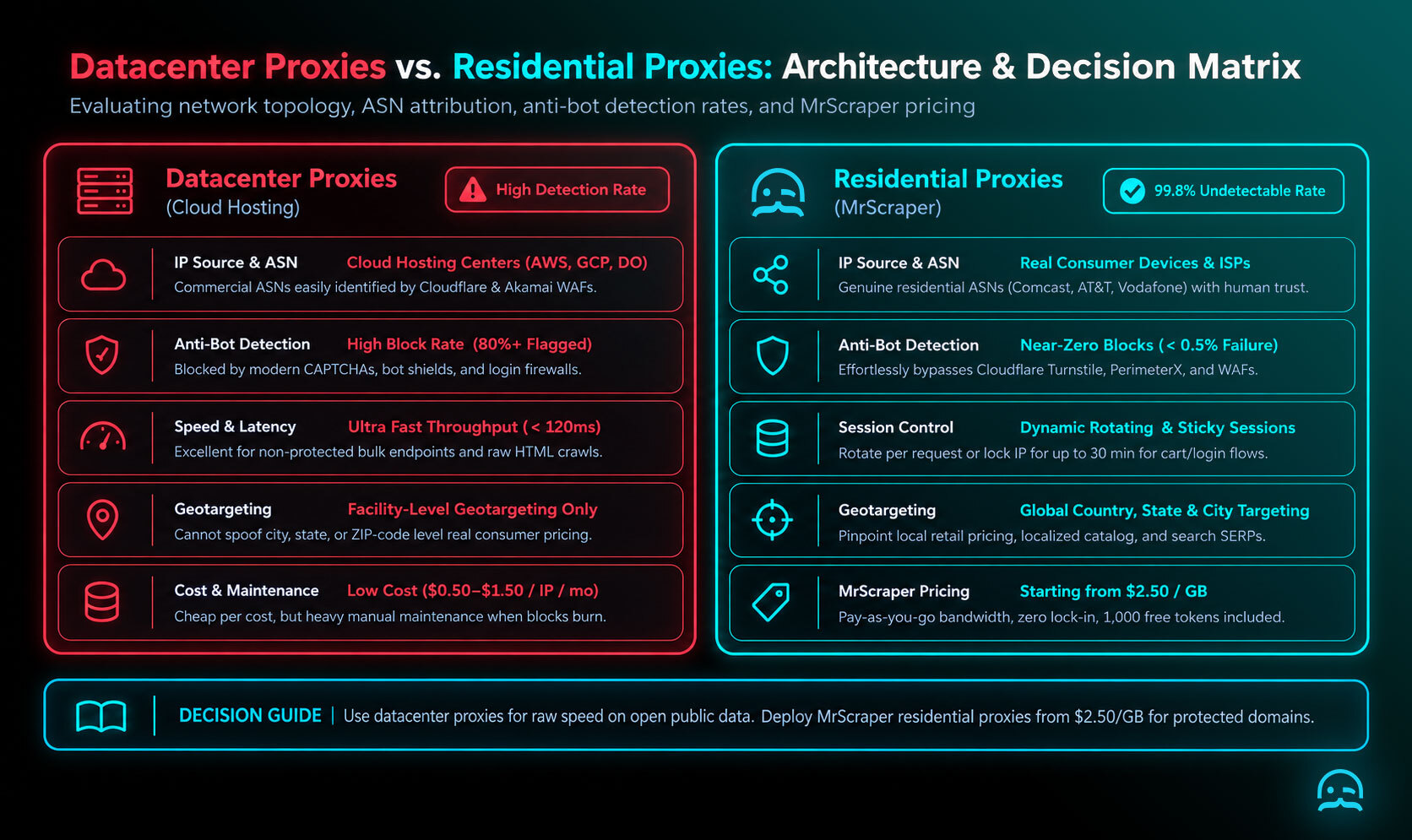
| Feature | Datacenter Proxies | Residential Proxies |
|---|---|---|
| IP Source | Cloud/Data centers | Real devices via ISPs |
| Trust Level | Moderate | High |
| Speed | Faster | Slower (depends on the device) |
| Detection Risk | Higher | Lower |
| Cost | Lower | Higher |
| Use Cases | Public data, bulk scraping | Login-protected pages, stealth scraping |
Which One Should You Choose?
- Go with Datacenter Proxies if you’re scraping publicly available data in large volumes and need speed at a lower cost. Ideal for tasks like price tracking or product listings.
- Go with Residential Proxies if you're dealing with sensitive websites that have bot detection, need IPs from specific regions, or want to simulate real-user behavior.
Scrape Smarter with MrScraper
This platform provides seamless access to both residential and datacenter proxies while managing the technical complexities of modern web extraction. The infrastructure includes several critical features designed to ensure high success rates.
- Automated IP rotation and session management
- Integration of real user fingerprints
- Comprehensive global geotargeting options
- Anti detection scraping environments
Whether your project involves gathering data from e-commerce sites, real estate portals, or competitive market research, these tools allow you to collect information without facing common blocks or disruptions.
Residential Proxy Credit Consumption and Tiers
This allows for seamless switching between proxy types within a single workflow.
import requests

# Residential proxy authentication using the credits system
proxy_config = {
    'http': 'http://username:password@residential.proxy-provider.com:8080',
    'https': 'http://username:password@residential.proxy-provider.com:8080'
}

response = requests.get('https://api.target-site.com/data', proxies=proxy_config)
print(f"Status: {response.status_code}")
Conclusion
Both datacenter and residential proxies have their strengths. Your choice depends on the level of stealth you need, your budget, and the complexity of the site you're targeting.
With MrScraper, you don’t have to compromise. Get the best of both proxy types and build scraping workflows that are fast, reliable, and undetectable.
Try MrScraper proxies today and power up your data extraction.
What We Learned
Selecting between these proxy types requires balancing operational overhead against target resistance. High security sites often necessitate the granular control of residential pools. For those implementing these via API, the choice usually manifests in the request headers or endpoint configuration, ensuring that the scraper adapts dynamically to the difficulty of the target domain.
import requests

# Residential proxy authentication example
proxy_config = {
    'http': 'http://user:pass@residential.proxy-provider.com:8080',
    'https': 'http://user:pass@residential.proxy-provider.com:8080'
}

response = requests.get('https://api.ipify.org?format=json', proxies=proxy_config)
print(f'Active IP: {response.json()["ip"]}')
| Requirement | Recommended Proxy Type |
|---|---|
| Bypassing advanced bot detection | Residential |
| High-speed market research data | Datacenter |
| Budget-friendly volume scraping | Datacenter |
| Accurate localized SEO tracking | Residential |
Put this into practice
Follow the quickstart guide to apply what you've learned to your own project.
Frequently asked questions
When should I choose residential proxies over datacenter proxies?
Opt for residential proxies when you need to bypass sophisticated bot detection, access login-protected content, or simulate real-user behavior from specific geographic locations. Their connection to physical ISP devices makes them significantly harder to detect.
Are datacenter proxies faster than residential proxies?
Yes, datacenter proxies typically offer faster performance because they are hosted in cloud environments rather than on individual consumer devices. This makes them ideal for large-scale projects where speed and cost-efficiency are the primary concerns.
Can I use both proxy types for web scraping?
Yes. Many advanced scraping workflows use datacenter proxies for high-speed retrieval of public data and switch to residential proxies for more sensitive or restricted pages to maintain high success rates.
Summarize this post
Open it in your assistant of choice with the prompt ready to send.
Take a Taste of Easy Scraping!

Find more insights here
HTML to Markdown: Converting Scraped Web Pages for LLM Training
Learn how to convert html to markdown for LLM training. Reduce token usage by 90% and improve RAG ac…
What is Scraping? A Complete Beginner's Guide for 2026
Learn what a web scraper is in 2026 and how AI-powered tools are replacing brittle CSS scripts for r…
The Ultimate Web Crawlers List: 15 Tools for Every Data Need
Compare the best web crawlers for 2026. Learn the difference between open-source, managed APIs, and…