
LunaProxy vs PYPROXY: Which Proxy Service Wins?
ProxiesCompare LunaProxy and PYPROXY across proxy types, coverage, protocols, scalability, pricing models, and ease of use to choose the right fit.
LunaProxy vs PYPROXY: Which Proxy Service Wins? Neither is a universal winner. Choose LunaProxy for wide coverage and easy large-scale scraping. Choose PYPROXY for proxy options and custom setup. Choose MrScraper for built-in support and simpler workflows.
What Are LunaProxy and PYPROXY?
Compare LunaProxy and PYPROXY in 2025 to find which proxy service fits your scraping, automation, or multi-account needs. This guide provides a practical comparison for developers and notes when built-in proxy support may be enough. By the editorial team. December 5, 2025. Three-minute read.
When building a web-scraping, data-crawling, or automation workflow, your proxy choice can significantly affect results. LunaProxy vs PYPROXY: Which Proxy Service Wins? The answer depends on your scale, technical requirements, and budget. Both providers support high-volume scraping, IP-ban avoidance, geo-restriction access, anonymity, and multi-account workflows. Each has different strengths and trade-offs. At their core, both services mask your real IP address. This can help maintain anonymity, avoid CAPTCHAs and geo-restrictions, and run scalable scraping, automation, or account-management tasks.
LunaProxy
LunaProxy offers a global pool of more than 200 million residential IPs across over 195 countries. Its proxy options include dynamic (rotating) and static residential proxies, along with ISP and datacenter proxies. Plans include unlimited residential packages without a bandwidth cap, plus flexible pricing by gigabyte or IP. It supports HTTP, HTTPS, and SOCKS5, and provides an easy dashboard with usage analytics and ISP- or city-level geolocation targeting.
PYPROXY
PYPROXY offers its own built, non-resold proxy network, including residential, mobile, ISP, and datacenter IPs. It provides rotating and static proxy options, supports HTTP(S) and SOCKS, and has plans for individuals through enterprises. Its offering focuses on speed, performance, and reliable uptime.
Authentication and API Adapters
LunaProxy vs PYPROXY: Which Proxy Service Wins? For API integration, the practical test is whether your client can pass provider credentials and the selected protocol without changing request logic.
import os
import requests

proxy = (
    f"http://{os.environ['PROXY_USER']}:{os.environ['PROXY_PASS']}@"
    f"{os.environ['PROXY_HOST']}:{os.environ['PROXY_PORT']}"
)
proxies = {"http": proxy, "https": proxy}
response = requests.get("https://example.com", proxies=proxies, timeout=30)
response.raise_for_status()
print(response.status_code)
Use the provider’s documented endpoint and protocol values, then keep the request layer unchanged when switching between services. For SOCKS5, use a client configuration that supports SOCKS proxies rather than an HTTP-only adapter.
Feature-by-Feature Comparison
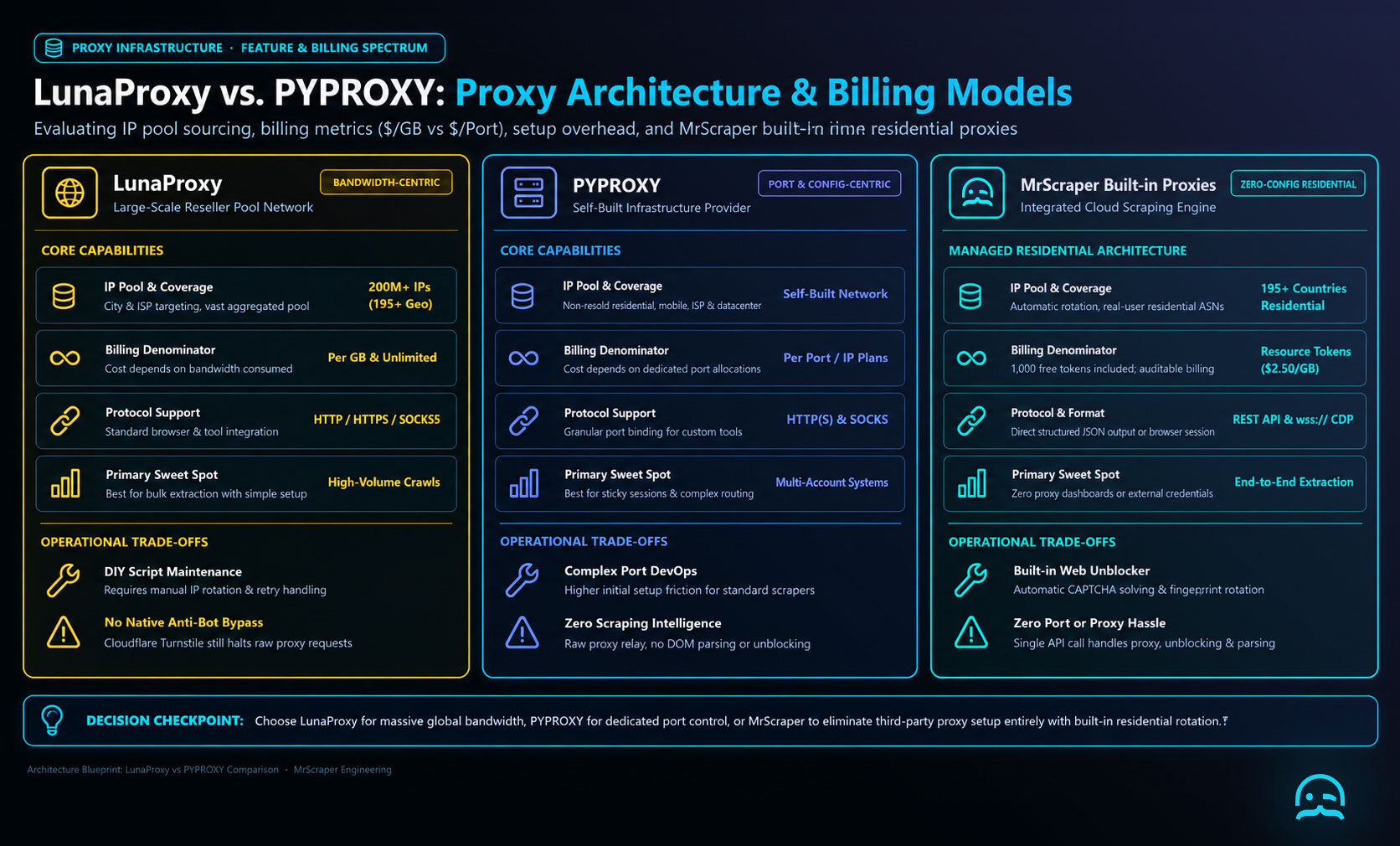
The comparison below highlights how LunaProxy and PYPROXY differ in coverage, connection options, scaling, performance, pricing, and setup.
| Feature / Attribute | LunaProxy | PYPROXY |
|---|---|---|
| IP pool and coverage | 200M+ IPs in 195+ countries, with city and ISP targeting | Large self-built pool covering residential, mobile, ISP, and data-center IPs |
| Proxy types | Rotating and static residential, ISP, data-center, and unlimited plans | Residential, mobile, ISP, and data-center, with rotating and static options |
| Protocols | HTTP, HTTPS, and SOCKS5 | HTTP/HTTPS and SOCKS |
| Anonymity | Large residential pool helps reduce IP reuse | Residential, mobile, and ISP diversity |
| Scalability | Supports large-scale tasks and unlimited concurrency on many plans | Scales from individual use to enterprise workflows |
| Performance | Stable for long sessions, SEO tools, and ad verification | Designed for speed and frequent rotations |
| Pricing | Per GB, per IP, and unlimited plans | Plans vary across budgets and use cases |
| Ease of use | User-friendly dashboard with simple setup | More configurable for advanced workflows |
Comparing Cost Denominators
LunaProxy vs PYPROXY: Which Proxy Service Wins? Compare the billing denominator before comparing headline prices. Record the quoted cost per gigabyte, or per port and billing period, then model the same workload against each offer.
gb_price = 8.00
expected_gb = 25
port_price = 18.00
ports = 3
months = 1

gb_total = gb_price * expected_gb
port_total = port_price  *ports*  months

print(f"GB plan estimate: ${gb_total:.2f}")
print(f"Port plan estimate: ${port_total:.2f}")
print("Lower modeled cost:", "GB" if gb_total < port_total else "port")
These figures are illustrative inputs, not provider quotes. Replace them with current plan prices, expected transfer, port count, and billing period. Recalculate separately for bursty traffic and persistent sessions, because the lower estimate can change when usage changes. Proxyway’s LunaProxy review provides additional context for the service comparison.
What This Means in Practice
The comparison below applies these differences to common proxy workflows.
Best for Large-Scale Scraping
For scraping in many countries, LunaProxy works well. It can handle millions of rows. You can also run many sessions at once. Its large proxy pool and simple setup make it efficient.
Best for Automation & Multi-Account Workflows
For advanced automation and multi-account workflows, PYPROXY offers more flexibility when you need mobile, residential, or ISP proxies. It also offers more customization.
Best for Small or Budget Projects
For small scraping jobs or testing, both providers offer entry-level plans. Choose LunaProxy when a straightforward setup matters most; choose PYPROXY when you need more configuration options.
Practical Tips for Using Proxies Effectively
- Rotate IP addresses deliberately to avoid recognizable reuse patterns.
- Select proxies across varied geographic locations and ISPs to create more diverse traffic.
- Use static or sticky sessions when managing multiple accounts so each workflow retains a consistent endpoint.
- Combine proxies with appropriate headers, user-agents, and browser profiles for a more complete request setup.
- Monitor success rates and adjust retry behavior and request frequency when performance changes.
- Track bandwidth usage because aggressive scraping can increase proxy costs quickly.
MrScraper’s Built-In Proxy Feature: A Strong Alternative
MrScraper already includes built-in proxy support, which can sometimes remove the need for an external provider.
Benefits:
- Seamless integration without external dashboards or separate credentials.
- Lower overhead for small tasks and quick experiments.
- Fewer dependencies for teams maintaining straightforward workflows.
- A practical fit for simple scraping jobs and lightweight automation.
- Often, a hybrid approach works best: use built-in proxies for lightweight tasks and external proxies for heavier operations.
Conclusion
LunaProxy vs PYPROXY: Which Proxy Service Wins? There is no universal winner; the right choice depends on your workflow. Choose LunaProxy for broad, global, high-volume scraping with minimal setup. Choose PYPROXY for flexibility, custom workflows, and a variety of proxy types. For a small or simple project, built-in proxies provide the easiest setup. Each option has distinct strengths, so match the service to your project’s scale, workflow, and setup requirements.
What We Learned
LunaProxy vs PYPROXY: Which Proxy Service Wins? The answer depends on the workflow’s deciding constraint, not a universal ranking. Use LunaProxy when you need broad coverage and easy scaling. Use PYPROXY when you need more proxy types or more workflow setup.
A useful closing checkpoint is to test both options against the same three questions before choosing. First, does the service cover the locations and proxy types the task requires? Second, will its session and rotation controls fit the workflow? Third, can the team operate it without unnecessary setup? The provider that satisfies all three with the fewest compromises is the practical winner.
- Choose LunaProxy for broad geographic coverage, high-volume work, and simpler operation.
- Choose PYPROXY for configurable workflows that need residential, mobile, ISP, or datacenter options.
- Reassess the choice when the workload, target regions, or session requirements change.
Compare MrScraper Plans for Your Workflow
Review MrScraper’s pricing options and compare them to the proxy needs in this guide. Use this to choose a good approach for your scraping project.
Summarize this post
Open it in your assistant of choice with the prompt ready to send.
Take a Taste of Easy Scraping!


Find more insights here

Scaling E-commerce Competitive Intelligence with Automated Data Harvesting
Scale e-commerce data harvesting with residential proxies and AI. Learn how modern data extraction s…

Scaling Data Extraction via AI-Driven Dynamic Selectors
Learn how AI-driven dynamic selectors and residential proxies reduce web scraping maintenance costs…

Why MrScraper is the Best ScraperAPI Alternative for No-Code Users
Compare ScraperAPI alternatives and discover why visual, AI-powered extraction is better for no-code…