Structured vs unstructured data: the real cost of scraping
Web ScrapingStop wasting engineering time cleaning HTML. Learn why structured data extraction is the key to scalable scraping and how ScrapeGPT automates the process.
You've finally bypassed the anti-bot system and rotated your residential proxies. Now you realize the HTML you just fetched is a 2MB nest of minified div tags. This is where the real work and the real cost begins. In 2026, a web scraper API does more than just fetch a page. Its true value is the ability to deliver clean, production-ready JSON records immediately. Many developers use scraperapi to handle these complex tasks efficiently.
The verdict: Why raw HTML is a legacy liability
Raw HTML requires expensive engineering time to clean, parse, and validate. Shifting to a structured data endpoint reduces post-processing overhead by up to 70%. Modern scraping APIs are pivoting toward intelligent data extraction to solve this problem at the source. When evaluating services, you should compare the scraperapi pricing to ensure it fits your budget.
The distinction between having data and having usable data is not new. Clive Humby, the mathematician behind Tesco's Clubcard, framed it in 2006 in a line that became shorthand for the entire data industry:
"It's valuable, but if unrefined it cannot really be used." Clive Humby, 2006
Raw HTML is crude. It contains what you want. But each hour your team spends turning it into records adds an extraction cost. You pay that cost in salary, not infrastructure.
- Faster deployment: Move from raw fetch to database-ready data in minutes.
- Lower maintenance: AI handles site changes so your parsers don't break.
- Reduced costs: Stop paying engineers to write and fix regex patterns.
Structured vs unstructured data: The engineering gap
Maintenance costs of CSS selectors
Traditional scrapers rely on XPath or CSS selectors. These are fragile. A single change in a site's DOM can break your entire pipeline. This "schema drift" is the primary reason scraping projects fail at scale. You end up in a cycle of constant fixes. This is far more expensive than the actual proxy costs, especially when considering the scraperapi pricing in 2026.
Ward Cunningham, who coined the term technical debt in a 1992 OOPSLA report, described exactly this compounding cost:
"Every minute spent on not-quite-right code counts as interest on that debt." Ward Cunningham — OOPSLA experience report, 1992
A selector-based parser is technical debt by definition. It works today because the target site's markup happens to look a particular way, and it accrues interest every time that assumption changes.
Handling schema drift with AI
An AI web scraper doesn't care if a div class changes. It uses semantic understanding to find the "Price" or "Product Name" regardless of the underlying HTML structure. This allows you to maintain stable data feeds even when the target website undergoes a total redesign. For example, you can use an AI web scraper to find a company owner's contact details automatically.
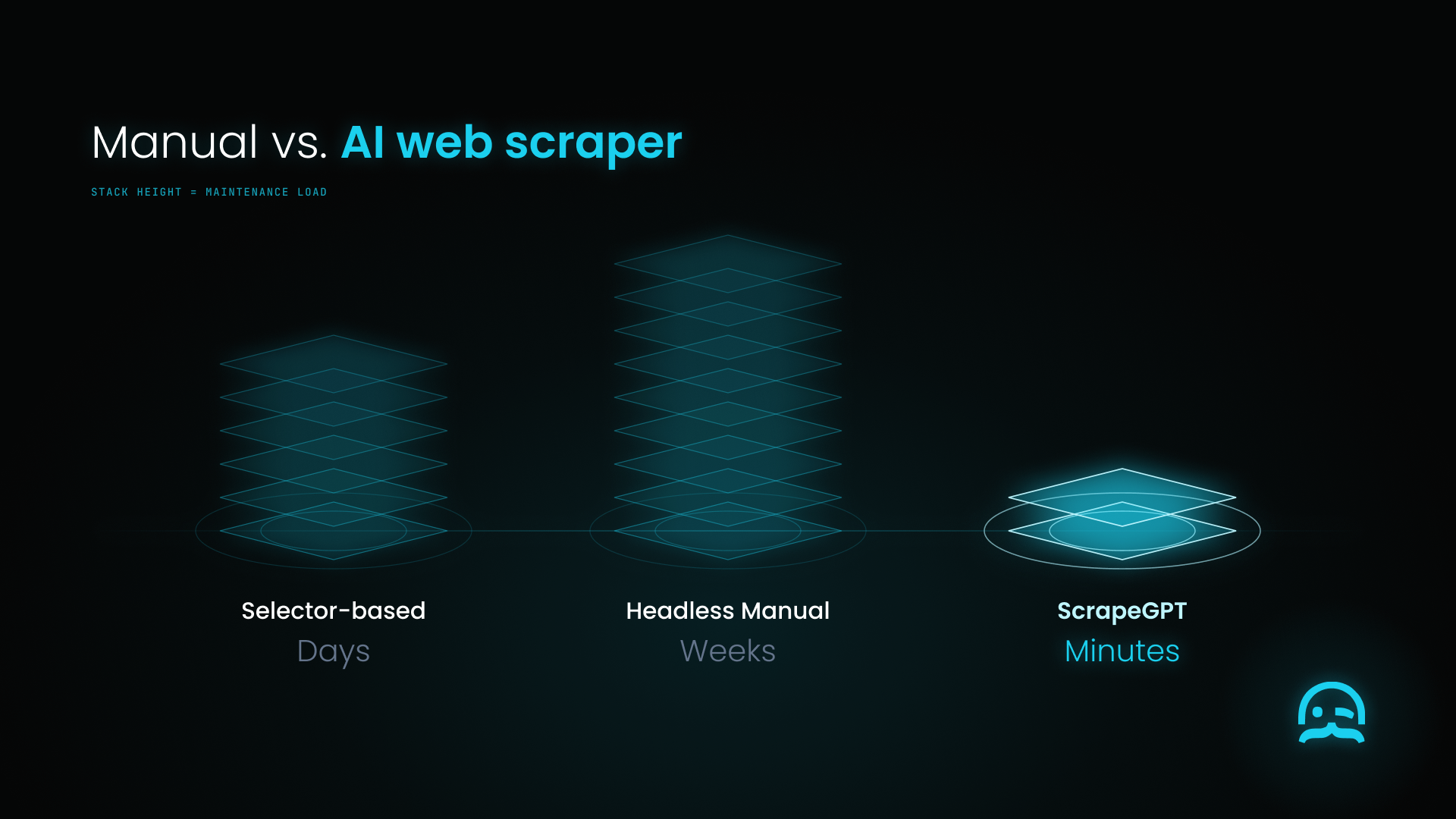
Comparing extraction methods: Manual vs. AI web scraper
| Method | Maintenance | Accuracy | Speed to Production |
|---|---|---|---|
| Selector-based | High | Manual | Days |
| Headless Manual | Very High | Manual | Weeks |
| ScrapeGPT | Low | AI-Verified | Minutes |
How to implement LLM feature extraction for legal text
- Define your JSON schema using a structured data testing tool.
- Use an AI web scraper to perform llm feature extraction legal text structured data.
- Prompt the extraction engine to identify specific clauses, dates, and parties.
- Validate the output against your schema to ensure consistency.
What to do next: Optimizing your pipeline
- Audit your current pipeline to identify how many hours are spent on selector maintenance.
- Switch to a managed web scraper API that offers native JSON output.
- Implement automatic residential proxy rotation to ensure high success rates during extraction.
Key takeaways
- Raw HTML is a liability that creates a "data cleaning tax."
- AI extraction solves the problem of fragile CSS selectors.
- Structured JSON output is the only way to scale a modern data pipeline.
What is a headless browser?
A headless browser is a web browser without a UI. Scrapers use it to render JavaScript and extract structured data.
How does ScrapeGPT handle schema drift?
It uses LLMs to understand the page content semantically rather than relying on fixed HTML tags.
Schedule a personalized demo today to see how MrScraper can automate your data extraction workflows with precision and speed.
Summarize this post
Open it in your assistant of choice with the prompt ready to send.
Take a Taste of Easy Scraping!


Find more insights here
522 Error: Cloudflare Connection Timed Out Explained
Cloudflare error 522 means the origin server did not respond in time. Learn what triggers it and how…
401 Unauthorized vs 403 Forbidden: What Is the Difference?
401 Unauthorized means authentication failed or is missing. Learn how it differs from 403, what caus…
429 Too Many Requests: How to Fix Rate Limit Errors
HTTP 429 means you have hit a rate limit. Learn how rate limiting works, how to fix 429 errors, and…