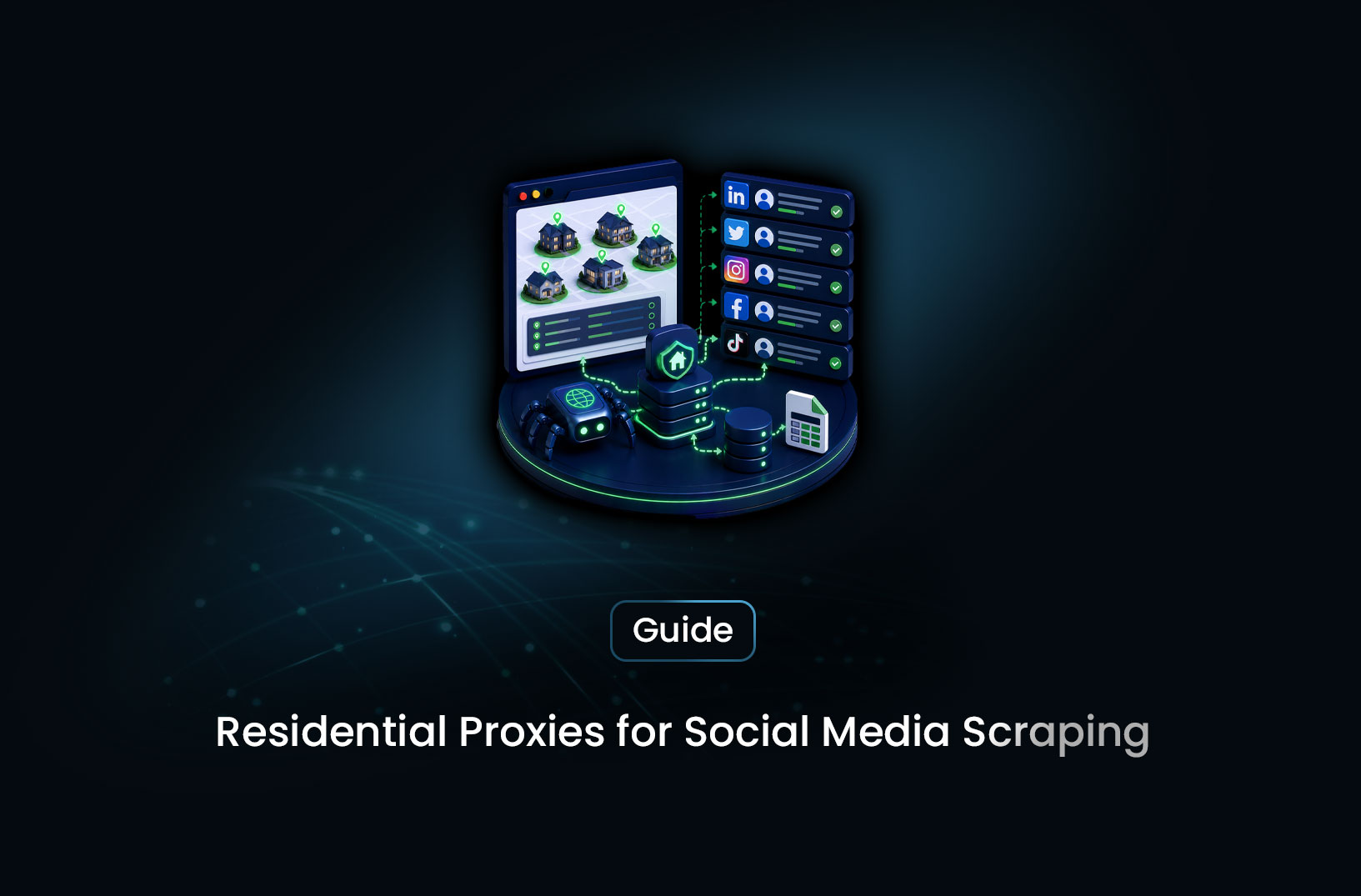
How to Use Residential Proxies to Scrape Social Media Without Getting Banned
GuideLearn how to use residential proxies to scrape public social media content without triggering bans — rotation, rate limits, and official API alternatives.
Brand monitoring, hashtag trend analysis, public sentiment research, and influencer marketing intelligence all depend on the same raw material: publicly visible social media content at scale. The problem is that every major platform invests heavily in detecting and blocking automated access — and the methods that work for scraping a simple ecommerce page fail almost immediately against platforms built specifically to identify and stop bot traffic.
Residential proxies for social media scraping address the specific detection layer that makes platforms like Instagram, Twitter/X, and TikTok harder to scrape than most commercial websites: IP reputation. Combined with rotation, rate management, and respect for what each platform's official API actually offers, residential proxies are the infrastructure layer that makes sustained public content collection viable. This guide covers how social platforms detect scraping, how to structure a collection approach around publicly visible content, and — just as importantly — when an official platform API is the better and more compliant path than scraping at all.
Table of Contents
- What Is Social Media Scraping With Residential Proxies?
- How Social Platforms Detect and Block Automated Access
- Step-by-Step Guide: Scraping Public Social Content Responsibly
- Best Tools for Social Media Data Collection
- Free vs. Paid: What the Investment Looks Like
- Key Features Your Social Scraping Stack Needs
- When Should You Scrape vs. Use an Official API?
- Common Challenges and Limitations
- Conclusion
- What We Learned
- FAQ
What Is Social Media Scraping With Residential Proxies?
Social media scraping with residential proxies refers to collecting publicly visible content from social platforms — public posts, hashtag results, public profile metrics, engagement counts on public content — using automated tools routed through residential IP addresses rather than data-center infrastructure, to avoid the immediate detection that data-center IPs trigger on platforms with significant anti-bot investment.
The scope that matters here is public content: posts, hashtags, and profile information that any visitor can see without logging in or that's visible to a logged-in account browsing normally — not private messages, gated content, or data behind authentication you're not authorized to access. This distinction matters both technically and from a compliance standpoint, and it's the framing this guide uses throughout.
Every major social platform — Meta (Facebook, Instagram), X (formerly Twitter), TikTok, LinkedIn, Reddit — explicitly addresses automated access in their Terms of Service, and most restrict or prohibit scraping outright. Some platforms provide official APIs specifically designed to give developers structured, compliant access to a defined subset of public data. Where an official API covers your use case, it's almost always the better choice: more reliable, ToS-compliant, and not subject to the constant arms race between scraping techniques and platform detection systems. This guide covers the technical proxy infrastructure relevant to scraping where it remains a consideration, while being direct that official APIs should be your first evaluation step for any platform that offers one.
How Social Platforms Detect and Block Automated Access
Social platforms have particularly sophisticated anti-bot infrastructure because automated abuse — fake engagement, spam, large-scale personal data harvesting — is a direct threat to their core business model and user trust. Understanding their detection layers clarifies why naive scraping approaches fail quickly.
IP reputation is the first checkpoint. Data-center IPs are flagged immediately by platforms that maintain extensive IP reputation databases. A request from an AWS or DigitalOcean IP range hitting a profile page or hashtag search is treated with elevated suspicion before any other signal is evaluated. Residential IPs — appearing as ordinary household connections — pass this initial check, which is the foundational reason they're used for sustained social platform access.
Account-level signals matter as much as IP for logged-in scraping. Many social platforms require login to view full content (Instagram and LinkedIn both gate significant content behind authentication). When scraping requires an authenticated session, the account itself becomes a detection surface — unusual browsing patterns, rapid profile visits, and automated-looking navigation can flag and restrict the account regardless of what IP it's using. This is a meaningfully different risk than IP-only detection on logged-out public pages.
Rate limiting is aggressive and platform-specific. Social platforms typically allow far fewer automated requests per IP or per session than ecommerce or content sites before triggering rate limits, CAPTCHA challenges, or temporary blocks. The acceptable request rate for sustained, undetected access to most social platforms is meaningfully lower than for typical commercial websites.
Behavioral and fingerprint analysis layers on top. Beyond IP type and rate, platforms evaluate browsing patterns, JavaScript execution environment, and request header consistency — the same multi-layer detection approach used by general-purpose bot management systems, applied with particular intensity given social platforms' direct exposure to bot-driven abuse (fake followers, engagement manipulation, mass data harvesting).
Step-by-Step Guide: Scraping Public Social Content Responsibly
Step 1: Check for an Official API First
Before building any scraping infrastructure, check whether the platform offers an official API that covers your use case. This is the single most important step in this guide, because it can eliminate the need for everything that follows.
- X (Twitter) API: Provides tiered access (including a free tier with meaningful limits) to public post search, user timelines, and engagement metrics. Official documentation at https://developer.twitter.com.
- Meta Graph API: Provides access to Facebook Pages and Instagram Business/Creator account data for connected accounts, including public post performance metrics — primarily designed for businesses managing their own pages and approved partners, not general public scraping. Documentation at https://developers.facebook.com/docs/graph-api.
- Reddit API: Provides structured access to public subreddit content, posts, and comments with documented rate limits. Documentation at https://www.reddit.com/dev/api.
- TikTok: Offers a Research API for qualified academic and research institutions, and a Display API for approved business integrations — narrower access than the other platforms but worth checking for qualifying use cases.
If an official API covers your data needs — even with rate limits or scope restrictions — it's the compliant, stable foundation to build on rather than a scraping workaround.
Step 2: Define Your Public Content Scope Precisely
For use cases where scraping public content is the chosen approach (data not covered by available APIs, or research/monitoring use cases evaluated as appropriate for your specific situation), define exactly what you're collecting: specific public hashtags, specific public account post counts, or aggregate engagement metrics on content that's visible without authentication.
Narrow, well-defined scope — "engagement metrics on posts using these five industry hashtags" — is both more technically manageable and a more defensible use case than broad, undefined collection.
Step 3: Route Through Residential Proxies With Conservative Rate Limits
For the IP-reputation layer, route requests through residential proxies rather than data-center IPs:
import requests
import time
import random

def fetch_with_residential_proxy(url: str,
                                   proxy_endpoint: str,
                                   proxy_credentials: str) -> requests.Response | None:
    """Fetch a public page through a residential proxy with conservative pacing."""
    proxies = {
        "http": f"http://{proxy_credentials}@{proxy_endpoint}",
        "https": f"http://{proxy_credentials}@{proxy_endpoint}",
    }
    try:
        response = requests.get(
            url,
            proxies=proxies,
            headers={
                "User-Agent": (
                    "Mozilla/5.0 (Windows NT 10.0; Win64; x64) "
                    "AppleWebKit/537.36 (KHTML, like Gecko) "
                    "Chrome/124.0.0.0 Safari/537.36"
                )
            },
            timeout=15
        )
        return response
    except requests.RequestException as e:
        print(f"Request failed: {e}")
        return None

def collect_with_conservative_pacing(urls: list[str], proxy_endpoint: str, proxy_credentials: str):
    """Process a URL list with deliberately conservative rate limiting for social platforms."""
    results = []
    for url in urls:
        response = fetch_with_residential_proxy(url, proxy_endpoint, proxy_credentials)
        if response and response.status_code == 200:
            results.append({"url": url, "content": response.text})
        # Social platforms warrant longer, more variable delays than typical web scraping
        time.sleep(random.uniform(8.0, 15.0))
    return results
Note the longer delay range (8–15 seconds) compared to typical ecommerce scraping patterns — social platforms' rate tolerance for automated traffic is generally lower, and conservative pacing reduces both detection risk and the load your collection places on the platform's infrastructure.
Step 4: Render JavaScript for Dynamic Content
Most social platforms render their feeds, post content, and engagement counts via JavaScript rather than serving them in the initial HTML response. A rendering-capable browser tool is necessary to access the actual content:
from playwright.sync_api import sync_playwright

def render_public_page(url: str, proxy_config: dict) -> str:
    """Render a public social media page with JavaScript execution."""
    with sync_playwright() as pw:
        browser = pw.chromium.launch(headless=True)
        context = browser.new_context(proxy=proxy_config)
        page = context.new_page()
        page.goto(url, wait_until="networkidle", timeout=30_000)
        content = page.content()
        browser.close()
        return content
Step 5: Store With Attribution and Respect Data Minimization
Store only the fields relevant to your defined use case — for aggregate sentiment or engagement analysis, this typically means post text, engagement counts, hashtags, and timestamp, not full profile data on individuals posting publicly. Minimizing what you collect to what your analysis actually requires is both good data hygiene and reduces compliance exposure, particularly relevant under data protection frameworks that apply to personal data regardless of its public visibility.
Best Tools for Social Media Data Collection
Official platform APIs (X API, Meta Graph API, Reddit API) are the first tool to evaluate for any social media data need — see Step 1. They provide the most stable, compliant foundation when your use case fits within their scope.
MrScraper — for public content collection scenarios where scraping is the appropriate approach and an official API doesn't cover your specific need, MrScraper's Scraping Browser handles JavaScript rendering and residential proxy routing for publicly accessible pages. The platform is designed for collecting publicly visible web content broadly, and the same infrastructure principles — rendering, IP reputation management, rate-aware collection — apply to public social content as to any other JavaScript-rendered target. Documentation at https://docs.mrscraper.com.
Brandwatch, Sprout Social, Hootsuite Listening — commercial social listening platforms that have established data partnerships and licensing agreements with major platforms, providing aggregate sentiment and engagement data without requiring your own scraping infrastructure. For brand monitoring and sentiment analysis use cases specifically, these licensed platforms are often a more appropriate and lower-risk option than building custom scraping.
Free vs. Paid: What the Investment Looks Like
Official APIs range from free tiers with meaningful rate limits (X API's free tier, Reddit API) to paid tiers for higher volume access. For use cases that fit within API scope, this is almost always the lowest-cost and lowest-risk path.
Residential proxy infrastructure for scraping carries the standard per-GB bandwidth costs covered in proxy pricing guides, with the added consideration that social platforms' conservative rate requirements mean lower throughput per dollar of proxy spend compared to less-defended targets.
Commercial social listening platforms (Brandwatch, Sprout Social, and similar) carry subscription costs that can range from moderate to significant depending on scale, but include licensed data access, established platform relationships, and analytics tooling that custom scraping pipelines would need to build separately.
Key Features Your Social Scraping Stack Needs
- JavaScript rendering: Required for virtually all modern social platform content — feeds, posts, and engagement counts are dynamically loaded.
- Conservative, configurable rate limiting: Social platforms warrant more cautious pacing than typical commercial scraping targets — your stack needs explicit, tunable delay configuration.
- Residential IP routing with rotation: Addresses the IP reputation layer that's the first and most common detection trigger.
- Public-content scope enforcement: Build technical guardrails that keep collection within publicly visible content and don't drift into authenticated or gated data without explicit authorization.
- Data minimization at the storage layer: Store only fields relevant to your defined analysis purpose, particularly for any data associated with identifiable individuals.
When Should You Scrape vs. Use an Official API?
Use the official API when:
- Your data needs fit within what X API, Meta Graph API, Reddit API, or platform-specific research programs provide
- You need reliable, stable, ongoing access without the maintenance burden of adapting to platform detection changes
- Compliance and ToS adherence are organizational priorities — which they should be for any commercial application
Consider scraping public content when:
- Your specific data need falls outside official API scope, and the content in question is genuinely public and accessible without authentication
- You've evaluated the target platform's ToS for your specific use case and geography
- You're collecting aggregate, non-personal signals (hashtag volume, public engagement counts) rather than individual-level personal data at scale
Strongly reconsider when:
- Your use case involves harvesting personal profile data on individuals at scale — this carries materially higher legal and compliance risk regardless of platform, similar to the concerns covered in lead generation and contact data articles
- The target platform has demonstrated active legal enforcement against scraping specifically (several major platforms have pursued litigation against scraping operations)
- A licensed commercial social listening platform already provides the data you need without custom infrastructure
Common Challenges and Limitations
Terms of Service vary significantly and change frequently. Each platform's policy on automated access, and the specific scope of what's permitted, differs and is revised periodically. What's described in this guide reflects general patterns; always review the current ToS for any specific platform before building a collection pipeline against it, and treat ToS review as an ongoing process rather than a one-time check.
Authentication requirements push scraping into higher-risk territory. Platforms that gate meaningful content behind login (Instagram, LinkedIn) require an authenticated session for full access, which introduces account-level risk beyond IP-level detection — a banned scraping account is a different and often more disruptive cost than a blocked IP, particularly if it's an account with established history and connections.
Data minimization is a compliance requirement, not just good practice. Personal data protection frameworks (GDPR, CCPA, and similar) apply to personal data regardless of its public visibility on a social platform. Collecting individual-level data — names, profile details, follower lists — at scale triggers compliance obligations distinct from collecting aggregate, non-identifying signals like hashtag volume or sentiment scores.
Platform detection systems evolve faster than most scraping setups can track. Social platforms update their anti-bot measures frequently given the direct threat automated abuse poses to their business. A collection pipeline that works reliably today may degrade significantly after a platform-side update, requiring ongoing monitoring and adjustment rather than a one-time setup.
Official API rate limits constrain real-time use cases. Even where an official API covers your data need, rate limits may not support real-time monitoring at the frequency some use cases want. This is a genuine constraint to plan around — through caching, aggregation, or accepting near-real-time rather than instant data — rather than a reason to bypass the API in favor of unrestricted scraping.
Conclusion
Social media data — public posts, hashtag trends, engagement patterns — is genuinely valuable for marketing, research, and brand intelligence, and accessing it responsibly requires navigating both technical detection systems and each platform's specific policies. The right starting point for any social media data project is checking whether an official API or licensed data partnership already covers your need; for many of the most common use cases (brand monitoring, hashtag analysis, public sentiment research) it does, and that path is more stable and lower-risk than custom scraping.
Where scraping of genuinely public content remains the right tool, residential proxies address the IP reputation detection layer, conservative rate management respects both platform tolerance and the spirit of responsible collection, and strict scope discipline — public content only, data minimization for any personal information — keeps the approach defensible. The technical capability to collect this data doesn't substitute for evaluating whether you should, and for which specific data, on which specific platform.
What We Learned
- Check the official API before building anything else: X API, Meta Graph API, Reddit API, and platform research programs cover many common use cases with a more stable, compliant foundation than scraping.
- Residential proxies address IP reputation, not the full detection stack: Social platforms layer rate limiting, behavioral analysis, and authentication-level risk on top of IP checks — proxies solve one layer, not all of them.
- Authenticated scraping carries account-level risk beyond IP detection: Platforms gating content behind login can flag and ban the account itself, a different and often costlier risk than a blocked IP address.
- Conservative rate limiting is a requirement, not a suggestion: Social platforms tolerate meaningfully less automated request volume than typical commercial scraping targets — pace accordingly.
- Data minimization reduces both compliance exposure and storage overhead: Collect only the fields your specific analysis purpose requires, especially for any data tied to identifiable individuals.
- ToS and platform policy review is ongoing, not one-time: Platform policies on automated access change; review current terms for your specific use case before and during any collection program.
FAQ
-
Do I need residential proxies to scrape social media?
For any social platform with meaningful anti-bot investment — which includes all major platforms — residential proxies address the IP reputation detection layer that flags data-center IPs immediately. However, residential proxies alone don't address rate limiting, behavioral detection, or account-level risk for authenticated scraping. They're a necessary component of a responsible collection approach, not a complete solution on their own.
-
Should I use an official API instead of scraping social media?
In most cases, yes, if the official API covers your data need. X API, Meta Graph API, and Reddit API all provide structured, compliant access to meaningful subsets of public data, with documented rate limits and stable terms. Official APIs avoid the ongoing arms race between scraping techniques and platform detection systems, and they keep you within each platform's Terms of Service. Evaluate API coverage for your specific use case before building scraping infrastructure.
-
Is it legal to scrape public social media posts?
The legal picture varies by jurisdiction, platform, and the specific data involved. Courts in some cases have distinguished between scraping genuinely public content versus content requiring authentication, but platform Terms of Service often restrict automated access regardless of content visibility, and ToS violations carry contractual risk distinct from the underlying legal question. Collecting personal data on identifiable individuals triggers data protection regulations (GDPR, CCPA) regardless of public visibility. For any commercial application, review the specific platform's current ToS and consult legal counsel given how significantly this varies by situation.
-
What is the difference between scraping public posts and scraping personal profile data?
Scraping aggregate, non-identifying public content — hashtag volume, public post text for sentiment analysis, engagement counts — is generally lower-risk than harvesting individual-level personal data (names, contact information, follower lists, personal details) at scale. The latter triggers data protection regulations regardless of the data's public visibility and carries materially higher compliance and legal exposure. Scope your collection to align with the lower-risk category whenever your use case allows.
-
Can social media platforms detect and ban accounts used for scraping?
Yes. Platforms that require authentication for full content access can detect unusual browsing patterns — rapid profile visits, automated-looking navigation, abnormal request timing — associated with a logged-in account and restrict or ban that account regardless of the IP address it's using. This is a different and often more disruptive risk than IP-level blocking, particularly for accounts with established history, connections, or business value.


Find more insights here
AI Web Scraping: The Complete Guide to Intelligent Data Extraction
A complete guide to AI web scraping — how LLMs enable selectorless data extraction, schema-driven ou...
Browser Automation for Web Scraping: Tools and Best Practices
A complete guide to browser automation for web scraping — Playwright, Puppeteer, Selenium compared,...
How to Scrape Websites Without Getting Blocked: A Complete Guide
A complete guide to scraping websites without getting blocked — proxy rotation, browser fingerprinti...