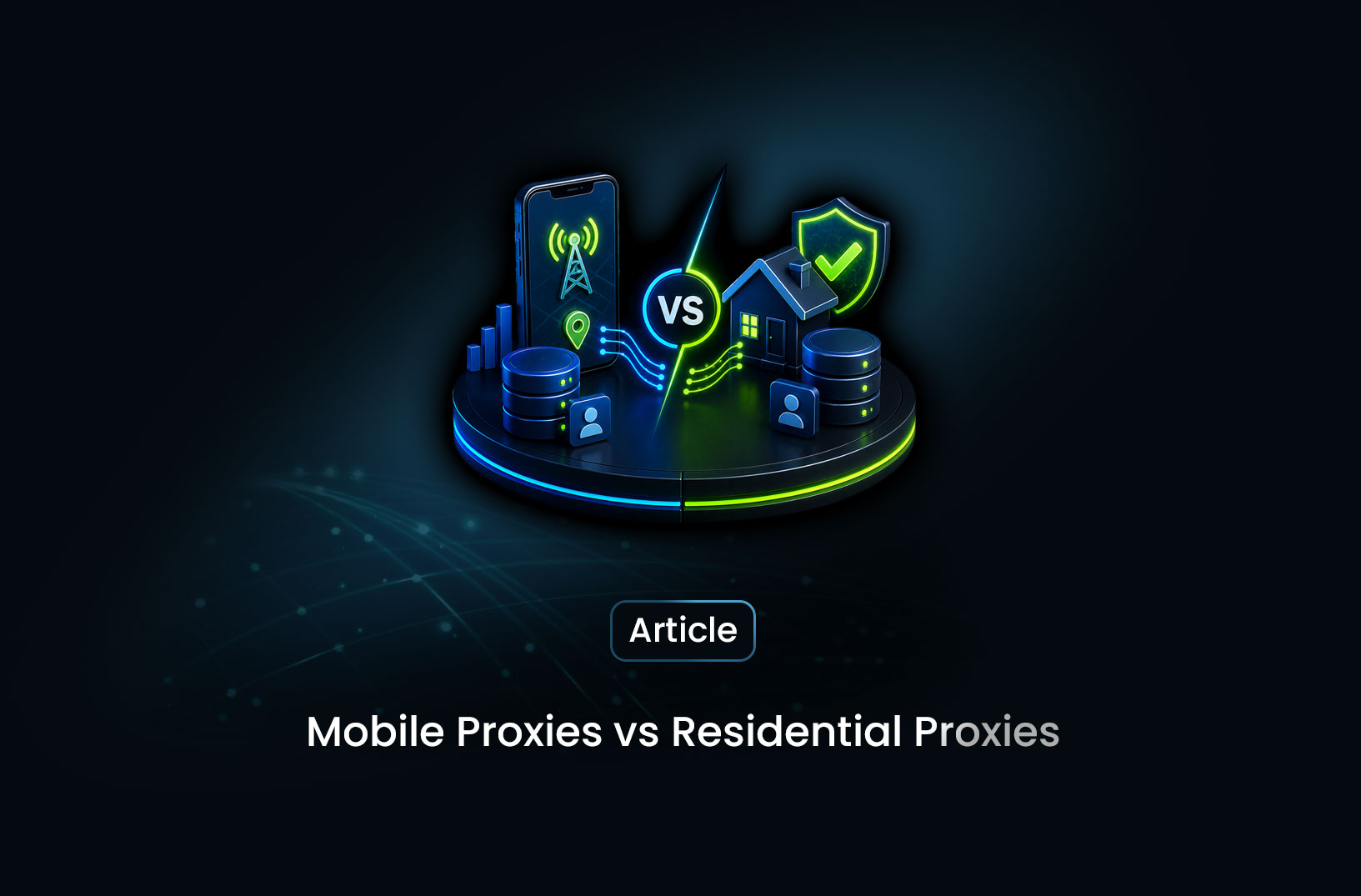
Mobile vs Residential Proxies for Scraping
ProxiesA concise overview of the differences between residential and mobile proxies, explaining when residential proxies are sufficient and when mobile proxies become necessary for scraping heavily protected, mobile-first platforms.
You've moved past datacenter proxies. You know residential proxies are the standard for scraping protected sites. But you're still hitting blocks on certain targets — Amazon, LinkedIn, Ticketmaster — the ones that seem to have a different, stricter layer of detection than most sites. Someone mentions mobile proxies. Now you're wondering: what's actually different about a mobile proxy, and is it worth the extra cost?
The direct answer: residential proxies are the right tool for most scraping use cases. Mobile proxies are a specialized upgrade for the highest-protection targets — sites that have learned to identify and block residential proxy provider IP ranges, or that use carrier-level detection to distinguish real mobile users from desktop scraping traffic. The price difference is significant ($5–15/GB residential vs. $20–30/GB mobile), so knowing when mobile proxies justify the premium is what this comparison is actually about.
Let's break it down properly.
What Are Residential Proxies?
A residential proxy routes your requests through an IP address assigned by an Internet Service Provider to a real household device — a home router, laptop, or desktop on a consumer broadband connection. The IP belongs to an ASN range owned by Comcast, AT&T, BT, or another consumer ISP.
To most bot detection systems, residential IPs are the gold standard. They pass ASN-based checks that instantly flag datacenter IPs, they have browsing history that makes them look "aged," and blocking them at scale risks blocking real customers — which sites won't do indiscriminately.
Residential proxy providers build their pools through SDK integrations and opt-in partnerships, routing your scraping traffic through real consumer devices when those devices have idle bandwidth. Pool sizes run into tens of millions of IPs across most major providers.
Best for: The vast majority of scraping use cases — e-commerce, job boards, real estate, SERP data, review platforms, news aggregation.
What Are Mobile Proxies?
A mobile proxy routes your requests through an IP address assigned by a mobile network operator — Verizon, T-Mobile, AT&T, Vodafone, EE — to a real mobile device on a cellular (4G/5G) connection. The IP belongs to ASN ranges owned by mobile carriers, not consumer broadband ISPs.
The key difference from residential: mobile carrier IPs have unique properties at the network level. Because mobile carriers use carrier-grade NAT (CGNAT), thousands of real users can share a single public IP address. A bot detection system that sees high traffic volume from a single mobile IP can't conclude it's a bot — because that's exactly what legitimate mobile carrier traffic looks like.
Mobile proxy providers source their IPs through physical SIM card farms, real device networks, or partnerships with mobile network operators. The result is a pool of IPs that sit on carrier-assigned ranges with genuine mobile network signatures.
Best for: The hardest targets — platforms that have learned to detect residential proxy provider ranges, sites running mobile-specific bot detection, high-value use cases that justify the price premium.
Head-to-Head Comparison
Bot Detection Resistance
This is where the two types diverge most clearly.
Residential proxies pass the first and most common detection layer: ASN classification. Comcast and AT&T IPs are in the clear. But sophisticated anti-bot systems that have operated long enough have started building reputation databases on residential proxy provider ranges specifically. They know which ASN blocks Bright Data, Oxylabs, and Smartproxy source their residential pools from. After enough scrapers run through the same IP ranges, those ranges start accumulating bad reputation scores.
Mobile proxies carry a different trust profile at the network level. Carrier ASN ranges (Verizon, T-Mobile, Vodafone) are not recognized as proxy infrastructure by any public IP intelligence database. The CGNAT characteristic — many users behind one IP — makes high request velocity from a mobile IP statistically plausible in ways it simply isn't for a residential broadband connection. A single Comcast IP making 500 requests an hour is unusual. A Verizon IP doing the same might just be a busy cell tower.
import requests

# Testing both proxy types on a high-protection target
def test_proxy_type(proxy_url: str, label: str, target_url: str) -> None:
    proxies = {"http": proxy_url, "https": proxy_url}
    headers = {
        "User-Agent": "Mozilla/5.0 (iPhone; CPU iPhone OS 17_0 like Mac OS X) AppleWebKit/605.1.15 (KHTML, like Gecko) Version/17.0 Mobile/15E148 Safari/604.1",
        "Accept-Language": "en-US,en;q=0.9",
    }
    try:
        response = requests.get(target_url, proxies=proxies, headers=headers, timeout=20)
        print(f"[{label}] Status: {response.status_code} | Content length: {len(response.text)}")
    except Exception as e:
        print(f"[{label}] Failed: {e}")

# Compare your residential vs mobile proxy on the same target
test_proxy_type(
    "http://user:pass@residential-proxy.com:8080",
    "Residential",
    "https://your-protected-target.com/data"
)
test_proxy_type(
    "http://user:pass@mobile-proxy.com:8080",
    "Mobile",
    "https://your-protected-target.com/data"
)
This head-to-head test on your actual target is the most reliable way to know whether mobile proxies are worth it for your specific use case. Run 50 requests from each proxy type and compare success rates. If residential is 85%+ successful, the upgrade may not be worth the cost. If it's 40–60%, mobile proxies often push that to 85–90%.
Winner: Mobile proxies — higher trust profile, especially on targets that have specifically flagged residential provider IP ranges.
Cost Per GB
Residential proxies: $5–$15/GB from reputable providers Mobile proxies: $15–$35/GB, with some specialized providers going higher
At 100GB/month:
- Residential: $500–$1,500
- Mobile: $1,500–$3,500
The cost difference is real and significant. For high-volume pipelines, this multiplier matters enormously. The math only works in mobile proxies' favor if the higher success rate on your specific targets means you need fewer total requests to get the same amount of successful data — or if the target simply can't be reached any other way.
Winner: Residential proxies — 2–3× cheaper per GB across the board.
Speed and Latency
Residential proxies route through home broadband connections — cable, fiber, DSL. Latency is variable (50–500ms), bandwidth depends on the source device's connection, and performance varies by time of day as home network load fluctuates.
Mobile proxies route through cellular connections — 4G LTE or 5G. Modern 5G connections can be faster than many residential broadband connections, but 4G performance varies significantly by location and tower load. Mobile proxies can actually be faster than residential in markets with strong 5G infrastructure, and slower in markets with congested or rural 4G coverage.
In practice, neither type offers the consistent, low-latency performance of datacenter proxies. For scraping pipelines, the success rate matters far more than latency — a 300ms mobile proxy that completes the request beats a 50ms residential proxy that gets blocked.
Winner: Tie — performance varies too much by geography and provider to declare a winner.
Pool Size and Rotation
Residential proxies have vastly larger pools — major providers maintain tens of millions of residential IPs. More IPs means lower per-IP velocity, better rotation, and more geographic diversity.
Mobile proxies have smaller pools by nature — real SIM cards and mobile devices are finite and expensive. Most providers have hundreds of thousands to low millions of mobile IPs, not tens of millions. This means mobile IPs rotate less frequently and can accumulate more per-IP request history on specific targets.
The CGNAT characteristic partially compensates — because thousands of real users share each mobile carrier IP, the threshold for "suspicious" request volume per IP is much higher than for a residential broadband IP. But the smaller absolute pool size is a real limitation for very large-scale scraping.
Winner: Residential proxies — larger pools, more rotation options, better for high-volume pipelines.
Mobile-Specific Use Cases
This is where mobile proxies have a genuine, category-specific advantage beyond just "better bot detection resistance."
Mobile app scraping: Many apps serve different content or use different APIs for mobile clients vs. desktop browsers. If you're scraping a platform by mimicking a mobile app, a mobile proxy with a matching mobile User-Agent presents a coherent mobile identity — carrier IP, mobile device signature, mobile app headers — that passes mobile-specific authenticity checks.
Social media platforms: Instagram, TikTok, Snapchat, and similar platforms have mobile-first architectures and aggressive mobile bot detection. The combination of mobile carrier IPs and mobile User-Agent strings is significantly more effective on these platforms than residential broadband + desktop headers.
Ticketing and high-value retail: Sites selling concert tickets, limited sneakers, and similar high-demand items have invested heavily in bot detection specifically targeting residential proxy providers. Mobile proxies are frequently more effective on these targets because the detection systems were built around known residential proxy ASN ranges, not mobile carrier ranges.
from playwright.async_api import async_playwright
import asyncio

async def scrape_mobile_app_style(url: str, mobile_proxy_config: dict) -> str:
    """
    Pair mobile proxy with mobile User-Agent for coherent mobile identity.
    Mobile carrier IP + mobile browser headers = highest trust profile.
    """
    async with async_playwright() as p:
        browser = await p.chromium.launch(
            headless=True,
            proxy=mobile_proxy_config,
        )

        # Use a real mobile device profile
        context = await browser.new_context(
            user_agent="Mozilla/5.0 (iPhone; CPU iPhone OS 17_4 like Mac OS X) AppleWebKit/605.1.15 (KHTML, like Gecko) Version/17.4 Mobile/15E148 Safari/604.1",
            viewport={"width": 390, "height": 844},  # iPhone 14 dimensions
            device_scale_factor=3,
            is_mobile=True,
            has_touch=True,
            locale="en-US",
            timezone_id="America/New_York",
        )

        page = await context.new_page()
        await page.goto(url, wait_until="domcontentloaded")
        content = await page.content()

        await browser.close()
        return content

mobile_proxy = {
    "server": "http://mobile-proxy.provider.com:8080",
    "username": "your_username-country-US",
    "password": "your_password",
}

asyncio.run(scrape_mobile_app_style("https://mobile-first-platform.com", mobile_proxy))
The is_mobile=True and has_touch=True Playwright context flags are important here — they trigger mobile-specific JavaScript behaviors in the browser that some platforms check for. Combined with a mobile carrier IP, this creates the most convincing mobile session fingerprint possible.
Winner: Mobile proxies — clear advantage for mobile-first platforms, social media scraping, and high-value retail with mobile-specific detection.
When to Use Each One
Use residential proxies when:
- Scraping general e-commerce sites, job boards, real estate listings, news, SERP data
- Volume is high and cost efficiency matters more than maximum bypass capability
- Your target hasn't specifically flagged residential proxy provider IP ranges
- You're testing a new scraping pipeline and want to validate before paying mobile proxy rates
Use mobile proxies when:
- Your residential proxies are getting blocked on a specific high-value target despite proper fingerprinting and rotation
- You're scraping mobile-first platforms: Instagram, TikTok, Snapchat, mobile apps
- Your target is a high-demand retail, ticketing, or financial platform with sophisticated bot detection
- You've run the head-to-head test and mobile success rates are meaningfully higher
The decision framework in practice:
def choose_proxy_type(
    target_type: str,
    monthly_volume_gb: float,
    residential_success_rate: float
) -> str:
    """
    Simple decision framework for proxy type selection.
    """
    # Mobile-specific platforms — mobile proxies are almost always better
    mobile_first_platforms = ["instagram", "tiktok", "snapchat", "mobile_app"]
    if any(platform in target_type.lower() for platform in mobile_first_platforms):
        return "mobile"

    # High success rate with residential — no reason to pay more
    if residential_success_rate >= 0.80:
        return "residential"

    # Low success rate + high volume = mobile proxies may be worth the cost
    if residential_success_rate < 0.60 and monthly_volume_gb > 50:
        cost_residential = monthly_volume_gb * 10  # $10/GB average
        cost_mobile = monthly_volume_gb * 25        # $25/GB average

        # Effective cost per successful GB
        effective_residential = cost_residential / residential_success_rate
        effective_mobile = cost_mobile / 0.85        # Assume 85% mobile success rate

        if effective_mobile < effective_residential:
            return "mobile"

    return "residential"

# Examples
print(choose_proxy_type("instagram_scraper", 100, 0.45))  # → mobile
print(choose_proxy_type("ecommerce_general", 200, 0.88))  # → residential
print(choose_proxy_type("ticketing_site", 50, 0.35))      # → mobile
The effective cost per successful GB is the right metric — not the headline price per GB. A $25/GB mobile proxy at 85% success rate costs $29.40 per successful GB. A $10/GB residential proxy at 35% success rate costs $28.57 per successful GB. At 35% residential success, mobile proxies are essentially the same effective cost — with much less engineering time spent on blocked requests.
Using MrScraper for Managed Proxy Infrastructure
Managing proxy types, rotation logic, and success rate monitoring yourself adds operational complexity. MrScraper's Scraping Browser bundles residential proxy rotation into its infrastructure — the proxy_country parameter handles geographic targeting, and the anti-bot bypass layer handles the fingerprinting and CAPTCHA solving that sit on top of the proxy layer:
import asyncio
from mrscraper import MrScraperClient

async def scrape_with_managed_infrastructure():
    client = MrScraperClient(token="YOUR_MRSCRAPER_API_TOKEN")

    result = await client.create_scraper(
        url="https://protected-target.com/listings",
        message="Extract all listing titles, prices, and locations",
        agent="listing",
        proxy_country="US",   # Managed residential proxy rotation — no provider account needed
    )

    print("Scraper ID:", result["data"]["data"]["id"])

asyncio.run(scrape_with_managed_infrastructure())
For Playwright-based scraping, connect_over_cdp() gives you the full browser control with residential proxies included:
from playwright.async_api import async_playwright
import asyncio

async def scrape_via_mrscraper(url: str) -> list:
    async with async_playwright() as p:
        browser = await p.chromium.connect_over_cdp(
            "wss://browser.mrscraper.com?token=YOUR_API_TOKEN"
        )
        page = await browser.new_page()
        await page.goto(url, wait_until="domcontentloaded")
        await page.wait_for_selector(".listing-card", timeout=15000)

        data = await page.eval_on_selector_all(
            ".listing-card",
            "els => els.map(el => el.textContent.trim())"
        )
        await browser.close()
        return data

asyncio.run(scrape_via_mrscraper("https://protected-site.com/listings"))
Common Pitfalls
Using mobile User-Agent with a residential proxy. A mobile browser User-Agent paired with a residential broadband IP creates a mismatch — real iPhone users aren't on Comcast cable. Some bot detection systems check carrier-UA coherence. Match your User-Agent to your proxy type: desktop UA for residential, mobile UA for mobile.
Assuming mobile proxies solve everything. Mobile proxies are not a universal bypass. Sites running JavaScript-based behavioral analysis, CAPTCHA challenges, or sophisticated fingerprinting can still detect automation regardless of carrier IP. Proxy type is one layer; fingerprinting and behavior are separate layers that both types require.
Not testing on your actual target. Success rates vary enormously by target. Don't assume mobile proxies will be better on your specific target — run the comparison test first. Some heavily scraped targets have good detection on mobile carrier IPs too, especially the high-value platforms that have seen every technique.
Ignoring pool refresh rates. Some mobile proxy providers reuse the same IPs for extended sessions without adequate rotation. A mobile IP that makes 10,000 requests to the same target eventually gets flagged regardless of carrier ASN. Check your provider's rotation policies before assuming mobile = unlimited requests per IP.
Conclusion
For most scraping use cases, residential proxies are the right choice — they pass the detection layers that matter for typical targets, cost significantly less than mobile proxies, and have large enough pools to support high-volume rotation.
Mobile proxies are a legitimate upgrade for specific, high-value targets: mobile-first platforms like Instagram and TikTok, high-demand retail and ticketing sites with sophisticated bot detection, and any target where you've already tested residential proxies and found success rates too low to justify the bandwidth cost.
Run the head-to-head test on your actual target before committing to mobile proxy costs. The effective cost per successful request — not the headline price per GB — is the number that tells you which proxy type is actually cheaper for your use case.
What We Learned
- Mobile proxies route through cellular carrier IP ranges (Verizon, T-Mobile, Vodafone), which sit on ASN blocks that bot detection systems don't recognize as proxy infrastructure — unlike residential proxy provider IP ranges, which sophisticated systems have started to catalog and flag
- CGNAT is mobile proxies' structural advantage — thousands of real users sharing one carrier IP means high request volume from a single mobile IP is plausible, not suspicious, making velocity-based detection less effective
- Residential proxies win on cost and pool size — 2–3× cheaper per GB and with tens of millions of IPs vs. hundreds of thousands for mobile, making them the right choice for high-volume pipelines where residential success rates are adequate
- Mobile proxies require mobile User-Agent coherence — pairing a mobile carrier IP with a desktop User-Agent creates a detectable mismatch; always use mobile device fingerprints (iPhone/Android UA, mobile viewport, touch events) with mobile proxies
- The effective cost per successful GB is the right metric — at 35% residential success rate, the math often equalizes or tips in favor of mobile proxies despite their higher headline price per GB
- MrScraper's managed infrastructure eliminates proxy type management — residential proxy rotation, fingerprinting, and CAPTCHA handling are bundled into the service so you focus on extraction logic rather than proxy selection and rotation
FAQ
- Are mobile proxies always better than residential proxies for scraping? No — for most general scraping targets, residential proxies perform equally well at a fraction of the cost. Mobile proxies are a specialized tool for specific high-protection targets. Always test your actual target before paying mobile proxy rates.
- Why do mobile carrier IPs get less scrutiny from bot detection systems? Two reasons: (1) mobile carrier ASN ranges aren't listed in public proxy infrastructure databases the way datacenter or known residential proxy provider ranges are; (2) CGNAT means thousands of real users share each carrier IP, so traffic volume thresholds for "suspicious" behavior are calibrated much higher for mobile IPs than for residential broadband IPs.
- Can I use mobile proxies with Python's
requestslibrary? Yes — mobile proxies use the same HTTP/HTTPS or SOCKS5 connection format as any other proxy type. Configure them exactly as you would residential proxies:{"http": "http://user:pass@host:port", "https": "http://user:pass@host:port"}. The difference is entirely in what IP address your requests originate from, not in the protocol. - How do I find a mobile proxy provider? Major proxy providers including Bright Data, Oxylabs, Smartproxy, and SOAX offer mobile proxy plans alongside their residential offerings. Pricing, pool size, and geographic coverage vary — compare at least two or three providers on your target geography before committing. Most offer trial credits or pay-as-you-go to test before bulk purchase.
- Does MrScraper use residential or mobile proxies? MrScraper's managed infrastructure uses residential proxy rotation. For the vast majority of scraping use cases, this provides the right balance of bypass capability, cost, and pool size. For use cases that specifically require mobile carrier IPs, pairing a dedicated mobile proxy provider with MrScraper's browser fingerprinting and extraction capabilities gives you the strongest combined stack.
Summarize this post
Open it in your assistant of choice with the prompt ready to send.
Take a Taste of Easy Scraping!

Find more insights here

Score Company Websites Against Your ICP with Jev
Create a company scoring workflow using public website evidence, an explicit ICP rubric, Jev decisio…
Classify Web Data with Jev and MrScraper: A Python Tutorial
Build a Python workflow that extracts web records with MrScraper, classifies them with Jev, validate…

What Is Jev? A Practical Guide for Web Data Teams
Learn what Jev does, how Choice, Score and Noul work, and where structured web data fits into classi…