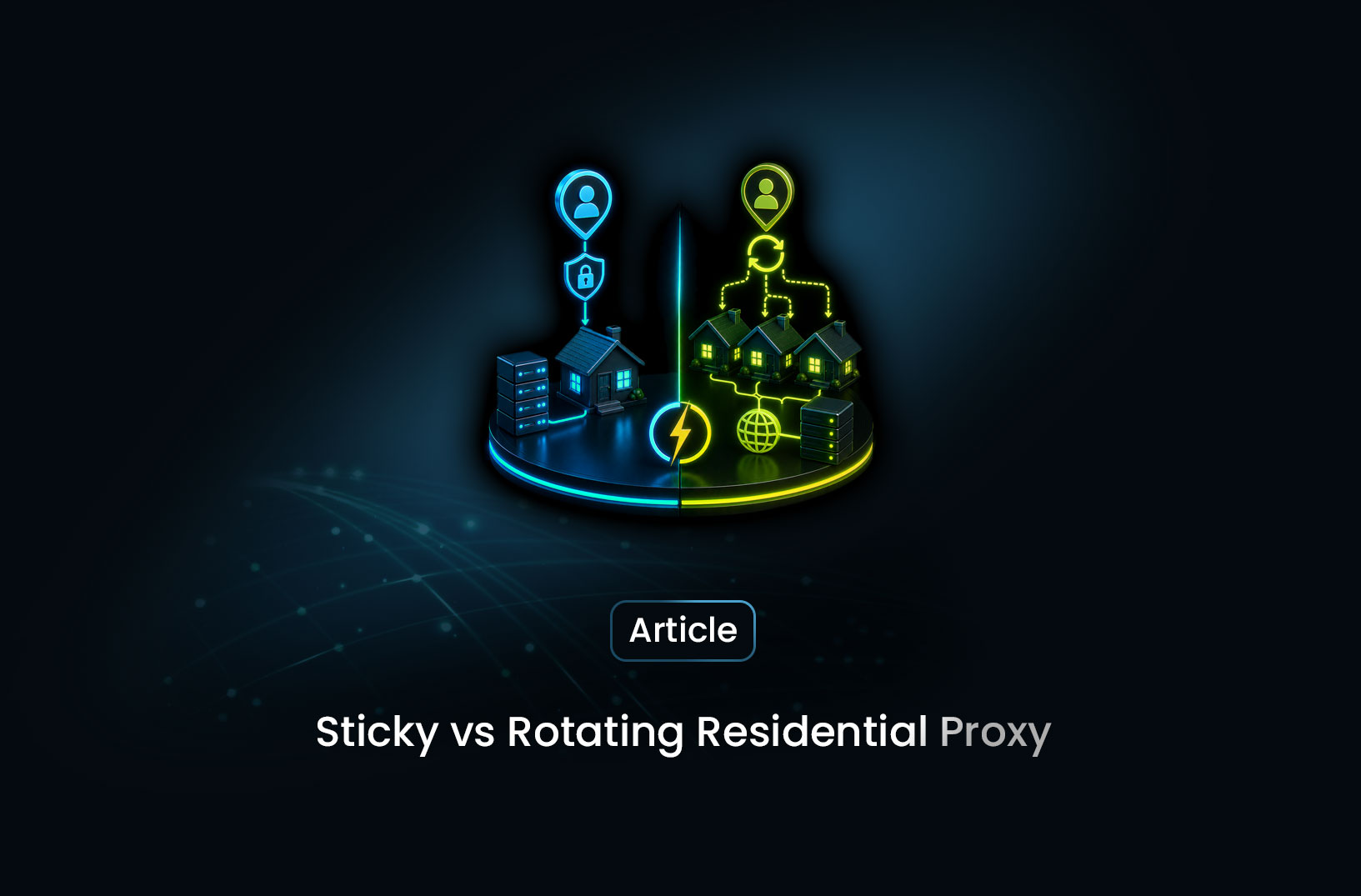
Sticky vs Rotating Residential Proxies
ProxiesA concise overview of the differences between rotating proxies and sticky sessions, explaining how production scrapers combine both for reliable authentication flows and scalable data collection.
You've signed up for a residential proxy plan and you're looking at the configuration options. There's a toggle or a username parameter for "sticky" sessions versus "rotating" proxies. The provider's docs explain it, but not in a way that helps you decide which one actually fits your use case.
Here's the crux of it: rotating proxies give you a fresh IP address on every request or every connection, while sticky sessions lock you to the same IP for a configurable window of time — typically 1 to 30 minutes. One maximizes IP diversity. The other maintains session continuity. Which is better depends entirely on what you're trying to do.
Get it wrong and you'll either burn through IPs unnecessarily or get logged out mid-scrape because your session IP changed. This guide makes the decision clear.
What Are Rotating Residential Proxies?
A rotating proxy assigns a new IP address each time you make a new connection — or on every request, depending on your provider's configuration. From the target site's perspective, each request appears to come from a different person in a different location.
Under the hood, your provider routes each new TCP connection through a different device in their residential pool. The IP changes before any per-IP velocity or behavioral history can accumulate.
import requests
import os

def make_rotating_request(url: str) -> requests.Response:
    """
    Each call to this function may use a different residential IP.
    No session object — new connection = potentially new IP.
    """
    proxies = {
        "http": f"http://{os.getenv('PROXY_USER')}-rotate:{os.getenv('PROXY_PASS')}@{os.getenv('PROXY_HOST')}:{os.getenv('PROXY_PORT')}",
        "https": f"http://{os.getenv('PROXY_USER')}-rotate:{os.getenv('PROXY_PASS')}@{os.getenv('PROXY_HOST')}:{os.getenv('PROXY_PORT')}",
    }
    return requests.get(url, proxies=proxies, timeout=20)

# Each call may originate from a different IP address
r1 = make_rotating_request("https://httpbin.org/ip")
r2 = make_rotating_request("https://httpbin.org/ip")
print(r1.json(), r2.json())  # Likely different IPs
When rotating proxies work well:
- Bulk data collection where each request is stateless
- SERP scraping — each keyword query from a fresh IP
- Price monitoring across many product pages with no session dependency
- Any scraping task where each request is completely independent
What Are Sticky Residential Proxies?
A sticky session locks your requests to the same residential IP for a configured time window — usually set via a session parameter in your proxy username string. All requests within that window appear to come from the same household, the same device.
The session duration varies by provider — common options are 1 minute, 10 minutes, 30 minutes, or until you explicitly release it.
import requests
import os
import time

def make_sticky_session(session_label: str, duration_minutes: int = 10) -> dict:
    """
    Build a proxy config that maintains the same IP for a session window.
    Syntax varies by provider — check your provider's documentation.
    """
    user = f"{os.getenv('PROXY_USER')}-session-{session_label}-sessionduration-{duration_minutes}"
    proxy_url = f"http://{user}:{os.getenv('PROXY_PASS')}@{os.getenv('PROXY_HOST')}:{os.getenv('PROXY_PORT')}"
    return {"http": proxy_url, "https": proxy_url}

# All requests with the same session label use the same IP
session_proxies = make_sticky_session("checkout-flow-001", duration_minutes=10)

r1 = requests.get("https://httpbin.org/ip", proxies=session_proxies, timeout=20)
time.sleep(2)
r2 = requests.get("https://httpbin.org/ip", proxies=session_proxies, timeout=20)
print(r1.json(), r2.json())  # Same IP both times
When sticky sessions work well:
- Login flows — maintaining session cookies across the authentication sequence
- Multi-step checkout or form workflows
- Any scraping task where the server tracks your session by IP
- Platforms that flag or invalidate sessions on IP changes
Head-to-Head Comparison
Session Continuity
Rotating proxies break session continuity by design. If you log into a site on IP A.B.C.D, then the next request comes from W.X.Y.Z, the server's session management often sees this as a suspicious IP change — triggering a forced logout, a security challenge, or a session invalidation.
Sticky sessions maintain session continuity. All requests within the window come from the same IP, so the server sees a consistent, predictable user. This is essential for any multi-step workflow.
# This BREAKS with rotating proxies — session gets invalidated on IP change
def login_and_scrape_rotating(login_url, credentials, data_url):
    # Request 1: Login — comes from IP A
    session = requests.Session()
    session.post(login_url, data=credentials)

    # Request 2: Fetch data — comes from IP B (DIFFERENT IP)
    # Server detects IP change → session invalidated → redirected to login
    response = session.get(data_url)
    return response  # Returns login page HTML, not data

# This WORKS with sticky sessions — same IP throughout
def login_and_scrape_sticky(login_url, credentials, data_url):
    sticky_proxies = make_sticky_session("user-session-001", duration_minutes=20)
    session = requests.Session()
    session.proxies.update(sticky_proxies)

    # Request 1: Login — comes from IP A
    session.post(login_url, data=credentials)

    # Request 2: Fetch data — comes from IP A (SAME IP)
    # Server sees consistent session → data returned correctly
    response = session.get(data_url)
    return response
Winner: Sticky sessions — required for any workflow involving authentication or server-tracked state.
Bot Detection Resistance at Scale
Rotating proxies distribute requests across many IPs, preventing per-IP velocity signals from accumulating. If your scraper makes 10,000 requests across 10,000 different IPs, each IP only made one request — well within any reasonable per-IP rate limit.
Sticky sessions concentrate requests on a smaller number of IPs for longer periods. An IP used for 30 minutes of continuous scraping accumulates significant request history against the target domain, potentially triggering velocity-based rate limiting or temporary blocks before the session expires.
import asyncio
import random

async def bulk_scrape_rotating(urls: list[str]) -> list[dict]:
    """
    Rotating: each URL request from a potentially different IP.
    Maximizes IP diversity, minimizes per-IP velocity.
    """
    results = []
    for url in urls:
        proxies = {
            "http": f"http://{os.getenv('PROXY_USER')}-rotate:{os.getenv('PROXY_PASS')}@{os.getenv('PROXY_HOST')}:{os.getenv('PROXY_PORT')}",
            "https": f"http://{os.getenv('PROXY_USER')}-rotate:{os.getenv('PROXY_PASS')}@{os.getenv('PROXY_HOST')}:{os.getenv('PROXY_PORT')}",
        }
        response = requests.get(url, proxies=proxies, timeout=20)
        results.append({"url": url, "status": response.status_code})
        await asyncio.sleep(random.uniform(1.5, 3.5))

    return results
Winner: Rotating proxies — for high-volume, stateless scraping where spreading requests across many IPs is the goal.
Cost Efficiency
Most residential proxy providers charge by bandwidth (GB), not by the number of IPs used. From a cost perspective, rotating vs. sticky doesn't directly change what you're charged — you pay for the data transferred, not the number of IP changes.
The indirect cost difference: rotating proxies can actually reduce bandwidth by avoiding retries. If a rotating proxy successfully fetches a page that a flagged sticky IP would have failed on, you avoid re-attempt bandwidth. Conversely, sticky sessions can be more efficient when the target site serves better content to "returning visitors" — some sites front-load challenges for fresh IPs but serve smoothly to IPs with session history.
Winner: Even — both cost the same per GB; efficiency depends on your specific target's behavior.
Speed
Rotating proxies introduce minor overhead on each connection as the provider routes you to a different exit node. This is usually negligible (10–50ms additional latency per request) but adds up in high-frequency scraping.
Sticky sessions avoid this reconnection overhead within the session window — the route is established and reused. For scraping patterns with many small requests in quick succession, sticky sessions can be marginally faster.
Winner: Sticky sessions — marginally, for high-frequency request patterns within a workflow.
Complexity
Rotating proxies are simpler to configure. One proxy endpoint, no session management, no session expiry to track. The simplest possible proxy integration.
Sticky sessions require session lifecycle management — knowing when a session starts, when it expires, and when to rotate to a fresh one. For multi-step workflows, you also need to ensure the same session is used consistently across all steps in the flow.
import time
import random
from dataclasses import dataclass, field

@dataclass
class StickySessionManager:
    """
    Manages sticky session lifecycle — creation, expiry, and rotation.
    """
    proxy_user: str
    proxy_pass: str
    proxy_host: str
    proxy_port: int
    session_duration_minutes: int = 10

    _session_id: str = field(default=None, init=False)
    _session_expires_at: float = field(default=0.0, init=False)

    def _new_session_id(self) -> str:
        return f"sess-{int(time.time())}-{random.randint(1000, 9999)}"

    def get_proxy(self) -> dict:
        """
        Returns a sticky proxy config, creating or refreshing the session as needed.
        """
        if not self._session_id or time.time() >= self._session_expires_at:
            self._session_id = self._new_session_id()
            self._session_expires_at = time.time() + (self.session_duration_minutes * 60) - 30
            # Subtract 30s buffer to rotate before expiry, not after

        user = f"{self.proxy_user}-session-{self._session_id}-sessionduration-{self.session_duration_minutes}"
        proxy_url = f"http://{user}:{self.proxy_pass}@{self.proxy_host}:{self.proxy_port}"
        return {"http": proxy_url, "https": proxy_url}

    def force_new_session(self) -> None:
        """Explicitly rotate to a fresh IP — call when session gets flagged."""
        self._session_id = None
        self._session_expires_at = 0.0
Winner: Rotating proxies — simpler to implement and maintain.
When to Use Each One
This is the practical decision guide. The answer is almost never one or the other exclusively — most production pipelines use both modes for different parts of the workflow.
Use rotating proxies for:
- Fetching pages where each request is independent (product pages, SERP results, news articles)
- High-volume data collection where IP diversity reduces per-IP velocity signals
- Initial site reconnaissance — crawling sitemaps, discovering URLs, collecting breadth data
- Any request where the server doesn't need to recognize you as the "same user" between requests
Use sticky sessions for:
- Login flows — all requests from registration to authentication to dashboard must share one IP
- Multi-step form submission
- Shopping cart and checkout flows
- Platforms that use IP-based session pinning (detecting IP changes as security events)
- Pagination where the server issues page tokens tied to your IP
- Any workflow where "being the same person" across multiple requests matters
The hybrid pattern (what most production scrapers actually use):
import requests
import os
from dataclasses import dataclass, field
import time
import random

@dataclass
class HybridProxyManager:
    """
    Uses sticky sessions for authentication flows,
    rotating proxies for stateless data collection.
    """
    proxy_user: str = field(default_factory=lambda: os.getenv("PROXY_USER"))
    proxy_pass: str = field(default_factory=lambda: os.getenv("PROXY_PASS"))
    proxy_host: str = field(default_factory=lambda: os.getenv("PROXY_HOST"))
    proxy_port: int = field(default_factory=lambda: int(os.getenv("PROXY_PORT", "8080")))

    def rotating(self) -> dict:
        """New IP per connection — for stateless requests."""
        user = f"{self.proxy_user}-rotate"
        proxy_url = f"http://{user}:{self.proxy_pass}@{self.proxy_host}:{self.proxy_port}"
        return {"http": proxy_url, "https": proxy_url}

    def sticky(self, session_id: str, duration_minutes: int = 15) -> dict:
        """Same IP for duration window — for session-dependent flows."""
        user = f"{self.proxy_user}-session-{session_id}-sessionduration-{duration_minutes}"
        proxy_url = f"http://{user}:{self.proxy_pass}@{self.proxy_host}:{self.proxy_port}"
        return {"http": proxy_url, "https": proxy_url}

proxy = HybridProxyManager()

def authenticated_scrape_pipeline(
    login_url: str,
    credentials: dict,
    data_urls: list[str],
) -> list[dict]:
    # Phase 1: Authentication — sticky session (same IP throughout login flow)
    auth_session_id = f"auth-{int(time.time())}"
    auth_session = requests.Session()
    auth_session.proxies.update(proxy.sticky(auth_session_id, duration_minutes=15))

    # Warm up session with homepage visit
    auth_session.get(login_url.rsplit("/", 1)[0])
    time.sleep(random.uniform(1.5, 3.0))

    # Login
    auth_session.post(login_url, data=credentials, allow_redirects=True)
    session_cookies = dict(auth_session.cookies)
    print(f"Authenticated. Captured {len(session_cookies)} cookies.")

    # Phase 2: Data collection — rotating proxies with session cookies
    # Each data request uses a fresh IP but carries the auth cookies
    results = []
    for url in data_urls:
        data_session = requests.Session()
        data_session.proxies.update(proxy.rotating())
        data_session.cookies.update(session_cookies)  # Auth cookies on fresh IPs

        response = data_session.get(url, timeout=20)
        results.append({"url": url, "status": response.status_code, "length": len(response.text)})
        time.sleep(random.uniform(2.0, 4.5))

    return results
The hybrid pattern — sticky for auth, rotating for data — is the most robust approach. You authenticate on a consistent IP, capture the session cookies, then carry those cookies into a rotating proxy pipeline for data collection. The platform sees authenticated traffic from varying IPs, which is consistent with how real users on mobile devices behave (IP changes as they move between Wi-Fi and cellular).
Using MrScraper for Managed Proxy Sessions
Managing sticky vs. rotating proxy configuration yourself — including session lifecycle, expiry tracking, and rotation on block signals — adds operational complexity. MrScraper's infrastructure handles proxy rotation automatically, with the proxy_country parameter handling geo-targeting:
import asyncio
import os
from mrscraper import MrScraper
from mrscraper.exceptions import AuthenticationError, APIError, NetworkError

async def scrape_with_managed_proxies():
    client = MrScraper(token=os.getenv("MRSCRAPER_API_TOKEN"))

    try:
        # Managed residential proxy rotation — no session config needed
        result = await client.create_scraper(
            url="https://example.com/listings",
            message="Extract all listing titles, prices, and locations",
            agent="listing",
            proxy_country="US",
        )
        print("Scraper ID:", result["data"]["data"]["id"])

    except AuthenticationError:
        print("Invalid API token")
    except APIError as e:
        print(f"API error {e.status_code}: {e}")
    except NetworkError as e:
        print(f"Network error: {e}")

asyncio.run(scrape_with_managed_proxies())
For authenticated workflows where you need session continuity with managed infrastructure, connect your Playwright authentication logic to MrScraper's cloud browser — the browser context maintains session state while MrScraper handles the proxy layer:
from playwright.async_api import async_playwright
import asyncio
import os

async def authenticated_scrape_via_mrscraper(
    login_url: str,
    username: str,
    password: str,
    content_urls: list[str],
) -> list[dict]:
    async with async_playwright() as p:
        browser = await p.chromium.connect_over_cdp(
            f"wss://browser.mrscraper.com?token={os.getenv('MRSCRAPER_API_TOKEN')}"
        )
        context = await browser.new_context()
        page = await context.new_page()

        # Login — session cookies accumulate in the browser context
        await page.goto(login_url, wait_until="domcontentloaded")
        await page.fill("input[type='email']", username)
        await page.fill("input[type='password']", password)
        await page.click("button[type='submit']")
        await page.wait_for_url(
            lambda url: "login" not in url.lower(), timeout=15000
        )

        # Scrape content — same context carries session cookies
        results = []
        for url in content_urls:
            await page.goto(url, wait_until="domcontentloaded")
            await page.wait_for_load_state("networkidle")
            data = await page.eval_on_selector_all(
                ".data-item",
                "els => els.map(el => el.textContent.trim())"
            )
            results.append({"url": url, "data": data})
            await asyncio.sleep(3.0)

        await browser.close()
        return results

asyncio.run(authenticated_scrape_via_mrscraper(
    login_url="https://example.com/login",
    username=os.getenv("SITE_USERNAME"),
    password=os.getenv("SITE_PASSWORD"),
    content_urls=["https://example.com/data/1", "https://example.com/data/2"],
))
Common Pitfalls
Using rotating proxies for multi-step flows. This is the most common mistake. If your scraping workflow has any dependency between requests — login state, cart contents, pagination tokens — rotating proxies will break it. Identify every stateful dependency before choosing proxy mode.
Setting sticky session duration too long. A sticky session that runs for 60 minutes on an aggressive scraping pipeline accumulates enough per-IP request history to get flagged. Keep session windows to 10–20 minutes for active scraping, or use shorter windows with explicit rotation between sessions.
Forgetting to rotate sticky sessions after a block. If a sticky session's IP gets rate-limited or blocked, continuing to use it wastes time. Build block-signal detection (403, 429) that calls force_new_session() rather than retrying on the same IP.
Treating rotating and sticky as binary. The hybrid pattern — sticky for auth, rotating for data, with session cookies bridging the two — is almost always the optimal approach for authenticated pipelines. Don't force a choice when you can use both.
Not aligning session parameters with your provider's syntax. The username parameter format (-session-ID-sessionduration-N) varies by provider. Bright Data, Oxylabs, Smartproxy, and others each have slightly different syntax. Always verify with your provider's documentation before assuming this guide's examples match your provider verbatim.
Conclusion
Rotating proxies and sticky sessions solve different problems. Rotating maximizes IP diversity and prevents per-IP velocity accumulation — it's the right default for stateless bulk scraping. Sticky sessions maintain session continuity — it's required for any workflow involving authentication, multi-step flows, or server-tracked state.
In practice, most production scrapers need both: sticky sessions for the authentication phase, rotating proxies for the data collection phase, with session cookies bridging the two. The HybridProxyManager pattern above makes this explicit and reusable.
For teams who'd rather not manage session lifecycle, rotation logic, and block detection themselves, MrScraper handles proxy management at the infrastructure level — you define what data you want, and the service manages the proxy layer transparently.
What We Learned
- Rotating proxies assign a fresh IP per connection, preventing per-IP velocity accumulation and maximizing anonymity across bulk requests — the right default for stateless scraping
- Sticky sessions maintain the same IP for a configurable window, preserving session continuity across related requests — required for login flows, checkout processes, and any server-tracked state
- The most common mistake is using rotating proxies for multi-step authenticated workflows — the IP change between login and data requests typically invalidates the session
- The hybrid pattern — sticky for authentication, rotating for data collection, with session cookies bridging the two — combines both strengths without the weaknesses of either mode
- Keep sticky session durations conservative (10–20 minutes for active scraping) to prevent per-IP velocity accumulation from triggering rate limits before the session naturally expires
- Build block-signal detection (
403,429status codes) that forces immediate session rotation rather than retrying on a flagged IP — burning credits on blocked IPs is the most common proxy cost inefficiency
FAQ
- Can I switch between sticky and rotating mode mid-scrape? Yes — the proxy mode is just a URL parameter in the proxy credentials string. You can switch between rotating and sticky on any request by changing the username format. The hybrid scraper pattern above does exactly this — rotating mode for data requests, sticky mode for auth flows, all within the same pipeline.
- How do I know if my target site does IP-based session pinning? Test it: log in with a sticky proxy session, confirm you're authenticated, then make a request from a different IP (without passing the session cookies). If you get a 401, 403, or login redirect, the site pins sessions to IP. If you remain authenticated, the site uses cookie-only session management and you can use rotating proxies with the auth cookies attached.
- What session duration should I use for sticky proxies?
Start with 10–15 minutes for most use cases. If you're doing light scraping (few requests per session), 20–30 minutes is fine. For aggressive scraping where you're making dozens of requests in the session window, keep it shorter (5–10 minutes) to limit per-IP history accumulation. Always rotate before the window expires rather than waiting for expiry — the 30-second buffer in the
StickySessionManagerhandles this. - Does MrScraper's
proxy_countryuse rotating or sticky proxies? MrScraper manages proxy rotation automatically at the infrastructure level — you don't configure sticky vs. rotating directly. For authenticated workflows where session continuity is needed, use theconnect_over_cdp()pattern with Playwright, which maintains session state in the browser context while MrScraper handles the underlying proxy routing. - Can I use sticky sessions with Playwright?
Yes — configure the proxy in
browser.new_context(proxy={...})with your sticky session credentials. All requests within that browser context will use the same IP for the session window. Create a new context with fresh sticky session credentials when you want to rotate to a new IP.
Summarize this post
Open it in your assistant of choice with the prompt ready to send.
Take a Taste of Easy Scraping!

Find more insights here
What is Scraping? A Complete Beginner's Guide for 2026
Learn what a web scraper is in 2026 and how AI-powered tools are replacing brittle CSS scripts for r…

The Ultimate Web Crawlers List: 15 Tools for Every Data Need
Compare the best web crawlers for 2026. Learn the difference between open-source, managed APIs, and…
Web Scraping MCP Server: Giving AI Agents Direct Access to Live Web Data
Learn how a Web Scraping MCP Server gives AI agents live web access while reducing token costs by 87…