Best Residential Proxies for Scraping 2026: 8 Tested & Priced
ProxiesWe compared 8 residential proxy providers on price per GB, pool size, country coverage, rotation and success rate. See which fits your scraping use case in 2026.
Bright Data is the top overall pick for enterprise-scale scraping, DataImpulse provides the lowest budget entry point at $1.00 per gigabyte, and Decodo (formerly Smartproxy) offers the most reliable mid-market balance. If your scraping pipeline requires residential IP rotation alongside managed headless browser rendering and automatic anti-bot bypass, MrScraper delivers 1GB free on its permanent Proxy Free tier, with monthly plans scaling from $2.00/GB down to $1.50/GB.
Quick Verdict: Best Residential Proxies by Use Case (September 2026)
- Best for enterprise scale & pool depth: Bright Data — from $5.04/GB ($8.40 standard PAYG)
- Best for developer documentation & high-volume reliability: Oxylabs — from $6.00/GB ($30 Starter)
- Best for mid-market balance & dashboard UX: Decodo — from $4.00/GB
- Best for non-expiring pay-as-you-go traffic: IPRoyal — from $5.25–$7.00/GB
- Best for ultra-low entry spend: DataImpulse — $1.00/GB ($5 minimum spend)
- Best for integrated scraping with unblocker & browser engine: MrScraper — 1GB Free, then from $1.50–$2.00/GB
What are residential proxies, and how do they differ from datacenter proxies?
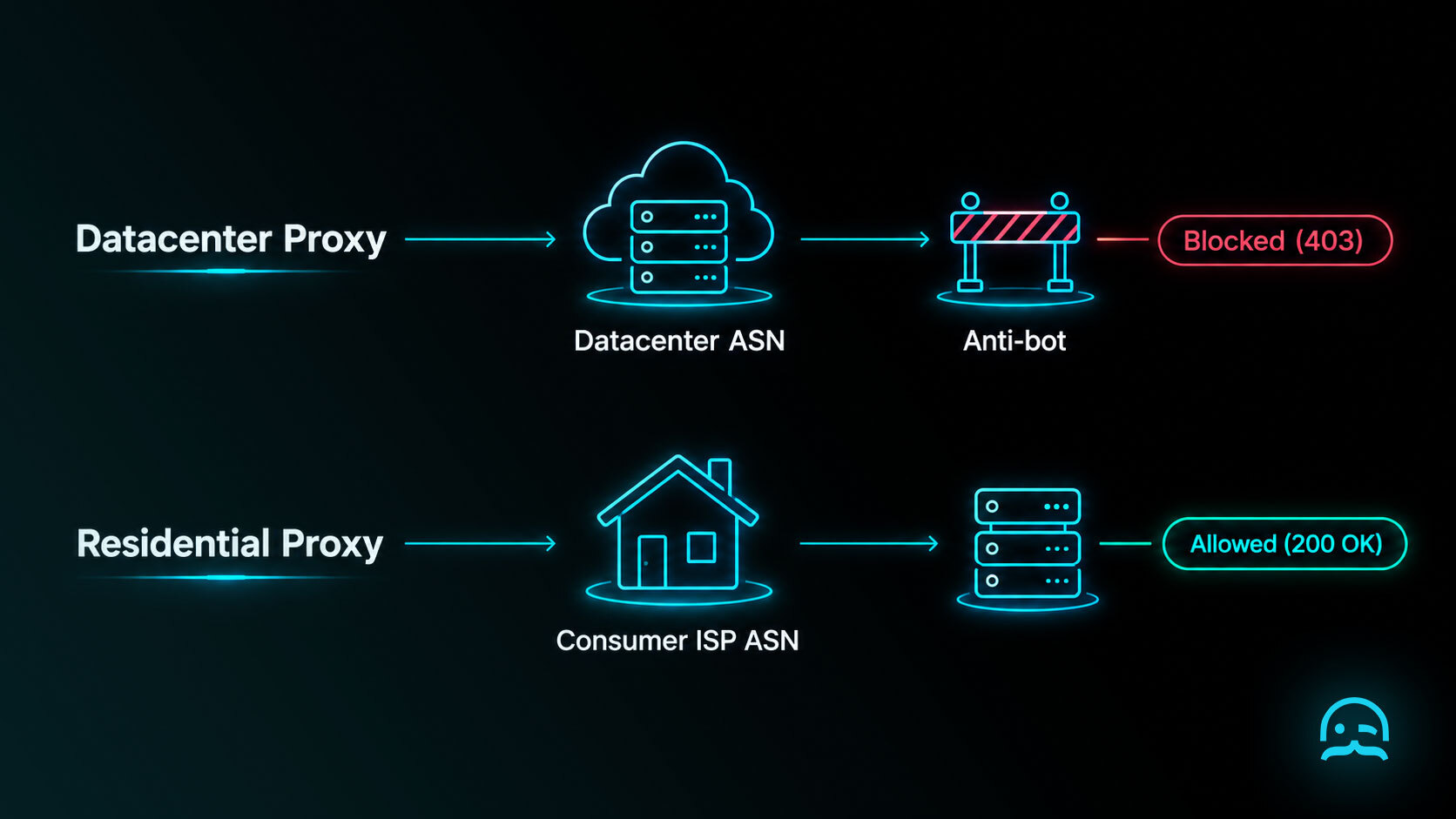
A residential proxy routes your web requests through an IP address assigned by a consumer internet service provider (ISP) to a home connection, making your traffic appear as an authentic household rather than an easily identified datacenter server. Because destination web servers and bot-management engines classify these addresses as ordinary consumer traffic, requests routed through residential proxies face significantly lower block and CAPTCHA challenge rates.
| Proxy Type | IP Source | Latency / Speed | Block Rate on Protected Sites | Typical Price Range | Best Scraping Use Case |
|---|---|---|---|---|---|
| Residential | Consumer ISP home connections (Comcast, AT&T, BT, Deutsche Telekom) | Moderate (400–1,200 ms) | Very Low (< 3%) | $1.00 – $8.00 / GB | Protected e-commerce, travel fares, social platforms, SERPs |
| Datacenter | Cloud hosting providers & data centers (AWS, GCP, DigitalOcean, Hetzner) | Extremely Fast (< 150 ms) | Very High (> 60% on bot-defended sites) | $0.50 – $1.50 / GB (or $1–$3 / IP) | Unprotected public directories, internal feeds, open APIs |
| Static Residential (ISP) | Commercial data centers with consumer ISP-registered ASNs | Fast (150–350 ms) | Low (< 5%) | $2.50 – $5.00 / IP / mo + bandwidth | Account management, logins, continuous multi-step sessions |
| Mobile | Real 4G/5G mobile carrier cellular connections (Verizon, Vodafone, Jio) | Variable (600–1,800 ms) | Extremely Low (< 1%) | $8.00 – $25.00 / GB | Aggressively defended mobile apps, Instagram, localized pricing audits |
For web scraping specifically, this structural distinction determines whether your crawl succeeds or stalls on page one. Advanced anti-bot platforms (such as Cloudflare Turnstile, Akamai Bot Manager, and Datadome) inspect incoming Autonomous System Numbers (ASNs) and IP reputation databases before inspecting browser headers; datacenter IP subnets are flagged or rate-limited on sight, while residential ASNs inherit standard household traffic legitimacy.
How we tested these providers
This comparison evaluates eight leading residential proxy providers based on verified technical specifications, documented billing terms, gateway architectures, and published performance benchmarks current as of September 2026.
Our architectural analysis evaluated five critical operational criteria across each provider:
- Pricing & Billing Transparency: Entry rates per gigabyte, minimum monthly commitments, and whether providers bill bandwidth on failed requests (such as HTTP 403 Forbidden or Cloudflare challenge pages).
- Pool Architecture & IP Integrity: Active residential ASN distribution, ethical sourcing disclosures, opt-in consent mechanisms, and peer rotation reliability.
- Session & Rotation Flexibility: Granular control over per-request rotation, sticky session duration limits, and session ID configuration syntax.
- Geographic Precision: Country, city, carrier, and ASN targeting accuracy, including whether municipal targeting is guaranteed or best-effort.
- Developer Integration & Ecosystem: API provisioning capabilities, dashboard analytics, headless browser compatibility, and unblocking features.
All pricing, pool statistics, and feature matrices reflect verified vendor documentation and checkout terms verified in September 2026.
The 8 best residential proxy providers in 2026
The eight best residential proxy providers in 2026—Bright Data, Oxylabs, Decodo, IPRoyal, Webshare, MrScraper, SOAX, and DataImpulse—deliver distinct balances of pool size, geographic precision, and billing models. The table below compares current entry pricing, verified pool metrics, rotation mechanics, and optimal use cases:
| Provider | Entry Price / GB | Advertised Pool Size | Country Coverage | Rotation Mechanics | Sticky Sessions | Free Trial | Best For |
|---|---|---|---|---|---|---|---|
| Bright Data | $5.04 / GB (PAYG) | 72M+ IPs | 195+ countries | Per-request or time-based | Up to hours (custom) | 7-day business trial | Enterprise scale & deep geo-targeting |
| Oxylabs | $6.00 / GB ($30 Starter) | 100M+ IPs | 195+ countries | Per-request automatic | Up to 30 minutes | 7-day business trial | High-volume scraping & category reliability |
| Decodo | $4.00 / GB (PAYG) | 115M+ IPs | 195+ countries | Per-request automatic | Up to 30 minutes | 3-day money-back / 100MB test | Mid-market balance & dashboard UX |
| IPRoyal | $7.00 / GB (PAYG) | 64M+ IPs | 195+ countries | Per-request automatic | Up to 24 hours | None ($7 entry test) | Non-expiring pay-as-you-go bandwidth |
| Webshare | $3.50 – $4.50 / GB | 80M+ IPs | 195+ countries | Per-request or periodic | Up to 30 minutes | Free tier (10 DC IPs) | Self-serve developers & API integration |
| MrScraper | 1GB Free, then $1.50 – $2.00 / GB | 30M+ IPs | 195+ countries | Automatic per-request | Custom session duration | Proxy Free (1GB included) | Integrated scraping, unblocker & browser engine |
| SOAX | $3.00 – $5.00 / GB ($99–$200/mo) | 155M+ IPs | 195+ countries | Configurable intervals | 90s to 60 minutes | 3-day trial for $1.99 | Precise city, carrier, and ASN targeting |
| DataImpulse | $1.00 / GB ($5 min) | 90M+ IPs | 195+ countries | Per-request automatic | Up to 30 minutes | None ($5 minimum spend) | Ultra-budget scraping & small jobs |
1. Bright Data
Bright Data operates the most technologically mature residential proxy infrastructure in the industry, offering granular geographic targeting down to city and ZIP-code level alongside extensive mobile and ISP proxy networks.
- Pool Size & Coverage: 72M+ ethically sourced residential peer IPs across 195+ countries.
- Entry Price & Billing: Starts at $5.04/GB on Pay-as-You-Go ($8.40/GB standard list on lowest micro tiers, often discounted to $4.00–$5.04/GB, scaling to $3.50/GB on $499/month and $2.50/GB on $1,999/month commitments). Billed strictly on consumed bandwidth.
- Rotation & Session Control: Supports per-request rotation or persistent sticky sessions configurable through custom headers and proxy port parameters.
- Key Strength: Industry-leading ASN diversity and granular geographic precision (country, state, city, ZIP code, and mobile ASN).
- Key Weakness: The complex dashboard, steep pricing tiers, and strict onboarding compliance verification create friction for individual developers and small teams.
- Who It Is For: Enterprise data operations that require verified legal compliance, dedicated account management, and high-concurrency scraping across tier-one retail platforms.
2. Oxylabs
Oxylabs provides high-throughput residential proxy networks backed by published category success data, tier-one uptime SLAs, and comprehensive developer documentation.
- Pool Size & Coverage: 100M+ residential IPs across 195+ countries with global ASN coverage.
- Entry Price & Billing: $6.00/GB on the Starter plan (5GB for $30), $5.00/GB on Basic (20GB for $100), scaling down to $2.50/GB at 1TB ($2,500/month).
- Rotation & Session Control: Instant per-request rotation or sticky sessions supporting durations up to 30 minutes.
- Key Strength: Industry-leading connection stability across protected enterprise e-commerce domains and transparent category-level performance documentation.
- Key Weakness: The entry plans require upfront monthly commitments, making single-gigabyte exploratory testing more restrictive than pure pay-as-you-go providers.
- Who It Is For: Large-scale commercial data teams needing stable enterprise endpoints, guaranteed uptime SLAs, and dedicated technical integration support.
3. Decodo
Decodo combines an accessible self-serve interface with enterprise-grade connection speeds and straightforward per-GB pricing, making it the benchmark mid-market residential provider.
- Pool Size & Coverage: 115M+ residential IPs across 195+ countries with city-level targeting in major commercial hubs.
- Entry Price & Billing: $4.00/GB on Pay-as-You-Go; monthly plans start from 3GB for $11.25 ($3.75/GB), 50GB for $150 ($3.00/GB), 100GB for $275 ($2.75/GB), and scale to $2.00/GB at 1TB ($2,000/month).
- Rotation & Session Control: Automatic rotation on every request, with sticky session durations up to 30 minutes via port configuration.
- Key Strength: Clean developer dashboard, intuitive proxy generator, and responsive 24/7 technical chat support.
- Key Weakness: City targeting is restricted to approximately 50 major metropolitan areas rather than universal global municipality coverage.
- Who It Is For: Growing data engineering teams and independent developers seeking reliable proxy infrastructure without enterprise minimum spending commitments.
4. IPRoyal
IPRoyal provides non-expiring residential proxy traffic sourced through its proprietary opt-in consumer network (Pawns.app), eliminating the monthly renewal pressure common among traditional proxy subscriptions.
- Pool Size & Coverage: 64M+ residential IPs across 195+ countries.
- Entry Price & Billing: Tiered Pay-as-You-Go starting at $7.00/GB for 1GB, $6.00/GB at 2GB, and $5.25/GB at 10GB, scaling down to $2.45/GB at 500GB+ and $1.75/GB on custom bulk tiers. Bandwidth never expires.
- Rotation & Session Control: Supports per-request rotation and sticky sessions ranging from 1 second up to 24 hours.
- Key Strength: Non-expiring bandwidth allows developers to purchase 10GB or 50GB and consume it gradually over months without wasted credit.
- Key Weakness: Average response latency runs slower than dedicated enterprise tiers due to peer node bandwidth variability across consumer devices.
- Who It Is For: Teams running sporadic or bursty scraping workflows where monthly recurring subscriptions would result in unused, expired bandwidth.
5. Webshare
Webshare delivers cost-efficient, developer-centric proxy endpoints optimized for self-serve programmatic deployment and automated infrastructure management.
- Pool Size & Coverage: 80M+ residential IPs across 195+ countries.
- Entry Price & Billing: Starts at $3.50–$4.50/GB on low-volume entry tiers, scaling down to approximately $1.40–$2.50/GB on structured monthly bandwidth commitments.
- Rotation & Session Control: Gateway endpoint rotation on every request or sticky sessions maintained via session ID parameters.
- Key Strength: Comprehensive REST API for programmatic credential provisioning, sub-user allocation, and real-time bandwidth consumption telemetry.
- Key Weakness: Geotargeting filtering can be probabilistic on smaller country pools, occasionally routing through neighboring regions.
- Who It Is For: Developers building automated microservices who prioritize clean API provisioning and predictable self-serve billing.
6. MrScraper
MrScraper approaches data extraction from the pipeline level: rather than selling raw, unmanaged IP tunnels, MrScraper integrates rotating residential proxies directly into a managed Web Unblocker, headless browser engine, and automated extraction platform.
- Pool Size & Coverage: 30M+ residential IPs across 195+ countries with standard ISO 3166 country-level targeting.
- Entry Price & Billing: Starts with 1GB free on the Proxy Free tier, with paid monthly tiers scaling down from $2.00/GB to $1.50/GB:
- Proxy Free: $0/month for 1GB included bandwidth ($0/GB) with community support.
- Proxy Basic: $100/month for 50GB bandwidth ($2.00/GB) with priority email support.
- Proxy Standard (Recommended): $895/month for 500GB bandwidth ($1.79/GB) with priority email support and dedicated account management.
- Proxy Pro: $1,500/month for 1,000GB (1 TB) bandwidth ($1.50/GB) with dedicated account management.
- Proxy Enterprise: Custom bandwidth allocations and dedicated private routing.
- Overages: When plan bandwidth limits are reached, usage continues automatically on Pay-as-You-Go at your plan's listed Price per GB ($2.00/GB, $1.79/GB, or $1.50/GB).
- Rotation & Session Control: Automatic rotation on every request (
user-country-{iso}:pass@proxy.mrscraper.com:10000) or custom sticky sessions configured with explicit session IDs and durations (user-country-{iso}-sessid-{id}-sesstime-{min}:pass@proxy.mrscraper.com:10000). - Key Strength: Eliminates the need to maintain separate third-party proxy gateways, headless Puppeteer/Playwright containers, and CAPTCHA solver plugins. A single API request handles residential IP routing, TLS fingerprint impersonation, and rendered DOM delivery. In addition, the dedicated Proxies dashboard (
app.mrscraper.com/proxy) features the interactive Proxy Scraper playground, external credential generator, real-time bandwidth telemetry, and sub-user quota allocations. - Key Weakness: MrScraper is engineered specifically for data extraction and unblocking workflows; Organizations looking for raw proxy for non-scraping use cases cannot purchase standalone IP blocks outside the rotational residential IP pools.
- Who It Is For: Developers and data teams that want to extract clean web data without manually assembling and maintaining separate proxy rotation, browser rendering, and CAPTCHA solving systems.
import requests

# Routing requests through MrScraper's residential proxy gateway with US country targeting
proxies = {
    "http": "http://YOUR_USERNAME-country-us:YOUR_PASSWORD@proxy.mrscraper.com:10000",
    "https": "http://YOUR_USERNAME-country-us:YOUR_PASSWORD@proxy.mrscraper.com:10000",
}

response = requests.get("https://httpbin.org/ip", proxies=proxies, timeout=30)
print(f"Connected residential egress IP: {response.json().get('origin')}")
7. SOAX
SOAX operates a high-purity residential network focused on clean IP reputation, offering precise carrier-level, city-level, and ASN-level targeting filters.
- Pool Size & Coverage: 155M+ residential and mobile IPs across 195+ countries.
- Entry Price & Billing: Starts around $99–$200/month for entry packages ($3.00–$5.00/GB), scaling down to $2.20/GB on mid-tier plans and $1.50–$2.00/GB on high-volume enterprise commitments.
- Rotation & Session Control: Configurable rotation timer from 90 seconds up to 60 minutes, or instant rotation per request.
- Key Strength: Strict carrier and node filtering allows scrapers to pin requests to specific mobile carriers (e.g., Vodafone, T-Mobile) and local ISPs.
- Key Weakness: Strict monthly plan expirations and mandatory account verification make entry slow for quick weekend prototyping.
- Who It Is For: Ad verification analysts, localized price intelligence teams, and QA engineers who require exact carrier and regional ASN simulation.
8. DataImpulse
DataImpulse is an ultra-low-cost residential proxy provider built for high-volume scrapers who need rock-bottom per-GB pricing without subscription commitments.
- Pool Size & Coverage: 90M+ residential IPs across 195+ countries.
- Entry Price & Billing: $1.00/GB flat Pay-as-You-Go, with a low minimum purchase requirement of $5.00 (5GB). Volume drops to $0.80/GB at 1TB. Bandwidth never expires.
- Rotation & Session Control: Automatic per-request rotation and sticky sessions up to 30 minutes.
- Key Strength: Unbeatable entry price point ($1.00/GB) with non-expiring traffic and no recurring monthly subscriptions.
- Key Weakness: Smaller pool depth results in higher IP reuse rates during sustained crawls on a single domain, triggering faster rate limits on aggressive targets.
- Who It Is For: High-volume data mining on moderately protected websites, academic research projects, and developers operating on strict infrastructure budgets.
How much do residential proxies cost in 2026?
Residential proxy pricing in 2026 ranges from $1.00 per gigabyte on ultra-budget providers to upwards of $8.00 per gigabyte on low-volume plans, with the market average settling between $2.50 and $4.50 per gigabyte for standard self-serve volume.
| Provider | Entry Price / GB | Price at 100 GB / mo | Price at 1 TB / mo | Minimum Commitment |
|---|---|---|---|---|
| DataImpulse | $1.00 / GB | $100 ($1.00 / GB) | $800 ($0.80 / GB) | $5.00 (5 GB) |
| Webshare | $3.50 – $4.50 / GB | $250 ($2.50 / GB) | $1,400 ($1.40 / GB) | $3.50 |
| MrScraper | 1GB Free ($0/GB) | $200 ($2.00 / GB via Proxy Basic + PAYG) | $1,500 ($1.50 / GB via Proxy Pro) | None (Proxy Free 1GB) |
| Decodo | $4.00 / GB | $275 ($2.75 / GB) | $2,000 ($2.00 / GB) | None (Pay-as-you-go) |
| Bright Data | $4.00 – $5.04 / GB | $350 ($3.50 / GB via $499 plan) | $2,500 ($2.50 / GB via $1,999 plan) | None on PAYG |
| Oxylabs | $6.00 / GB | $400 ($4.00 / GB via Advanced) | $2,500 ($2.50 / GB via Corporate) | None ($30 on Starter) |
| IPRoyal | $7.00 / GB | $400 ($4.00 / GB) | $2,450 ($2.45 / GB) | None ($7.00 for 1GB) |
| SOAX | $3.00 – $5.00 / GB | $300 – $350 ($3.00 – $3.50 / GB) | $2,000 – $2,200 ($2.00 – $2.20 / GB) | $99 – $200 / month |
Headline per-gigabyte costs look deceptively inexpensive until you account for resource loading. A raw HTML GET request to an e-commerce product page transfers roughly 150 to 300 kilobytes, allowing one gigabyte of proxy bandwidth to cover between 3,300 and 6,500 pages.
However, if your scraper launches a full headless browser (such as Puppeteer, Playwright, or Selenium) without blocking media assets, the browser downloads client-side JavaScript bundles, tracking scripts, web fonts, and high-resolution product images. A single product page then consumes between 2.5 and 5.0 megabytes of data. At that rate, one gigabyte yields only 200 to 400 pages, inflating your effective scraping cost by more than 1,000 percent.
Three operational factors commonly trigger unexpected proxy bill spikes:
- Aggressive Retry Loops: When a scraper encounters HTTP 403 or 429 status codes and immediately retries without exponential backoff, each failed attempt consumes full bandwidth.
- Unblocked Media & Analytics: Third-party tracking scripts, video previews, and high-DPI image assets bill bandwidth without providing structured data value.
- Bandwidth on Error Payloads: Most proxy providers bill for every byte transferred across the gateway, including Cloudflare CAPTCHA challenge pages and 500 internal server error bodies.
Are free residential proxies safe to use?
Free residential proxy pools do not exist as sustainable commercial products because maintaining genuine residential peer infrastructure requires continuous financial compensation to device owners and constant network monitoring. Services that advertise completely free residential proxies are almost universally public datacenter proxies mislabeled to attract traffic, abandoned botnet exit nodes that harvest credentials, or honeypots operating to intercept unencrypted payload data.
| Provider / Channel | Free Offering | Trial Duration / Cap | Verification Required | Safe for Production? |
|---|---|---|---|---|
| Public "Free Proxy" Lists | Unverified public IPs | Indefinite (High churn) | None | No (Severe security risk, traffic logged) |
| MrScraper | Proxy Free (1 GB bandwidth) | Permanent free tier | Email only (No credit card) | Yes (Commercial proxy gateway & unblocker) |
| Decodo | 100 MB testing allowance | 3-day window | Business verification / card | Yes (Full commercial pool access) |
| Bright Data | 7-day credit allocation | 7 days | KYC identity & business review | Yes (Full enterprise feature access) |
| Oxylabs | 7-day credit allocation | 7 days | Corporate email & KYC check | Yes (Full enterprise feature access) |
| SOAX | 3-day paid trial ($1.99) | 3 days | Credit card ($1.99 fee) | Yes (Full commercial pool access) |
| Webshare | Free tier (10 DC IPs) | Permanent | Email registration | Yes (Testing gateway environment) |
| DataImpulse / IPRoyal | No free trial | $5 / $7 test minimum | Payment registration | Yes (Paid self-serve evaluation) |
Public free proxy lists expose your infrastructure to three severe operational risks:
- Active Traffic Interception: The entity operating the exit node can inspect, log, and manipulate plaintext HTTP traffic, capturing session tokens, API keys, and scraped data.
- Pre-Existing Domain Bans: Public proxy addresses are hammered by thousands of bot scripts daily; by the time an IP appears on a free public list, major e-commerce and social platforms have permanently blocklisted it.
- Malware & Botnet Exposure: Many open proxy nodes originate from compromised consumer hardware or malicious VPN extensions, creating legal and security exposure for corporate networks connecting to them.
Reputable vendor free trials and permanent free developer tiers (such as MrScraper's 1GB Proxy Free tier) represent the only safe, compliant method to test residential proxy routing at zero monetary cost.
Residential vs datacenter proxies — which should you use?
Datacenter proxies should be your default choice for high-speed, cost-sensitive scraping on unprotected targets, whereas residential proxies are mandatory whenever targets implement commercial anti-bot defense, localized pricing, or behavioral fingerprint analysis.
| Scraping Target / Use Case | Recommended Proxy Type | Operational Reason |
|---|---|---|
| Open Public Directories & Open APIs | Datacenter | Zero bot protection; datacenter IPs deliver maximum bandwidth throughput at lowest cost per gigabyte. |
| Large-Scale E-Commerce (Amazon, Walmart, Target) | Residential | Enterprise anti-bot engines (Akamai, Cloudflare) immediately challenge or ban datacenter ASN subnets on page one. |
| Travel & Dynamic Airline Fares | Residential | Flight pricing engines serve regional currency and localized fares based strictly on consumer ISP geolocations. |
| Social Networks (LinkedIn, Instagram, X) | Mobile or Residential | Aggressive behavioral rate limiting; datacenter addresses trigger immediate phone-verification checkpoints. |
| Search Engine Result Pages (Google, Bing SERPs) | Residential | Google aggressively serves CAPTCHAs to non-residential ASNs executing automated search query volumes. |
| Authenticated Accounts & Behind-Login Portals | Static Residential (ISP) | Frequent IP switching flags account security systems; static ISP proxies provide clean residential identity with fixed IP continuity. |
What should you check before buying a residential proxy?
Before committing budget to any residential proxy provider, evaluate their technical infrastructure against these seven concrete verification questions:
- Will the provider confirm their pool size in writing?
Marketing headlines routinely advertise "100M+ IPs," but concurrent online pool availability during your target scraping window is what matters. Ask sales engineering for active concurrent peer metrics in your primary target countries. - Is geographic targeting guaranteed or best-effort?
Confirm whether targeting a specific city or region guarantees egress through that municipal ASN, or whether the gateway falls back to a national exit node when local peer inventory drops. - How long does a sticky session actually hold?
Verify the documented maximum sticky session duration and test whether IP churn occurs prematurely during long file downloads or multi-step checkout simulations. - On which specific target domains was the success rate measured?
A vendor boasting a "99.5% average network success rate" may achieve that figure on static Wikipedia pages while failing on Amazon, Nike, or LinkedIn. Demand benchmark metrics specifically for your target domain. - Does the gateway bill bandwidth on failed connections?
Determine whether the provider bills for HTTP 403 Forbidden responses, 502 gateway timeouts, and Cloudflare challenge loops. Transparent providers exclude failed connections or provide automated failure credits. - How are peer IPs sourced, and is opt-in consent documented?
Ensure the provider enforces ethical peer acquisition (such as user-rewarded bandwidth apps) with documented end-user consent. Enterprise legal departments routinely audit proxy supply-chain compliance. - Is support backed by a contractual SLA?
Verify whether technical support operates via a live 24/7 engineering chat or a slow email ticketing queue, particularly if your business relies on time-sensitive, continuous scraping runs.
When do residential proxies fail?
Residential proxies fail when anti-bot systems detect automated client behavior beyond the IP address, such as mismatched browser fingerprints, high-concurrency pool exhaustion, or unoptimized media asset loading.
- Browser Fingerprinting Mismatches: If your request originates from a standard Python
requestslibrary or an unpatched headless Chromium instance, anti-bot systems detect mismatched TLS JA4 signatures, canvas hashes, and missing WebGL capabilities within milliseconds, issuing a block regardless of how clean the residential IP is. - Pool Exhaustion on High-Concurrency Jobs: When scraping millions of pages across a small geographic territory (such as a single metropolitan market), the provider's active pool for that region may contain only a few thousand active peers. High concurrency causes rapid IP reuse, triggering site rate limits on previously rotated addresses.
- Probabilistic Geolocation Discrepancies: Proxy gateways rely on commercial IP geolocation databases (such as MaxMind or IP2Location). If the target website relies on a different database that maps the IP to a different country or state, your scraper receives irrelevant regional currency or fallback content.
- Bandwidth Depletion from Media Assets: Running unoptimized headless browsers through residential bandwidth quickly drains balances. Failing to block images, fonts, and third-party advertising trackers inflates bandwidth bills without improving extraction yields.
- Sudden Peer Disconnection: Because residential proxies rely on real consumer devices connected to home Wi-Fi, peer devices frequently go offline, sleep, or switch networks mid-request, causing connection reset errors that require resilient client-side retry handling.
Which residential proxy should you choose?
Choose your residential proxy provider by matching your monthly scraping volume and target complexity directly against the vendor's billing structure and network features.
- Choose Bright Data or Oxylabs if you are an enterprise data team with high monthly volume (> 200 GB/month), require guaranteed contractual SLAs, and need deep ASN, city, and ZIP-code targeting across global markets.
- Choose Decodo if you are a mid-market company or engineering team looking for the ideal balance between reliable connection success rates, responsive 24/7 live support, and transparent self-serve pricing.
- Choose IPRoyal or DataImpulse if you are an independent developer, researcher, or early-stage team running sporadic jobs who requires low-cost pay-as-you-go traffic with zero expiration dates or monthly subscription minimums.
- Choose MrScraper if your engineering team wants to eliminate the overhead of managing proxy rotation, headless browser clusters, and CAPTCHA solving libraries separately, routing requests through unified scraping endpoints and residential proxy gateways starting with 1GB free on Proxy Free and paid plans scaling from $2.00/GB down to $1.50/GB.
Ready to eliminate fragmented proxy configurations and brittle browser maintenance? Try MrScraper free today—start with 1GB of residential proxy bandwidth on Proxy Free with no credit card required.
Frequently asked questions
1. What is a residential proxy?
A residential proxy routes your requests through an IP address that a consumer internet provider assigned to a real home connection. Because the traffic looks like it came from an ordinary household rather than a server, websites are far less likely to block it than a datacenter address.
2. Which residential proxy provider is best?
There is no single best provider—it depends on volume and target. Bright Data and Oxylabs lead on pool size and enterprise features. Decodo and IPRoyal are stronger on price and self-serve access. For small or bursty jobs, a provider with pay-as-you-go billing and no monthly commitment usually costs less overall.
3. How much do residential proxies cost?
Residential proxies are usually billed per gigabyte of traffic rather than per IP. Entry pricing in September 2026 spans from $1.00/GB on ultra-budget providers like DataImpulse up to $6.00–$8.00/GB on enterprise pay-as-you-go tiers like Oxylabs. MrScraper offers a permanent 1GB Proxy Free tier with paid plans scaling from $2.00/GB down to $1.50/GB, while high-volume commitments across other providers average $2.00–$3.50/GB.
4. Are residential proxies legal?
Using a residential proxy is legal in most countries, and businesses run them routinely for price monitoring, ad verification and testing. What matters is how the IPs were sourced and what you do through them. Use providers that document consent from the people supplying IPs, and follow each target site's terms and applicable law.
5. Are free residential proxies safe?
No. Genuinely free residential proxy pools are not a sustainable product, so anything advertised as one is usually either a limited trial or an unsafe public list. Public lists are run by unidentified operators who can log or alter your traffic, and most of their addresses are already blocked. Use a paid provider's free trial instead.
6. What is the difference between rotating and static residential proxies?
A rotating residential proxy gives you a different IP on each request or after a set interval, which spreads traffic so no single address hits a rate limit. A static residential proxy keeps the same IP across requests, which is what you need for logins, carts and any multi-step flow the site has to remember.
7. Do I need residential proxies for web scraping?
Not always. Public catalogues, documentation and open APIs are usually fine with cheaper datacenter proxies. Residential proxies earn their cost on sites with serious bot protection—e-commerce, travel, ticketing, social platforms and search results—where datacenter addresses are identified and blocked on sight.
8. How many residential proxies do I need?
Bandwidth matters more than IP count, because residential proxies are billed per gigabyte and the provider handles rotation. Estimate your monthly gigabytes from page weight and page count, not from how many addresses you think you need. A single rotating endpoint usually covers jobs that would otherwise need thousands of individual proxies.
9. Why am I still getting blocked with residential proxies?
A clean IP is only one signal. Sites also check browser fingerprints, header order, connection characteristics, request timing and behaviour. If your requests come from an obviously automated client, a residential address will not save them. Blocks that survive good proxies are usually fixed in the browser environment, not the proxy.
10. What is a sticky session?
A sticky session keeps the same exit IP for a set period instead of rotating on every request. Use it whenever the target site needs to remember you between requests—logging in, adding to a cart, or paging through results. Session length is set by the provider, so check the documented limit.
11. Can I get a residential proxy free trial?
Several providers offer trials, though the terms vary widely. MrScraper offers a permanent Proxy Free tier with 1GB included bandwidth and no credit card required, allowing developers to test proxy routing and extraction workflows. Decodo offers a 3-day money-back guarantee and a 100MB testing balance for verified users. Bright Data and Oxylabs provide 7-day business trials requiring corporate email verification and KYC identity reviews.
12. What is the difference between residential and ISP proxies?
A residential proxy uses an IP on a real home connection, so it rotates as the network changes and looks like ordinary household traffic. An ISP proxy uses an address registered to a consumer provider but hosted in a datacenter, giving you the residential appearance with datacenter speed and a stable IP that doesn't change.
Summarize this post
Open it in your assistant of choice with the prompt ready to send.
Take a Taste of Easy Scraping!

Find more insights here

HTML to Markdown: Converting Scraped Web Pages for LLM Training
Learn how to convert html to markdown for LLM training. Reduce token usage by 90% and improve RAG ac…

What is Scraping? A Complete Beginner's Guide for 2026
Learn what a web scraper is in 2026 and how AI-powered tools are replacing brittle CSS scripts for r…
The Ultimate Web Crawlers List: 15 Tools for Every Data Need
Compare the best web crawlers for 2026. Learn the difference between open-source, managed APIs, and…