
Can Web Scraping Be Detected?
Web ScrapingCan Web Scraping Be Detected? Learn how websites identify automated activity and which responsible strategies can reduce detection risks.
Yes. Can Web Scraping Be Detected? Websites can flag automated activity through request rates, user-agent signals, IP patterns, behavioral anomalies, CAPTCHAs, and hidden elements. Detection is not guaranteed, so scraping should respect site rules and applicable law.
How Websites Detect Web Scraping
Websites employ a range of techniques to detect and prevent web scraping. Here are some of the most common methods:
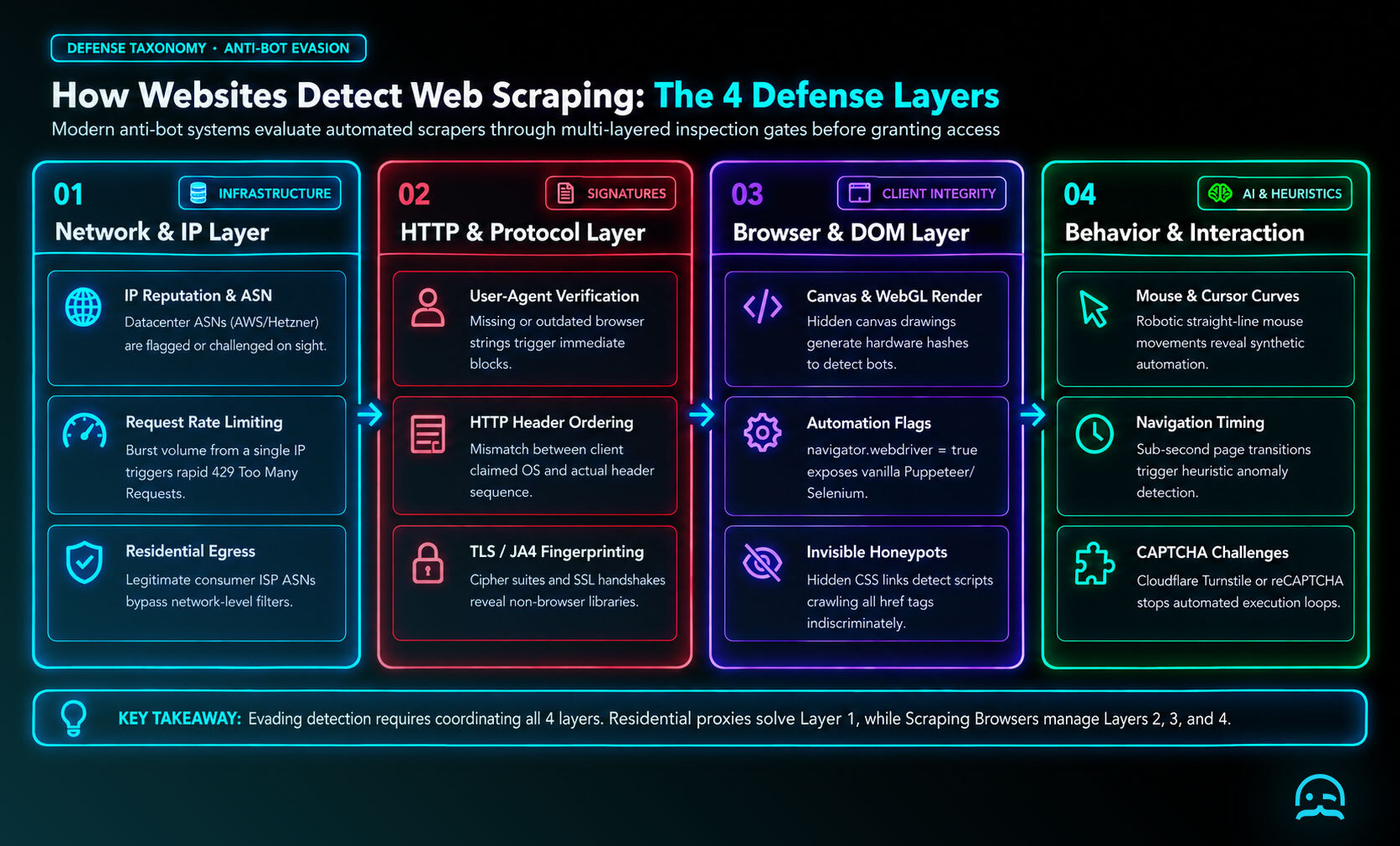
- Rate Limiting and Traffic Monitoring
Websites monitor the frequency and volume of requests made to their servers. If a single IP address makes an unusually high number of requests in a short period, it raises a red flag. Rate limiting is a technique used to restrict the number of requests a user can make in a given timeframe. Exceeding this limit can result in temporary or permanent bans.
- User-Agent Analysis
When a browser requests a website, it sends a user-agent string that identifies the browser and operating system. Web scrapers often use default user-agent strings associated with popular scraping libraries. Websites can detect and block requests from these known user agents or challenge them with CAPTCHAs.
- IP Address Blocking
Repeated requests from the same IP address can be a clear indicator of web scraping. Websites can block IP addresses that show suspicious activity. To counter this, scrapers often use proxy servers to rotate IP addresses and distribute requests across multiple locations.
- Behavioral Analysis
Websites analyze patterns in user behavior to detect anomalies. For instance, human users typically exhibit varied and slower browsing patterns, including mouse movements and random delays. In contrast, automated scripts tend to navigate websites predictably and rapidly. Behavioral analysis can help distinguish between human and bot activity.
- CAPTCHA Challenges
CAPTCHAs are designed to differentiate between humans and bots. Websites often present CAPTCHAs to users who exhibit unusual browsing behavior. While CAPTCHAs can block scrapers, they can be a big hurdle. There are automated solutions that attempt to bypass them, but they are not always reliable.
- Honeypots
Honeypots are hidden elements on a webpage that are invisible to human users but can be detected by bots. Interacting with these elements signals to the website that the visitor is likely a bot. Honeypots can include hidden links, form fields, or other elements that a human user would never interact with.
Can Web Scraping Be Detected by Fingerprints
Can Web Scraping Be Detected? Yes. Beyond request rates and browser headers, advanced defenses can compare the network connection and the browser’s rendering behavior.
Canvas tracking adds a client-side signal. A canvas result alone is not proof of automation, because real devices also differ. It becomes more useful when you combine it with TLS data, cookies, JavaScript features, and navigation history.
(async () => {
  const canvas = document.createElement("canvas");
  canvas.width = 320;
  canvas.height = 80;
  const context = canvas.getContext("2d");

  context.textBaseline = "top";
  context.font = "16px Arial";
  context.fillStyle = "#1769aa";
  context.fillText("Canvas signal", 7, 9);
  context.fillStyle = "rgba(210, 40, 90, 0.65)";
  context.fillRect(115, 18, 120, 30);

  const bytes = new TextEncoder().encode(canvas.toDataURL());
  const digest = await crypto.subtle.digest("SHA-256", bytes);
  const fingerprint = [...new Uint8Array(digest)]
    .map(byte => byte.toString(16).padStart(2, "0"))
    .join("");

  console.log(fingerprint);
})();
This browser console example shows how a site can get a repeatable canvas value. It does not prove a visitor is a scraper. Responsible collection should disclose fingerprinting, minimize retention, and respect applicable privacy rules. For operators testing a crawler, compare its TLS and canvas signals to a normal browser session. Then investigate any mismatches instead of treating one fingerprint as final.
Strategies to Avoid Detection
Can Web Scraping Be Detected? Yes. These techniques can reduce the chance of detection or blocking, but none guarantees that automated activity will appear human. Web application firewall controls can combine request patterns with client signals, so avoiding detection requires ongoing adjustment. Common approaches include:
- Using proxy servers to rotate IP addresses spreads requests across many addresses. It can also mimic users from different locations and lower the chance of a block.
- Changing the User-Agent string to match other browsers or devices makes automation less obvious. It is harder to detect automation based on that header alone.
- Random delays between requests and human-like browsing patterns can reduce suspicion. This may include simulating mouse movement, scrolling, and other typical interactions.
- Automated CAPTCHA-solving services and tools can help scrapers bypass challenges. However, they are not foolproof and may raise legal and ethical concerns.
- Headless browsers like Puppeteer or Selenium render pages, run JavaScript, and mimic user actions. They help scrapers browse sites more naturally. They also make automation harder to tell from human use.
- Scrapers must monitor activity continuously, update scripts for new detection mechanisms, and adjust their strategies as website defenses change.
Used together, these tactics can make traffic less uniform. But websites may still detect it using behavioral, network, and browser signals.
Can Web Scraping Be Detected? Code Controls
Can Web Scraping Be Detected? Yes. Code can reduce obvious automation signals, but no header, proxy, or stealth plugin makes a scraper invisible. Treat anti-detection like request hygiene. Identify your client the same way each time. Limit concurrency. Respect server responses. Stop when a site presents a challenge.
Keep credentials in environment variables rather than source code.
import { chromium } from "playwright-extra";
import StealthPlugin from "puppeteer-extra-plugin-stealth";

chromium.use(StealthPlugin());

const browser = await chromium.launch({
  headless: true,
  proxy: process.env.PROXY_SERVER
    ? { server: process.env.PROXY_SERVER }
    : undefined
});

const context = await browser.newContext({
  userAgent: "Mozilla/5.0 (X11; Linux x86_64) AppleWebKit/537.36 Chrome/128 Safari/537.36",
  extraHTTPHeaders: {
    "Accept-Language": "en-US,en;q=0.9",
    "Accept": "text/html,application/xhtml+xml"
  }
});

const page = await context.newPage();
await page.goto("https://example.com", { waitUntil: "domcontentloaded" });
await page.waitForTimeout(1200 + Math.random() * 1800);

if (await page.locator("iframe[title*=CAPTCHA i]").count()) {
  throw new Error("Challenge detected; stop and review access permissions.");
}

console.log(await page.title());
await browser.close();
Do not automatically bypass a CAPTCHA or repeatedly retry a blocked response. Log the status code, challenge type, proxy identity, and timestamp, then route the run for review. This makes failures diagnosable and keeps collection within the site's permission and rate limits.
Conclusion
While websites can detect web scraping using various methods, MrScraper offers sophisticated techniques to avoid detection. Remember, it's essential to scrape responsibly and legally. Always check a website's terms of service and consider seeking permission. For more on the ethical and legal aspects of web scraping, see our previous blog titled " Legal Considerations When Using Scraped Data". By understanding detection methods and strategies to avoid them, you can scrape data effectively and ethically.
What We Learned
Can Web Scraping Be Detected? Yes. Detection is not one test. It is a decision based on request volume, identity signals, browser behavior, and challenge responses. A reliable workflow treats each collection run as a risk-managed process, not a race to send more requests.
The most useful pattern is a stop-aware collection loop. Define a request budget before the run. Follow published access rules. Cache successful responses. Stop when the target returns blocks, challenges, or unexpected status patterns. Do not attempt to defeat a CAPTCHA. Pause, request permission, or use an official data source instead. This approach also makes failures explainable when reviewing logs or asking for access.
from time import sleep

MAX_REQUESTS = 100
STOP_STATUSES = {403, 429, 503}

def should_stop(status_code, requests_made):
    return requests_made >= MAX_REQUESTS or status_code in STOP_STATUSES

requests_made = 0
for item in items_to_collect:
    if requests_made >= MAX_REQUESTS:
        break

    response = fetch(item)  # Use an approved client and obey site rules.
    requests_made += 1

    if should_stop(response.status_code, requests_made):
        log_event("collection_paused", response.status_code, item)
        break

    save(response)
    sleep(1)  # Keep a deliberate, documented pace.
In practice, the key takeaways are simple. Detection is possible, disguise is not a guarantee. A successful run includes a safe stopping condition. Review response codes, timestamps, and challenge frequency after each run. Request-inspection controls such as those described in F5 BIG-IP ASM documentation illustrate why isolated signals should be considered together. Responsible limits protect the target, reduce wasted work, and leave a clear record of how the data was collected.
Plan a responsible extraction workflow
Explore practical resources for organizing and scaling your data extraction workflow with MrScraper.
Frequently asked questions
How to bypass CAPTCHAs during web scraping
Avoid treating CAPTCHA bypass as guaranteed. CAPTCHA challenges are one detection method, and automated solving may be unreliable or raise legal and ethical concerns. Prefer permission-based, terms-compliant access and review each site’s requirements.
Summarize this post
Open it in your assistant of choice with the prompt ready to send.
Take a Taste of Easy Scraping!

Find more insights here

What is Scraping? A Complete Beginner's Guide for 2026
Learn what a web scraper is in 2026 and how AI-powered tools are replacing brittle CSS scripts for r…
The Ultimate Web Crawlers List: 15 Tools for Every Data Need
Compare the best web crawlers for 2026. Learn the difference between open-source, managed APIs, and…

Web Scraping MCP Server: Giving AI Agents Direct Access to Live Web Data
Learn how a Web Scraping MCP Server gives AI agents live web access while reducing token costs by 87…