Competitor Price Monitoring: How Retailers Track Prices in 2026
Web ScrapingHow retail and e-commerce teams monitor competitor prices: what to track, how often, what it costs, MAP enforcement, and how to turn price data into pricing decisions.
Competitor price monitoring is the practice of automatically tracking what other sellers charge for the same or comparable products, so pricing decisions are based on current market data rather than periodic manual checks. Instead of assigning merchandising teams to browse rival storefronts and copy numbers into spreadsheets, automated monitoring systems track competitor catalogs, match identical SKUs, record price histories, and flag pricing shifts the moment they occur.
Note
Key Takeaways
- Operational foundation: Automated tracking replaces slow manual auditing with continuous catalog checks, historical trend tracking, and margin protection.
- Product matching bottleneck: Reliable monitoring depends entirely on accurate SKU, GTIN, and attribute matching; mismatched variants produce confident but disastrous pricing errors.
- Contextual data points: Effective repricing requires tracking inventory stock status, seller identity, and shipping fees alongside headline prices.
- Refresh discipline: Checking prices more frequently than products actually reprice inflates infrastructure expenses without delivering actionable commercial value.
- Brand governance: Brands use Minimum Advertised Price (MAP) monitoring to detect unauthorized dealer discounting and preserve distributor relationships.
What is competitor price monitoring?
Competitor price monitoring is the automated tracking of rival product pricing, inventory availability, and promotional activity across digital retail channels. Rather than performing occasional manual spot-checks, a monitoring system automatically watches an agreed set of competitor websites, builds historical price benchmarks, and alerts merchandising teams whenever market rates shift.
A structured price monitoring system produces four core operational deliverables for merchandising teams:
- Matched product catalogs: Cross-referenced directories linking your internal product SKUs directly to equivalent competitor listings across multiple sales channels.
- Granular price history records: Time-series logs documenting historical price changes, promotional cadences, and seasonal discounting curves for every tracked item.
- Real-time threshold alerts: Instant notifications sent to Slack, email, or webhook endpoints whenever a rival seller drops below your target price index or profit floor.
- Price position reports: High-level executive summaries showing where your catalog sits relative to market benchmarks (e.g., 5% above category average, matching the buy box, or leading on price).
Competitor price monitoring differs fundamentally from ad-hoc competitor research. Ad-hoc research provides an isolated snapshot of competitor pricing at a single point in time, quickly becoming obsolete as competitors adjust prices dynamically. Continuous price monitoring turns market observation into a predictable, automated operational workflow.
While price monitoring relies on web extraction to collect raw numbers, the underlying technical collection is known as price scraping. For a deep technical breakdown of scraping mechanisms, proxy networks, and extraction tools, explore our comprehensive guide to price scraping tools and architecture.
Who uses price monitoring, and what for?
Price monitoring serves retail teams, brand manufacturers, and commercial analysts who need accurate market intelligence to protect margins and grow sales volume.
| Role | What they track | What they do with it |
|---|---|---|
| Online retailers | Direct competitors across identical and substitute SKUs. | Adjust catalog prices dynamically to protect gross margin while defending market share. |
| Brands and manufacturers | Authorized dealers, marketplace resellers, and grey-market merchants. | Enforce Minimum Advertised Price (MAP) compliance and maintain brand equity across distribution tiers. |
| Marketplace sellers | Buy-box winners, competitor inventory depth, and fulfillment methods on Amazon and Walmart. | Win the buy box profitably by automating algorithmic repricing within defined margin guardrails. |
| Wholesale distributors | Downstream dealer pricing and regional wholesale price sheets. | Identify unauthorized transshipment and negotiate volume rebates based on real retail market conditions. |
| Travel and hospitality operators | Competing hotel room rates, flight routes, and car rental availability. | Maximize revenue per available room or seat through algorithmic yield management. |
| Pricing analysts | Historical category price elasticity, promotional frequency, and competitor discounting patterns. | Build predictive demand models and design quarterly promotional calendars backed by empirical data. |
What should you track besides price?
Competitor price monitoring requires tracking contextual catalog variables because an isolated price figure rarely tells you whether a competitor poses a genuine commercial threat.
- Stock availability: A competitor advertising an item 20% below your price is entirely harmless if their inventory is depleted; lowering your price to match an out-of-stock seller needlessly sacrifices profit margin.
- Shipping cost and free-shipping thresholds: Many online retailers advertise artificially low product prices while charging hefty delivery fees or imposing strict minimum spend thresholds; capturing true landed consumer costs prevents false price matching.
- Seller identity: Marketplace listings often feature dozens of third-party merchants; identifying whether an offer comes from the marketplace itself, an authorized dealer, or an unverified grey-market seller determines how aggressively you must respond.
- Promotions, coupons, and basket discounts: Advertised catalog rates often conceal on-page voucher checkouts, bundle discounts, or multi-buy savings; tracking promotional flags reveals true transaction pricing.
- Variant and pack size specifications: Unit-level comparisons easily break when competing listings represent differing pack sizes, weights, or refurbished units; tracking exact variant attributes prevents matching single units against multi-packs.
- Customer ratings and review counts: Premium brands can comfortably sustain a 10% to 15% price premium over competitors whose listings suffer from poor reviews or low trust scores.
How does price monitoring work?
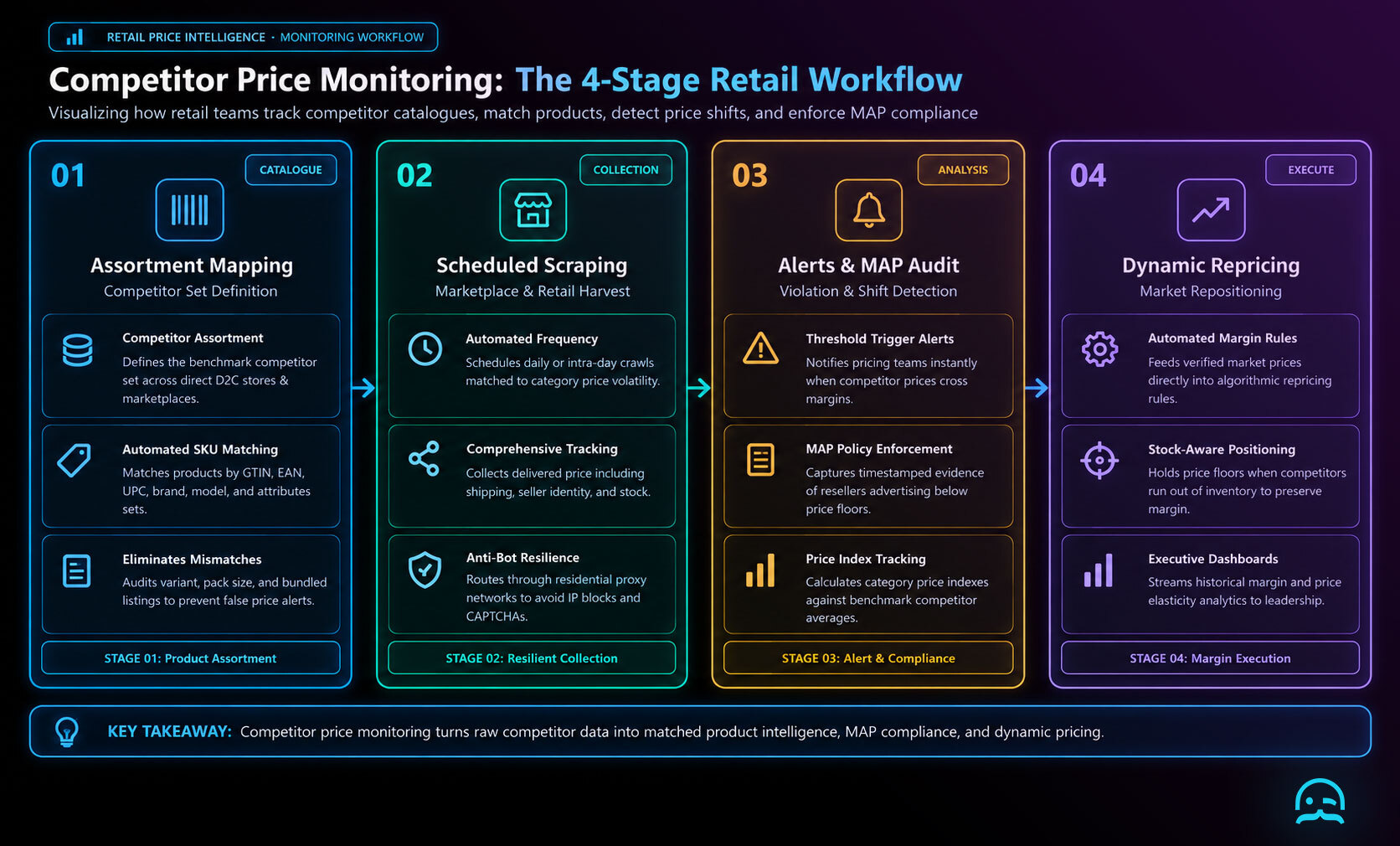
Competitor price monitoring operates through a disciplined six-stage workflow that translates public competitor listings into actionable retail pricing decisions:
- Define the competitor set and priority assortment: Select the specific rival storefronts, marketplaces, and key revenue-generating SKUs that require continuous surveillance.
- Match your catalog products to competitor listings: Pair your internal product identifiers with competitor pages using standardized universal barcodes or attribute-matching heuristics.
- Collect pricing and inventory on an automated schedule: Dispatch automated extraction routines at set intervals to record current price tags, shipping terms, and stock levels.
- Store historical price curves: Maintain a persistent time-series database documenting every price fluctuation, discount duration, and inventory outage over time.
- Trigger automated threshold alerts: Broadcast immediate alerts when a competitor breaches your target price position, triggers an inventory sellout, or violates policy boundaries.
- Feed repricing rules and strategic reviews: Push verified pricing updates directly into your automated repricing software or weekly category review meetings.
The product matching bottleneck
Product matching is the single most vulnerable stage of the entire price monitoring pipeline. If your system pairs a 500ml shampoo bottle against a competitor's 1-liter value pack, your repricing software will conclude that your business is severely overpriced, triggering automatic price reductions that destroy gross margin.
Product matching succeeds reliably when structured around two distinct methods:
- Exact identifier matching: Matching products using standardized universal codes such as Global Trade Item Numbers (GTIN), European Article Numbers (EAN), Universal Product Codes (UPC), or Manufacturer Part Numbers (MPN). This is the gold standard for branded packaged goods, electronics, and consumer appliances.
- Attribute heuristic matching: Matching private-label goods, apparel, and customized items that lack universal barcodes by evaluating product titles, brand names, volume specifications, and material attributes. This approach requires regular human audit workflows to flag near-matches and prevent inaccurate comparisons.
How often should you check competitor prices?
Checking competitor prices should match the natural pricing volatility of your specific retail category rather than running at arbitrary maximum speed.
| Retail category | Typical rate of price change | Recommended check frequency | Operational rationale |
|---|---|---|---|
| Consumer electronics & appliances | Multiple shifts daily during promotional seasons. | 3 to 6 times daily. | Algorithmic repricing and marketplace buy-box competition demand rapid response times. |
| Fast fashion & apparel | Weekly markdowns and seasonal clearance cycles. | Daily or twice weekly. | Apparel pricing is driven by seasonal inventory clearing rather than hourly algorithmic adjustments. |
| Grocery & everyday essentials | Weekly promotional flyers with occasional mid-week shifts. | Daily. | Category managers adjust promotional pricing against major supermarket chains on morning schedules. |
| Travel & hotel bookings | Dynamic yield management shifting continuously with occupancy. | Hourly or every 2 hours. | Airline seat and room rates fluctuate based on real-time booking velocity and calendar proximity. |
| Marketplace third-party resale | Constant automated shifts as sellers fight for the buy box. | Hourly. | Automated repricing bots battle continuously over pennies to secure primary buy-box placement. |
| Industrial B2B & MRO supplies | Monthly or quarterly wholesale contract revisions. | Weekly. | B2B catalog pricing moves slowly; high-frequency monitoring wastes budget on identical data. |
A common mistake in retail monitoring is collecting data faster than your merchandising team or repricing rules can act. Monitoring a slow-moving industrial catalog every hour multiplies data collection costs by twenty-four without yielding a single operational advantage.
What is MAP monitoring, and do you need it?
Minimum Advertised Price (MAP) monitoring is the systematic tracking of reseller pricing to ensure third-party distributors and retailers do not advertise a brand's products below an established price floor. When manufacturers distribute products through hundreds of independent e-commerce merchants, aggressive sellers frequently slash advertised prices to capture quick sales volume, sparking price wars that erode brand prestige and anger compliant retail partners.
A standardized MAP monitoring workflow follows three clear steps:
- Continuous price detection: The monitoring system scans all authorized and unauthorized reseller listings across marketplaces and independent storefronts multiple times daily.
- Automated evidentiary capture: Whenever an advertised price drops below the designated MAP threshold, the system automatically captures a timestamped screenshot, logs the seller name, and records the active URL.
- Structured escalation and enforcement: Brand protection teams use the captured evidence to issue formal violation notices, enforce contractual penalties, or withhold wholesale supply from chronic offenders.
Enforcing MAP policies involves distinct legal considerations across global jurisdictions. In the United States, unilateral MAP policies established under the Colgate doctrine are widely recognized as lawful when properly structured. In contrast, European Union competition law strictly prohibits resale price maintenance (RPM), treating agreements that restrict a distributor's ability to determine resale prices as unlawful anti-competitive behavior.
Disclaimer: This section provides general business information on brand governance practices and does not constitute formal legal advice. Antitrust regulations vary substantially across international jurisdictions. Always consult specialized trade counsel before instituting or enforcing resale price policies.
What does price monitoring cost?
Competitor price monitoring costs depend on catalog scale, competitor count, refresh frequencies, and whether you choose an all-in-one software platform or an internal data pipeline.
Commercial price monitoring solutions generally bill across four structures:
- Per product tracked per month: Platforms bill based on the total number of SKUs monitored in your catalog, typically charging between $0.10 and $0.50 per product monthly.
- Per check or collection run: Data providers charge for every individual product page audit, allowing flexible scheduling across fast- and slow-moving items.
- Flat subscription tiers: Platforms offer fixed monthly software packages based on catalog tiers (e.g., up to 500 products, up to 5,000 products, or custom enterprise pools).
- Data volume consumption: In-house pipelines built on scraping infrastructure pay strictly for API tokens and residential proxy bandwidth consumed during catalog extraction.
Worked monthly cost example: monitoring 5,000 products across 5 competitors
Consider an e-commerce retailer tracking 5,000 priority SKUs across 5 competing retail websites once per day:
- Daily audit volume: 5,000 products multiplied by 5 competitors equals 25,000 page checks per day.
- Monthly collection volume: 25,000 checks multiplied by 30 days equals 750,000 total checks each month.
- Turnkey retail platform pricing: Enterprise commercial monitoring suites (such as Wiser, Prisync, or Competera) typically charge between $1,500 and $3,500 per month for this volume, covering automated matching dashboards, historical analytics, and repricing connectors.
- Managed scraping pipeline pricing: Ingesting raw pricing data through a flexible cloud platform like MrScraper consumes predictable resource tokens. On MrScraper's Scraper Pro tier ($199/month for 200,000 Plan Tokens) with pay-as-you-go overages at $0.001 per token, gathering 750,000 monthly checks costs roughly $749 per month in total data extraction infrastructure.
Build vs buy: evaluating internal monitoring systems
Building a proprietary price monitoring suite requires substantial ongoing investment beyond initial software development:
- Product matching engineering: Creating and maintaining automated catalog matching algorithms that account for title variations, missing barcodes, and irregular pack sizes requires dedicated data engineering resources.
- Scraper maintenance and anti-bot handling: Retailers continuously update page layouts, introduce bot-blocking firewalls, and restrict automated access, requiring constant engineering attention to maintain data feeds.
- Infrastructure and proxy overhead: Operating headless browser clusters and routing requests through premium residential proxy networks to avoid blocks adds $200 to $600 in monthly operational bills.
For mid-sized retailers, building an internal monitoring engine from scratch is rarely cost-effective unless catalog requirements are highly unique. Most commercial teams achieve optimal ROI by utilizing managed data extraction platforms like MrScraper to handle data collection, feeding clean records directly into business intelligence dashboards or existing ERP systems.
What makes price monitoring data unreliable?
Price monitoring data becomes unreliable when retail teams fail to anticipate six pervasive data collection traps that distort public pricing figures:
- Mismatched product variants: Comparing a single product unit against a bundle, refurbished model, or multi-pack produces wildly inaccurate comparisons that mislead repricing software.
- Undetected geographic and currency variances: Retailers frequently serve different prices, taxes, and shipping rates based on the shopper's IP location; monitoring without localized proxies captures generic fallback numbers rather than local market reality.
- Hidden cart and checkout pricing: Certain sellers hide promotional discounts behind account logins or show discounted rates only after an item is added to an active shopping cart.
- Personalized and dynamic A/B test pricing: Advanced e-commerce stores display personalized rates based on browsing history or run live price elasticity experiments, causing prices to vary across different visits.
- Stale cached data presented as live: Monitoring dashboards that fail to refresh catalogs on schedule display outdated prices, leading teams to react to expired promotional campaigns.
- Silent blocking and empty fields: Anti-bot firewalls often return blank pages or fallback templates rather than explicit errors; poorly configured scrapers record these gaps as zero-dollar prices or missing items.
Conducting regular manual audits across a random sample of matched products ensures your monitoring pipeline remains accurate and trustworthy.
How do you choose a price monitoring approach?
Choosing a price monitoring approach depends on whether your team requires pre-packaged retail analytics, custom data feeds, or specialized brand protection tools.
| If you… | Choose | Why |
|---|---|---|
| Track a fixed competitor set and want instant dashboards | A turnkey price monitoring platform | Built-in product matching, email alerts, and out-of-the-box repricing integrations require zero technical setup. |
| Need custom fields, unique marketplaces, or irregular data | A managed scraping platform feeding your internal BI | You retain complete ownership of extraction rules, database schemas, and catalog delivery formats. |
| Are a brand manufacturer policing unauthorized discounting | A specialized MAP monitoring service | Purpose-built workflows capture legal-grade screenshot evidence and automate reseller compliance tracking. |
| Have internal engineers and large catalog volumes | Build on a high-reliability scraping API | Delivers the lowest cost per tracked SKU at massive catalog scale, provided your team manages parser maintenance. |
How MrScraper supports price monitoring
MrScraper supports price monitoring by providing high-reliability cloud data extraction infrastructure that delivers accurate competitor catalog records directly to your merchandising systems. Instead of building and debugging custom web scrapers or managing third-party proxy subscriptions, retail teams use MrScraper to collect competitor prices, inventory levels, and product metadata automatically.
To monitor competitors with MrScraper, you supply target catalog URLs, marketplace brand storefronts, or sitemap feeds directly through the cloud console, via CSV batch files, or programmatically using our REST API. MrScraper's visual point-and-click scraper allows merchandising analysts to highlight price tags and stock fields in minutes, while our AI scraper extracts catalog attributes using plain English prompts without breaking when retailers modify their website code.
Behind every collection run, MrScraper routes requests through our built-in residential proxy network with precise country-level geotargeting, ensuring your monitoring captures authentic localized prices without triggering anti-bot blocks. Cloud headless browsers execute client-side JavaScript automatically, capturing dynamically loaded prices, variant selectors, and promotional banners with complete fidelity.
You can schedule monitoring jobs to execute hourly, daily, or on custom retail schedules, exporting structured data directly into Google Sheets, Amazon S3, internal data warehouses, or BI dashboards via webhooks. Pricing is completely transparent and token-based: start on the Scraper Free plan with 1,000 Plan Tokens monthly, or upgrade to Scraper Pro at $199/month for 200,000 Plan Tokens with 100 concurrent connections and predictable overages at $0.001 per token.
Ready to eliminate manual price checking and protect your retail margins? Try MrScraper free today—claim your 1,000 free Plan Tokens with no credit card required.
Frequently asked questions
What is competitor price monitoring?
Competitor price monitoring is the automated tracking of what other sellers charge for the same or comparable products. A monitoring system matches your products to theirs, collects prices on a schedule, stores the history, and alerts you when prices move — so pricing decisions rest on current data rather than periodic manual checks.
How do retailers track competitor prices?
Most retailers use software that visits competitor product pages and marketplace listings on a schedule and records the price, stock status and seller. The system matches those listings to their own catalogue, builds a price history, and flags changes. Manual checking only remains practical for very small catalogues or a handful of competitors.
Is competitor price monitoring legal?
Collecting publicly displayed prices is generally treated as lawful and is standard practice across retail. The position changes when data sits behind a login, when a site's terms prohibit automated access, or when collection volume burdens the site. Using competitor prices to coordinate pricing between businesses raises separate competition-law issues. Take advice for your situation.
How often should I check competitor prices?
Match frequency to how fast prices move in your category. Travel, electronics and marketplace resale can justify several checks a day. Most retail categories are well served by daily collection, and slow-moving industrial catalogues by weekly. Checking more often than prices actually change increases cost without improving any decision you make.
What is MAP monitoring?
MAP monitoring tracks whether resellers are advertising a brand's products below the minimum advertised price the brand has set. The system watches reseller listings, flags prices under the threshold, and captures evidence of the violation so the brand can act. It is mainly used by manufacturers selling through distribution networks.
What is the difference between price monitoring and price scraping?
Price scraping is the collection step — extracting prices from websites into structured data. Price monitoring is the full workflow around it: matching products to competitors, tracking prices over time, alerting on changes, and reporting price position. Monitoring platforms include scraping; a scraping tool on its own does not include monitoring.
How much does price monitoring software cost?
Most platforms charge by the number of products tracked and how often they are checked, so cost scales with catalogue size and refresh rate rather than with a flat fee. Monitoring a few hundred products against a handful of competitors is inexpensive. Large catalogues checked several times daily across many competitors cost considerably more.
How do I match my products to competitor listings?
Where a shared identifier exists — a GTIN, EAN, UPC or MPN — matching is reliable and should be used first. Where it doesn't, systems match on title, brand, model and attributes, which needs review because near-matches are common. Product matching is the step most likely to produce confident but wrong comparisons.
Can I monitor prices on Amazon and other marketplaces?
Marketplace prices can be monitored, but they are harder than standard retail sites: the buy-box winner changes, multiple sellers list the same product, and prices vary by region and fulfilment method. Capture the seller identity and fulfilment type alongside the price, or you will compare your listing against an unrelated third-party offer.
Why is my competitor price data wrong?
The usual cause is product mismatching — comparing a different pack size, variant or bundle. Other common causes are regional pricing served by location, prices only visible after login or in a cart, promotional pricing applied at checkout, and collection failures returning gaps that look like unchanged prices. Spot-check matches regularly.
Do I need proxies for price monitoring?
If you are collecting prices yourself, yes. Retail and marketplace sites block repeated automated requests from the same address, and regional pricing only appears from a local IP. Managed monitoring platforms handle this for you. Teams building their own collection usually need residential proxies with country-level targeting.
Can I use competitor prices to set my own?
Using publicly available competitor prices to inform your own pricing is normal commercial practice. What is not acceptable is agreeing or coordinating prices with competitors, which is a competition-law matter in most jurisdictions regardless of how the data was gathered. Keep pricing decisions independent, and take legal advice on your approach.
Summarize this post
Open it in your assistant of choice with the prompt ready to send.
Take a Taste of Easy Scraping!

Find more insights here
Create a Source-Verified Question-and-Answer Dataset From Web Pages
Build a question-and-answer dataset from your own documentation pages. Every answer is an exact span…

Prepare Web Data for Fine-Tuning: Quality, Provenance and Splits
Prepare web data for fine-tuning a model. Pick records that fit your task, filter duplicates and wea…

Evaluate AI Web Extraction With Field-Level Accuracy Tests
Build a repeatable test for AI web extraction. Create ground-truth records, score missing and invent…