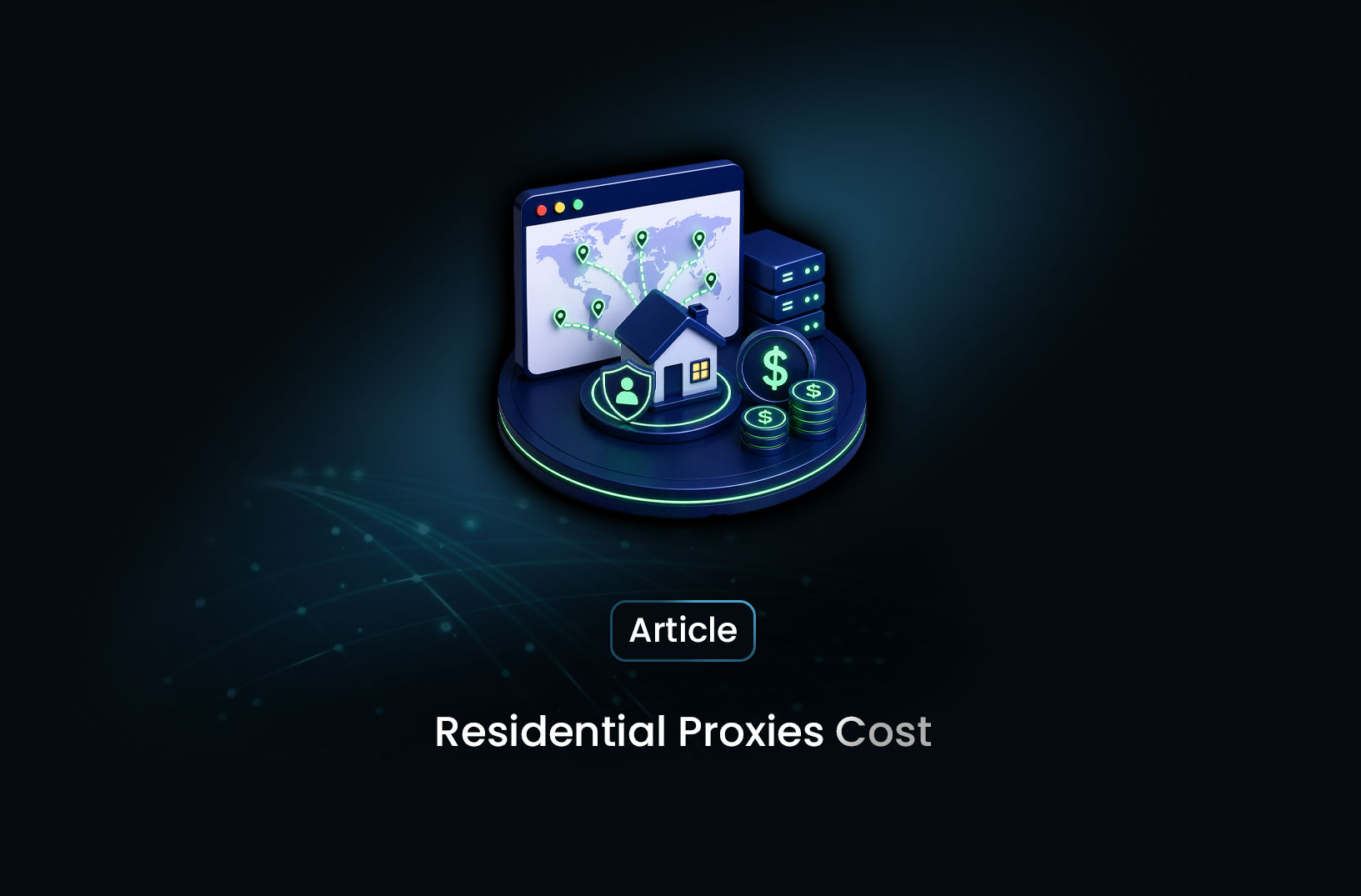
How Much Do Residential Proxies Cost?
ProxiesResidential proxy pricing explained for developers — per-GB billing, hidden costs, provider comparisons, and how to model your actual cost before buying.
Residential proxy pricing looks simple until you try to model it. The headline rate is per gigabyte — $5/GB, $9/GB, $15/GB. You pick a plan, budget accordingly, and start scraping. Then the first invoice arrives and it's three times what you expected, because you didn't account for image loading, or for how the browser downloads JavaScript bundles, CSS files, and third-party analytics scripts alongside every page you actually wanted to scrape.
Residential proxy pricing is a category where the sticker price and the real cost of ownership diverge significantly if you don't understand the billing model. This guide gives you the complete picture: how different pricing models work, what drives actual bandwidth consumption, what major providers charge and for what, how to model your costs before committing to a plan, and where the hidden cost multipliers live that most comparisons skip. By the end you'll have a reliable framework for evaluating proxy costs against your specific scraping use case — rather than guessing and discovering the real number on your first invoice.
Table of Contents
- How Residential Proxy Pricing Models Work
- What Drives Your Actual Bandwidth Consumption
- Residential Proxy Provider Pricing Comparison
- Free vs. Paid: What You Actually Get at Each Level
- Key Factors to Evaluate Beyond the Per-GB Rate
- When Should You Invest in Residential Proxies?
- Common Challenges and Billing Surprises
- Conclusion
- What We Learned
- FAQ
How Residential Proxy Pricing Models Work
Residential proxy providers use three distinct pricing models, and which one applies to your contract determines what you're actually paying for.
Per-GB Bandwidth Pricing (Most Common)
The dominant model in the residential proxy market is per-gigabyte bandwidth billing. You pay for the total volume of data transferred through the proxy — request headers, response bodies, and all assets loaded as part of each proxied connection. The rate varies by provider and tier, typically ranging from $4 to $15 per GB for rotating residential proxies. Volume discounts reduce the per-GB rate as your monthly consumption increases.
This model is usage-aligned — you pay only for what you actually transfer — which makes it practical for scraping operations with variable or unpredictable volume. The risk is that bandwidth consumption is harder to predict than request count, and unexpected asset loading can multiply your actual cost beyond your projection.
Per-IP Monthly Pricing (Dedicated Proxies)
For dedicated residential proxies — ISP proxies or static residential proxies that assign specific IPs exclusively to your account — pricing is per IP per month rather than per bandwidth consumed. Rates range from $2 to $15 per IP per month depending on whether the IP is data-center-class, ISP-class residential, or mobile.
This model is predictable (your cost is fixed per IP count) but has different economics than per-GB billing. It makes sense when you need consistent IP assignment for account management or session persistence, and when your bandwidth consumption would be high enough that per-GB billing exceeds the flat monthly rate.
Per-Request Pricing (API-Based Services)
Some managed scraping APIs charge per successful request rather than per GB transferred. This model is simpler to forecast (you know how many pages you need to scrape) and insulates you from bandwidth variation caused by asset loading differences between pages. Managed scraping platforms like MrScraper that bundle proxy infrastructure with browser rendering and extraction typically use per-request or subscription-based pricing rather than raw per-GB proxy billing — a different cost structure worth modeling if your use case involves JavaScript-heavy pages where browser rendering multiplies bandwidth consumption significantly. More at https://mrscraper.com.
What Drives Your Actual Bandwidth Consumption
The most important number to understand before buying residential proxy bandwidth is how much bandwidth each scraping request actually consumes — because it's almost always more than the page content alone.
HTML-only requests (plain HTTP scraper, no browser rendering): A typical product page or article in raw HTML is 100–300KB. At $9/GB, 10,000 HTML-only page fetches consume roughly 1–3GB and cost $9–$27.
Browser-rendered requests (Playwright, Puppeteer, or a browser-based scraping API): When a browser loads a page, it requests everything the page references — JavaScript bundles, CSS files, fonts, images, analytics tracking pixels, third-party script tags, CDN-hosted libraries. A product page that's 200KB of HTML becomes 2–5MB of total browser download. At $9/GB, 10,000 browser-rendered pages now consume 20–50GB and cost $180–$450. The multiplier is 10–25x.
This is the single biggest source of billing surprises for developers moving from API-based scraping to browser-based scraping. The page you want is 200KB; the browser you need for JavaScript rendering downloads everything else too.
Mitigations that meaningfully reduce browser-rendered bandwidth:
# Block image and font loading in Playwright to reduce bandwidth
# A browser scraper with these blocks is ~50-70% cheaper to run on per-GB billing

page.route(
    "**/*.{png,jpg,jpeg,gif,webp,svg,ico,woff,woff2,ttf,eot}",
    lambda route: route.abort()
)

# Block analytics and tracking scripts that add zero data value
page.route(
    "**/{google-analytics,hotjar,mixpanel,segment,intercom}**",
    lambda route: route.abort()
)
Blocking images typically reduces browser-rendered bandwidth consumption by 40–70%. Blocking fonts and analytics adds another 10–15%. For most data extraction scraping tasks, none of these resources contain target data — they're pure cost without value.
Geographic targeting premium: Some providers charge a premium for specific geographies beyond their baseline rate. City-level targeting, specific country markets with smaller IP pools, or mobile carrier IPs in certain regions may cost 20–50% more per GB than standard country-level routing. Confirm per-geography pricing before assuming the headline rate applies to your target markets.
Residential Proxy Provider Pricing Comparison
The residential proxy market has several established providers with meaningfully different pricing structures. Rates change frequently — always verify current pricing directly from each provider's website before making a purchasing decision, as the figures below reflect general market positioning rather than current published rates.
Bright Data
Bright Data operates one of the largest residential proxy networks and targets the enterprise tier with correspondingly premium pricing. Their residential proxy pricing is tiered by commitment level — pay-as-you-go rates are the highest per-GB; annual commitment or high-volume plans reduce the effective rate significantly. They offer a starter package for smaller teams. Current pricing: https://brightdata.com/pricing/proxy
Best for: Enterprise data teams with high volume, geographic precision requirements, and budget for premium network quality.
Oxylabs
Oxylabs publishes tiered pricing based on bandwidth volume — entry-level plans, growth plans, and enterprise plans with per-GB rates that decrease as monthly volume increases. Their residential network is well-regarded for consistent success rates on commercial targets. Current pricing: https://oxylabs.io/pricing
Best for: Mid-market to enterprise scraping operations that need predictable pricing with volume-based discounts.
Smartproxy
Smartproxy is positioned as the mid-market option — residential proxy pricing meaningfully below the enterprise tier without the quality drop of entry-level providers. Their plans include a free trial with limited bandwidth to evaluate quality before committing. Current pricing: https://smartproxy.com/proxies/residential-proxies
Best for: Growing scraping teams and developers who need reliable residential access at a lower price point than enterprise-tier providers.
IPRoyal
IPRoyal offers pay-as-you-go pricing with no minimum commitment — buy bandwidth as needed without a monthly subscription. This makes it the most accessible entry point for teams with low or unpredictable volume who don't want to over-commit to a monthly plan. Current pricing: https://iproyal.com/residential-proxies/
Best for: Developers exploring residential proxy use cases, low-volume operations, or teams with highly variable monthly requirements.
How Provider Pricing Actually Differs
Beyond the per-GB rate, providers differ in ways that affect total cost of ownership:
IP pool freshness and size determine success rates on protected targets. A cheaper provider with a smaller, lower-quality pool may require more requests per successful data extraction — effectively increasing your real cost per successful page despite a lower per-GB rate.
Geographic sub-pool depth matters for geo-targeted scraping. A provider with 100M global IPs but thin coverage in your specific target market produces higher per-successful-request costs due to IP exhaustion and increased blocking on that sub-pool.
Customer support response time affects cost when things break. A provider at $6/GB with no responsive support that leaves you debugging for two days has a higher real cost than a provider at $9/GB with a 2-hour support SLA.
Free vs. Paid: What You Actually Get at Each Level
Free proxy options — public proxy lists, free tiers on some providers — are not a viable alternative to paid residential proxies for any production scraping operation. The reasons are consistent and documented across the industry:
- Free proxy IPs are shared across thousands of simultaneous users and heavily present on blocklists
- They provide no IP pool freshness, no geo-targeting, no rotation infrastructure, and no reliability guarantees
- On any commercial target with bot detection investment, free proxy IPs achieve 0–10% success rates at best
- The hidden cost of failed requests and wasted engineering time exceeds any bandwidth savings
Free trials from reputable paid providers are genuinely useful — they let you test extraction success rates on your specific target sites before committing to a billing tier.
Entry-level paid plans ($20–$100/month, 1–10GB) are appropriate for: evaluation, low-volume personal use cases, and scraping operations that genuinely process only a few thousand pages per month. The quality is real but the pool depth in specific geographies may be limited, and support is typically self-service.
Mid-tier plans ($100–$500/month, 10–100GB) cover most developer and small-team scraping operations — competitive pricing intelligence, lead generation pipelines, research datasets. The bandwidth is sufficient for meaningful production use and the IP pool depth is adequate for most commercial targets.
Enterprise plans ($500+/month, 100GB+) are for operations where residential proxy bandwidth is a meaningful operational expense — high-volume ecommerce monitoring, large-scale data products, multi-market competitive intelligence. Volume discounts make the effective per-GB rate materially lower than entry-level rates.
Key Factors to Evaluate Beyond the Per-GB Rate
When comparing residential proxy providers on pricing, the per-GB headline rate is the starting point, not the complete picture. These factors determine your real cost:
- Minimum monthly commitment vs. pay-as-you-go: Does the plan require a fixed monthly spend, or can you pay exactly for what you use? For operations with variable volume, pay-as-you-go flexibility has real value even at a slightly higher per-GB rate.
- Rollover or expiration of purchased bandwidth: Do unused GB carry forward, or do they expire at month end? Expiring bandwidth makes it expensive to over-estimate your monthly usage.
- Free trial terms and credit size: How much bandwidth is included in the free trial, and does it adequately cover testing against your real target sites?
- Geographic pricing premiums: Is the advertised rate uniform across all geographies, or does city-level or specific-country targeting cost more? Confirm for your target markets specifically.
- Asset-loading exclusions for browser-rendered requests: Does the provider offer any mechanism to reduce bandwidth billing on non-content assets? Some providers have relationships with managed scraping clients that address this through API-level billing.
- Success rate guarantees: Some providers offer success rate guarantees (they only bill for successful responses) rather than billing for all bandwidth consumed regardless of outcome. This significantly changes the economics on heavily protected targets where success rates are low.
When Should You Invest in Residential Proxies?
Residential proxies are the right investment when:
- Your target sites have anti-bot measures that immediately flag data-center IPs — which describes most commercial ecommerce, financial, social, and enterprise sites
- You need accurate geo-targeted data where the apparent IP location affects the content returned — regional pricing, localized search results, market-specific listings
- Your scraping runs at volume high enough that a single IP or small data-center IP pool accumulates detectable request patterns
- You're doing sustained scraping of the same target domain rather than diverse, distributed access across many different sites
Consider alternatives when:
- Your targets have no meaningful bot protection and tolerate data-center IPs without issue — unprotected informational sites, open government data portals, personal or research sites
- Your scraping volume is low enough that a small number of data-center IPs don't accumulate suspicious pattern history
- Your use case is well-served by a managed scraping API that bundles proxy infrastructure into per-request pricing — potentially more economical when the fully-loaded cost of bandwidth + browser rendering overhead is modeled correctly
Common Challenges and Billing Surprises
The browser rendering multiplier arrives on the first invoice. The most consistent billing surprise in the residential proxy market is developers who move from simple HTTP scraping to browser-based scraping without adjusting their bandwidth budget. Browser-rendered pages consume 5–25x more bandwidth than plain HTML requests of the same content. Block images, fonts, and non-essential scripts from the start — not after you've seen the invoice.
Here's a cost modeling exercise to run before choosing a plan:
def estimate_monthly_proxy_cost(
    pages_per_day: int,
    mb_per_page: float,   # HTML-only: 0.1-0.3MB; browser-rendered: 1-5MB
    price_per_gb: float,
    working_days: int = 30
) -> dict:
    """Estimate monthly proxy bandwidth cost before committing to a plan."""
    total_mb = pages_per_day * mb_per_page * working_days
    total_gb = total_mb / 1024
    estimated_cost = total_gb * price_per_gb

    return {
        "pages_per_month": pages_per_day * working_days,
        "estimated_gb_per_month": round(total_gb, 2),
        "estimated_monthly_cost_usd": round(estimated_cost, 2),
    }

# Example: 5,000 browser-rendered pages per day at 3MB per page, $9/GB
estimate = estimate_monthly_proxy_cost(
    pages_per_day=5_000,
    mb_per_page=3.0,   # Browser-rendered product pages
    price_per_gb=9.0
)
print(estimate)
# {'pages_per_month': 150000, 'estimated_gb_per_month': 439.45, 'estimated_monthly_cost_usd': 3955.08}
Run this calculation for your specific use case before buying. If the estimate is larger than expected, optimize for bandwidth reduction first (block assets) and then revisit the per-GB rate.
Sub-pool exhaustion inflates cost per successful extraction. When your geographic targeting draws from a small available IP sub-pool relative to your request volume, IP reuse increases, detection rates rise, and you spend more bandwidth on failed requests per successful data extraction. A cheaper provider with thin geographic coverage in your target market may have a higher real cost per useful data point than a premium provider with deeper local coverage.
Expiring bandwidth creates pressure to over-use. Monthly plans that expire unused bandwidth at month-end create perverse incentives — teams scramble to use up remaining bandwidth before expiry, often running lower-priority scraping that they wouldn't otherwise run. Pay-as-you-go plans without expiry avoid this dynamic.
Retry-on-block multiplies bandwidth consumption. When a request is blocked and your scraper retries, each retry consumes proxy bandwidth — for a request that may ultimately fail. Implement retry limits and block detection that stops retrying on hard blocks (403, CAPTCHA challenges that don't resolve) rather than retrying indefinitely. Unbounded retry logic on blocked requests can rapidly consume bandwidth budget against protected targets.
Success-rate-based billing is rare but valuable. Most residential proxy providers bill for all bandwidth consumed, including failed requests. A few providers offer outcome-based billing where you're only charged for successful responses. For scraping operations with significant success rate challenges — heavily protected targets where 20–30% of requests are blocked — the economics of outcome-based billing are significantly better. Ask providers explicitly whether their billing includes failed/blocked requests.
Conclusion
Residential proxy pricing is predictable once you understand the three variables that drive real cost: the per-GB rate you're billed at, the bandwidth each request actually consumes (which is dramatically higher for browser-rendered pages than for plain HTTP), and your monthly request volume. Model all three before committing to a plan, not after your first invoice.
For most developer and small-team scraping operations, mid-tier plans from providers like Smartproxy or Oxylabs in the $100–$500/month range cover the operational need. For operations where engineering time is more constrained than per-page cost, managed scraping APIs that bundle proxy, rendering, and extraction into per-request pricing remove the bandwidth modeling exercise entirely — at the cost of less pricing granularity at high volume.
The provider you choose matters less than the plan you model correctly. Run the cost estimate before buying, block unnecessary assets to reduce bandwidth consumption, and monitor your actual GB consumption against your projection for the first 30 days — adjustment is easier before you've built a production pipeline around a specific provider and pricing structure.
What We Learned
- Per-GB bandwidth billing is the dominant model: You pay for total data transferred through the proxy — HTML, JavaScript, images, fonts, and all other assets the browser loads, not just the content you wanted.
- Browser rendering multiplies bandwidth 5–25x: A 200KB HTML page becomes 2–5MB when a browser loads all referenced assets — model this before choosing a plan, and block images and non-essential scripts from day one.
- Provider quality affects real cost per successful extraction: A cheaper provider with thin geographic coverage or low pool freshness may cost more in practice if it requires more requests per successfully extracted data point.
- Free proxy lists are not viable for production scraping: Shared, blocklisted, unrotated free proxies achieve near-zero success rates on commercial targets — free trials from paid providers are the legitimate free evaluation path.
- Minimum commitment and bandwidth expiry are real cost factors: Pay-as-you-go flexibility and rollover bandwidth are worth paying a slightly higher per-GB rate for if your volume is unpredictable.
- Model your cost before you buy: Pages per day × MB per page × days per month ÷ 1024 = GB per month. Multiply by the provider rate. Do this calculation for your specific use case before choosing a tier.
FAQ
How much do residential proxies cost per month?
Residential proxy costs vary significantly by volume and provider. At entry level (1–5GB/month), expect $20–$75/month from reputable providers. Mid-tier operations (10–100GB/month) typically spend $100–$500/month. High-volume operations (100GB+/month) negotiate enterprise rates that reduce the effective per-GB cost substantially. Always model your expected GB consumption from your actual scraping behavior before choosing a tier.
Is residential proxy pricing per GB or per request?
Most residential proxy providers bill per gigabyte of bandwidth consumed. This means you pay for all data transferred through the proxy — not just the HTML you wanted to scrape, but all assets a browser loads alongside it. Some managed scraping APIs use per-request billing instead, which is simpler to forecast and insulates you from bandwidth variation caused by asset loading.
Why is my residential proxy bill higher than expected?
The most common cause is browser-rendered scraping loading more assets than budgeted for. A browser scraper downloads JavaScript bundles, CSS files, images, fonts, and third-party scripts alongside every HTML page — often 5–25x more data than the HTML content alone. Block images, fonts, and non-essential scripts in your browser automation code to reduce bandwidth consumption by 50–70%.
What is the cheapest residential proxy provider in 2026?
IPRoyal offers the most accessible entry point with pay-as-you-go billing and no minimum commitment, making it cheapest for low-volume and variable usage. For sustained mid-volume operations, Smartproxy typically offers better per-GB rates at higher commitment levels. "Cheapest" depends on your volume and use case — model your expected monthly GB consumption against each provider's pricing tiers rather than comparing headline per-GB rates in isolation.
Do I pay for failed proxy requests?
With most residential proxy providers, yes — you're billed for bandwidth consumed regardless of whether the request succeeds. If a request is blocked and returns an empty response or a CAPTCHA page, the bandwidth used for that request still counts toward your billing. This makes it important to implement request limits and stop retrying hard-blocked requests rather than burning bandwidth on requests that will continue to fail. A small number of providers offer success-rate-based billing — worth asking about explicitly if your target sites have high block rates.
Is it cheaper to use a managed scraping API instead of buying raw proxy bandwidth?
For browser-based scraping of JavaScript-heavy pages, managed APIs can be more economical when all costs are modeled correctly. Raw residential proxy billing charges you for the full browser payload — including all assets — which multiplies your per-page bandwidth cost significantly. Managed APIs charge per successful request regardless of the underlying bandwidth consumed. The break-even point depends on your target pages' asset load and your per-GB proxy rate. For HTML-only scraping of lightweight pages, raw proxy bandwidth is usually cheaper.
Summarize this post
Open it in your assistant of choice with the prompt ready to send.
Take a Taste of Easy Scraping!

Find more insights here
What is Scraping? A Complete Beginner's Guide for 2026
Learn what a web scraper is in 2026 and how AI-powered tools are replacing brittle CSS scripts for r…

The Ultimate Web Crawlers List: 15 Tools for Every Data Need
Compare the best web crawlers for 2026. Learn the difference between open-source, managed APIs, and…
Web Scraping MCP Server: Giving AI Agents Direct Access to Live Web Data
Learn how a Web Scraping MCP Server gives AI agents live web access while reducing token costs by 87…